PeterW
-
Posts
18480 -
Joined
-
Days Won
207
Everything posted by PeterW
-
I bet if you stick them in the market place someone will buy them ..... X10 controlled shower with auto toilet roll change anyone .......??
-
A tundish is there to provide two things. An air break in a potable supply, and a visual indication for a relief valve. If the tundish is sealed then there is no air break on a UVC between a waste pipe or discharge and the potable water in the UVC so if it did draw back it would potentially be contaminated. A boiler PRV is on the heating system side so is non-potable so it’s irrelevant if it pulls water back from the drain as it won’t contaminate the supply.
-
Keep up - no zone valves as this is all electric and DHW only.. Telford require you to use their stats too...
-
And on the other point, a G3 stat has a pair of stats inside the box. The initial one is a non-resetting limit stat that has a black threaded cap over it. The other is a standard dial next to it. You wire it from A to B - through the limit stat and into the dial stat and then into the immersion. If it’s been wired correctly, the limit stat trips first and then the engineer has to manually check and reset the overheat so the immersion’s can’t run away unchecked.
-
He’s not certified to install an Unvented Cylinder to the G3 standard and self certify. He can install it but must get it signed off by someone else before it’s commissioned. End of, its not a legal install.
-
It’s even worse then as you HAVE to check that the overheat interlink has been wired correctly in the thermostats otherwise if the stat goes postal, the overheat link won’t trip and you have a electric powered steam bomb.....
-
No he needs to go to the local job centre and apply for his old job back at McDonald's ... If - and only if - he has resized the D2 to be 22/28mm based on his calcs to allow both the boiler and UVC to vent through the D2, then the boiler needs to run though a 15mm tundish with a cover on (Boiler regs, cover required due to potential for scalding non-potable water) and the initial D1 leg of the UVC needs a 15mm in / 22mm out tundish with no cover on (G3 UVC regs, cover not allowed due to risk of drawing non-potable water into the UVC). If he is certified to work on both gas and UVC (G3) then he would know all this... So whilst Billy McPenis has installed a tundish, he's installed the wrong type, in the wrong place, and in contravention of the regs....
-
It still doesn’t meet either structural or building regs ..! The absolute maximum a 172mm SIP panel can span is 2.8m and it’s U Value doesn’t meet the regs for England or Scotland as it’s 0.16w/mK Whole house in Scotland is now 0.11 for roof, with a limiting fabric factor of 0.15. You don’t need 300mm roof trusses. A 240mm steico can span 5.8m at 400mm centres. If that is full fill with 190mm rockwool and then 50mm PIR between followed by 50mm over, the roof easily hits the 0.11 required. It’s 290mm deep, has a long decrement delay and will also have a decent sound absorbtion.
-
So a 225 SIP will still need a supporting beam at its midpoint as it cannot span a 5m span unsupported. The purlin for that would be dependent on the span but would be fairly large. I can’t find any supplier that states you can use an insulated spline in a roof - most say solid timber or the use of “reinforced SIPs” which are effectively 6x2 encased in OSB and injected insulation. The thermal bridges are still there and the challenges of installing 150-200kg panels remains.
-
..? A SIP roof to meet BRegs insulation standard will be exactly the same thickness as one with full fill PIR. Chances are both will need internal insulation or insulated plasterboard. In terms of heat loss, a SIP roof with timber spines will lose more than one built with I-Joists of the same thickness.
-
Not strictly true. You cannot have an accessible inspection chamber on a public sewer within a property. You can apply for a build over agreement and replace the IC with a set of junctions or swept connections and then concrete over the lot. The junctions remain but the IC is removed. The sewer route should be unnafected by this.
-

New Kitchen/Living extension. Brick & block or brick and timber?
PeterW replied to Triggaaar's topic in Brick & Block
It is .... for timber frame new builds ..! The whole house shrinks and the expansion gaps in the window heads and other openings take up the slack. Ask him how he wants to detail the flat roof upstand junction with the main house to allow the timber frame to drop by 20mm with shrinkage and not tear the membrane roof..? -
Borderline on G3 as it has to be within 500mm of the tank or PRV outlet so would be pretty hard work to make it not easily checked. Having it behind the tank would make testing and checking near impossible. I think its McDonald who fit the tundish to the PRV on the tank from memory - I know one does and it’s a good idea in my opinion.
-
Errrr .... 15mm too ..?? To give an example of the issue you face, find a 22mm pipe at 3bar and try and force it into a 15/22 connector ... hard work, you will get wet and it will spray everywhere ... Now do it with 90c water ..... A boiler over pressure pipe is designed to take a limited - ie reduce the boiler from over pressure to 1.5-2bar - and then stop. It’s not designed to take the full force of 3 bar water, which will flow constantly once this has trigger or failed, that is being supplied through a 22mm mains pipe.... that’s the worst case scenario. Best case is that the PRV blows and it’s only cold water, but still, 22 into 15 doesn’t go... Combining of discharge pipes is allowed but they must be larger at each junction.
-
Breach of G3 Regs....
-
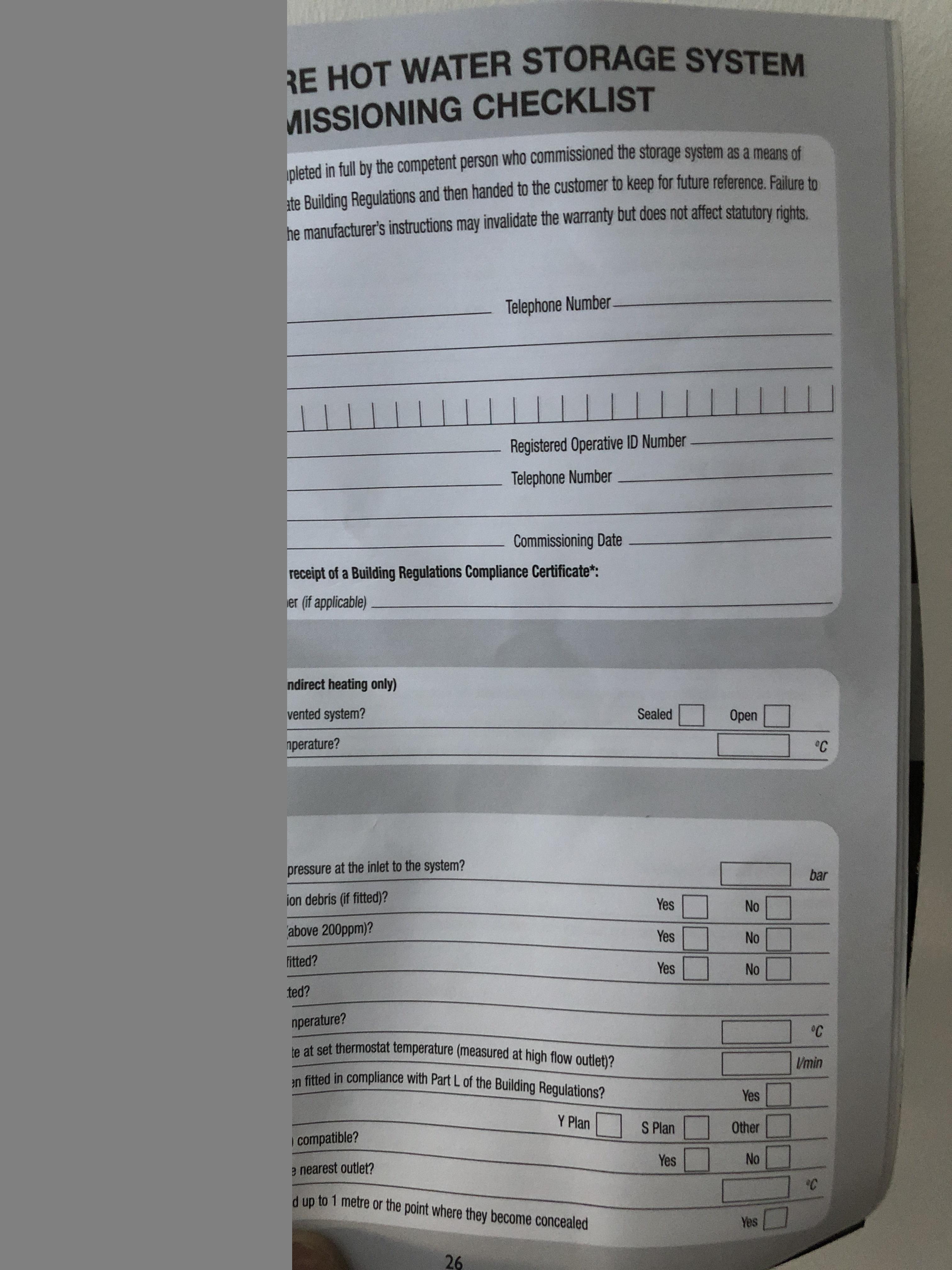
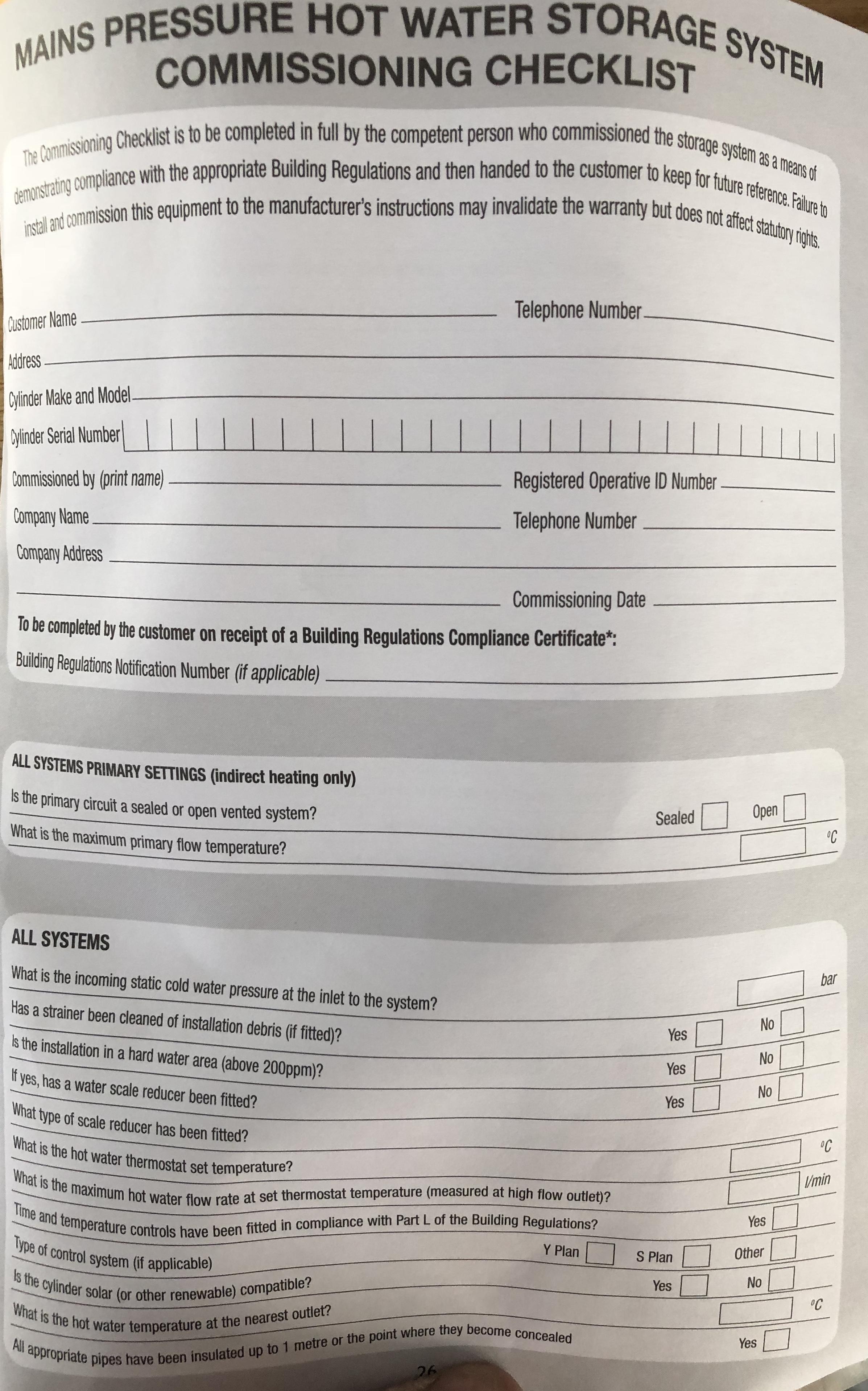
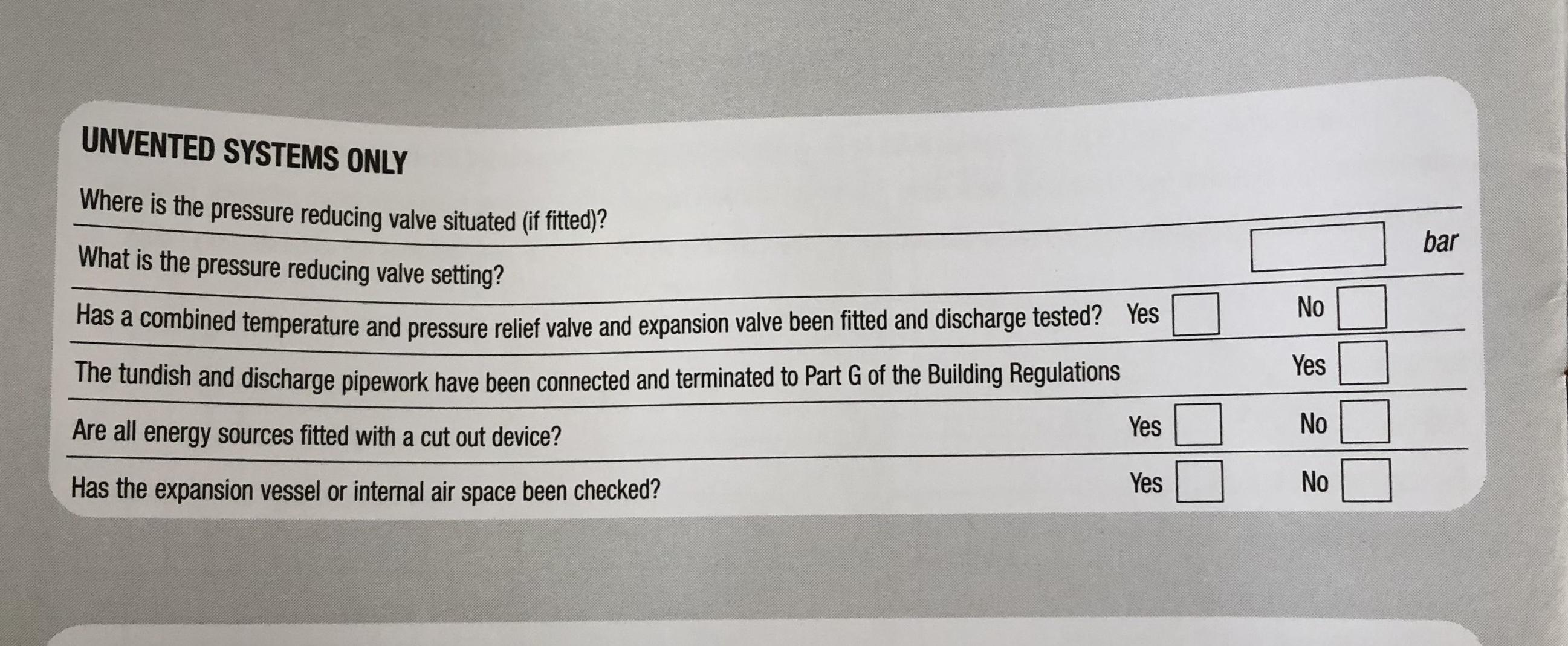
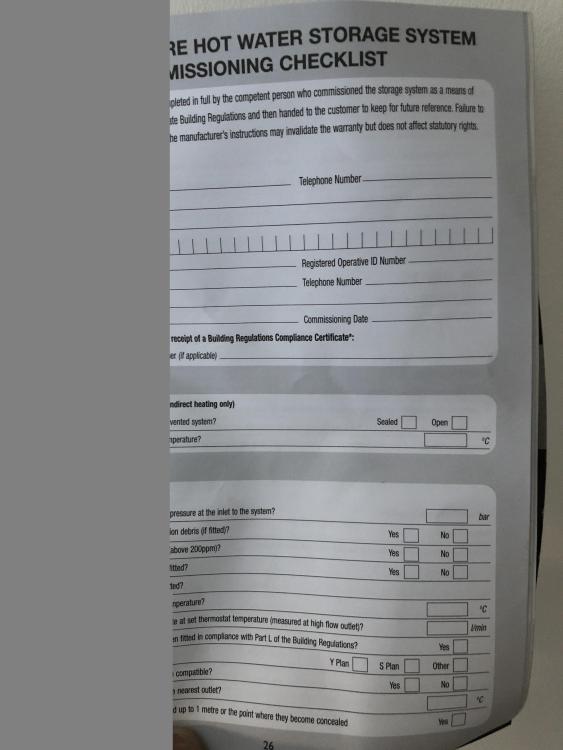
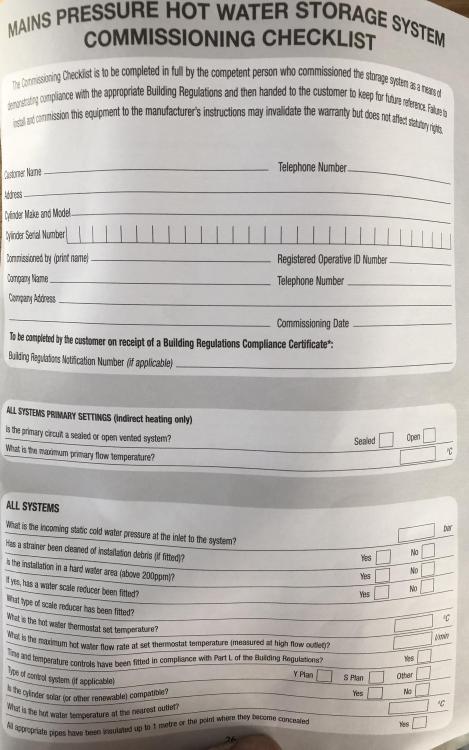
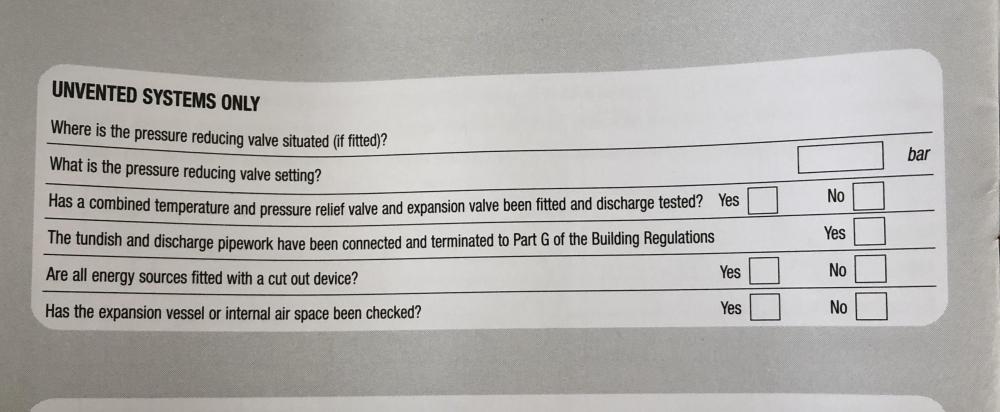
Tank should have one of these ... if you go to the next page under unvented you will see this. Note item 4..... If this has been done to building regs then they have to fill this in, and it has to be provided to you ...
-
I’d just stick with the ICF and be done with it tbh as everything else will be a faff. Your core losses will be tiny compared to the windows.
-
Is the 2 hours to Dunstable a target that you want to do every week or is it an occasional journey ..?? 90 mins gets you into the Grantham / Peterborough / Spalding triangle so your £200k would go much further. Due east takes you to Cambridge and the prices rise sharply.
-
So there should be a tundish in the output pipe from the PReV (tank one) within 500mm of the valve. If the relief pipes are combined from the inlet group (big thing with a red and grey cap) and the tank then they should be increased to a minimum of 22mm as close as practical to the joint of the pipes. This also depends on the length of the relief pipe and the number of bends too... But someone with a G3 ticket would know all that.......
-
Where is the tundish on the tank PReV and who signed it off ....??? Looks like both the relief on the tank and the relief on the PRV go to a single 15mm pipe..??
-
You can’t do this as there is nothing tying the concrete core below to the wall above - there could be close on to a tonne of blocks up there and the EPS would give way.
-
mvhr and minimal other heating
PeterW replied to scottishjohn's topic in Mechanical Ventilation with Heat Recovery (MVHR)
Not quite sure where you’re getting the numbers but solar PV panels are about £90-100 at most now, and a full 3.6kw system can be had for less than £2.5k. To get the same from ST you would need say 40 tubes which with a pump station, glycol and the rest would be around £1.7k. The issue is on a sunny warm day, you don’t need hot water so it becomes a stagnation issue. You could go to a 4,000 litre store but notwithstanding the sheer size, it would set you back £3k for the tank. And you can only use a certain amount of hot water a day ..! -
Sloping it to the stairs at a day 1:40 GRP to give you a gully at the end would work and then just use slabs / porcelain on stands to level it and make it look good ..?? Could give a decent wash stop before the steps but hidden by the slabs ..? Thoughts..?
-
That would be preferable if nothing below as going through walls always causes problems.
-
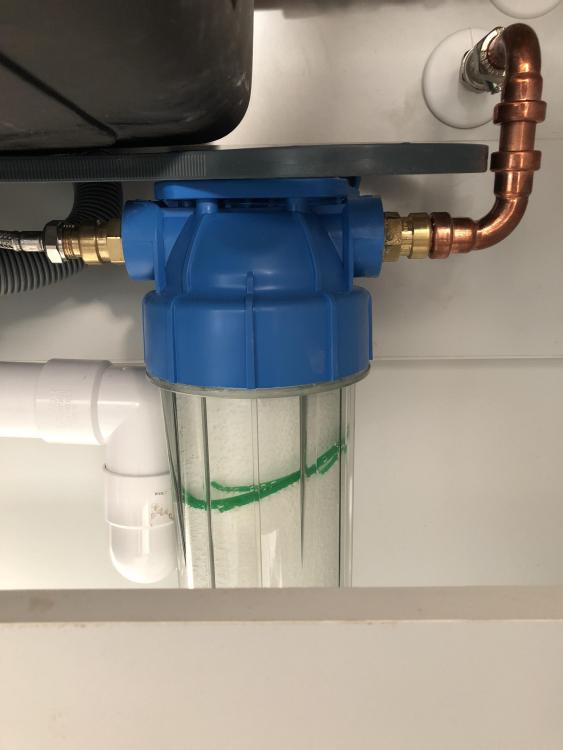
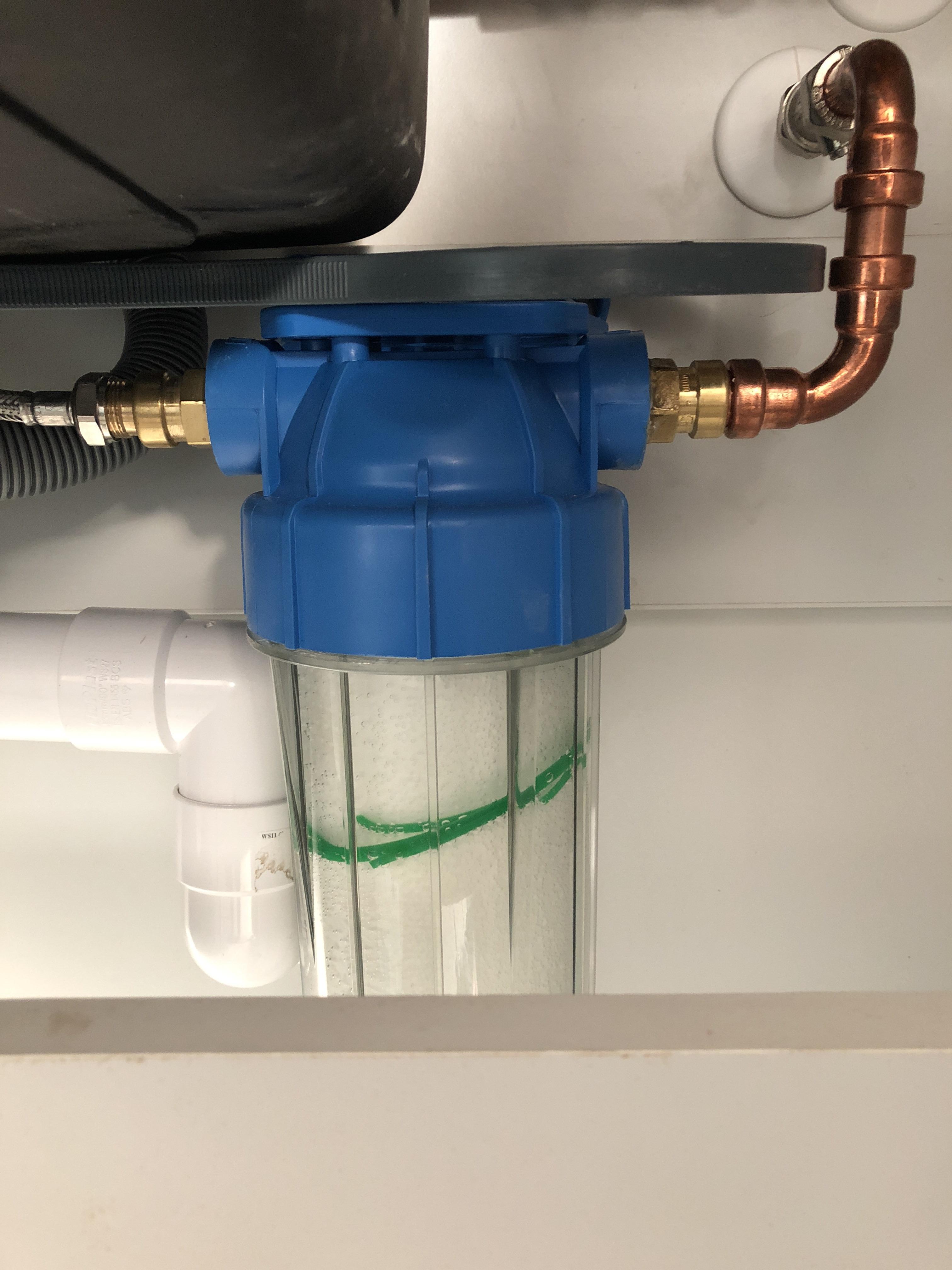
Try this - pipework in copper / Tectite at client request. Units are well made, Tectite male 1/2” connectors are wound with 2 wraps PTFE as this is brass into HDPE so can sometimes bite a little as the thread pulls in. Look to be machined threads in the HDPE head rather than moulded so they are better tolerance. Came with a 5 micron wound filter that will be replaced with a carbon block after commissioning. Dynamic balanced 3 bar across the build, no discernible difference in flow between hot and cold (hot unfiltered) They do them in 1/2”, 3/4” and 1” but the limiting factor is the flow rate through the filter itself so anything above 1/2” isn’t really necessary if it’s feeding a single tap.