


PeterW
-
Posts
18480 -
Joined
-
Days Won
207
Everything posted by PeterW
-
47x220 C24 at 400mm centres will just do that span but will have some deflection in it. Reduce to 300mm centres and you may get away with 47x195 C24 but again, it will flex. If you went to an I-joist then a JJI195C at 300mm centres would work with hangers but centre deflection would be 10mm so not sure if that would be acceptable.
-
We aren’t ..? Lots of different methods on here - from traditional brick and block to durisol and ICF, not just timber frame. The forum is full of different methods and preferences - and budgets !! So if you start on the basics you will be able to build up your own opinion of what is right and wrong for you.
-
Why would you..? Concrete slab - Concrete screed - Concrete slabs There is nothing with an adverse expansion coefficient so why start introducing a flexible adhesive ..? I expect the slabs are recommended with a thin mortar bed too.
-
No issues with laying any patio in winter, but just add frost proofer to any mortar or bedding to be sure. Also worth sealing Indian sandstone before laying it to stop mortar marks.
-
It’s pin marks by the looks of it - where in the UK is it as that mortar is very coarse ..? Would only take an hour as @Mr Punter said to touch that lot in
-
40mm is quite thick - you may be better adding a 30mm screed on the current slab and then setting them on a 10mm mortar mix. If you make the screed more of a cement mixer (4:1) or even a concrete mix with a 10mm ballast it will be easier to level between a couple of rails.
-
Single pipe ..?? Explain ... If it is temporary then just get any direct hot water tank off eBay (other auction sites are available) and then just pipe it into the system. If you get an indirect one, just use the cold in / hot out and loosely cap the coil.
-
20x20 will be around half a cube of concrete so it won’t be going anywhere ..! Blocks set in a dry haunched mix may be better and quicker.
-
Modern estates use teams of brickies - it’s not unusual to see different mortar beds, bonds etc as you move up a building. It is also why when you have two working together that haven’t before, only one does the setup of the corners unless they are using profiles.
-
Seriously... PIR does not absorb water - it is what is also used for floatation in boats and canoes. Yes, under the correct conditions it will burn, but as I said it needs to be very hot and at that point and more crucially where it is in the “sandwich” of a house, you have bigger issues ..!! Off gassing of materials is an issue not just with PIR. MDF and other engineered woods can contain formaldehyde, paints have varying levels of VOCs, and you will struggle to find anything other than straw, sheep’s wool, mud and raw timber that don’t have some sort of chemical emissions. Given where PIR is normally used, it is encased in concrete or blockwork, or inside roof structures where the emissions can escape to the outside air, there is very little issue with this in modern buildings.
-
Just use Caber/Egger and that will be fine. Depending on joist spacing, 18mm or 22mm will be needed. Just get them to glue it to the joists and make sure if they nail it down they avoid the pipes where it crosses the joists.
-
 Lead valley is your friend there - only issue will be the Jack rafter isn’t high enough to sit valley boards on so you may need to pack it.
 -
UFH 8 zone Heatmiser System Under Floorboards
PeterW replied to AshleyH's topic in Underfloor Heating
That setback is far too low - up it to 17c. I think the issue is that the room itself is losing heat - I’d check the insulation in the attic before doing much more. -
Empty Plot vs. House to Demolish – which option?
PeterW replied to bpk101's topic in General Self Build & DIY Discussion
Location, location, location ..... you can get the maps for the services near a plot for a few pounds, some such as Cadent (gas) are free. The issue is that if there is no mains water or electricity within 1km, you are talking £20-40k minimum to connect. As other say, if you’re on an infil site then it could be a few thousand. I also think your architect is talking rubbish ... planning for replacements can be a nightmare, and you can budget £2k to detach the services from a building and connect a temporary builders supply, then the same to do them again to the new build. -
Sika 111 is the one I use - you would not need much, just duct tape round the edges and pour it in.
-
What temperature do you run yours at?
PeterW replied to recoveringbuilder's topic in Underfloor Heating
They are for mere mortals, but @nod is a plasterer with god like standards ... so it’s his bread and butter ! -
Also check the distance down the roof outside - some insist on it also being in line with the old regs too. If it’s any consolation, the one I’ve done recently is 1050mm, but we have also had to put intumescent strips on all the doors and do steps onto the dormer windows.... Better safe than ......?
-
so ... ...? So your spec says that it should be fully encased, but your beam overhangs the padstone...? You can’t do both ..! The spec will be for fire protection - that beam will also need two layers of plasterboard to encase it. And yes, you can dry pack that lot but it will be much easier with a 1:1 semi dry bed mix.
-
Just a query - who specced the beam / padstones..? You have a 190mm padstone with a 203mm beam so an overhang..? Would have been better going to a 254 x 146 and getting it to properly sit on.
-
1:1 cement and sand thin mortar bed will sort that. You won’t split slate fine enough. Worth checking the other end too, is it absolutely level..? Depending on the length of the beam, it may be that it’s deflecting enough to kick the end up slightly. Are they being bolted down at all..?
-
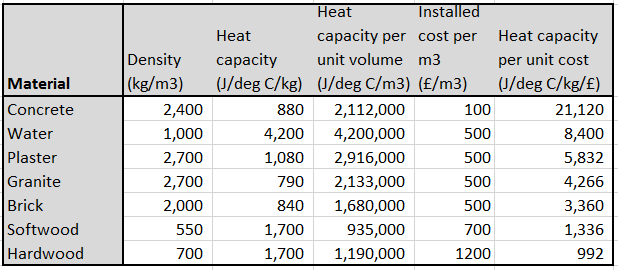
Did you see this table ..?? Gypsum is more dense than concrete. Ordinary plasterboard is vapour permeable - it’s why if you want a vapour sealed one it has foil on the back. And PIR works under water as an insulation as it is closed cell and does not absorb moisture. It also doesn’t burn unless it is under significant prolonged heat exposure above 500c, at which point your whole house is on fire so is probably a moot point ...
-
Concrete isn’t the best storage media - gypsum plasterboard and plaster are better. Have a read here ..
-
What can I expect (Party wall)
PeterW replied to Rich Pen's topic in Party Wall & Property Legal Issues
Again, a path does not count as a party wall -
What can I expect (Party wall)
PeterW replied to Rich Pen's topic in Party Wall & Property Legal Issues
A timber fence is not a party wall or a party fence wall - you need do nothing as long as there are no built structures within 6m of your foundations. https://www.partywall.expert/party-fence-wall/ -
Decent site to understand all the “Plans” https://www.flameport.com/electric/central_heating/heating_wiring_W_plan.cs4

