


A_L
-
Posts
652 -
Joined
-
Last visited
-
Days Won
1
Everything posted by A_L
-
@mike2016 , in central England 100mm EPS would save about 16.1kWh/m2 per year and the 200mm about 19.7kWh/m2 per year (old SAP model)
-
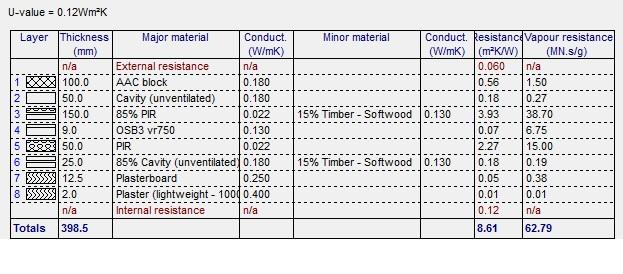
With 150mm of 0.035 mineral wool instead of PIR in timber frame U=0.147. It is software but not currently available.
-
U=0.124
-
There is an optimum relationship between density, size of air spaces and thermal resistance. You should find that 0.032 has a greater density and smaller/more air spaces than 0.037
-
With PIR in a timber frame, a 50mm service cavity and a thin render on carrier board U<= 0.15 (PH max) can be achieved at 350-375mm
-
@Corry A warm roof is one where the insulation is wholly or partly above/outside the structural elements. It may be that there is no insulation because this area is notionally outside the heated space/volume and no insulation required.
-
Honestly not sure exactly what you are doing but the correct way is to calculate the heatloss of each component (in W/K) and add these to give total heat loss. Then multiply by the temperature difference you want to design to. This gives the heat demand in Watts.
- 204 replies
-
- 1
-

-
- heat loss
- ventilation
- (and 4 more)
-
Hello and welcome from Glasgow.
-
How does Carbon Dioxide increase global temperatures?
A_L replied to SteamyTea's topic in Boffin's Corner
An individual molecule may have several vibrational states which each require different wavelengths of light because the energy of the absorbed photon (and therefore the wavelength) must be the same as the change in energy needed to move between the vibrational states. e.g. a water molecule as three vibrational modes, 1. where the two O-H bonds change length in unison (symmetric stretch) 2.where they oscillate out of phase with each other (asymmetric stretch) 3. where the H-O-H bond angle oscillates. Different molecules absorb at different wavelengths simply because their vibrational states are different and require different energies. Absorption at UV wavelengths requires electronic transitions within an atom. Some molecules e.g. H2O simply do not have constituent atoms with the necessary transitions. Ice definitely absorbs IR at a slightly longer peak wavelength than liquid water. Since water cannot absorb UV it must reflect/transmit it -
How does Carbon Dioxide increase global temperatures?
A_L replied to SteamyTea's topic in Boffin's Corner
Try this :- CO2 is a strong absorber of infrared radiation. It is then re-emitted. Think of the CO2 in several layers which absorb the same amount of infrared transmitted through it. The lowest layer re-transmits 50% back to the ground and 50% to the second layer which then absorbs and retransmits 50% back to layer 1 and 50% on to layer three (and so on). So an increase in CO2 increases retained infrared radiation. Thus the temperature rises. -
How does Carbon Dioxide increase global temperatures?
A_L replied to SteamyTea's topic in Boffin's Corner
@SteamyTea , in simple molecules where we are considering a single bond between two atoms the bond is free to rotate and the rest of the atoms at either end can be considered as two homogeneous conglomerations and their 3d structures unimportant. If the two atoms are connected by double or triple bonds then the end groups cannot rotate and the 3d structures can produce minor differences in the frequencies absorbed/emitted -
How does Carbon Dioxide increase global temperatures?
A_L replied to SteamyTea's topic in Boffin's Corner
It is certainly true that electrons closer to the nucleus require more energy to escape from the atom angle ????? -
How does Carbon Dioxide increase global temperatures?
A_L replied to SteamyTea's topic in Boffin's Corner
No, atoms can only absorb photons of the same energy as the difference between two of their energy levels. Different atoms have different energy levels. It is why emission spectra of atoms consist of lines at discrete wavelengths. -
Hello, IMHO there is nothing to gain by going below a U value of 0.1W/m2.K for any fabric element. Assuming no thermal bridges (e.g. rafters) this occurs at 250mm (or slightly less) for most PUR/PIR products (e.g. Celotex). The money would produce a greater financial and environmental benefit invested in renewables/air tightness/efficient appliances etc
-
No Condensate from MVHR?
A_L replied to Timpal's topic in Mechanical Ventilation with Heat Recovery (MVHR)
Obviously works fine for me! Here is the relevant claim Paul claim recovery of 60-80% of exhaust water vapour. Here is web page as pdf Paul ehthalpy heat exchanger2.pdf -
No Condensate from MVHR?
A_L replied to Timpal's topic in Mechanical Ventilation with Heat Recovery (MVHR)
As outside temeratures fall towards freezing balanced MVHR systems increasingly become unbalanced MEV systems to prevent condensation in the outgoing side of the heat exchanger freezing. Obviously this affects the energy recovery and probably occurs quite frequently.. Removing water vapour from the outgoing air reduces the temperature at which this has to occur to where it becomes a minor contribution to energy requirements. Link says reduction to -6°C http://waermetauscher.paul-lueftung.de/en/product-information/enthalpy-exchangers-erv.html -
Air gap behind render carrier board.
-
The frame will probably be about 100mm. Use acoustic insulation e.g. Rockwool RWA45/RW3/RWA4/RW5/RW6 leaving a rainscrreen type cavity.
-
Detailing insulation / VCL below internal stud walls
A_L replied to andyscotland's topic in Heat Insulation
PIR has a 10% deformation compressive strength of 120kPa (or higher). This is too high to use but tells us that the 1% value is 40kPa or better. This corresponds to about 4000kg/m2 . If your sole plate is 50mm wide then they could load the floor to 200kg/m run. -
PCDB = Product Characteristics DataBase - performance characteristics used in RdSAP (epc's) and SAP
-
Indirect Hot Water Cylinder allowance for Boiler sizing (3KW?)
A_L replied to HaloThree's topic in Boilers & Hot Water Tanks
Yes, if you want to guarantee having 15kW available to heat the cylinder when at the external design temperature, probably -1°C/-3°C. The 3000W value for water heating is used by the Standard Assessment Procedure (SAP) boiler sizing algorithm. -
The ceiling joist wool is resisting the passage of heat to the roof space and the heat that does pass through is being lost to the outside. Both effects together are responsible for the room/roof space temperature differential. With the ceiling insulation in place the loft space will never be at a constant temperature. If your measurements are accurate and we can assume that the outside is at 0°C then we can say that the rafter insulation is providing 3/4 of the thermal resistance of the whole structure and the ceiling insulation 1/4. Given a little time to come to an equilibrium the roof space will tend to be the room temperature minus 25% of the difference between room temperature and the outside temperature. This assumes no significant solar heating.
-
No £2, the model only counts losses when heat is required to maintain demand temperature (Full SAP) but yes premium versions are rarely worth it from a saving point of view. Adding 50mm of PIR to either will reduce the U value by about 0.04 and save approximately 3.5kWh of gas per m2 per year
-
Nearly ?, about 1kWh/m2/year less will leak out of the heated space but allowing for the inefficiency of the boiler you will probably use (about) 1.25kWh less of gas per meter squared per year of wall area.
-
Both the 100mm and 150mm cavity walls have a U-value about 0.014/0.015 less with the 0.032W/mK option. This translates to an energy saving of less than 1kWh/m2/year A U-value reduction of 0.05 saves about 3kWh/m2/year
