andyscotland
-
Posts
633 -
Joined
-
Last visited
-
Days Won
1
Everything posted by andyscotland
-
Insulating suspended floor from below - VCL?
andyscotland replied to andyscotland's topic in Heat Insulation
Yikes! Fortunately mine are on sleepers so that makes life easier. I'm finding one of the biggest issues bringing a house up in stages while living in it is the constant journey of "well, this would be viable at the moment but in X years time when we do Y then [something else will be easier/that will cause us a problem]" Identifying the critical path and the logical way to approach things is a journey & a job in its own right! Not to mention there is a budget for how many things can be in progress/look a bit of a mess for a while because finishing them would be undone in a future phase, without triggering divorce 🤣 Many evenings turning over ideas in the mind and trying to work out how it all fits together, then energy goes through the roof and you start to think "JFDI"! -
Insulating suspended floor from below - VCL?
andyscotland replied to andyscotland's topic in Heat Insulation
Yes, going between floorboards is the issue. Floor covering is not an option. At some future point we will sand floors and restore joints but that is further down the list. Generally I think it's good to keep dust etc out of insulation as it compromises performance over time. And ideally to prevent spilt liquids getting down there. -
Insulating suspended floor from below - VCL?
andyscotland replied to andyscotland's topic in Heat Insulation
Thanks, that and the subsequent links are broadly what I did last time when I was working from above. The only thing being that doing it supported on breather membrane was easy/felt very secure from above - just draped it over the joists and then I'd made myself a little jig to push it down to form trays the right depth to hold the insulation flush to the top. So then it just took a few staples into the joist tops to stop the breather moving. And also that the manufacturer's instructions specified an airtight/vapour layer between the insulation and the room which again was easy with the boards up. I'll read that government doc carefully, maybe it will shed some light. Most of the details/guides I've read all assume either working from above, working with a continuous/solid floor covering e.g. chipboard/new floorboards etc, and don't feel like they're quite so easy to replicate from below without disruption. -
I don't have enough on my list 🤣 so I'm thinking about sorting out insulating our suspended timber floor (traditional 1960s floorboards on joists). In my old flat I did that from above - I took up & sold the floorboards, draped breather between the joists, then insulation, then a polythene VCL across the whole floor, then laid a new chipboard deck and carpet. Lots of common references to that approach online. But that's not an option here due to disruption, so I will need to do it from the crawl space below. My main concern is what (if anything) to do about a VCL: The bottom of the joists will need to breathe, so I don't think I can take it between & under. I considered cutting strips of DPM to roughly the joist spacing, double-sided tape to the bottom of the floorboards then silicone seal along the floorboard / joist junctions. But given there will still be a moisture gradient I'm wondering if sealing between the joists will actually force more into the timber, making things worse. No matter what, I think I'll need something between insulation and floorboards just to reduce airflow and keep dirt, dog sick 🤢 etc out of the insulation (there are quite a few small gaps in floorboard joints) . But that could obviously be a breather membrane. I was also considering fixing a layer of Steico/etc board across the bottom of the joists for a few reasons - to support the insulation, to get a better u-value than achievable just with wool between joists, to improve airtightness from below, and for a reasonable surface to fix cables / pipes etc too (most of which I've inherited just draped loose across the void). What do you all reckon?
-
Fixing planning permission ( stopping the clock)
andyscotland replied to PXR5's topic in Planning Permission
And they do technically have the discretion to refuse to extend if they don't think you're making adequate progress/can justify it, which I think is intended to stop developers locking in a build with e.g. old u-values/fire/whatever and then leaving it idle for years. I'm on my second extension now (I asked for 6 months, they gave me 18, seems they're more realistic than me about how much I have left to do 🤣). But there were no questions asked, I suspect post COVID/everything they're comfortable with the idea of things being delayed. -
Depends, as kids my recollection of every visit to my granda's house was as soon as grandma had given us tea and cake he'd take us somewhere (usually the utility room) to see the latest bit of plumbing he'd done/changed 🤣
-
I think underground pipe is not UV resistant and the colour is to mark that? Although I guess unless your basement has windows you may get away with that (in practice, dunno about from a BC point of view)?
-
I definitely wouldn't want that, doesn't sound good at all! 😯
-
The key thing is to make sure if it's an opening window that there's adequate clearance particularly on the hinge side. So it will depend on frame profile and/or whether you have frame extenders.
-
Fair enough, that's good news. Always worth checking these things!
-
Building for dummies, project 1, woodshed
andyscotland replied to Grian's topic in General Self Build & DIY Discussion
Oh also, as @SteamyTeasaid, triangulation is very useful not just for measuring & setting out but also structurally. Rectangles and squares can very easily skew into different shapes but a bit of timber screwed/nailed tightly along the diagonal can work wonders to make something that feels a bit rickety suddenly a lot more robust. -
Building for dummies, project 1, woodshed
andyscotland replied to Grian's topic in General Self Build & DIY Discussion
For a shed, nails vs screws probably doesn't matter too much so go with what you're comfortable with / have the tools for. Nails from a nail gun are very fast, fairly idiot proof to use (so long as you follow the instructions and avoid shooting yourself), but of course you need a nail gun. Screws are slower than nails from a nail gun, but probably not nails with a hammer until you're very skilled with the hammer. Screws usually work out a bit more expensive but for a small structure it won't make much difference and it will save your time & thumbs. Screws can be more forgiving for assembly as you can put them almost all the way through the first piece of timber, hold it in position and finish screwing in to secure it, where hammering a nail will make your piece of wood jump around all over the place (at first). Screws can be better at pinching wood tight together over the long term (nails can work loose as wood expands and contracts), but are more likely to snap if they take a sideways load, where nails just bend a bit. But for your product that's unlikely to make much difference. And the shape/thin-ness of nails means you can usually hammer them straight into most timber, where screws may need you to drill a narrow pilot hole first to stop the screw forcing the wood apart and splitting it (especially near the ends/edges of the wood). Good quality self drilling screws reduce that risk but don't eliminate it. But for your project you'll probably get away with a few splits without having to discard the timber - start on a hidden side and patch it up if you make mistakes - until you get a feel for what it will tolerate and what it won't. Definitely go for it, things are not as scary/complex as they seem and that seems like a project you want to get right but can afford to not get perfect, which is a good learning opportunity. Remember to measure things at least twice before cutting any wood, and try to sketch or at least visualise how it will all fit together in 3D, sometimes a joint feels like it will work on paper but doesn't line up the way you thought it would in real life. Again for this that won't be too much of a problem and if you start from the bottom and work upwards you probably can't go far wrong. -
Do you have a drawing/section of your plan just to be certain we're not talking at cross purposes? Is there any insulation/vapour barrier at the ceiling level below the loft? What u-value are you trying to hit? If it's as I picture it then adding ridge/soffit ventilation (inside/below the wool & PIR) would significantly undermine the insulation as the cold air will just go round it, it would potentially make the PIR largely pointless. You could explore using a breathable insulation instead of PIR (wood fibre boards or similar). Or you could speak to the manufacturer of your PIR and see if they'll do a calc/condensation analysis for your buildup.
-
If you are insulating on top of and between rafters then I think that's a hybrid roof rather than a warm roof. There are some concerns about hybrid roofs, due to the risk of condensation within the structure. This will be more problematic with a non-breathable insulation (e.g. PIR) on the exterior layer. I'd think you definitely need a fully sealed vapour barrier below the rafters - really you should have a condensation risk analysis for the full buildup to confirm it's going to be ok. I'm a bit surprised your BCO hasn't flagged/objected to this TBH as I know a lot of the insulation manufacturers quite strongly advise against hybrid roof construction.
-
One option might be to explore LED strip - it would give a more even light than the individual lamps in that photo which IMO would look better. And as it's extra-low voltage and cold running avoids any safety/legal issues. If you want to do it with individual lamps, from an electrical POV so long as you use off-the-shelf fittings designed to be exposed e.g. batten lampholders, and keep all wiring connections inside the fittings, there's no real legal/regs issue. It's not that different from making up a table lamp, or e.g. replacing a pendant lampholder with a new one/a different fitting, both of which are things anyone can do. If you want to get an electrician to check it over you can, or just stick to 12V e.g. halogen capsules or similar. If the frame is metal then in theory if you use enclosed lampholders you don't need to earth it but I probably would. The bigger safety thing is probably fire, multiple lamps enclosed in a box can get pretty warm, less so with low-energy but even still. It'd just be a case of having some ventilation (holes in bottom and top) and a reasonable distance between lamps and surfaces.
-
The ad may have been a bit misleading/confusing. Paper receipts are going nowhere. The "Making Tax Digital for VAT" scheme just means that businesses are now required to keep their VAT calculations digitally - e.g. a spreadsheet/software product listing each separate transaction with the date/amount/VAT amount etc, and use software to submit the totals from those records to HMRC without a human editing them. Rather than, for instance, putting all the receipts in a shoebox and then at the end of the quarter adding up the numbers with a calculator and putting the answers onto a paper VAT return. They can, of course, still put the receipts in a shoebox and give it to their accountant to type up into an itemised spreadsheet! It's partly to reduce risk of error, partly to ensure people's workings are visible/auditable if they have a VAT inspection.
-
Where is the kWh price heading in 2022?
andyscotland replied to epsilonGreedy's topic in General Self Build & DIY Discussion
That's a fair point, but I'm not sure if the new contracts would necessarily have to be 25 years. The Guardian writer says: In effect, the generators would get more certainty (and still a very nice price) over revenues in two or three years’ time in exchange for selling at sub-market lower prices today. The actual Cornwall Insight piece he links to is silent on how long the new contract might be, they just say: to incentivise participation, the contract terms could extend project support beyond that envisaged by schemes that these new CFDs would replace (like the renewables obligation) My assumption was that the proposal was for much less than 25 year contracts. You're absolutely right that the longer they are the more they will cost overall. Equally the further we get into the future these legacy projects will become a progressively smaller share of UK generation capacity - and if we stick with the merit order system of picking the cheapest generators first then presumably they will become a smaller share of total energy produced as newer, cheaper, projects come on stream. So I'm not sure that the long-term cost is quite as bad as you envisage? -
Where is the kWh price heading in 2022?
andyscotland replied to epsilonGreedy's topic in General Self Build & DIY Discussion
Finally starting to see more noise about generation-side options to reduce the cost. Cornwall Insight have calculated that even just getting older renewables/nuclear generators onto newer Contract for Difference arrangements could save us all £44.4bn this winter as a direct reduction from bills with no tax->subsidy mechanism required. They reckon that could be sweetened by extending the term so generators would be locking in a guaranteed return to investors at the upper end of original projections but beyond the point that original deal was due to expire. Seems like a win-win to me... https://www.theguardian.com/business/nils-pratley-on-finance/2022/aug/30/wanted-a-new-energy-contract-for-renewables-and-nuclear-projects -
Where is the kWh price heading in 2022?
andyscotland replied to epsilonGreedy's topic in General Self Build & DIY Discussion
My argument is not that the government impose a price cap unilaterally. It's that they negotiate one. The carrot would be that renewables generators still get to charge more per unit than they ever expected. The "stick" would be that the alternatives are a recession/depression massively suppressing demand, a windfall tax - well within the legal powers or governments - or even a massive acceleration of constructing new renewables on new contracts making theirs redundant sooner than expected. I think it's extremely unlikely any of the generators would think any of those alternatives were attractive. It is entirely normal in commerce to at least get round the table and attempt to renegotiate a deal to respond to changed circumstances - unexpectedly high inflation, changes in consumer behaviour, whatever - regardless of whatever was agreed originally. Sometimes there's no deal to be done, but more often than not people are able to be pragmatic. I have personally negotiated break clauses into leases that previously had none, and adjustments to RPI-based annual escalators that were running far ahead of expectations. This is a very good point domestically, but getting wholesale electricity prices down would make a huge difference to industry, retail etc and therefore do a lot to soften the current inflationary pressures. We're all having kittens about home heating bills going up but the (uncapped) increase in electric bills for factories, pubs, hospitals, supermarket freezers and the like are also going to hammer us all. -
Where is the kWh price heading in 2022?
andyscotland replied to epsilonGreedy's topic in General Self Build & DIY Discussion
I think we are no longer part, though may be wrong. Perhaps that was the ambition but it seems bonkers. As far as I can see the logical incentive is to develop just enough renewables to almost cover the power demand but ensure a bit of gas is still required. That way the generator gets a huge volume of units, but paid at the gas price. Any time there is enough power from renewables alone, renewable generators are paid a much lower rate. I disagree. In a normal commercial relationship at this point I think we'd be well past the point of invoking force majeure/unexpected circumstances and seeking to renegotiate e.g. the way shop chains get round the table with landlord to agree a rent reduction when the alternative is going out of business and no rent at all. It should be perfectly possible to find a renewables wholesale unit price that is well above the investors absolute-best-case projections but below what we are paying now. Establishing a ceiling for the gas-linked unit price paid to windfarms would also be significantly simpler and more transparent than any windfall tax on "excess" profits. It would immediately reduce bills - avoiding admin overhead and unexpected consequences of taxing suppliers to subsidise customers to pay those same suppliers. It would also by definition only have any effect for the exact period of extreme gas price surge(s), much better for investors than hoping a future Treasury would roll back any windfall tax promptly. -
Where is the kWh price heading in 2022?
andyscotland replied to epsilonGreedy's topic in General Self Build & DIY Discussion
Their analogy makes it sound like whisky is driving the price up because it pushes the average up. My understanding based on various articles from Octopus and others is that it is actually even worse: all the generators are paid the price of the most expensive generator required at any given moment. So in the analogy it's like if every time you needed any whisky to top off the bucket you also paid the whisky price to the water & fizzy drink suppliers. And in fact it's even worse because for the "fully renewables" tarrifs the supplier has to pay the gas-based wholesale price for the consumption and then separately on top for the renewables certificates to guarantee that an equivalent amount of renewables has been fed into the mix. Octopus and others have been pushing for the market to be reformed e.g. to pay everyone the average price at any given moment, or to have a separate pool/different rate for renewables. It seems to me that would be vastly more effective than subsidising individuals or windfall taxing generators, quite why the government aren't talking about that as a solution is beyond me... -
Where is the kWh price heading in 2022?
andyscotland replied to epsilonGreedy's topic in General Self Build & DIY Discussion
To be fair that generally means the manufacturer has included public domain open source code that the author has allowed to be used without payment so long as they get a credit. It's the closed source code manufacturers add that you need to be worried about! -
Cladding/batten/breather membrane is a pretty standard detail for a wall construction. I've never seen a wall specified with an extra layer of felt. Not looked at dormer construction in detail but can't think why it would be different. From your first picture it looks like they started with a line of breather parallel to the roof. I can't see in the photos but from the angle/cut of the pieces I assume they are L-shaped and come out from the wall a bit at the bottom & overlap either your tiles or the roof membrane below the lead. If so, that should catch any driving rain/condensation that gets behind the cladding and take it out down the roof. Potentially your neighbour is familiar with older construction methods & not aware of what the breather membrane is & does.
-
Where is the kWh price heading in 2022?
andyscotland replied to epsilonGreedy's topic in General Self Build & DIY Discussion
100% this. The biggest issue is surely the way the wholesale electricity market pays the gas-based price to the renewables generators even tho, as you say, their costs have not changed. Quite why the government can't just intervene and say "force majeure folks, we need to renegotiate the contracts" I don't know. It must be possible to find a price per kWh for wind power that still gives the turbine owner a healthy profit on their investment (beyond anything they could have anticipated) but is still lower than they are being paid at the moment? It seems to me that's entirely in the government's hands, would make a real difference to the cost of people's bills, and without costing the taxpayer anything. Perhaps I'm missing something. -
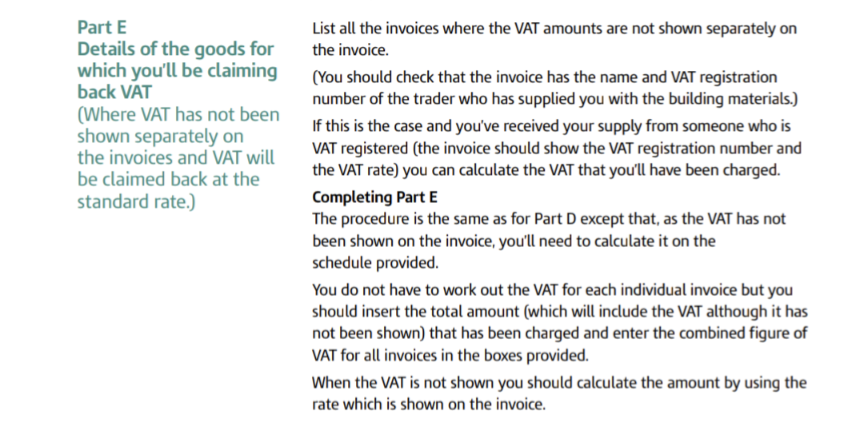
The notes on section E of the reclaim form say this: Note the comment "You should check that the invoice has the name and VAT registration number of the trader who has supplied you with the building materials.)" In other words section E is for things like the retail scheme where you have bought from a VAT-registered trader who has provided a simplified retail receipt which shows their details inc VAT number but not an actual breakdown/amount of VAT charged. If you are buying from a non-VAT-registered trader then even if they paid VAT on the stuff they bought, and even if that is included in the price they charge you, it is not "VAT" when you pay it and it cannot be reclaimed by you. That's a basic principle of VAT accounting and as far as I know there is no special exemption for that on the self-build scheme although I am not an expert.