


puntloos
-
Posts
1575 -
Joined
-
Last visited
-
Days Won
1
Everything posted by puntloos
-
 OK, I was/am unclear if they pay the inc or ex VAT price (hence my #2 question) when they are purchasing stuff from 3d parties ("Jewson" or "Kitchen subcontractor co"). From your answers I am taking that they should be paying ex VAT prices (and then their OH/P added on), and therefore the only one who should fill out the reclaim is me. Fair enough.
 -
Since this is a new build, and my contractor is at least doing some of the VAT hassle, but I've also been sourcing some stuff by myself (some tiles, fancy toilet etc) my questions 1/ Do we submit one reclaim for the entire build? Or can I submit and contractor submits for the same build/address? 2/ Does the contractor pay their suppliers inc VAT, and if so, does that mean they will give me a bag of money after the build (when the reclaim happens?) 3/ Are there cases where I can pay the price minus VAT and the supplier makes a note for their books somehow? (sometimes having the money stay in my pocket is better than perhaps literally having to borrow money to pay the inclusive vat price)
-
This one is interesting, I am hoping it'll apply to me but I'm not holding my breath. My situation is that I bought the place but took a fairly long time to draw up our plans (architecting, tender stage, planning permission) and during this time we didn't live in the old house, but let a few friends stay in it while they were selfbuilding, and then a ukranian refugee family for a while.
-
We have 0.8 tog underlay, and there is a huge range of "normal" but I would still strongly suggest you get as low tog as you can find, within reason. Point being that a strong insulating carpet will direct the heat downward, which means that while it might not be 'lost' it will end up in a place you don't need it.
-
Should I have a storm lightning conductor fitted?
puntloos replied to readiescards's topic in Electrics - Other
Ah, I badly misunderstood the principle - it's called rolling sphere, and the important part is that it's not just 50m between houses, but if you imagine a ball of paint of 50m would it be able to paint any part of your house. The problem is that from this system, it seems to me every house known to man probably needs some protection unless you're the house from 'up' Trying to understand a bit more...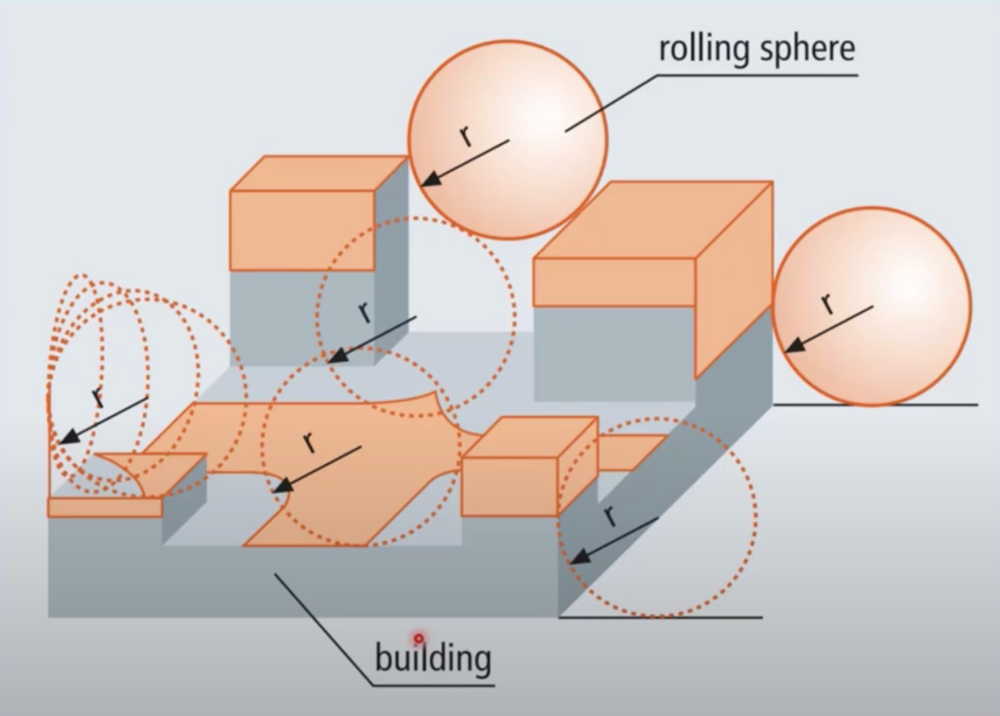

-
Should I have a storm lightning conductor fitted?
puntloos replied to readiescards's topic in Electrics - Other
Actually, the closest higher point than my house is 47m away from my house. I guess I can barely scrape by with that. -
We like the idea of a dark fence: https://www.buildersmerchant.com/product/black-painted-treated-feather-edge-board-175mm-x-32mm-2-4m-8ft/ But what are the downsides of this? Do we have to paint this every 2 weeks, or will it look otherwise terrible quickly? Or is this a reasonable choice that we won't regret? (unless we discover we don't like the look after all)?
-
Should I have a storm lightning conductor fitted?
puntloos replied to readiescards's topic in Electrics - Other
Coming to the same question - does anyone know some 'rules of thumb' around what constitutes good cover for your house? My house is arguably sliiightly higher than the closest other houses, but there's a 4 storey flat about 100m away with a big honking tv antenna on top. Am I good? -
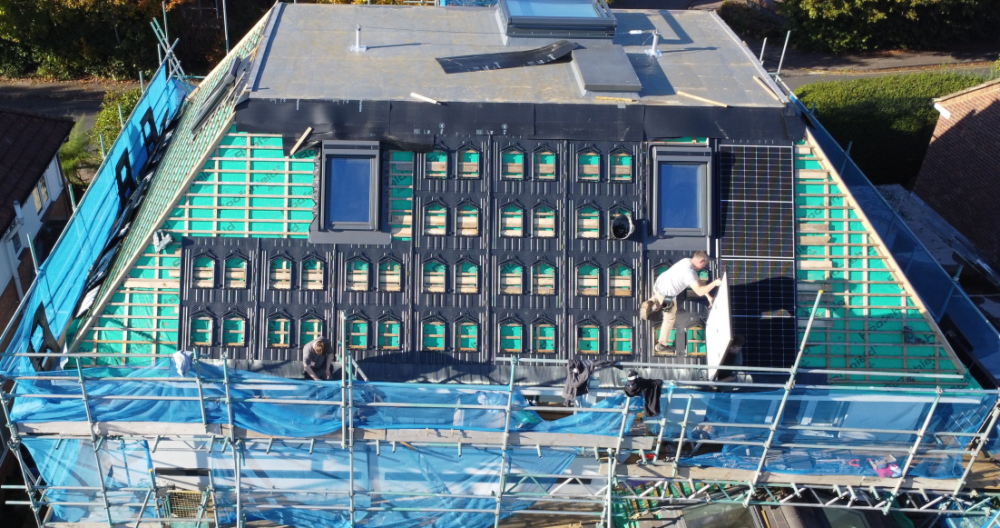
The question sounds almost obvious but my solar guy said the GSE is interlocking to ensure watertightness. Sounds sensible by itself but does a roof (the 'top layer' of course) need to be fully watertight? Or do you think you managed to keep watertightness without using GSEs the way they are intended?
-
Somehow the builder thinks the GSE thinks *have* to 100% click together and I imagine in your case that's not the case? Or is there some 'clicking correctly' happening but you had to somehow trim a few edges?
-
If you take a look at my current roof: I'm sure most of you will agree there's theoretically enough space to the left of the left window. However, I'm told that GSE flashings connect together in such a way that you can't 'stagger' them. Can anyone confirm or deny that one? Does the 'top' panel have to be straight under the bottom panel? And if it is possible, maybe some description I can take to the builder
-
Frankly it sounds like I should probably give up on burying any water "loops" in my garden and just work with overground minisprinklers or (gasp) no sprinklers at all.
-
Fair point, I can certainly imagine these leaky hoses breaking down silently and suddenly some thing dies on you without you ever knowing it was something making the leaky hose.. less leaky - ha. But with those mini sprinklers you don't really embed them in the ground rather than you lay them on the ground, no? Not that I *have to* put this in the ground but it just feels more 'solid' rather than just rolling some 'cable' around the garden.
-
One new headscratcher for me is the difference between 'leaky hose' style irrigation and proper "power" irrigation, more classic garden sprinklers that cover grass too. Would you install both systems? Presumably you'll need two runs of pipe rather than use the same? Or do grass manually (we have a small garden, not a huge chore) with a simple roll-up hose?
-
Taking apart an Mitsu Ecodan ASHP (to paint it)
puntloos replied to puntloos's topic in Air Source Heat Pumps (ASHP)
Indeed I'm aware of this team but I have onsite spraypainting for near-free.. so do I need to go the 'wrapping' solution? -
Taking apart an Mitsu Ecodan ASHP (to paint it)
puntloos replied to puntloos's topic in Air Source Heat Pumps (ASHP)
So from this picture it looks like the white pieces 2, 9, 10, 11 are detachable. That seems to only leave the "rear left" bit is a bit less defined? -
So, a big honking white thing, in a green place (aka garden) is not ideal. Putting a tarpaulin over it- also not ideal. Does anyone know if a Mitsubishi Ecodan comes apart fairly easily so a painter can just strip the white bits and spray paint them? Or will I be left with a few pieces that are anchored to the device in such a way you can never safely spraypaint without hitting sensitive bits with your paint?
-
Reviving an old one but here's a thought: A conditioner temporarily prevents the scale from sticking to things. I believe it crystalizes it somewhat. If this water is exposed to open air it will start to scale thigns up again. -> Any water that gets swirled around in open air (kettles, dishwashers, drinking glasses, showers etc) will scale-ify your things. A softener permanently de-scales your water, but in exchange makes it more salty, which might be a negative taste-wise, and I heard (anyone confirm?) that salty water might also affect devices negatively. It's certainly true that oceanwater is much more harmful to 'humanmade things' - boats, houses than eg rainwater. So, would it perhaps make sense to do both? - Shower: softened - Dishwasher: softened (a compromise) - Kitchen (drinking) tap: conditioned - Washing machine.. Or is there no point in conditioning once you have a softener?
-
Just curious- What's the official definition of new build? 1 wall? How about 1 single wall and a petunia planter? 2 walls? Foundation?
-
One update, does anyone have recommendations for brands of booster pumps that are QUIET (uh, but still are powerful enough to serve say 2 showers and "some third thing" at the same time from a 200L vessel) Are any brands recommended or not recommended here?
-
As someone who played with this choice for about 3 years before we pulled the trigger on flatten+newbuild, I can give you my biased view that others might shoot holes in: - VAT adds up, so yes, at a certain point and at a certain thoroughness of renovation it starts to make sense to do a newbuild. Haven't really figured out a universal rule of thumb but I suspect that if every room needs major work and you want to add a bunch of extra things/space then you quickly will be better off rebuilding. - I have no idea if renovating or newbuilding makes a major difference to the satisfaction, I do know that with newbuild there are 6fewer constraints which means you'll probably have more decision fatigue, as well as tons of choices where there simply isn't a 'right choice' ("should the mantle be sticking out further or less far than the hearth of a fireplace"). - Not too concerned about regs. Most of them are simply reflecting the 'direction' of innovation, and probably sane to follow. There are a bunch that are somewhat annoying and can trip you up, for example in my local area you have to have 27 meters between your 1st floor window and any existing 1st floor windows facing you, and in a tightly packet town that sometimes means you can forget about that 2 story extension for no good reason. End of the day, I think both styles of project are great, the accent differences are what might sway you one direction or the other,
-
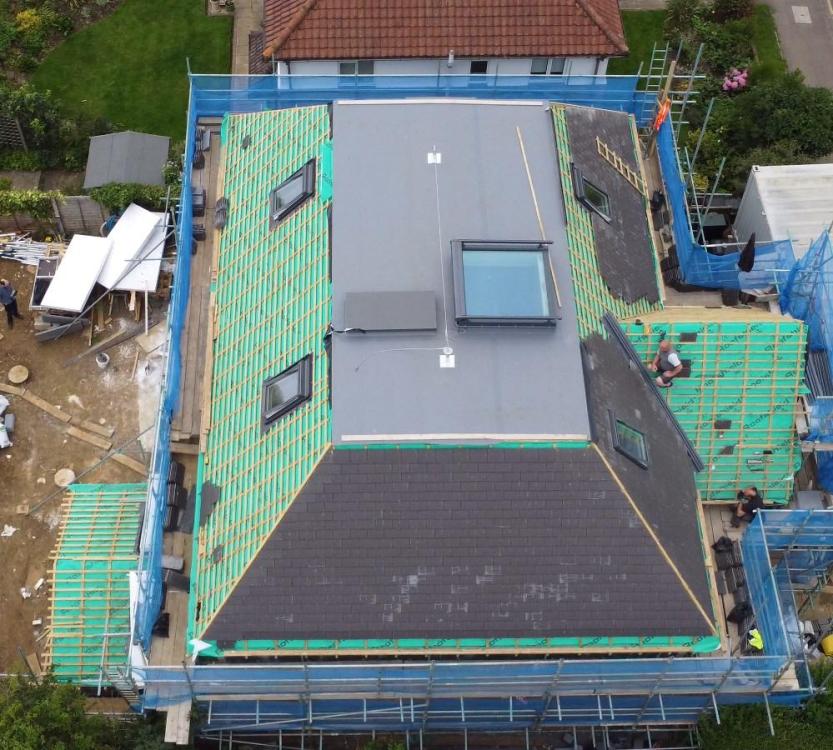
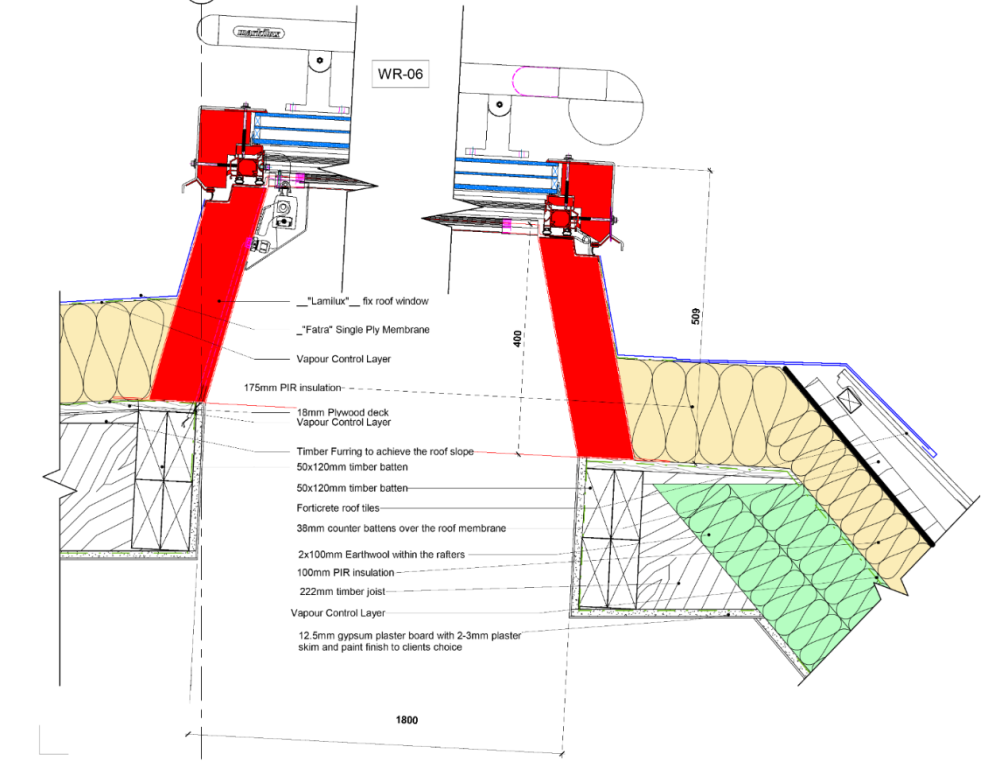
I suppose (as a non-roof-expert) my only question is where - with a tightly laid roof tile set (forticrete interlocking tiles) - air can go in and out at all. Sure, battens means there are 'voids' below the panels, and I'm sure the GSE design can connect those voids so air can travel anywhere under the roof, but I'm not quite sure where air is let in or out of the roof? Or are the gaps between GSE tray and actual tiles sufficient to let air in and out? Here's the current roof state And here is the general roof buildup - obviously without the GSE trays listed
-
Small update on this one - the builder says that because we have flat, interlocking concrete tiles and passivhaus membrane close by, the amount of wind (aka cooling) that can rush through/under the panels is low, hence the ventilation thing. Does that make sense or is it still unneeded in this forum's opinion?
-
Quick update, I'm told this is not allowed... Not sure how to 'create' a separate earth stake, but seems simple enough to also switch earths if grid goes kablooie?
-
I used to know electronics but switched to computer software so long ago that while that sounds right I can't verify it But good lead, thx.


