Dan F
-
Posts
1431 -
Joined
-
Last visited
-
Days Won
2
Everything posted by Dan F
-
Green homes Grant (£5000)
Dan F replied to ykhan16's topic in P2P lending, Crowd Funding and Alternate Sources
I was wondering the same. Thinking about using immersion heater only for DHW, and then adding a ASHP post-completion to get 2/3 of price. -
Yes, with so much glazing it's hard to know if it'll be enough to prevent over-heating though!! 0.36 g-value in 100m2 glazing is 10x 0.36 g-value in 10m2 glazing!
-
Added about 40% on top of our windows price I think, but we put blinds on 80% of windows. Problem with Roma is you can only buy them along with one window brand, they don't resell in UK. The only two options I found with UK-reseller for windows/blinds packge was Internorm + Gaulhofer. Warema blinds are also very good, and there are a couple of UK suppliers if you wanted to do windows/blinds separately.
-
I think it will come down to local planners and if you have any neighbours that might notice and or complain. The advice our architect gave us was: - Can't add windows (we didn't discuss removing windows, but I guess it depends if/how they impact overall look/street scene etc.) - Can adjust windows size/position sightly within reason with no issue. Others might have have different experiences though..
-
Sorry, my numbers aren't quite right as the solar glass numbers I was looking at were double-glazed, not triple-glazed (sorry). So would be bit lower than 25-55%. I'd get the actual numbers but seems calumenlive.com isn't quite working...
-
COOL-LITE SKN 144 II has 0.23 g-value (vs. typical 0.5 for no coating) but light transmittance is reduced to 41% (vs more normal 70% with no coating). Given the amount of glazing though 0.23 g-value might not be enough to stop overheating, very hard to know without modelling it. If I was in your position I would: 1) Look at overhangs and/or reducing glass as @Mr Punter pointed out. 2) If I couldn't do either of those, I'd probably want to model it to ensure whatever I did was going to work, as if it didn't it'd be a major discomfort (using PHPP probably). 3) I'd personally probably go down the blinds route (we are using roma.eu blinds), but given how much glass you have you might want to consider using some solar glass too... SageGlass is conveient in a different way to blinds, I'm unsure on the relative prices though. If you do look at blinds, if possible try to order windows/blinds together to save headaches.
-
Heat loss from pump to storage cylinder
Dan F replied to paulc313's topic in Air Source Heat Pumps (ASHP)
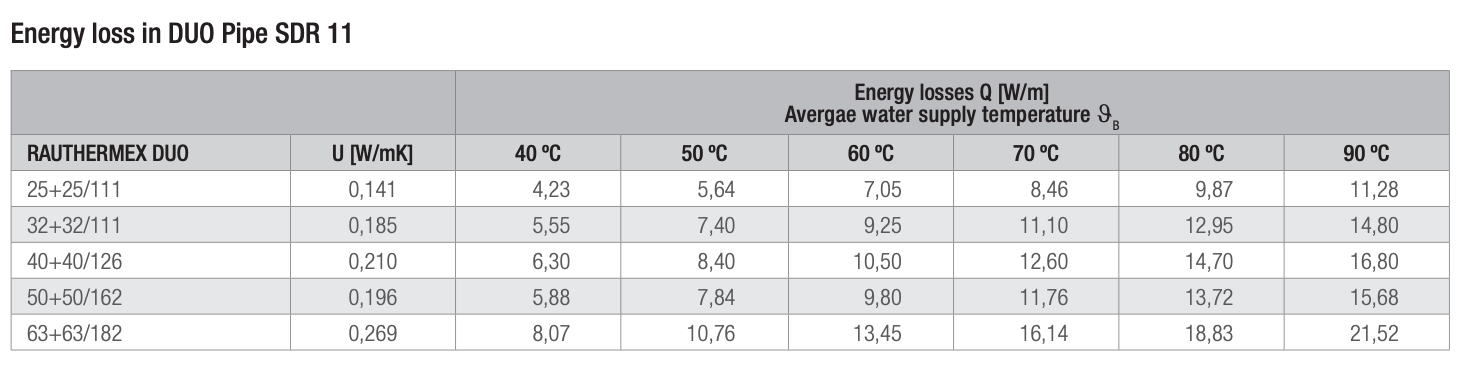
(Page 17 of RAUTHERMEX manual)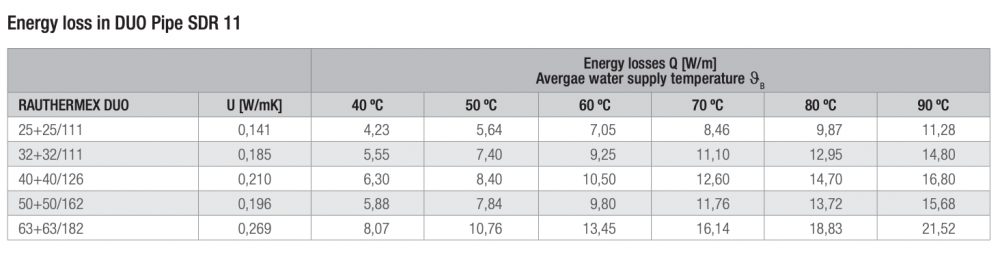
-
Heat loss from pump to storage cylinder
Dan F replied to paulc313's topic in Air Source Heat Pumps (ASHP)
I paid £22/m2 for Rauthermex 25+25/111mm DUO Pipe. We are using it for ASHP flow/return, and put it under slab to avoid penetrations in wall and also because our plant room doesn't have an external wall. -
So you are right to be looking at solar glass, blinds and SageGlass! My guess is that blinds or SageGlass would probably be sufficient on their own. Solar glass might not be, unless you went for a 0.23 g-value variant maybe, but that would impact light-transmittence fairly significantly which might not be ideal in winter. Quick look at some of the spec sheets: - Good blinds will reduce solar gain by 70%+ and can be raised/lowered/tilted. - SageGlass will reduce solar gain by 25% all-year (which may be beneficial given amount of glass), and up to 95% when activated. (25%, 70%, 80% or 95% by the look of it) https://www.sageglass.com/sites/default/files/sageglass_datasheet_climatop_42.1ec-12-4-12-4_classic_en.pdf - Solar glass will reduce solar gain by 25%-55% depending which coating you get. The more reduction in solar gain, the lower the light tranmission. Can't be adjusted. (all vs. standard 0.5 g-value for triple-glazing) On the forum there are people that have used/using both options: blinds (me and others) and SageGlass too (@NSS)
-
Before looking at glass options, have you: 1) Built in any overhangs and/or modelled the design in something like Sketchup that will allow you to design a south-facing elevation that avoids direct sun during the summer? 2) Done any modelling to understand how much a overheating problem you might have e.g. PHPP? (model can also be used to test different solutions) It all depends on how much you need to reduce solar gain, which will depend on orientation, tree shading and overhangs etc. Solar glass itself with a low g-value might be enough, but it might not be.
-
Internorm: Order with solar glass, or apply external film later?
Dan F replied to tanneja's topic in Windows & Glazing
Yes, thats fair. I'm not arguing against Sageglass, just highlighting that if you want high light transmittance and good amount of solar gain in winter (like we do) then temporary shading has it's advantages. -
Internorm: Order with solar glass, or apply external film later?
Dan F replied to tanneja's topic in Windows & Glazing
For the same reason I wouldn't use any glass that reduced light transmissions and solar gain. Different build have different requirements, but for our build we wanted to maximize light transmission (to ensure its nice and bright inside all year) and ensure we get good solar gains in winter to reduce heating demand. (or course this means that temporary shading is a must) Interestingly the coating the OP mentioned still transmits 70% of light (more than Sageglass with no tint) yet still reduces g-value to limit solar gain. Of course it's not adjustable though, which is the really nice thing about SageGlass. Typical Double Glazing: 83% Light Transmittance, 0.8 g-value High-g Triple Glazing: 77% Light Transmittance, 0.6 g-value Typical Triple Glazing: 71% Light Transmittance, 0.5 g-value SKN 176 II Coating Triple Glazed: 70% Light Transmittance, 0.37 g-value Sageglass (no tint) Triple Glazed. 54% Light Transmittance, 0.34 g-value. -
Internorm: Order with solar glass, or apply external film later?
Dan F replied to tanneja's topic in Windows & Glazing
Fair enough. Original question was about use of solar glass coating/film, so this is why I was comparing this to blinds. SageGlass seems like a great alternative to blinds, my only two concerns would be i) price ii) low g-value as it seems that even when "off" the g-value is 0.38 versus 0.5 for standard triple glazing. -
Internorm: Order with solar glass, or apply external film later?
Dan F replied to tanneja's topic in Windows & Glazing
Only if they are down, and you can control this as needed. Solar glass is there all day/year.. In our case I expect blinds to be up all winter and nearly all of early spring and late autum which will mean we get useful solar gain during this season but also the house should also we very will naturally illuminated. (Our motivation for high-g glass wasn't to improve numbers in PHPP spreadsheet, although it did, but rather to get light transmission closer to double glazing numbers to ensure things are nice and bright inside) -
Internorm: Order with solar glass, or apply external film later?
Dan F replied to tanneja's topic in Windows & Glazing
We are going with: - Moderate overhangs - External venetian blinds. I'd be concerned about solar glass limiting solar gain and pushing up heating costs, but aside from that the house is just generally just to be darker inside wont it! We've actually gone for high g-value (0.6) glass on our windows, including south-facing! Not sure i understand the concern about operating blinds or them being electic. You can even automate them based on temperature and sun direction etc if you want to. If you don't like venetian blinds you can get fabric alternatives that are see though too i think. -
We were advised to avoid any/all joints in MDPE if at all possible. Also for any joints, if required, to be accessible. That doesn't mean an elbow won't work, it will, I just think that most people would typically try to avoid it. In our case, it needed a bit of help, but 32mm went round 200mm bend OK.
-
Not sure who is doing your slab or what they do, but a typical approach is to use a 110mm UPVC pipe with a shallow bend for water supply and then to put MDPE through this afterwards. A 200mm shallow bend will just about work with 32mm MDPE assuming you feed it through from inside. (we were worried about this).
-
This is what out building inspector asked for: All drains are 110mm UPVC and have straight runs with minimal connection points below the slab. All drains are to be bedded and backfilled with 10mm pea shingle and the slab is reinforced. Drains serving as SVP’s to first floor are to have 200mm long rest bends at base with concrete support. Could it be there is a mix-up regarding the concrete supports? What passive slab system are you using? This is exactly what we did. See this post, you can just about see the concrete support in the drainage picture.:
-
MBC (EPS is from KORE) did the whole foundation and are also doing frame. They started yesterday, but I'm behind with the blog posts..
-
Critique my home automation cabinet wiring
Dan F replied to joth's topic in Networks, AV, Security & Automation
I was initially planning to use a graded alarm (not taken final decision yet), but the thought of ugly PIR detectors in each room on top of whatever you might use for Loxone functionality , that are only used by the alarm system put me off. Same with window/door contacts; We've ordered windows with integrated (macotronic) reed contacts that aren't visible and a front door with electric lock, so don't really want to have to add additional door contacts either. You are planning to integrate a catflap though! ? -
Critique my home automation cabinet wiring
Dan F replied to joth's topic in Networks, AV, Security & Automation
Using an "approved" alarm then? Is this an insurance requirement? My current plan is just to use Loxone for alarm using Loxone presence sensors and factory-integrated window contact sensors... -
After around 18 months of planning things have finally been moving a lot faster over the last couple of weeks which is great! I'll try to summarise the interesting bits: Type 2 vs. Type 3 Our EPS was installed on a sub-base of 150mm MOT Type 2 and 50mm sharp sand for blinding. Structurally this is absolutely fine, but there was an awful lot of and fro with the foundation designers about if permeable type 3 + grit should actually have been used as specified in the system certificates. I believe the only potential down-side of this approach is the potential for capillary action causing water uptake in the EPS and reduced thermal performance, but, given we upgraded to 300/400mm EPS this shouldn't be a significant concern. Drainage below EPS While it was a challenge with the invert levels (especially with the 400mm EPS) we decided to try and ensure that all drainage went through the sub-base and not through the EPS. This resulted in a redesigning the drainage runs as well as ensuring we use inspection chambers without drops, but it all works in the end, with just small notches being required in the underside of the bottom 100mm of EPS in a couple of isolated locations. "The bend at the foot of the stack should have as large a radius as possible and at least 200mm at the centre line" One warning when putting drainage in. Make sure the correct shallow bends are used! Our building inspector had, in theory, given us a pre-pour approval, but then when he got the drainage photos it was clear that the correct bends hadn't been used for first floor SVP's which he flagged up, so we had no choice but to mine through 300-400mm EPS and change them! Why so much EPS? Given our house design has stepped sides (something to do with street scene according to our architect) this means there are numerous steels and load-bearing walls internally. What this meant in practice for the foundation design was that around 60% of the slab needed reinforcing and would have 250mm concrete and only 200mm EPS. We had a u-value calculation done based on our actual foundation design and as we expected the u-value wasn't great, so we decided to go ahead and upgrade the EPS to 400mm which ensure there is a minimum of 300mm EPS across the while slab. It might have been overkill, but the price to upgrade wasn't that much and our PHPP calculation was already assuming 0.10.
-
In our case it's on 150mm of Type 2, blinded with sharp sand and then EPS (without any DPM between sand and EPS). This is the same foundation system/manufacturer as Jeremy and many others. We hadn't realised that the detail in our foundation design had this until the slab was in. ?. Agree with @ADLIan that it's not really the way to do things, but I don't know if it's an issue in practice, other than potential for small decrease in u-value due to moisture absorption through capillary action. Any thoughts?
-
I have quote for £57/m2 supply and fit. This is based on a fairly small area of 13m2. Edit: Oops completely misread as "Sedum"!, so that £57/m2 is for Sedum roof, sorry!
-
Have you already decided on window manufacturer? It makes things simpler and reduces risks if you can get blinds supplied with windows/ Alternately try https://www.brightablind.com/ or https://cornerstaraluminium.com/ for Warema blinds in U.K.