joth
-
Posts
2861 -
Joined
-
Last visited
-
Days Won
5
Everything posted by joth
-
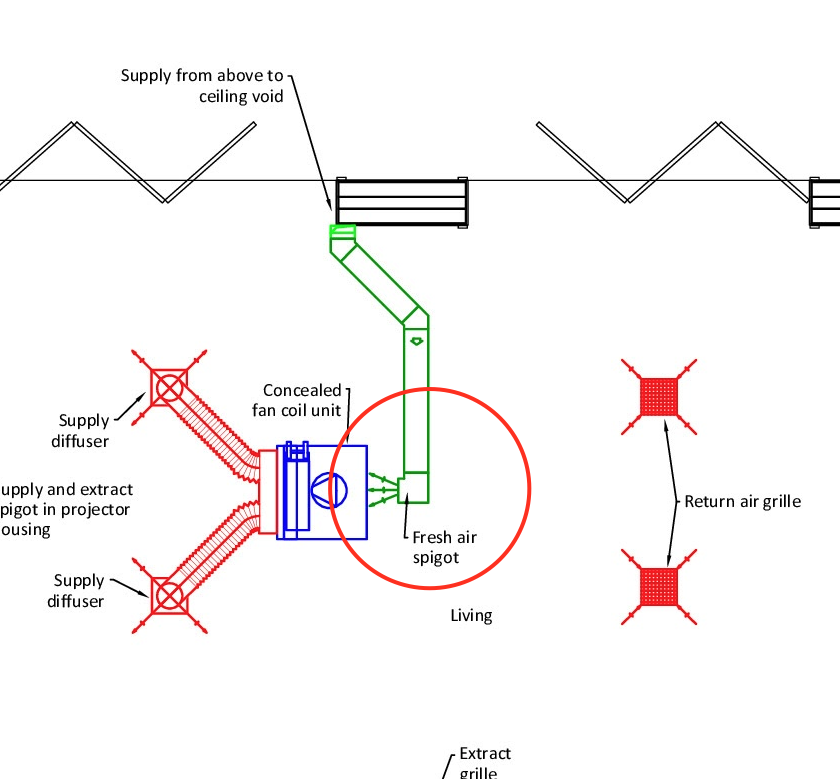
 On the rooms with MVHR supply and FCU, will the MCHR "Fresh air spigot" be supply fresh air into the ceiling void (the -ve pressure supply plenum for the FCU) or into the room? If the former, you'll only get the fresh air supplied when the FCU is operating, which seems less than idea, but if the latter then I'd expect it to be nearer the "Return air grille" plenum inlets if the intention is to use the FCU to disperse fresh air (which appears to be the intent) EDIT: looking at the first floor, it does indeed seem you only get fresh air supply when the FCU is running. I'm not sure how wise that is. The MVHR fresh air supplies are directly tied into the FCU supply plenum which might make balancing the whole system a lot more complex, and if you run any FCU at high speed it might suck air out of the MVHR network, pulling air back up out of other supply-side rooms. What I've read suggests it's easier to commission and operate if the two systems air kept independent, and I've generally seen the FCU acting as an optional agitator of the fresh air supply once it's already made it into a room (e.g. by positioning the supply vent somewhere near the FCU intake) How will downstairs FCU be accessed for maintenance, filter changes? If the ceiling void is being used as an open negative pressure plenum (which I think is the intent, as there's not pipework shown from the Return air grille to the FCU) then is any special allowance made to avoid trades leaving a lot of dust and plaster and general sh*te in the void that it will blow around? Is there no rockwool for sound insulation between ceiling and floor above, to impede air movement in that channel?
-
Well, on the other hand e.g. cooking on a powerful hob would also generate an additional heat for a longish time. But yeah I will ask. Yes but I don't put the hob in a small insulated box, and it is designed to deal with heat in a way that a rack of network equipment or a projector might struggle with, nor does it run for hours and hours at a time at full whack. So long as there's a way to ventilate these electronics aside from the MVHR you'll be fine: worst case the respective rooms start to overheat and the FCU kicks in. I think for A2W the ecodan 6.0 kwh is planned - PUZ-WM60VAA - very similar to yours I seem to recall? Similar, ours is 8 kW for about half the floor area. We could have got away with 5kW but oversized it for DHW tank reheat speed. With a 400L tank, you should check what happens there too. As you're using a split system, it's a shame the A2A and A2W can't share a single 4-pipe external unit. That way you'd have the full power of it available for DHW reheat, and it would be more effective in moving excess heat between areas (cooling and heating different rooms simultaneously). It's actually more the norm than the exception: for 9 months the year you need next to no heating, but it's still pleasant to walk on not-freezing tiles in the morning. The buffer has many purposes, and only if you're sure you'll never (for the lifetime of the system) want any of them would I be confident to forgo it. Off top of my head: 1/ Load shifting. Both for overnight cheap rate and for times of excess solar generation. This is not so much about "storing more energy" as allowing the heat pump to operate for a longer period at a significantly higher flow rate, as the UFH manifold then mixes it down to the desired temperature. The ecodan FTC6 has a "smart grid" input to make use of cheap electricity (inc from solar) but this only works if you have a buffer tank with thermistor. 2/ Faster DHW to heating transition. Maybe ecodan specific, but I find it takes 20-30 mins to cool down after doing DHW before enabling heating. Buffer tank should remove that delay. (Having a split system might also resolve this one) 3/ Deal with very low heat demand. The "one bathroom calling to heat up tiles" scenario is the one I can easily see, but there maybe others. (Guest staying that likes a bedroom extra hot?) - the smaller 6kW size will help a bit with this at least. 4/ Backup heating, if it has an immersion. (Moot as you have an independent A2A system anyway) 5/ provides a heat source for defrost cycles, but probably moot with split system and everything else going on. Couple other comments: - be interested how you get on with tendering. My contractor quoted £12,000 to install a single H20 FCU! (Hence why I DIYed it, with variable level of success) - do you have a plan for control systems for it all? It would be easy for the A2A and A2W, and even MVHR and stack venting (if you automate it?) all to end up in a battle royale unless something is coordinate the lot.
-
I don't follow this at all. What does "tied into" and "beam" mean? Additional fans to force air into? That will greatly unbalance the system and you'll probably just have the hot air blowing back from other extract points. At normal MVHR air movement rates, extracting an additional 1400W through and MVHR is not going to happen. Depends what size A2W heat pump is specified, and what is the smallest zone that maybe driven? If you ever want to use it just for the bathrooms e.g. to make the tiles feel warmer in shoulder season, then yes it will definitely be short cycling. But then, you'll probably have the A2A running at the same time on cooling mode to compensate so short cycling is the least of the worry ?
-
Looks like the immersion on mine will go to 70ºC +/- 5ºC, and has a second cut out at 87ºC, and the UVC T&P valve fires at 90. https://osohotwater.co.uk/wp-content/uploads/2021/11/Manual-Delta-Geocoil-DGC-UK.pdf So yep 70 maybe a more reasonable max target.
-
The irony being, if you are using an ASHP the Sunamp requires even more p***ing about, last I looked .. ? That's a very large bath. If that's the actual size, and you expect to use it regularly, you maybe just as well to keep the combi boiler.
-
It depends on the heat demand and the emitter size, neither of which were given. The larger the volume in the UFH loops, the lower temperature they can run at for the same power delivery. There is one clue though: > Upstairs thermostats are wired and only control the manifolds, they are set to close at 18°c. This reduces the system volume, thereby increasing the flow temperature required to achieve the needed power delivery. This may result in a less efficient (more expensive) system than if you let all the rooms stats call for heat together. (i.e., remove the room by room zoning) Given the overall system is driving the house to too high a temperature, that suggests: a) that flow curve is too high. I'd try reducing it to 30-40 deg C range and experiment from there. b) there's whole-house room stat is not working, so it's in a permanent call-for-heat state. How much of an issue that is depends on how hard it proves to get the compensation curve dialled in. Presumably you don't have any delicate wood floors or the like? These generally don't want to be above 26 deg C, which IME means keeping flow temps below 35. (I use a temp probe in the screed to back off the max allowed flow temp as the screed warms up)
-
Are you heating it from gas boiler, ASHP, oil, direct electric, other? I think for 2 ppl in a space constrained situation, if you're doing sunamp at all the only sensible choice would be to get the largest sunamp you can and forgo the cylinder. The only drawback of that is if you're hoping to charge it from ASHP, but you have that issue anyway. Alternatively, if you're not using ASHP (or can compliment it with anything else), the easiest way is to increase capacity of a UVC is to increase the storage temperature. E.g. you can store water at 50 deg C most the time, but bump it up to 85 on the days when you know you need more. We do this with ASHP and the immersion heater as a boost to get above 55 deg C. (I have it all automated, so the more people staying in the house overnight, the hotter the tank is in the morning, charged up from overnight cheaprate electric). In case it's not obvious, this depends on having thermostatic mixer on the outlet / all showers, so that a constant temp is delivered, but using less DHW from the tank if t's at a higher temp, thereby achieving a larger effective heat energy store. You can't do this with Sunamp, hence why UVC is strictly better for "variable storage" requirements. btw if you mostly use DHW for showers, you can reduce their demand by about 35% by installing a showersave.com device. Also if you're having a boiling water tap in the kitchen you can consider getting one with an integrated instant DHW supply (e.g. Quooker Combi) which also reduces demand on the main tank
-
It's common that these are split to different layers of the wall build up, e.g. for a wind-tight layer outside the insulation, and airtight layer on the inside. e.g. https://www.pavatex.com/uploads/tx_sbdownloader/120913_Pavatight_eng_12.pdf and https://www.isocell.com/en/airtightness-systems can both work that way
-
Lost with DALI/KNX Lights (single room)
joth replied to J1mbo's topic in Networks, AV, Security & Automation
I think one challenge with this is most rotary knobs have end stops for 0 and 100%. This is difficult to work with a remote control, as you either need to motorize the knob to move the the set location (as was very popular for the big volume knob mid range hifis in the 90s) or find one without end stops, which does remove one of the nice tactile feedback elements of using a knob. That is a roundabout way of saying, I've not been able to find anything more convenient that meets this need. My current thought is use a 0-10V rotary dial like https://www.aliexpress.com/item/32923159930.html feed that into the microcontroller, and then have that drive an LED dimmer like https://www.aliexpress.com/item/1005002863778354.html do you know minimum PWM frequency to meet this need? The one above is 500Hz which feels like it should be fine. It depends a bit on the exact LED used, if you have diffuser, and, in my experience, whether the emitter is directly visible to the eye or if it's only visible via reflection off a surface (which generally gives a much nicer light anyway) -
Yeah it looks like a v2 smart meter with the Toshiba comms hub (per Ovo). You had said you were on an analogue meter, this changes things! SMETSv2 polyphase meters use net-metering, so you can split loads and PV across the phases however you want - you'll be billed based on the net usage across all phases. Having one phase per "building" makes sense, and then drop the PV into whichever phase is on the building where the inverter sits. Ideally the inverter should be as close to the meter head as you can, to reduce the voltage differential across the line to the inverter, which can cause it to cut out if you're in a location that regularly runs over 250V. The scribbling at the bottom of the meter board does indeed make it look like you are. (Volts = 250, 245, 250).
-
Lost with DALI/KNX Lights (single room)
joth replied to J1mbo's topic in Networks, AV, Security & Automation
The fundamental challenge you have here is two controllers trying to drive the same lighting fixture. DALI (and DMX) are really a 1:N relationship of controller (bus master) to actuators. You'll need to decide whether the rotary knob or the RaspberryPi is the master, and have the other controller redirect commands to that master and hence to the lighting. You didn't mention if this is the ONLY DALI device in the house, but I'm assuming it is, in which case it seems a bit overkill (and adding KNX even more so). Personally I'd fine a simply constant voltage LED strip driver that takes some kind of digital input (Wifi HTTP, and bluetooth are common, but there's lots of alternatives), drive that from the PhPi (or ESP32) and have a big rotary dial as an input to the microcontroller. If you do want to keep with DALI, getting one of these HTTP driven controllers may be a good place to start https://www.amazon.co.uk/dp/B081TNRGMN/ from -
I guess that's going in heavy on the "M" of M&E. Throw in a moving floor swimming pool, automated glass walls, some cinema automation theatrics and so on, it'll soon eat a 7 figure sum.
-
aside from market economics (and lack there of - fossil fuel is more dictated by global politics than market conditions as we all know), If you have (a lot) of solar PV, you can get "effectively free" supply at certain times, and this does make load shifting a very desirable anyway. Linking back to the OP - I built out my house with a lot of "smart home" tech (full Loxone system self installed) and this enables all sorts of neat things. For example it's very cold but sunny here today, and I just noticed that the solar redirect to immersion was hunting for the set-point a lot because the of other devices turning on and off at a low frequency. So I've now integrated all the resistive heating elements in the house (immersion heater, 3 towel rads and 2 UFH mats) under a single PID controller which pulse-width modulates the solid-state relays that control each of them, meaning that as the PV generation increases and we have excess power, it slowly turns the dial up on all the heating elements in the house, to use the excess. Obviously it's all tied to the house temperature, so as the inside temp increases to target the amount redirected to towel rads and UFH mats is capped and gradually scales back, letting more into the immersion heater. I could do this without a smart home system, but rewiring lots of devices to come from a single hardware PV redirect controller, but as I'd already built the whole lot out using Loxone it was a software only (graphical editor) change to add this additional level of intelligent control. It's really building management system, with automations. I don't really like the term "smart home" as everyone imagines humans shouting commands at the appliances and nothing more. I much prefer this idea that the house handles stuff automatically, no need for barking voice commands all the time.
-
HA! ok fine ? Yeah for offgrid the monthly kWh estimate only tells part of the story, an estimate of how many contiguous days are likely to have no or next to no sun is also key information, but I'm going to wildly guess Mediterranean climate helps a lot here. (That said, we spent 2 weeks in Majorca November just gone, and it did not stop raining once...)
-
Some HA bits to give away for freeee (KNX/Dali/modbus)
joth replied to joth's topic in Networks, AV, Security & Automation
Ah yes, looks like someone else on the internet has similar needs to you ?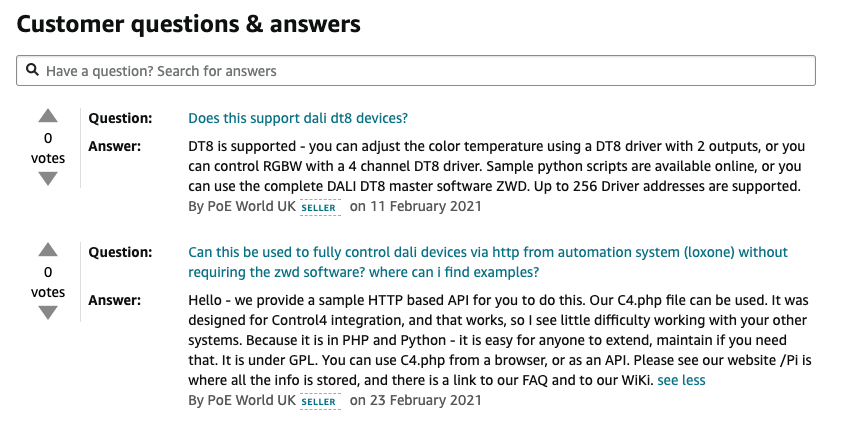
-
REmember that a 9kWh battery will give absolute best case scenario 3days of running. You need a MUCH bigger battery than that if you want guaranteed availability. At least, where I am in the UK it can be cloudy for a week or two at a time. And even then, a single day of sunshine in December might barely meet the 3kWh demand for that day, let along recharge 10days worth of depleted battery. 3kWh is impressively low! Presumably no heating or hot water in that? We average 15-20kWh per day, for everything - heating, hotwater, cooking, 2 people working at home, a bunch of computers, but no workshop! (I see the UK average is 9kWh electricity, and 33kWh of gas, per day, for a 2.4 person household)
-
Some HA bits to give away for freeee (KNX/Dali/modbus)
joth replied to joth's topic in Networks, AV, Security & Automation
They're yours! I'll send a PM FWIW my process was fairly backwards: choosing wiring standard, then the application programming tools, then the dimmer protocols, then built up my cabinet, then did the lighting design. I panicked at the last stage and contracted a professional lighting designer and then eventually realized that getting the design right, then choosing the dimming protocols based on the models available that meet the lighting requirements, then from that selecting the protocols and building the cabinet. That said, it's definitely worth having a splunk with the various parts first so you can rule out any non-starters you just don't get on with. The only thing I'd reiterate about DALI is it's very expensive to get started with on Loxone (over £1k for a miniserver and the DALI extensions), but @Dan F is investigating an IP / microcoontroller based alternative DALI driver and maybe will share with the community if it proves successful? -
Interesting setup! I was going to ask how this would be grid tied as the SPF 5000 doesn't have a G.99 certificate AFAICT, but I see now you're making a fully offgrid system, pretty cool. 9800kWh sounds on the low side for an off-grid battery, and that much generation. Guess it depends on the usage patterns of the building, but nice thing with that system is you can always add more batteries later if needed?
-
Some HA bits to give away for freeee (KNX/Dali/modbus)
joth replied to joth's topic in Networks, AV, Security & Automation
Everything except 3 Dali dimmers still available to claim! I had a good go with KNX but the end decision was easy: programming it was a chore and always on an annoying learning curve, wheras Loxone was fun, and I wanted this to be a fun project. I could see with KNX I could make something that would work as well as conventional light switches, but once there I'd never want to touch it again and I'd rapidly lose memory of how to program it at all. ETS is a dog, and the whole ecosystem, is just stacked with compromises and paying over the odds for essentially 30+ year old technology. Loxone programming software is an absolute joy to use in comparison, and I get great fun making improvements to it. Maybe too much fun! This project is never going to be "finished" ? DALi was a tougher call, and often wish I had stuck to original plan and used it. I think the main downside was cost, especially as the Loxone Dali extensions are very limited and expensive. DMX was already familiar to me from theatre lighting, and is cheaper and more flexible. I have DMX driving SSRs for heating controls, blinds, towel rails, all sorts now. Modbus was simply not useful for inputs in Loxone, as it has a max polling rate once per 5s. For anything responding to human action that's useless. I successfully tested polling it from ESP2866 chip, and it also has TCP/IP support so I thought it might get used somewhere eventually but seems I never did! I do use modbus (from ESP) for energy monitors. -
Can't tell, would need the specific product data sheet, as max voltage is as much about the insulation thickness as the conductor area. Cross section area is only useful for gauging max current. I think all PV cable should be good for 300V though? 1000V is typical rating.
-
Blinds that are compatible with Loxone
joth replied to Dunny1234's topic in Networks, AV, Security & Automation
I have Somfy Glydea® Easiest integration with somfy is to use a pair or relays on the dry contact inputs. This is (generally?) on an RJ112 connector but your old BT phone extension is no use to plug into it as you need a cord with all 6 pins connected which was a bother to track down. This is not the most cost effective though as you're also paying for an unused Somfy RTS transceiver (and the brand name). Another model with basic 240V motor input would be just as easy to drive and cost less. I just panicked about the range of prices available on AliExpress and punted for the premium alternative. We have internorm windows with iTec integrated blinds which were their own fun adventure to integrate (I went for the Mediola rather than Loxone gateway) -
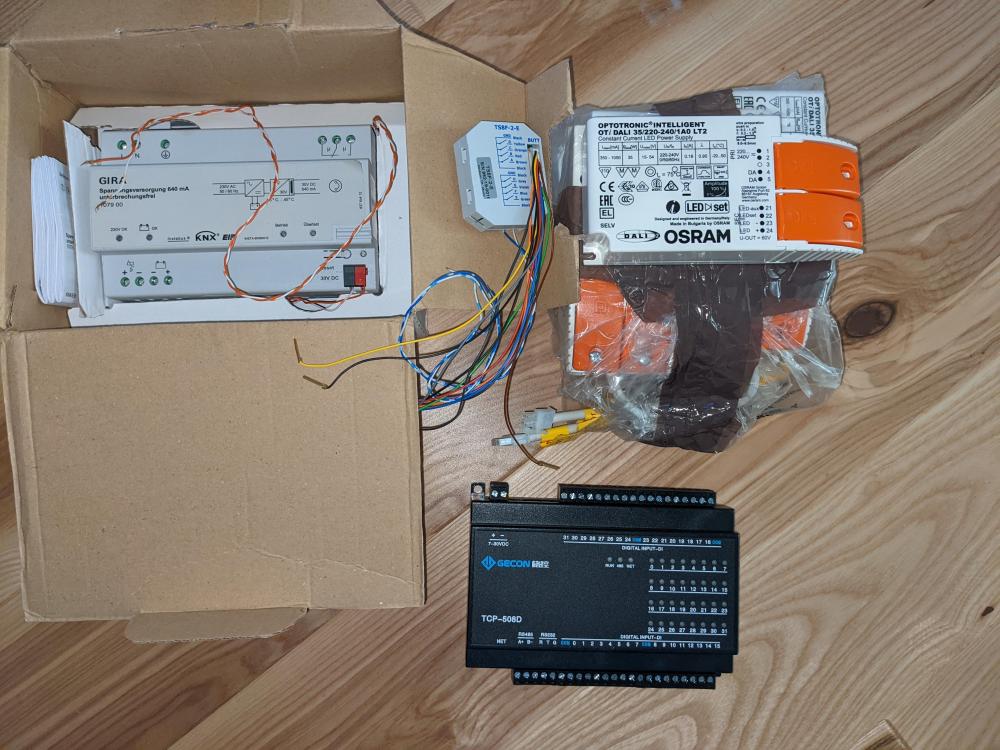
Left over from my build, all using protocols I decided not to go with in the end 1x GIRA KNX bus PSU (2nd hand from ebay) 1x Theben ts8f-2-e 8 way KNX digital input 7x Osram 350-1050mA constant current DALI LED dimmers (2nd hand from ebay) 1x 32 way modbus digital input (aliexpress special) Yours for the cost of P&P (or free free for collection in Herts or N1C London). If you feel compelled, or there's strong competition for any item, donations to buildhub coffers or shelter welcome ?
-
Octopus Go is 4x the price in peaks vs off-peak, so it'd take a massive drop in COP overnight to offset the financial benefit. I guess if the outside temperature subzero and so doing a lot of defrost cycles it might approach or even fall below a COP of 1, but I've not seen that in practice. If this was purely about Go I wouldn't be so interested, but the same applies on sunny days (like today) when the midday sun is generating >3kW we can run heating at 1/4 of the (opportunity) cost of importing electricity, and again it makes sense to run the ASHP as hard as possible when the electricity is cheap. Indeed, I can perhaps even modulate the flow temperature based on the exact level of excess generation, but I'm a long way off that! (Eventually I'd like to see if I can make the smarts smart enough to deal with dynamic pricing like Octopus Agile; while the last 6 months has shown the version of Agile they implemented reveals too much exposure to wholesale prices, I can imagine a future variant that has a capped 24-hour average price but dynamically shifts around the peaks and troughs of pricing throughout the day based on supply/demand patterns.) Altogether the project is see how far I can get with demand load shifting, before inevitably throwing in the towel and buying a house battery.
-
Ha. Well it was working ok but failed to come on last night: at some point yesterday I'd fat-fingered the thermostat control in Home Assistant and turned it from Flow to Room based control. Exactly the sort of error that shows how in appropriate HA is for heating controls unless really carefully done. Anyway in principle I can get much finer control driving flow temperature from Loxone as it can see every room temperature, outdoor temp (Inc recent averages and forecast), UF slab temperature, current energy price, number of people in the house, etc... My current project is maximizing heat output during the Octopus Go cheap rate, which means running it at the max safe flow temperature. So I can initially put e.g. 38°C water into the pipes and back it off as the screed starts to warm up, to stabilise around 29C flow temp for 26C screed max temp.
-
+1 to that. I have Loxone control system that can modulate the flow temperatures very nicely, but trying to get the ecodan to listen to it was a job of work: HTTP to Home Assistant, experimental for of the MELcloud integration sends it to the Mitsubishi cloud and from there back to my FTC6. . I wouldn't consider such a pukeworthy setup for long term use, but have done it for now just to test out how much more control it gives me over flow temperatures than using the FTC built in compensation curve. (actual call for heat is still done via the relay dry contact input to the FTC, so if the cloud is unavailable it should still all still work, just with suboptimal flow temps)