joth
-
Posts
2861 -
Joined
-
Last visited
-
Days Won
5
Everything posted by joth
-
One challenge with this is it will require high voltage DC (i.e. higher than 50V so not SELV), which while not a problem in theory, is a bit of a grey area for most installers as they just won't know what regs apply. Camper/Caravan gear seems most likely place this would emerge but it will be a challenge as they tend to be only 12V or mains AC. I found this: https://coolmach.com/roadmap/ - if it gets beyond vapourware stage, then delivering 4kW output would imply around 100A @ 12V input (COP of 3.3), which just doesn't seem practical. It's unfortunate camper leisure batteries don't typically get installed at 24V or even 48V. Or perhaps camper architecture will change to collocate leisure batteries with the aircon (and water heating) gear which would enable this better.
-
I run the condensate drains into the nearest bathroom waste stack. Put it through a dry-running trap and down the drain it goes. Not sure why you'd want it in the plant room specifically. However, as said above if you run the ASHP just above dew point and can still avoid short cycling (e.g. by running UFH+FCU together no zoning) then you can probably skip the condensation drain altogether.
-

Fancoil plan P (yes, there’s been lots of iterations….)
joth replied to G and J's topic in Ventilation
If you are happy to self install (or can find someone else competent enough to do it professionally) this will work, just bear in mind if doing it above dew point it's much more of a low-and-slow cooling power rather than the icy hurricane-on-demand you can command on an a2a. And always run UFH+FCU together to minimize short cycling. -
Fancoil plan P (yes, there’s been lots of iterations….)
joth replied to G and J's topic in Ventilation
Those are great diagrams of a simple concept I've explained many times in words and bad pictures haha Do you have a link to this knowledge base? Thx -
Fancoil plan P (yes, there’s been lots of iterations….)
joth replied to G and J's topic in Ventilation
Ha OK actually read the OP now, rather than just the post I was tagged in @G and J is this a 2-story building, with bedroom(s) on the 1st floor? Don't underestimate the effort it takes to add one FCU to an otherwise simple ASHP+UFH install. If you run the FCU on its own, it will have a much lower emitter size (and water volume) than the UFH so you're very likely to create short-cycling on the heat pump. Further if you run it as 2 zones you'll now need 3 circulation pumps, low loss header and electronic mixing valve (per Ecodan MIs at least, fairly typical) vs just one pump directly driving the UFH. And you lose some amount of cooling when the system switching to DHW and back. And you have to meticulously insulate all the ASHP pipework to avoid condensation (or only run it at 15+ degrees, which looses a heck of a lot of the cooling capacity which in turn increases risk of short cycling) If doing it all again I'd look very seriously at adding a separate A2A system for the bedroom. While it maybe a bit more in materials, it really isn't that much, and the installation cost may actually be less simply because it's such a well known process to install a mini-split a2a. Can still use the ASHP for slab cooling, but this is then a very simple control system. And this way you get two separate systems so still have some heating/cooling even if the other breaks. Worth a look at least -
Fancoil plan P (yes, there’s been lots of iterations….)
joth replied to G and J's topic in Ventilation
That quote about Mitsu vs Panasonic is 5+ years ago so no idea how it applies today. I've worked with 4 different Ecodan 8.5kW installs though, so can vouch it works fine for cooling. Another Daikin option is now available here: https://www.oceanairuk.com/product/daikin-fwp-2-pipe-medium-static-duct-fan-coil-unit-2-61kw-6-47kw/ It's actually the FWP-CT now, not -AT. (I swear these manufacturers much change model numbers more frequently than they sell units lol.) This is the MSRP for the naked 2-pipe FCU, just takes mains input and (I believe) a 0-10V signal to control speed -- it's inverter driven so very fine grained controlled over speed vs the old 3-speed coils, which is great for anyone like me integrating it with advanced controls (e.g. Loxone). Per JohnMo comment, I put separate thermistor on the flow pipework to shut off the fan if there's a slug of warm water in the pipe (i.e. when switching from DHW reheat back to cooling) But agree with Dave Jones that putting a concealed ducted unit is a lot of extra work, and especially so if retrofitting them like I did. If you can figure out a plan for the condensation drain and don't object to the aesthetic, wall mounted is a much more sensible way to go. The unit is actually inside the room being serviced, so ~100% efficient whereas the ducted ones always loose a bit of efficiency to air leaks, and the pipework and heat exchanger itself sitting inside a non-serviced space.
-
Was on glycol but added anti-freeze valves a year ago and I believe all glycol will be out of the system by now. I've had to drain and refill it several times due to other things going on. (Adding FCUs, adding volumizer, adding more bleed valves, probably something else). When I washed through the system filter (fernox tf1) the discharge was perfectly clear looked just like tap water. When I last filled it up last (Nov 2023) I put some misc inhibitor in (Sentinel X100) as there's no glycol to act as inhibitor. That's rated down to -2.5°C. the water never drops below 10°C so can't see that would be causing an issue. But, the gradual decrease in flow since May does corelate to the start of cooling season. If I can limp through to autumn it'd be interesting to see if heating-only mode undoes the problem. Otherwise I'm wondering if there's a strainer somewhere else in the system that has got clogged. Maybe on the external flexi pipes. Also to clarify the flow sensor (and the L9 error) are just on the primary circuit, which consists of: ASHP, pump, filter, 3-port valve*, LLH/UVC So issues in the zones (UFH and FCU) shouldn't impact this flow. * - the 3 port valve is a mid-position valve - yuck. I bought a diverter valve ages ago to replace it with, but when I went to fit it last week I found out I'd ordered 22mm but need 28mm. (The UVC is in 22mm which I measured, not spotting the reducer right where it enters the valve). I've just received the correct size 28mm diverter and plan to install, but this was mostly to reduce my suspicion that DHW/cooling switch over was losing efficiency due to a sloppy mid-position valve change over. I don't think it physically could be the cause of a reduction in flow rate.. But who knows.
-
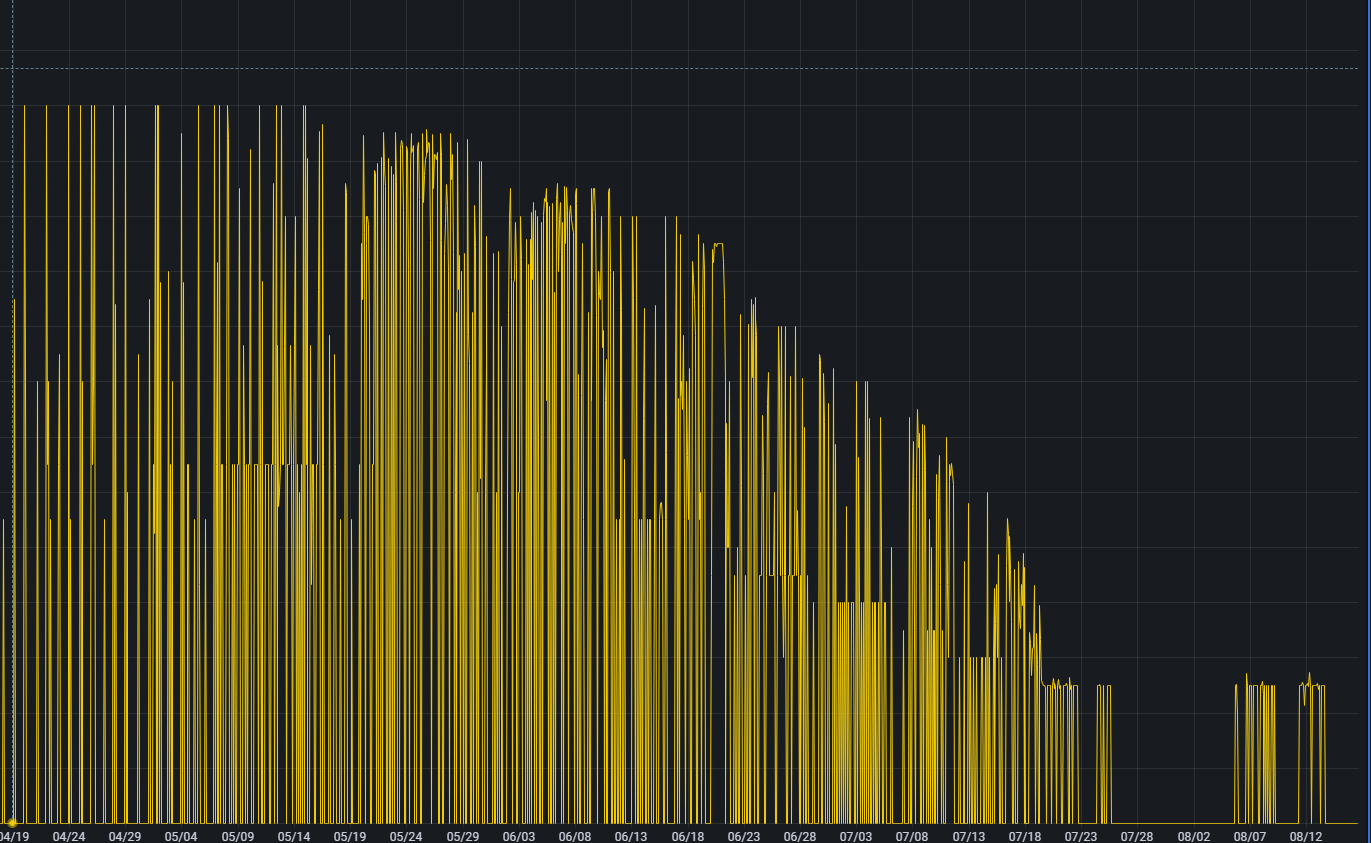
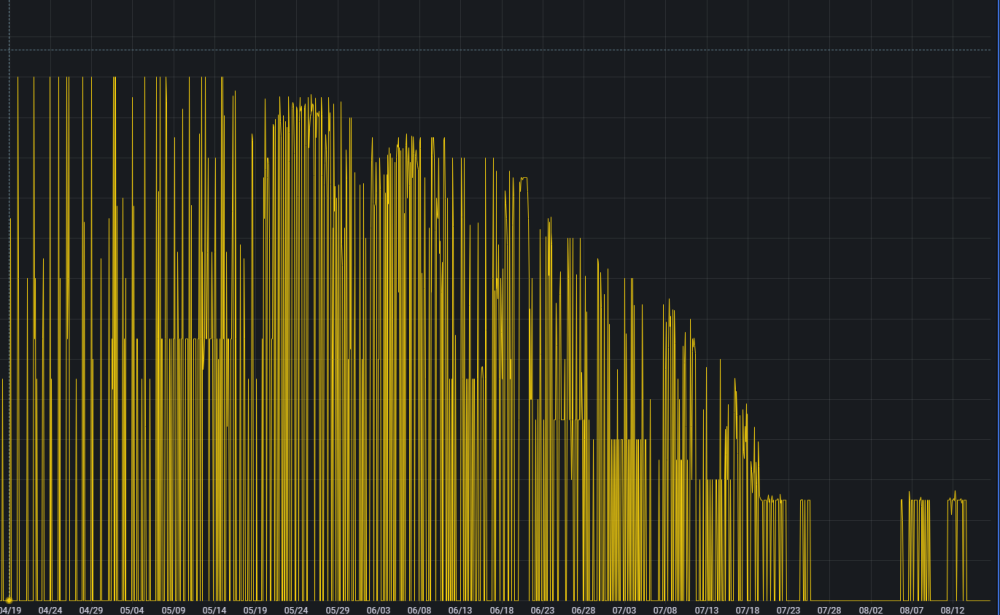
Since July I've been getting periodic L-9 "Low flow rate" system error on my FTC6 (for MITSUBISHI Ecodan PUHZ-W85VAA) I've checked all filters etc and everything is clean and appears to be free running. The circulation pump is set to maximum flow rate (factory default, as it always was). I'm currently using it in cooling mode only (disabled DHW, doing that with immersion) and still happening. (When I had DHW enabled it happened more often in the DHW phase, but even happens without at a couple random times per day) Using the controller "commissioning wizard" I see the flow rate was flickering on and off at 5l/min, which is about the lowest value it can sense. Looking back through grafana, I see prior to May it would peak at about 12l/min but then steadily declined month on month until the errors started. I've flipped dip switch 2-8 to say "no flow sensor" and the unit has been working fine for the last week. (Very needed as it's been very hot and the cooling is very desired by our guests!). Only downside is the output energy monitoring now gives bogus values (as it estimates it based on flow rate and temperature drops). So questions 1. Does this sound like the flow sensor itself has failed? Any suggestions how to verify it is at fault? (Is this a reasonable thing to fail after 3 years use?) 2. Aside loss of energy monitoring, do you see big risks of further damage by using it without a flow sensor? 3. Any tips where to buy a new one? It's a SIKA VVXC9SNBUC00242P. (Mitsubishi won't talk to me as I'm not MCS + mitsu trained installer)
-
Congratulations on the publication. The main comment I have is same as I made on LinkedIn a few weeks ago: without also modelling the effect that increased short-cycling on ASHP COP, I don't think a firm conclusion can be drawn either way on this zoning debate.
-
How much cooling does a passive house need?
joth replied to WisteriaMews's topic in Air Source Heat Pumps (ASHP)
Phpp gives a total building cooling load, but no critical room analysis for cooling. This was a problem for us as the building as a whole does not overheat but a few specific rooms seriously do. Passive stack venting is great for the building as a whole but no good for individual rooms if they're closed off a d not open to the stack venting flow. I'd suggest good analysis of shading (passive and active), stack venting, and either install or plan for easy retrofit of a/c in specific critical rooms (bedrooms and living areas) -
How much cooling does a passive house need?
joth replied to WisteriaMews's topic in Air Source Heat Pumps (ASHP)
Forced air heating/ cooling as used in every other country is recirculating. Mvhr is not. Recirculation you can increase air speed without decreasing efficiency, so you can blow a gale and nothing is lost outside. But with Mvhr the amount of wasted energy (thrown out the building) increases linearly to the air speed -
thanks for this but afraid the advice is not required in this instance, as my use case is completely different actually - trying to shut off water into a fan coil (used for cooling) just after the DHW heat up cycle. Traditional zone actuators are too slow, whereas these Salus ones are much better (faster response time and lower power draw; basically use zero power when open). As I said up thread, if there was an non-autobalancing fast response (i.e. servo driven) actuator available I'd rather go with them Also FWIW I already have auto balancing actuators on my UFH and they work fine there. I broadly don't use zoning, but I do shut off zones when necessary to avoid specific rooms overshooting.
-
It funny, I used LMS server back when it was Slim device Squeezebox (I got one in 2006/7, the hardware still works really well) but I've gone back and forward between that and using Chromecast audio groups several times. In the end the multizone amplifier was the best investment, but I still have a couple places like the gym where we ended up using an additional IP player to fill in the gaps and it's all great until it isn't. Current iteration is we gave up on LMS as the Spotify plugin kept breaking, but now giving up on Chromecast as every time my wife uses it it comes up at a random (super loud) volume then mutes to homeopathic levels of noise when she tries to adjust it
-
Anyone know if these arrived in the UK yet? And, what is their part number? AFAICT everywhere is still stocking THB23030 / THB2430
-
Exactly. After a lot of messing with long hdmi cable and a very expensive Blustream distribution matrix, I ripped it all out and just hung the Nvidia shield straight on the back of the main TV. With a bit of jiggery I send audio from the TV to the central amp. Lesson learned, currently going through process of doing the same in the new camper van. Except new car stereos come with an HDMI input but no spdif/optical audio input. Can't appreciate why anyone wants hdmi on their car stereo but there we go.
-
HDMI over CAT6[A] is always a compromise vs having genuine cable installed; features like ARC, ethernet over HDMI, highest resolution/frame rates etc tend to be limited, not to mention adds extra hurdles for the HDCP copy protection to fall over on.On the flip side, my experience of putting a few HDMI cables in (again, back to the central AV/comms cupboard) was not good: not one of them actually worked when I came to use them 😞. My understanding is despite not exceeding (or, barely exceeding) the HDMI max length, the cables used are long enough x poor enough quality they interfere with HDCP anyway. (In most instances, 1080p would play, but not 4K, over these longer cables). What I really wished was I'd put in a spare optical fibre or two, that could be used for HDMI extension, or for simple audio return path (my multi-room amplifier is in the central AV cupboard and having the "actual" sounds from the TV sent back there would be handy in a number of scenarios) If you do install HDMI, make sure to buy the cables in plenty of time and test with the exact kit intended to be used with. Also, if at all possible run it through oversized ducts so they can be replaced in case of failure, or HDMI being superseded by something else in future... (ours was a retrofit project, so it wasn't possible to the main TV, alas)
-
Do you have any non PoE device you can plug in there to test the data connection on its own? Have you tried different switch ports or poe injector? Presumably you're using the exact same port as works when used on a shorter run. Just how long are we talking? If there's a poor quality termination then it can pass the light flash test but not work at speed. A professional cable tester will give signal quality reading for a cable too.
-
Making the most of excess solar with a 3-phase supply
joth replied to Tom's topic in Photovoltaics (PV)
Smart meters all do net metering. It's defined by the SMETS V2 spec. Search this forum for "polyphase" and you'll see the many times I quote the spec. I don't know about HARVI specifically but sounds like it's designed to work correctly, i.e. only divert to immersion if the sum of all phases is negative (i.e. exporting) This is all moot really though. With 13kW array and a "mere" 300L tank you'll divert a wee bit but the bulk of your generation will still go to grid. Especially if you're already doing the base of dhw via the ASHP. -
It's not clear, are you proposing to replace your existing heating (gas boiler?) with a heat pump, or just use the heat pump for the UFH in the extension? You'll only get the grant if the ASHP can provide all heating and hot water for the whole property. Not just the extension. And if doing the whole property, the extension is the easy bit. The big ticket items are installing/upgrading heat-pump ready hot water cylinder and radiators.
-
Sorry I'm possibly side-tracking this thread but I think this is hilarious. I gave perplexity a passive-aggresive slapdown for answering the wrong part of my question and it came back with a much more on-topic set of suggestions me: "sorry but most of that answer is treating Acrophobia . please can you focus the answer on height vertigo specifically?" Answer I apologize for the confusion in my previous response. You're absolutely right that I focused too much on acrophobia rather than height vertigo. Let me provide a more targeted answer for height vertigo:Height vertigo, also known as visual height intolerance or visual vertigo, is a specific condition where a person experiences dizziness or a sense of imbalance when exposed to heights, often due to visual stimuli. Here are some strategies to help overcome height vertigo: Understand the condition: Height vertigo is often triggered by visual cues and can be exacerbated by a lack of nearby visual references. Vestibular rehabilitation: This type of physical therapy can help retrain your brain to process balance information more effectively. Gaze stabilization exercises: Practice focusing on a fixed point while moving your head to improve your visual stability in high places. Proprioception training: Exercises that improve your sense of body position can help counteract the disorienting effects of height vertigo. Gradual exposure: Slowly expose yourself to heights in controlled environments, such as using virtual reality simulations or visiting observation decks with solid barriers. Visual anchoring: When in high places, try to focus on stable, nearby objects rather than looking at distant or moving scenery. Maintain good physical health: Regular exercise, particularly activities that challenge your balance like yoga or tai chi, can improve your overall stability. Consider medication: In some cases, anti-vertigo medications may be prescribed by a doctor to help manage symptoms. Cognitive Behavioral Therapy (CBT): While primarily used for phobias, CBT can also help manage the anxiety often associated with height vertigo. Consult a specialist: If symptoms persist or significantly impact your daily life, consult with a neurologist or an ear, nose, and throat (ENT) specialist for a thorough evaluation and personalized treatment plan. Remember, height vertigo is a physiological response and may have underlying causes that require medical attention. Always consult with a healthcare professional for persistent or severe symptoms.
-
So I thought I'd try out perplexity on [How can I overcome height vertigo] => https://www.perplexity.ai/search/How-can-I-U.DSvr_rSMeWMrdmDagkCg#0 FWIW I'm not at all convinced by this answer, it starts off clarifying the difference between vertigo and acrophobia, but then all but the first treatment seem to be tackling the latter. Answer To overcome height vertigo, you can try several strategies: Understand the difference between vertigo and fear of heights. Vertigo is a physiological response involving the inner ear, while acrophobia is a phobia or fear of heights. If you experience true vertigo, consult an ENT specialist to check for any inner ear issues. Gradually expose yourself to heights. Create a list of situations that trigger your fear, ordered from least to most anxiety-provoking. Start with the easiest scenarios and work your way up, staying in each situation until your anxiety subsides. Practice relaxation techniques. Use mindfulness or breathing exercises before, during, and after exposure to heights to help manage anxiety. Challenge your beliefs about heights. Identify and gradually challenge any irrational thoughts or beliefs that fuel your fear, such as thinking a building might collapse. Reduce safety behaviors. Gradually try to expose yourself to heights without relying on behaviors you think keep you safe, like holding onto rails or shutting your eyes. Focus on your surroundings. When in high places, engage with your environment by noticing details like colors, textures, or counting floors instead of focusing on your anxiety. Use visual strategies. When walking in high places, look a few steps ahead instead of to the sides or in the distance. If you need to look around, stop walking first and hold onto something stable. Build confidence in your equipment. Invest in reliable hiking gear and learn how to use it properly to increase your sense of security. Seek support. Talk to other hikers or people who have overcome similar fears. Their experiences and advice can be valuable. Consider professional help. If self-help methods aren't effective, cognitive-behavioral therapy (CBT) with a trained therapist can be highly beneficial in treating acrophobia. Remember, overcoming height vertigo takes time and patience. Start with small, manageable steps and gradually work your way up to more challenging situations.
-
I'm just some dude on the internet so make your own judgement, but to my mind what you describe sounds more like height vertigo (height induced dizziness) than acrophobia (fear of height) https://www.ncbi.nlm.nih.gov/pmc/articles/PMC6734202/#sec1-5title is good for definition & causes, but no so helpful on treatment; it suggests avoiding height, or lying down or crawling past. At very least, this may give you some more search terms to look for (or pump into chatGPT).
-
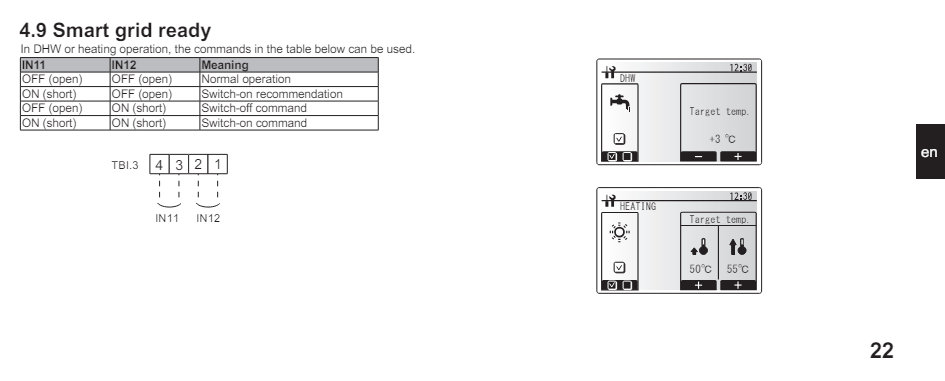
What battery do you have? (And what inverter is it connected to?) Rather than worry about the PV at all, really the main thing you want to know is "Is the battery full". Whenever it is, then put the ASHP into "DHW boost" mode. The ecodan this is fairly easy: you need a relay to close input IN11 (the so-called Smart Grid Ready feature) which tells it a switch-on recommendation. Then in the settings, you configure a DHW target temp boost of +10C or whatever in the smart grid settings -- see page 22 of the FTC6 installer manual The tricky bit is knowing the battery is full - very battery dependent. Note I'm assuming that you can charge the battery at the rate of excess energy generated, i.e. 13kW minus your base load. If you are limited on the battery charge rate you may indeed want to trigger the DHW boost sooner, based on grid export exceeding a threshold or PV generation above a certain level. this should be possible from a correctly shelly energy monitor, and a 240V coupling relay to connect into the FTC6 - see https://www.instructables.com/Shelly-EM-Auto-Toggle-Based-on-Solar-Panels-Produc/
-
Afraid I didn't think that much about it, by buying in Europe I just knew they'd work in a euro back back the interchangeable "Gira 55" style surround is definitely a good hint it's intended for EU market, if you can figure what that's called in Schneider speak
-
I've got a pair of husqvarna aspire r4 (one per lawn). They're OK. You need a well maintained (not overgrown) lawn to start with - it won't tackle a jungle. Laying the perimeter sensor wire correctly is crucial It struggles around trees etc getting stuck in tree wells. We put in push-in edging for it to bump and turn around, but surprisingly fiddly to have it not get stuck It doesn't work well in the wet. It has no rain sensor, I setup a Home Assistant automation to stop it mowing when grass is wet but for various reasons that's one of the least reliable automations I've had. (combination of different HA integrations failing, smh)