
Radian
-
Posts
2586 -
Joined
-
Last visited
-
Days Won
15
Everything posted by Radian
-
Well it's got the bi-directional IEC 62056-21 port but that's password protected. The blinking LEDs that track consumption at a rate of 4000 flashes/kWh don't appear to distinguish direction of power flow which is odd. At least some meters lock on solid when exporting. Not mine.
-
More of a Wordle type really. Until it went mainstream 🙄 That's a smart move I hadn't thought of. Will bear it in mind in case it proves simpler. Yes, I often see this advice when reading up on the subject. I have several chips of this type in various meters, smart sockets etc. but I've yet to see one that is fast enough to do cycle-by-cycle analysis which, rightly or wrongly, is what I've set out to achieve. Again, it may be the fall-back solution but I'm becoming deeply interested in the nuances of power monitoring. One early discovery I made was that my venerable Current Cost CC128 meter that I hacked to get working wirelessly over MQTT reads apparent power which is why my base load looked over inflated. Mostly the power factor for that is under 50%. More surprises in store I'm sure!
-
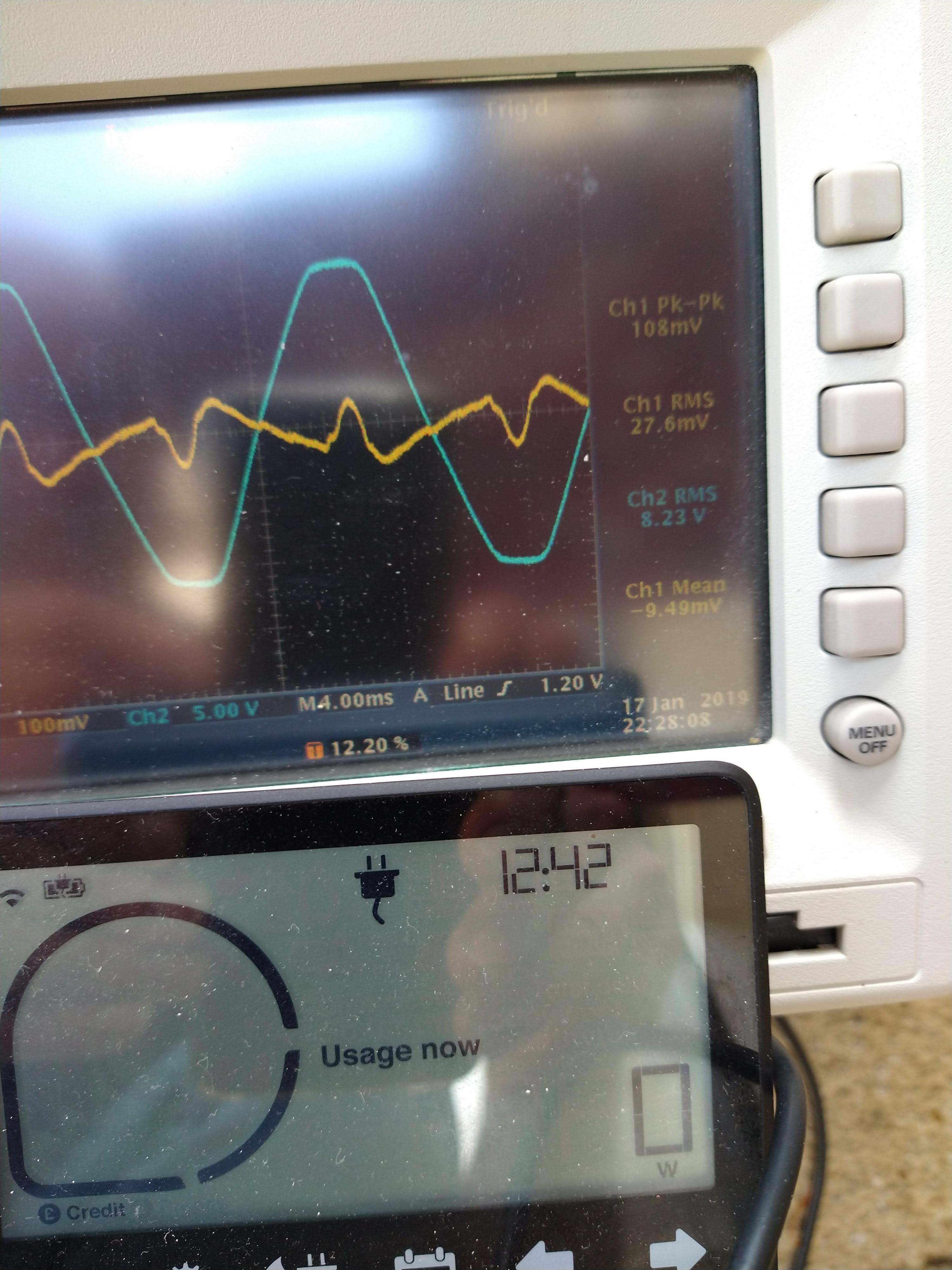
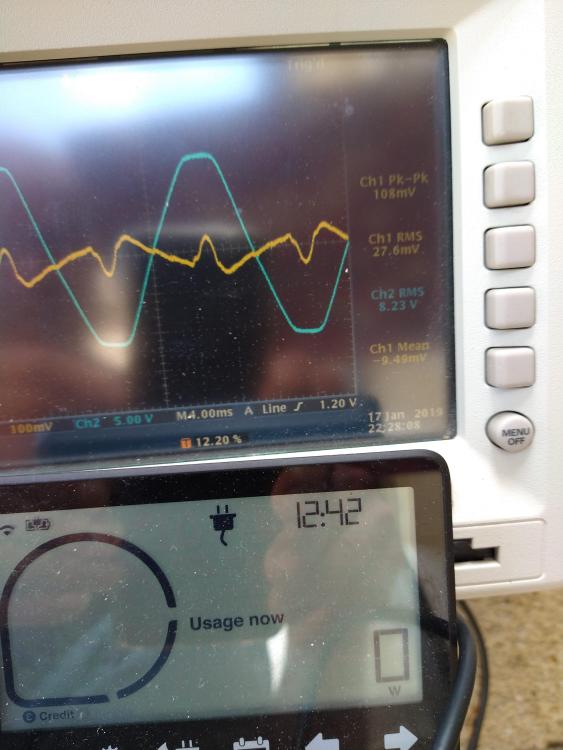
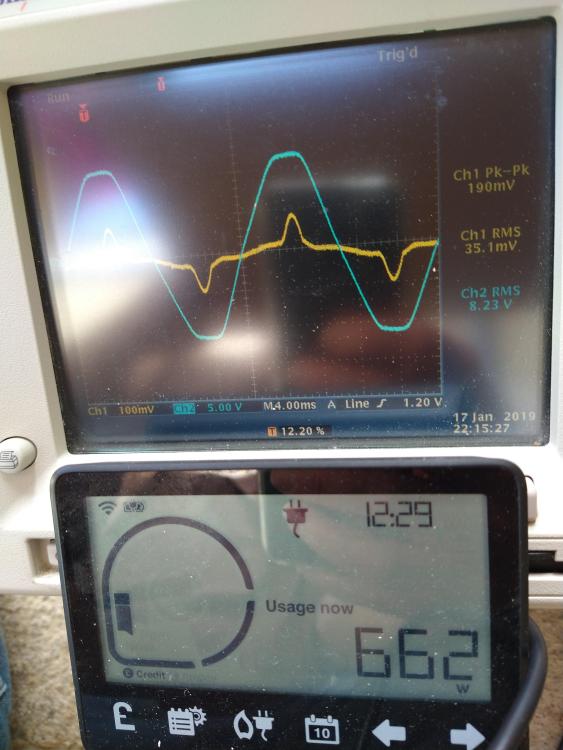
Always feels a bit pretentious starting a thread in Boffin's corner but I guess it's best to keep electronics & coding out of the other sub forums. Anyhow, I'm messing around with a bit of an 'old chestnut' - a device that spots power being exported to the National Grid and intervenes to dump it into something more useful such as a DHW cylinder immersion heater. Being tight, and having a comprehensive store of electronics parts to hand, I feel compelled to roll my own - as has been done by numerous others before me - such as Robin Emley and, I believe, our own @ProDave So far all I have is a small mains transformer, a couple of CT's and a scope looking at what happens when a grid-tied inverter pushes more into the grid than is coming out and I'm already seeing issues. First photo shows relation between voltage and current during base-load 662W import: The voltage waveform (blue) is typical of a small 240VAC transformer saturating (not the ideal way to represent the mains waveform but hey, it's safe). The current waveform (yellow) is 'peaky' in the middle of the cycle showing just how much of my ~700W baseload is capacitive - i.e. lots of switch-mode PSU's rectifying the AC and recharging their reservoir capacitors after partial discharge between cycles. So far so good I guess although I don't like the idea of sampling the distorted voltage waveform. Next photo is when the Sun comes out: Oops, 0 Watts imported, who knows how many exported then? That's my task here now. So the current due to the resistive component of the baseload is starting out from the zero crossing and immediately being cancelled out by the inverter which manages to push the current drawn into negative territory, until it gets overwhelmed by the capacitive loading later in the cycle. The inverter loses the fight near the middle of the cycle and current begins to flow back in from the grid. But on balance, over the whole cycle, more current was going out than coming in hence the utilities smart meter shows zero (it doesn't show export amount but the meter logs it in one of its registers - 1.1kWh so far!). The scheme seems to be to measure the real power, retaining its sign, on every cycle and keeping a running total such that when it reaches a certain (-ve) threshold (before 3600 Joules is reached) it triggers the Immersion heater to 'claw back' the same amount of Joules to keep from tipping the meter into registering an export. Thus filling and emptying a so called 'energy bucket'. Makes sense. But a few questions arise - how quick does the triggering of the Immersion load have to be? Can it be made less critical by setting a lower threshold? I ask because I can't easily wire directly from the meter area to the immersion so I guess a wireless solution is required and these all have a degree of latency. What are the other significant challenges I wonder?
-
Are you going to take out a Mortgage to pay for that? 🤣 I keep meaning to start a topic on the eye-watering cost of composite decking and how the financial side stacks up. But yes, as Conor mentions, good air circulation is probably the most effective measure for preserving the 6x2s. But are you planning to rest them directly on the patio slabs or space them off with something?
-

Are solar panels worth it with my roof and sloping direction?
Radian replied to MrTWales's topic in Photovoltaics (PV)
In 2016 Cross Safety UK carried a report of wind damage to a roof: Interesting mix of in-roof and on-roof modules. Awful photo but it looks like the tiles to the ridge were poorly attached. We can only guess if the adjacent modules had a role to play. May have happened regardless of their presence.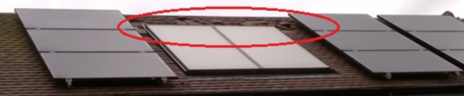
-
And have you noticed that we've been getting loads of Saharan dust in the rain for several months now?
-
Are solar panels worth it with my roof and sloping direction?
Radian replied to MrTWales's topic in Photovoltaics (PV)
Some research shows that panels mounted close to roof edges can actually mitigate problems with wind uplift damage to roofs. The panel manufacturers seem pretty confident in the panels themselves withstanding extreme winds. Having seen the typical lag screws used to secure the brackets to rafters I'm not concerned with them being unable to resist wind forces on the panels. I could say that you don't see many reports of modules causing problems - but then we've got rules in place making sure of that.🙄 -
Are solar panels worth it with my roof and sloping direction?
Radian replied to MrTWales's topic in Photovoltaics (PV)
From the mcscertified.com PV Book : I've seen other, smaller, numbers like the ones you quote. But as you say, rules change. Of course in reality, the actual calculations will be complicated and highly dependent on the specific local topology - and probably completely useless if climate change means maximum wind speeds increase as they are expected to do. My point is, it's mostly hand-wavy guesswork that runs the risk of erring on the overly cautious side. You mean Navier–Stokes? Just say it man! -
Are solar panels worth it with my roof and sloping direction?
Radian replied to MrTWales's topic in Photovoltaics (PV)
I would love to see how this magic 'distance to edge of roof' comes about. -
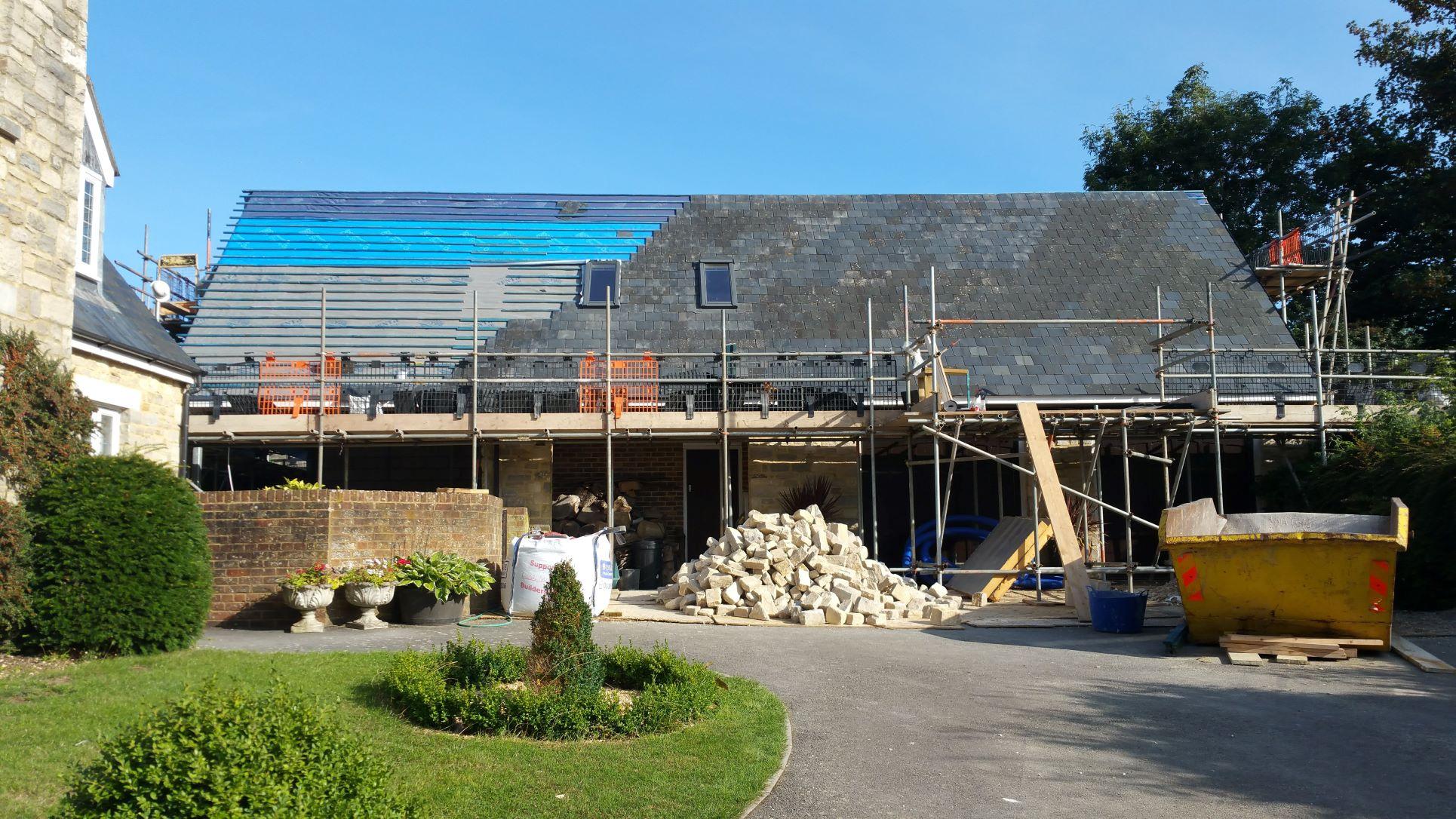
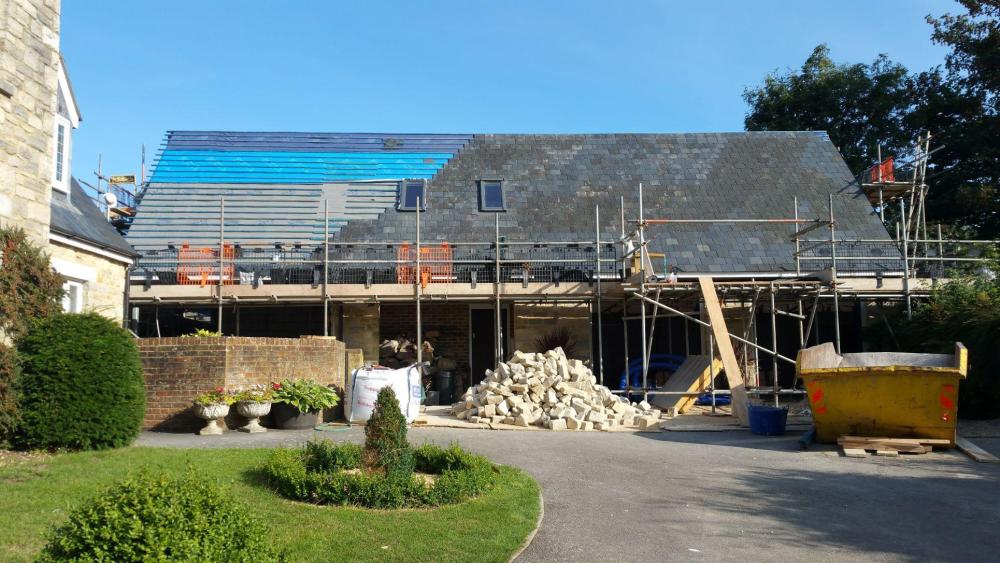
The photo is WIP on a recent extension to our garage. This was done with blockwork. Most of the stone went into landscaping retaining walls to match the building. I posted it as it was the only photo I had showing the pile of cropped walling stone as delivered.
-
Areas of your elevations are reasonably modest - I'd go with full sandstone. Not sure how your farm stone would clean up though. I was buying cropped walling stone from Purbeck which comes in random sizes but all fairly close to 120mm deep. Was £150/ton delivered the year before last and does about 4m2 per ton. Lay with a ginger sand and hideously expensive white cement or if you have a very strong orange sand you can get by with OPC (still looks buff coloured).
-
Do old style rotary dial meters go backwards
Radian replied to Barryscotland's topic in Photovoltaics (PV)
With asymmetric import/export charges, clearly a backwards running meter is theft. Others scenarios are less clear cut. A meter that only registers imported units is impossible to swindle but our national terms of connection prohibit any amount of export without prior agreement. i don't know what penalties might be expected if terms are not met. -
Distributed battery power banking
Radian replied to Radian's topic in Networks, AV, Security & Automation
Yes, the 5V and 12V stuff is the lowest-hanging fruit we have - except for the difficulty in reaching it all with wires. What's annoying is the cost of PoE equipped switches when I find I need a bunch of them to cover all my off-grid devices. However, I recently realised there's also lot of unused UHF coax snaking its way around the house... -
If it's a cavity wall then I'm wondering about the position of your wall ties. The maximum horizontal spacing should be 900mm and the maximum vertical spacing 450mm so you should already have a couple of rows with ties.
-
Distributed battery power banking
Radian replied to Radian's topic in Networks, AV, Security & Automation
Sofar so good - what is it with these Chinese names? (often have the word fire in them somewhere) So inverter battery charge control for £800 then add another £800 for a 2.4kWh battery. Well, the numbers match with my best-buy battery deal but the electronics still have room for improvement. However, it's real (unlike my imagined circuitry) so yes I think we're getting there! I think I'd prefer to keep it in an outbuilding though. That's actually what I had planned for my own attempt 🧨🔥 -
Oh dear. The days of mortar dabs are long gone. A continuous mortar bed is the only way to lay any kind of slab. For more info have a look at this paving expert article Also, as Jonny mentioned a slurry primer should have been applied to the slate as it's not the least bit porous. A mix of SBR and cement the consistency of runny porridge is brushed on just prior to laying. Frome the article: Spot Bedding British Standard 7533: Part 4 , which covers the installation of both concrete and natural stone flags or slabs, requires that these are laid on a "full bedding layer". This applies to ALL classes of pavements, including patios and driveways, not just the big projects undertaken in the town centre or on a retail park.
-
What temperature should my hot water be set at?
Radian replied to Mike_scotland's topic in Boilers & Hot Water Tanks
You can get a device that routes excess PV generation into an immersion heater. This can then be set to higher temperature to do the sterilisation. -
At last. On page 53, An actual statement declaring that an agreement must be reached with the DNO before exporting a Watt. No, make that an attowatt - that's more than zero. Duh.
-
Many thanks although 89 pages might take a while to scan through.
-
I think you have to find a way to turn the power to the unit off and back on to reset it.
-
Thanks for the reply. It's really hard to find out what's required 'of us' when it comes to DIY solar. I've wasted yet another day trying to get to the bottom of the issues without any success. As far as I can determine the interested parties might be (in no particular order and there may be others): Distribution Network Operator Electricity supplier Local Planning Authority Home insurer Mortgage Lender But the very bottom line would be 'the law'. In extremis, 'ignorance of the law is no defence' - but I simply can't find any clear legal obligation placed on an individual who chooses to set up a solar PV array and connect an inverter to the grid. The closest to such a thing might be The Electrical Equipment (Safety) Regulations 1994 but even this is ambiguous in the case of "plug in solar" - which is a thing in case anyone's wondering.
-
@JohnMo Do you mind me asking how you got on with this? I'm very curious about how ordinary people (not installation companies) would go about notifying their DNO about self-installed equipment. I downloaded a copy of g98 form B Installation document for connection under G98 and it showed no indication of there being a need for a schematic.
-
Are solar panels worth it with my roof and sloping direction?
Radian replied to MrTWales's topic in Photovoltaics (PV)
Expecting @SteamyTea to point out that one knot is 0.51 meter/second and that we can convert between kilogram-force meter/second and joule/second - but we would need to know the mass of something relevant to work out how many joules/second (Watts) that represented... -
What temperature should my hot water be set at?
Radian replied to Mike_scotland's topic in Boilers & Hot Water Tanks
Do you have any Solar PV? -
Try this 😀
- 1 reply
-
- 1
-