
Radian
-
Posts
2586 -
Joined
-
Last visited
-
Days Won
15
Everything posted by Radian
-
 You might be able to get the SE to spec. a goalpost arrangement - we have a 6m UB supported at each end on a 100x100 square hollow section post. This hides in the inner leaf and is strapped to the blockwork courses. It has to have a good connection to the foundation though.
 -
When I was installing our new dishwasher in the summer, I had the kick panels off under the sink unit and marvelled at the ~20mm ragged edge gap between screed and bottom edge of the dry lining. I was going to foam it but the gun had seized so made a mental note to come back and do it later. Yeah, right. Of course now I think about it the gun and canister wouldn't have fitted under there anyway. I can just imagine it.
-
Is this to achieve more plasterboard to floor sealing? I ask because the way you put it sounds like you could mean sealing the top and bottom of the baseboard instead. This would obviously leave a large volume of unconditioned air under the units - the inside of which would also be cold.
-
SWMBO had enough of the cold then?
-
Mold and condensation in cold deck flat roof-new install
Radian replied to Paul Alan's topic in Flat Roofs
Not really. They're just checking that building regulations are being adhered to where they're applicable. They don't give a fig about how well or sensibly a thing is built. Just that it meets regs. Any solution they agree to with a builder to make things meet regs is probably coming from the builder. -
Mold and condensation in cold deck flat roof-new install
Radian replied to Paul Alan's topic in Flat Roofs
There are CWI solutions that could be applied retrospectively. Walltite is one option. If the 50mm PIR is correctly held against the inner leaf then the injected foam will happily fill the remaining 50mm. -
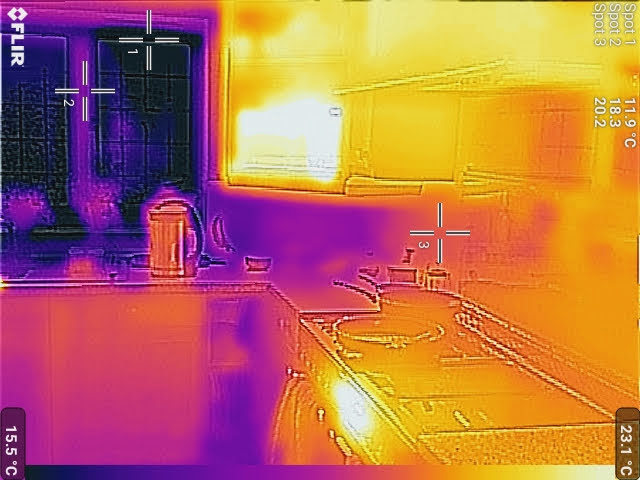
Have you never met the public? 🤣 But I do sympathise with your stance on trickle vents. The ones on my kitchen window are closed in this thermal image... In case it's not clear from this image of our kitchen at 20oC, the wooden DG window frames are at around 18oC except for where they're being washed down with cold air from the poorly designed vents, leaving large areas at around 12oC or less.
-
Mold and condensation in cold deck flat roof-new install
Radian replied to Paul Alan's topic in Flat Roofs
So it all went downhill when your brickie failed to insulate the walls sufficiently. Was there a drawing for what he was supposed to do? If not then who's design was he working to? Then the BCO officer decides to increase the roof insulation to make up for the deficit in the walls. Presumably this is when the architects warm roof design got ditched - possibly because the height of the additional insulation couldn't be accommodated? It all appears to come down to the failure of the walls to be insulated correctly. What is the actual makeup of the walls? -
I'm reminded of how we designed our house and garage to be at 90 degrees forming an L shaped plan. We were not on site when footings were put in and block and beam floors were constructed. Only after the patios were eventually laid did it become obvious that it was about 93 degrees between hose and garage so the slabs were all cut on an angle. At the time I had a mind to have the garage torn down and completely rebuilt but we were keen to see an end to it all. 25 years on it just makes me smile.
-
Looking at that photo (nice house BTW) what's going on with the lack of snow below the paired roof windows? It seems to have fallen into the gutter rather than being melted off by a thermal bridge in that area, but you never know.
-
One bit of psychology to add: once a big decision has been made, you're invested in it and won't give it a second thought. It's only at the umming and ahhing stage before the big decision has been made that your mind will be 'all over the place'. Crack on.
-
Unlikely to find one that can discriminate between copper and steel unless the pipe is so close to the surface that you can adjust the sensitivity right down. But gas flow is quite noisy - perhaps if you whack on a lot of gas, you might be able to hear it - got a stethoscope?
-
Need help/advice on new house with MVHR & no heat
Radian replied to mccltd's topic in Other Heating Systems
What's the model number of the A/C units? Did the installer size them up for the property in which case there should be a comprehensive heat loss calculation involved. Unless huge corners were cut leading to a big discrepancy between as-designed and as-built performance of your house the A2A's should more than solve your problem. I have a couple of 3.5kW Daikin A/C heating a large outbuilding and I'm a total convert. If the gas boiler packs up in the house I'll be very tempted to try and figure out how to switch over to A2A but my house is a 90's nightmare. -
Don't let @SteamyTea catch you dropping your h's I take it your 10900kWh/year was just space heating and hot water? The Primary energy indicator of 62kWh/m2/year seems a bit pessimistic (as usual).
-
That'd be almost impossible to get a secure bond to. I think you're overthinking this. If you go over the wall with the low expanding adhesive foam wherever you see any dodgy bits at the same time you matrix-up the back of the insulation you're certainly not going to get a howling gale going on behind the sheets. Convection is stymied by continuous horizontal lines of adhesive. The airtightness of just about any type of foam would prevent mass airflow. But maybe someone else here has experience of using FM330 to bond rigid PIR?
-
I think the approvals schemes are still unfit for purpose. The "Cavity Wall Insulation Victims Alliance" was set up in response to CIGA's indifference. CIGA is still the nexus for all the nonsense there's been in the industry. "whilst we continue to promote the BBA as an effective offer from an established provider it is pleasing that CIGA can now build on this with our agreement with KIWA BDA"
-
In the kitchen near where the cold main comes in. Your plumber would know if he used any. It's not mandatory though. I really can't see an airlock completely shutting off mains pressure water. Too much of a coincidence in this unprecedented cold spell. At the very least I would suggest you turn off the main stop tap for the house before going to bed tonight. fortunately any leak would be limited to the small quantity of water in the pipework with the main water turned off.
-
Something like

-
So it's all internal. Did the plumber use any isolators beyond the main stop valve?
-
Very important this! I don't know what your system is like but It sounds like the cold taps and hot water cylinder are gravity fed from storage tanks in the loft. If you've had -14oC the problem might be a frozen pipe in the loft. When this thaws it could mean a leak. If you do have pipework in the loft you really need to have it inspected for splits. If your system is gravity fed from the loft there should be an isolating valve somehwere accessible i.e. in an airing cupboard on a pipe going up to the ceiling. Seeing as you have no water except for the kitchen tap, as a precaution I suggest you turn off any isolating valves. Again, if it's gravity fed from a storage tank in the loft then there may be an isolating tap near where the water comes out from the bottom of the tank. This would also be wise to close as the tank could still empty through a burst pipe when thawed. All the above is moot if you have direct water fed to an unvented hot water cylinder and to cold taps - with all pipework in heated spaces but there should still be an isolator somewhere. As a final thought, your household insurance firm might help you get a plumber as they will understand the importance of containing this potential problem.
-
Using plenty of low expansion foam adhesive, create horizontal cells to limit convection - and treat the pockets as a feature, not a bug?
-
Another trick they sometimes use on a corner is to inject just over a brick width in from the edge to get into the cavity of the return wall - should access to the side be an issue. They even use lance extensions to get further into the wall. Sods law says you'll end up on a wall tie though.
-
You're nearly there but I figured out an additional trick for that: Mass. Because the shower pump was boxed-in by a raised floor in a cupboard, I was able to stand the pump on a concrete paving slab which in turn was sat on a square of carpet underlay. I actually stood the pump in a plastic box after the previous pump leaked. A leak alarm also lives in the box. As with all sound transmission attenuation, the energy is absorbed by having to make something massive jiggle. The more mass there is, the less it jiggles for a given energy input. A further de-coupling through the underlay finishes off the job.
-
I initially read that as the entire unit 'coming through the ceiling' 🤣 But as @joth says, if it can be serviced from inside the attic and incorporated within MVHR then there's a number of potential benefits. At least it's good to see stuff being innovated in this very slow moving market space - even if it's being done by a bunch of bell****