Spinny
-
Posts
598 -
Joined
-
Last visited
Everything posted by Spinny
-
Just wondering which plasterboard to use for utility ceiling - washer, dryer, sink, boiler, cylinder, manifolds. Only about 2m by 3m, but has a double steel level with the joists so needs fireboard under the steels. Thinking maybe it makes sense to just use fireboard over the whole ceiling ? Then there is fireline but also fireline MR and whether to use 15mm or 12mm. The spec sheet for fireline MR says 'You should normally avoid applying skim plaster to moisture resistant boards'. But am expecting to have the plasterer skim coat the boards. So does this rule out using MR ? Will have 6 downlights in the ceiling. I have one sheet of fireline on site but it has been here indoors for about 18 months - plasterer has suggested boards dry out over time and it then sucks the moisture out when skimming making it harder to plaster. So maybe 2 new sheets of 15mm fireline and bin the old sheet ? Paint the ceiling in bathroom paint ?
-
When it comes to measurement, 'there ain't 'alf been some clever bastards'... Part 1... https://youtu.be/YdOXS_9_P4U?feature=shared Part 2... https://youtu.be/hFMaT9oRbs4?feature=shared
-
Laser levels have error factors, have you compared the tolerance of your chosen laser(s) on the product specification with what you are achieving in practice ? Do you have anything to calibrate them against ? My window/door company came to site twice - once to survey, and once to fit. Insisted that I must have changed my floor levels by 12+mm over 9m, despite me saying with certainty there was no such change. People get fixated with the idea that laser levels are 100% accurate, and that they never go out of calibration, even if rattling around in the back of vans. They made me get the builder in to cut down a timber but for other reasons couldn't fit. So I bought myself a water level for £20 and carefully struck true levels onto some walls - inside and outside. When they came back my levels were shown to be good within 1mm. Over 12m, I'd say use a water level. As good today as it was in ancient times. Along with the plumb bob. https://youtu.be/29lzibkKeAI?feature=shared
-
Definitely check all drains and sewers, remove all inspection chamber covers - look for any evidence including droppings. We once had a problem because someone that came to unblock the drains left the cover off the bypass pipe to the u bend in the sewer. I put it back and used a piece of wood to ensure they couldn't push it out again. Also check all the chamber linings - we were told they could gradually scrape away mortar etc to make openings, even digging under concrete slabs. Putting the poison blocks down worked. You will know it is working when you get a plague of flies, but you need to stop them at the sewers. Get a parsons russell terrier - our much loved parsons sadly died 3 weeks ago.
-
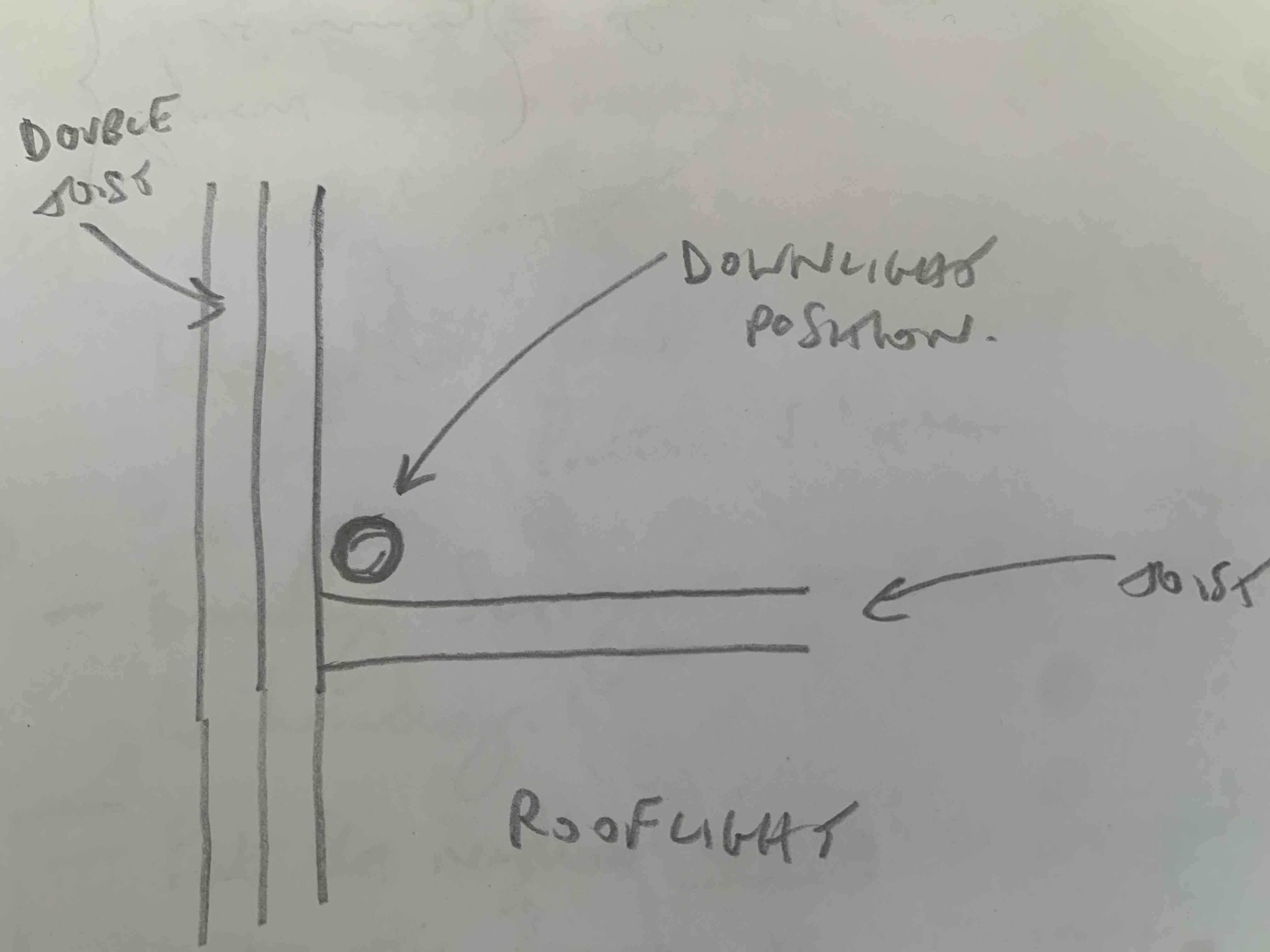
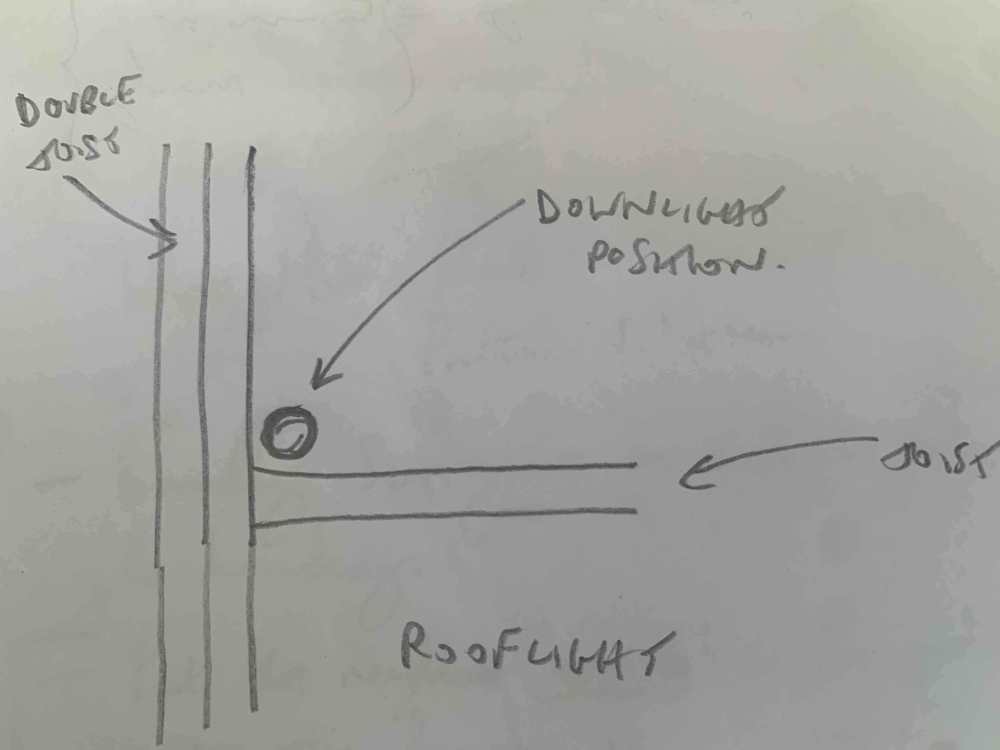
Sketch attached. Space above the light position is not a problem between the joists. Ideally the light would be slightly under one joist to align centrally with a kitchen wall cupboard, but I can get within 15mm or so and miss the joist. But with two springs at 180 deg, whichever way you twist it, one spring arm will be up against a joist. I guess I'll have to cut one arm off and see if one arm alone will hold it level anyway - or maybe I could wedge it against a small filler on that side between the joist and the light cylinder. Worktop will be 650mm, wall cupboards 370mm, so thinking centre it about 150mm out off the front of the wall cupboard at 520mm ? (I agree about spares, have bought a few spares already. Not fully decided in the open area - something larger than GU10 might be nice - but also contemplating plaster in ones. Want everything dimmable.)
-
Dot and dab versus 2 coat plaster on block walls
Spinny replied to Caroline's topic in Plastering & Rendering
OK I was being deliberately opinionated. And yes I only have my one experience to draw on - which has been troubled. TBH you could argue my experience both ways. The builder sent a plasterer and (1) He could skim a stud wall no problem but (2) He took a plumb wall and wet plastered it and it was over 10mm out over 2.4m height by the time he had finished with it - thick at the bottom, thin at the top. So you could argue that as a good case for dot and dab where that then wouldn't have happened. I hired another plasterer of my choice who has worked diligently to correct previous problems and wet plaster other walls and ceilings to excellent effect though. In my case where dot & dab has been used it is a minimum of 10mm, and often 15mm of dab. So 15mm dab + 12.5mm board + 3mm skim = 30.5mm and on both sides of a room would be 61mm. Whereas wet plaster can be say 8-9mm plus 3-4mm = 12-15mm and on both sides of a room would be 24-30mm. So dot and dab can lose 30mm from the width of a room or alcove etc. In my case space is tight (don't we all want a bigger building/plot) and some dimensions were planned at the architect stage to fit kitchen/appliances/shelving etc. The architects chosen plaster allowance was 15mm to each wall at that stage which was way before any discussion of dot and dab or not. I guess you can say it is horses for courses. Large roomy build or refurb with rather wonky existing walls and/or a desire to tightly control cost and minimise delays - maybe you want dot & dab. Tight spaces with a good brickie and plasterer - wet plaster. What I don't like about dot & dab: losing space to blobs of mortar, wall fixing implications, possibly cold (or damp) air gaps Things to like about dot & dab: quick, easy, and economical, useful for wonky walls. It is all trade-offs and individual perspectives in the end. -
Getting there, and time to sell up
Spinny commented on BotusBuild's blog entry in South East Cornwall Low Energy build
Wow ! -
No hole has been cut yet, not boarded yet. Planning ahead. Just trimmed a noggin back today. Just have some kitchen lights that need to go in the right place w.r.t. the kitchen design. Ideally to within 5mm, certainly to within 25mm. (If we had a vote, how many punters here, or architects, or builders planned for compatibility between the joist layout and the lighting design ? (10% ?))
-
Dot and dab versus 2 coat plaster on block walls
Spinny replied to Caroline's topic in Plastering & Rendering
What exactly are people meaning by 'warmer feel' ? I cannot really fathom why 12mm of 2 coat plaster should 'feel' different to a board with 3mm skim. IMO only, dot and dab is a modern convenience and short cut in a world of high labour costs and sometimes questionable quality of blockwork. I think many builders love it because it is relatively quick and easy and it hides a multitude of sins - walls not built plumb - walls lumpy and bumpy - can't be bothered to pay the sparky to chase out ? Why would a builder care if your rooms all get smaller by 30mm in each dimension ? Why would a builder care if you have to mess about with special wall fixings because you have a void behind the p/board. Why would a builder want to pay for and wait for availability from an experienced and skilled 2 coat plasterer when he can call in someone cheap to skim the board ? Also less drying out I guess. More homes these days are built to use plasterboard on the stud walls - I guess internal masonry walls almost unheard of now. So no doubt most plasterers spend most of their time skimming board. IMO if you can find a good plasterer then go 2 coat on masonry walls (provided you had a good brickie doing reasonable plumb work) and provided you can afford to pay for the good brickie and the good plasterer. -
Thanks nod, but I think I've finally had a stroke, cause I don't understand a word of that. Move and patch back in ? Corley ? (oh wait, do you mean move the downlight position, cut a new hole and fill it with the plasterboard circle cut out of the old hole ? (he guesses) Can't move the downlight, it is a new ceiling and it needs to go in that location because that is the location it needs to go in.)
-
I will have some ceiling downlights to fit close to joists on two orthogonal sides. I am wondering whether anyone has advice or a wizard wheeze for dealing with the spring arms that hold the downlight up against the plasterboard in this type of situation. Whichever way I twist the light I will have a spring arm up against a joist without room to spring down. Cut/remove one arm off ? Use some kind of putty to hold one side of the light against the ceiling ?
-
Getting there, and time to sell up
Spinny commented on BotusBuild's blog entry in South East Cornwall Low Energy build
Looks absolutely amazing, congratulations and well done. You must have worked so hard with huge diligence. A huge inspiration to all of us to keep on keeping on and eventually we will see off all the trials and tribulations. Amazing view through the bifolds (Although I love trees, it might perhaps be tempting to remove the central one to open the vista ?) -
Help! How can we avoid trickle vents on a Jacobean cottage reno?
Spinny replied to Amberella's topic in Windows & Glazing
Our building notice was obtained just before the regs change in '22 so we didn't have to have TVs except where we wished. One window supplier fitted windows with TVs even where we had requested no TVs - they swore blind they couldn't supply windows without them as they were now a universal part of window manufacture. Living in a cold and draughty house we couldn't imagine why anyone would want to punch holes to the outside. Now I wonder whether we should have had more vents, and why the Architect didn't go into ventilation and solar gain aspects. Not sure what to expect when we get to turn the kitchen extractor on full. I guess we can open the rooflight as needed as long as it doesn't rain at less than 5deg from the horizontal. -
Help! How can we avoid trickle vents on a Jacobean cottage reno?
Spinny replied to Amberella's topic in Windows & Glazing
I typed 'who can authorise a deviation from building regulations into google' and the AI said... -
They will be building over a lateral drain as they are building at the boundary. A lateral drain is considered part of the public sewer system and is the responsibility of the water company. According to the water company standard criteria, if you are building within 0.5m of a public sewer you will need a build over agreement. Whether they are aware of this, or the fact they cannot build over a gas pipe remains to be seen. When should a building notice be served ?
-
Thanks @kandgmitchell. Yes we can say it is 'their problem' however it has ramifications for us and for all future owners of both properties. IMO if you cannot afford to do the job properly then you shouldn't do it at all. We all know how these things work. Down the line if there is a drain problem they will be coming down our driveway to rod it, not taking up the nice floor they have laid over the top of their manhole. And if the drain blocks they will be laughing their heads off saying 'there is nothing we can do from our side' as 'stuff' emerges from our ground drains.
-
New extension DPC Tray Flat / Sagging - What to do?
Spinny replied to boxrick's topic in Brick & Block
I am no builder, but as I understand it the principle is that any water which might enter the wall cavity would move down the wall cavity under gravity. It would then encounter the 'cavity tray' with a slope towards the outer leaf, so that it could then find its way out via weep holes in the outer leaf. I think the reality is that this is a second order mechanism because you should not have water in the cavity in the first place. Obviously moisture could enter through the outer leaf, through the top of the wall if the roof/parapet/gutter leak, or I guess through some condensation process. But under normal circumstances this shouldn't occur. However when building things with long lives the non-normal needs to be considered. Others will be able to advise more, but I wonder have the works been seen by a building control person as I think DPC level is a normal inspection point ? I'd also like to say you have my sincere sympathies for your situation because I have been through the same process of having to terminate a builder's contract and I know how difficult and stressful things become and know you will find some good and very experienced people here. -
@mjc55 That is the same as what I said in different words. As the neighbours will be building over a lateral drain which is the responsibility of the sewer company, they will require agreement to do that from the sewer company in the form of a lateral build over agreement. Whether the sewer company will accept the neighbour's (IMO daft as a brush) wish to build over their only drain access and rodding point will be up to the sewer company. Any building regs will also apply, but it is still somewhat unclear to me whether they do apply in any way to private drains ?
-
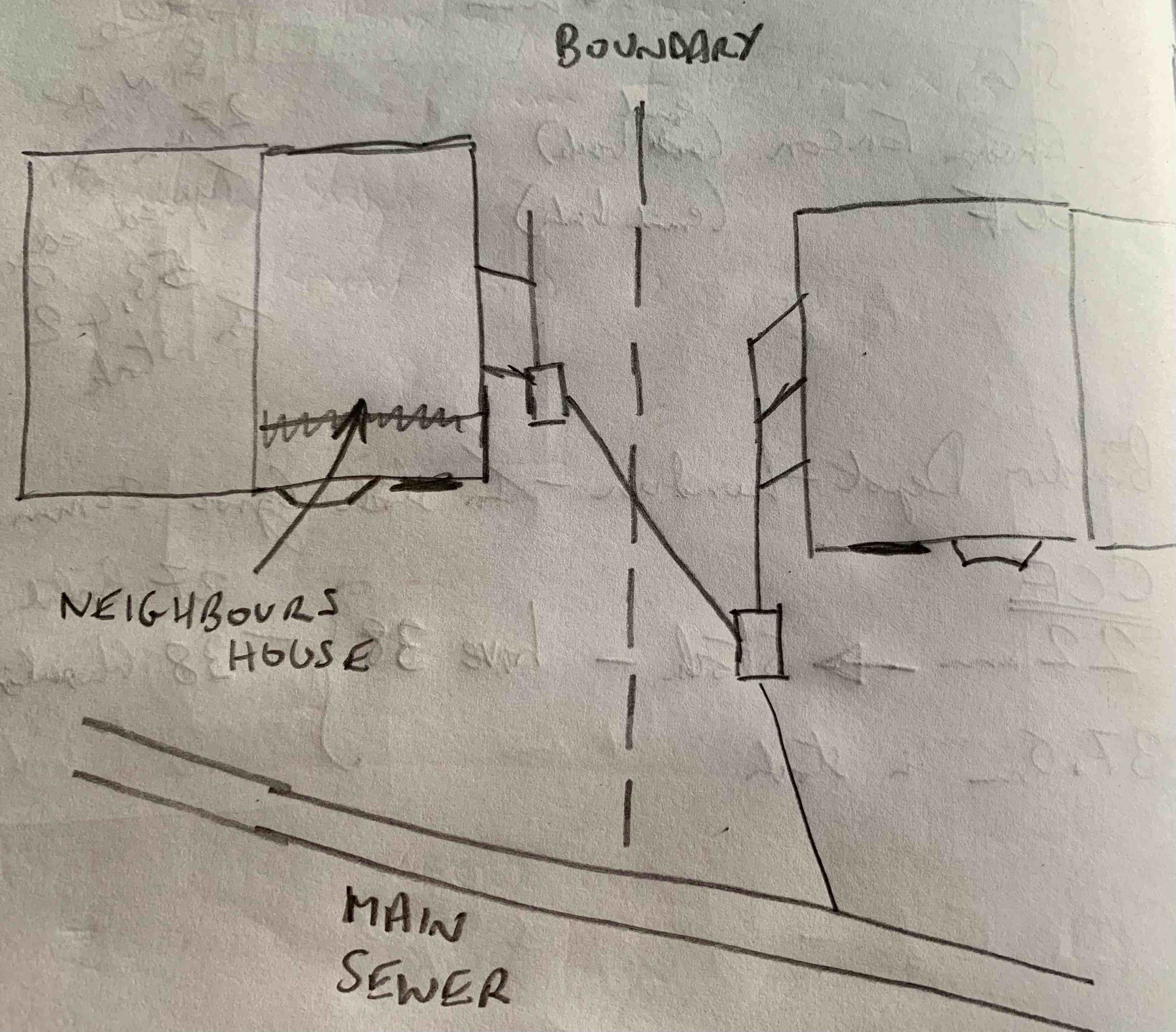
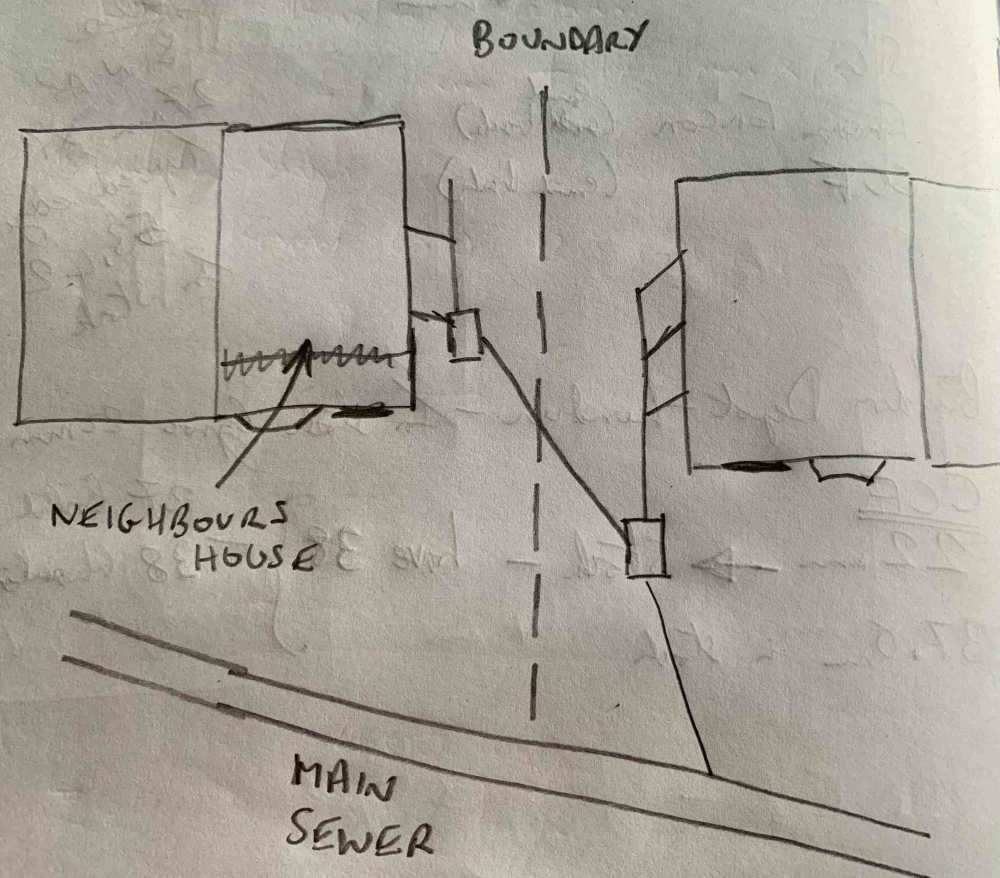
@JuddlyFire No I don't believe it does imply that. My reading of it is that where a drain serves more than one property then it is a public sewer and it the responsibility of the sewer company. So this means the red extends to and includes the first chamber only. Nothing beyond that is used by more than one property. However the pipework between the neighbours private chamber and my public chamber is also the responsibility of the sewer company but only where it runs on my property. That is the section on my property is buff coloured and is a lateral drain. Therefore I believe the neighbour requires a lateral build over agreement from the sewer company. Presumably it will be up to the sewer company whether they will grant this when the neighbour plans to build over their chamber restricting the sewer company's ability to rod the lateral drain they own from the upstream side ?
-
It can and may well affect us in multiple ways. 1/ The chamber on our land has blocked several times in the past. Difficult to definitevely assign cause between the properties but has sometimes appeared to be caused by products used by the previous neighbour. 2/ When that shared chamber becomes blocked it causes backup down our drains because our property is about 1 meter lower than the neighbours. Anything from the neighbours drain that cannot then exit the chamber will back flow down our drains and in extremis emerge through our surface drains. 3/ Once built over, whatever the theory that they will lift a hatch in their floor, unseal their underfloor drain cover (releasing smells into their property), send a rodder under the floor to clean/inspect then reseal etc seems unlikely in practice. So any future drain issue on their property is likely to generate requests to service their drains from our property as they will have no ready access from their own chamber. 4/ They have no construction plans and have declined to answer any polite questions about the rainwater drainage arrangements which appear to include taking water from the main roof and extension and using downpipes at the boundary with no apparent drainage routes. 5/ Should they build without adhering to the regs, it may not just impact the saleability of their own property, but given the connection and being lower lying - our own property too once searches and questionnaires show the existence of the shared/public drain on our land. No building notice is registered yet despite work being imminent. Few, polite and straightforward questions were all rejected at the party wall stage - a truly ridiculous game of chinese whispers and obstruction. Odd, dishonest, and deceiving behaviour throughout. I accept it is 'up to them' to adhere (or not) to regs but given the circumstances remain extremely concerned.
-
Anyone know the answer here ? Do building regulations not apply to drains on private properties (i.e.most/many houses) because they don't appear on 'sewer maps' ?
-
Also note that none of these drains are shown on the 'sewer map' held by the local sewer company. Their map only shows the main sewer and does not show any of the chambers and pipework that connect all the properties to the main sewer. When I last spoke to the sewer company they said my chamber and the pipe to the boundary were indeed public sewers even though not shown on their map. Furthermore they said they did not need to be added to their map as all public sewers were their responsibility anyway. (Not sure now whether this might just be the sewer company avoiding extending their map ?) This seems like a huge hole in the building regulations...? (Is this really meant to mean you can do as you please with a drain/sewer not shown on a map - which presumably means millions around the country ?)
-
The neighbour's drain does not 'serve' my property, rather the neighbour's drain exits the inspection chamber at the side of his property then crosses the boundary and feeds into the inspection chamber on my property. My drain also feeds into the inspection chamber on my property. The inspection chamber on my property is then connected onwards to flow into the main sewer serving the houses on my side of the street. So unless there is some special meaning to the word serve, it would seem the inspection chamber on my property and the pipe that crosses the boundary onto my land to connect to it 'serves' his property. Therefore it seems he can build over it ? He says he will retain access to it via a hatch in the floor above it. Am I missing something ?
-
Please can anyone advise on building over a domestic drainage access/inspection chamber ? Is this permitted by building regulations ? (My neighbour has advised he plans to build an extension over the access/inspection chamber for his drain and install a floor hatch for access. (Sub floor void likely to be 60-75cm). This drain then crosses the boundary to join our drain and therefore as I understand it becomes a public drain at that point.)
-
I think with all things it can help to keep your eye on what is being done as it is occurring. Always difficult as few of us appreciate having people 'standing over us' while we do something. Even then it is easy to forget or miss things, but so much easier to adjust or correct work in progress than to get it corrected afterwards. I have probably become too obsessed with trying to work details out before the work takes place - and even then things can go awry - it sends you a bit loopy in the end. I would go around and check all the doors and windows at this stage - are they plumb, positioned ok in the aperture, matching heights around the rooms, compatible with your planned finished floor levels inside and out, will open properly and with relevant clearances. And then think long and hard about any issues you find because now is the time to get it corrected even if that means having to pay for the change/correction. I had to get one window cill changed because it blocked the opening of an adjacent window. (I have one door that opens against a wall and wanted it to open 90deg with clearance for the handle. Looks like it is going to be really tight now once plastered and may not open 90. Had I spotted it at the time I could have got the fitters to put it tight up against one side of the opening to give a few mm more clearance. Also had to buy and use a water level to prove that the fitters laser level was wrong and their measurements at fit were in disagreement with their measurements at survey. (Water levels actually rather useful for checking levels between inside and outside of buildings and around corners etc.) PS I think doors and windows are normally sized to be about 6mm all round smaller than the opening.