.jpg.c21f3ac78c9b7efd90cbdcb312744dc5.jpg)
jack
-
Posts
7350 -
Joined
-
Last visited
-
Days Won
38
Everything posted by jack
-
.jpg.c21f3ac78c9b7efd90cbdcb312744dc5.thumb.jpg.7adcad4c0e384f5ecd7d56b0618df6e5.jpg) I replaced all of my fire/smoke alarms last week, as they're coming up to 10 years old (two starting beeping within a week of each other). Each came with an elasticated cover and instructions not to remove the cover until at least 24 hours after completion of any work involving decorating, including sanding and painting. I've put the covers aside for when we eventually repaint.
I replaced all of my fire/smoke alarms last week, as they're coming up to 10 years old (two starting beeping within a week of each other). Each came with an elasticated cover and instructions not to remove the cover until at least 24 hours after completion of any work involving decorating, including sanding and painting. I've put the covers aside for when we eventually repaint. -
Sorting out expansion vessel and overtemperature valve
jack replied to jack's topic in Boilers & Hot Water Tanks
Good point. I haven't mentioned it in this thread, but I'm absolutely getting a plumber involved. This thread is more about making sure I know exactly what I want done, as in my experience, trades tend to advise what's convenient for them rather than best for you (e.g., the last time I had a G3 inspection, the plumber installed - directly onto the tank- an overpressure valve designed for strictly cold water use, presumably because that's all the local plumber's merchant had in stock and he didn't want to come back again). -
Sorting out expansion vessel and overtemperature valve
jack replied to jack's topic in Boilers & Hot Water Tanks
Our NRV is right at the mains inlet. There's no separate NRV after the branch to the cylinder from the cold feed. It's funny you mention that. Until I did the diagram above, I assumed we had one. Indeed, I thought it was a requirement (or at least a recommendation), but from a brief review I couldn't find any such requirement. No such valve is shown in the manufacturer's installation diagram, as shown in John's post above. I was going to ask whether it's at least best practice, as this would be a good opportunity to add one. The cold feed to the cylinder is quite long and there's plenty of room to fit an NRV in the cold feed to the cylinder upstream of the expansion vessels. -
Sorting out expansion vessel and overtemperature valve
jack replied to jack's topic in Boilers & Hot Water Tanks
Thanks John. Yes, the existing EV is right above the cylinder. I'll take this opportunity to move it to the cold inlet. Given that the water softener has isolation valves, would it be best practice to connect the EVs after the softener, so they can never be disconnected from the cylinder? Thanks. -
Sorting out expansion vessel and overtemperature valve
jack replied to jack's topic in Boilers & Hot Water Tanks
I don't know why you found the offset being there so offensive! 😆 I could have moved the table so the offset wasn't required, but it was easier to add the offset than to undo the cell merges, move the table, and re-merge the cells. Not even close. I've figured out which one to get but I need to figure out where to locate it in the plant room. This needs a bit of thinking due to the location of the water softener. -
Look up Andrew Jones, "The VATman". A few on here have used him, with good feedback from memory. In at least a couple of cases, the BH member successfully claimed back additional items worth more than the cost of the VAT reclaim service, due to additional items Andrew's team identified that the BH member hadn't considered.
-
Depends on the type of rain. It's just about impossible to predict localised patchy rain. You can only really rely on the forecasts that say 90% chance of rain for at least a couple of hours. For short term predictions (minutes to an hour or two), looking at the weather radar can help.
-
Sorting out expansion vessel and overtemperature valve
jack replied to jack's topic in Boilers & Hot Water Tanks
I've put the answer to your "indirect" question in bold below, but in case anyone's interested in the way the whole thing works (which might give an insight into how my brain "works"): As you know, the coefficient of expansion for water changes with temperature, and the actual equation for calculating expansion between two temps is quite complicated. I made a table of temps from 4 - 95 °C, at 1 °C per cell. I inserted the known cofficients for 4 °C, 10 °C, 20 °C, ..., 90 °C at the appropriate positions in the table. I then did a linear interpolation for the values between the known values. For the values between, say, 10 and 20 °C, I took the average of the coefficients for 10 and 20 °C, then divided by 10 (call that value "x"). The value for 11 °C is the (known) value for 10 °C + x. The value for 12 °C is the value for 11 °C + x. It's not perfectly accurate, because the relationship isn't actually linear, but it's certainly close enough for this task. Since the coefficient represents the expansion at that temperature for a 1 °C temperature change, all you need to do to find the total expansion is to add all of the values between the two temperatures. The indirect function in Excel (which I only learned about when doing this spreadsheet) lets you construct a cell reference based on any other input. In this case, the row in which each temperature value sits in the table is one higher than value of the temperature itself. For example, the coefficient for 7 °C is in row 8. I therefore needed to add 1 to the values of the start and end temps to use them as references to the correct rows in column G. I can't remember where I got the values for the expansion coefficients this is all based on, but the results are very close to the table you included in your original spreadsheet. I assume the difference is due to the interpolation mentioned above, but either way, it's close enough for this purpose. Edited to add: Updated version of my earlier spreadsheet includes a graph and the comparison table above: System pressure calculator - updated for BH.xlsx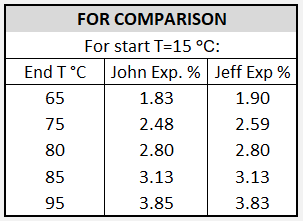
-
What's the case for not getting an ASHP?
jack replied to kentar's topic in Air Source Heat Pumps (ASHP)
If I get a few mins later, I might try to split out all the later content into a new thread. -
Sorting out expansion vessel and overtemperature valve
jack replied to jack's topic in Boilers & Hot Water Tanks
Thanks Nick. I was talking about using an accumulator (i.e, a vessel sold as an accumulator) as an additional expansion vessel rather than as an accumulator per se. Neither here nor there now, as I'm going to go for an actual expansion vessel. Does the best location change if we're talking about an expansion vessel? I figured it should be connected on the DHW tank side, without any other components (e.g., water softener, second PRV) between it and the DHW tank. As for the location of the 22 L tank, that's where it's currently installed. I figured the simplest thing would be to add more capacity on the cold side, as you suggest. I suppose there's nothing stopping me moving the 22 L tank to the cold side as well. Thanks John. I modified your spreadsheet the other day to get the numbers I referred to above. My version lets you put in start and end temps (updated 29 Aug to include graph and comparison table): System pressure calculator - updated for BH.xlsx -
Sorting out expansion vessel and overtemperature valve
jack replied to jack's topic in Boilers & Hot Water Tanks
Thanks John. I think the numbers for using an accumulator as an accumulator (rather than as a glorified expansion vessel) don't work that well in my case. Our mains is only about 3.4 bar, so realistically we'd need to consider a pumped system to get useable volume out of it. A 200 L accumulator + pump + additional pipework/valves would add a lot of cost and complexity, plus we don't really have space for a 200 L accumulator. Having done a bit of research, I don't think there's any benefit in using an accumulator instead of an expansion vessel in this application. They don't seem to be much cheaper. -
Sorting out expansion vessel and overtemperature valve
jack replied to jack's topic in Boilers & Hot Water Tanks
Just coming back to this after spending some time reading and thinking over the weekend. First, I've installed the new 3.5 bar pressure relief valve, turned off the immersion diverter, and reduced the inlet PRV pressure to 2.2 bar while I sort all of this out. Second, @John Carroll, your spreadsheet was hugely helpful, so thanks again for sharing it. While I understood the general principle behind expansion vessels, seeing the actual numbers was eye-opening to say the least. A few percent expansion doesn't sound like a lot, but when you combine it with a limited maximum DHW tank pressure and an immersion diverter, the peak operating pressure very quickly gets problematic. As an example, with a starting temp of 10 °C and a finishing temp of 70 °C (not crazy numbers with the immersion diverter working on a sunny day with colder mains in the autumn), the inlet PRV set at 2.5 bar, and my current 22 L expansion vessel, the final guage pressure of the system would exceed 3.5 bar. Adding a 50 L expansion vessel would drop the final pressure to 2.8 bar. 2.2 bar is proving to be unpleasantly low in practice, so I really want to bump that number up with a larger expansion vessel or accumulator. Using the nominal operating parameters in the cylinder manual (2.1 bar inlet PRV, operating temp 65 °C), and assuming an inlet temp of 7 °C (doubt it ever gets much lower in my circumstances), gives a peak pressure of about 3.1 bar. This should be a reasonable guide to a maximum operating pressure. By fitting an additional 80 L expansion vessel, I can run at close to 3 bar on the inlet PRV while keeping a similar peak pressure. Even allowing for a final temperature of 80 °C, I'd still be 0.2 bar below the 3.5 bar set by the pressure relief valve. These are pretty extreme numbers, so I should rarely reach them. @Nickfromwales, I know the difference in principle between an expansion vessel and an accumulator, but in practice, is there any benefit to choosing one over the other? Are they structurally different? I see diaphragm versus bladder - are diaphragms intended to stretch, so that the pressure buffering is partly provided by the elasticity of the membrane? In general, would you expect either type to last longer than the other? The 22 L expansion vessel would stay in place near the outlet at the top of the tank. I assume the new vessel/accumulator would go after the water softener in this diagram?: I also plan to install a new PRV between the softener and the new pressure vessel/accumulator, so that the 3 bar supply is set after the water softener.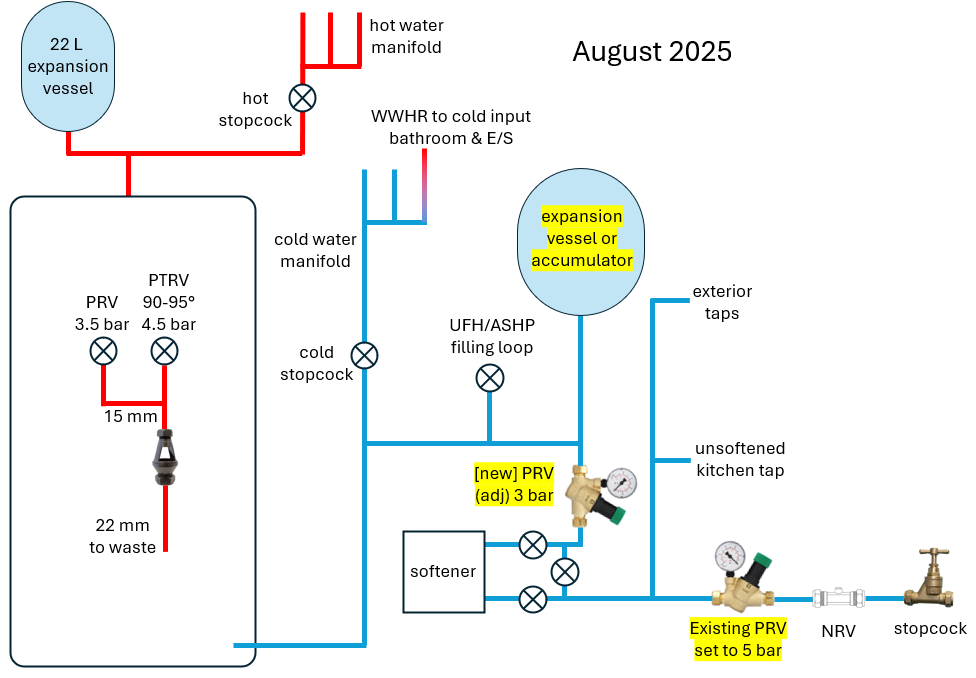
-
Sorting out expansion vessel and overtemperature valve
jack replied to jack's topic in Boilers & Hot Water Tanks
Thanks John. I found that document a couple of days ago. It was one of the triggers for my comment about rethinking the setup as a whole. It's frustrating the original plumber apparently didn't read the manual before installing a 3 bar PVR on the incoming mains 10 years ago! While it's been fine operating at 3 bar for 10 years, I'm going to lower the incoming PRV to the recommended pressure. I'll also install another expansion vessel to help keep the pressure low. While static pressure is fine, it does drop noticeably if a couple of showers or taps are in use. I suspect the most likely culprit is the water softener, but I'll be doing some pressure tests on the weekend to see what I can learn. Either way, I'd like to do what I can (within reason) to avoid making the crappy dynamic pressure any worse when I change to the lower pressure PRV on the incoming main. -
Sorting out expansion vessel and overtemperature valve
jack replied to jack's topic in Boilers & Hot Water Tanks
Originally 3 bar and it's located above the cylinder. I'll make sure I do what you say when I recharge it (didn't manage to do it over the weekend). I've turned off my immersion diverter for the moment, so the temperature in the tank won't exceed ~50° C until I've got all of this sorted out. There's a 3 bar pressure reducing valve on the incoming mains. I already have a pressure gauge on its way so I can test it. Okay, thanks. I'm going to have a think about the setup as a whole. Currently considering adding an additional expension vessel to the cold feed near the tank, as there's more space there than where the current one is near the ceiling. There are two valves: 3.5 bar pressure relief, and 90-95°/4.5 bar temperature/pressure relief. Thanks again, I appreciate the feedback. -
Sorting out expansion vessel and overtemperature valve
jack replied to jack's topic in Boilers & Hot Water Tanks
Thanks John, it sounds like a larger (or additional) expansion vessel is definitely needed, as per @Nickfromwales's suggestion. -
Sorting out expansion vessel and overtemperature valve
jack replied to jack's topic in Boilers & Hot Water Tanks
Ha, no need to apologise, I'd rather have the honest feedback. I assume the reason for the low relief valve pressure is that this is a copper cylinder, which I expect has a lower max pressure than stainless steel? -
Sorting out expansion vessel and overtemperature valve
jack replied to jack's topic in Boilers & Hot Water Tanks
Nope. Cylinder manufacturer's instructions say this is supplied with a 3.5 bar PRV: (The guy was a complete monkey though. Installed the water softener isolation valves the wrong way around, so you wouldn't have been able to isolate the unit. I sorted it was wrong the second a looked at it. He failed to screw the waste trap onto its fitting when he was done, which I only learned about several months later when I found mould growing behind the tank. And the pipework he assembled for the water softener was crooked and put a lot of sidewards force onto some of the fittings. And my wife wonders why I don't just get trades in to do things that need doing around the house!)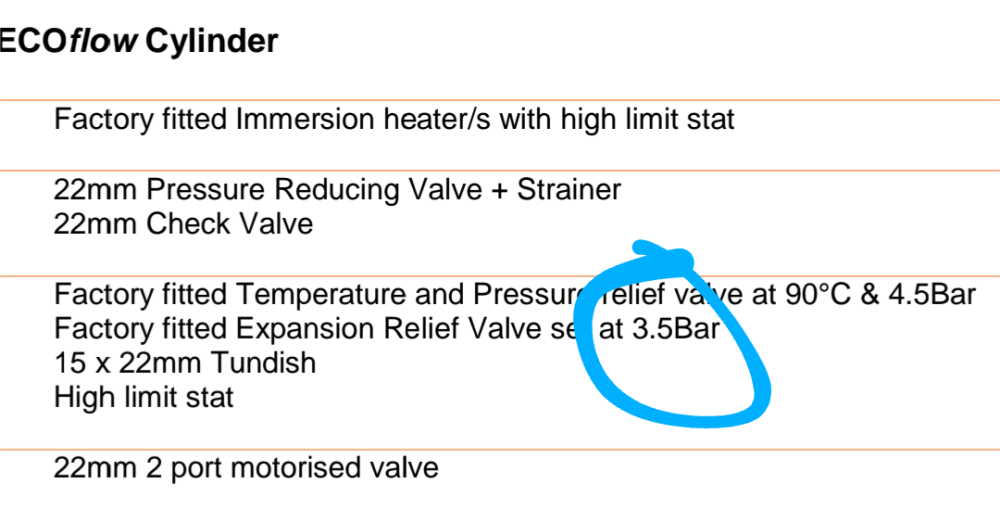
-
Sorting out expansion vessel and overtemperature valve
jack replied to jack's topic in Boilers & Hot Water Tanks
Incidentally, this is the same setup as Altecnic (possibly rebadged? I know McDonald and another manufacturer sell exactly the same cylinder we bought from them):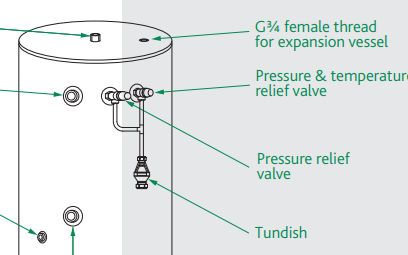
-
Sorting out expansion vessel and overtemperature valve
jack replied to jack's topic in Boilers & Hot Water Tanks
There's no control group as such. There's a pressure reducing valve on the incoming main. It's a bit hard to get to and I can't remember the pressure it's set at, but possibly 3 bar? Our static water pressure is typically around 2.8-3 bar I think. There's no pressure relief valve at that point. I'd be happy to use this opportunity to rejig the whole setup tbh. The dynamic water pressure's always been a bit shite, probably at least partly due to the pressure drop across the water softener. There's been the odd weep from a couple of the connections that I want to sort out too. -
Sorting out expansion vessel and overtemperature valve
jack replied to jack's topic in Boilers & Hot Water Tanks
It's on the cylinder. To save me going and taking a photo, this is how it came from the manufacturer (McDonald Cylinders): The one on the left is the PRV, which is what's failed. Interestingly, this diagram shows a light blue handle on the valve, which accords with the 107-series ("cold only", but rated to 110° C) Reliance valve I mentioned above.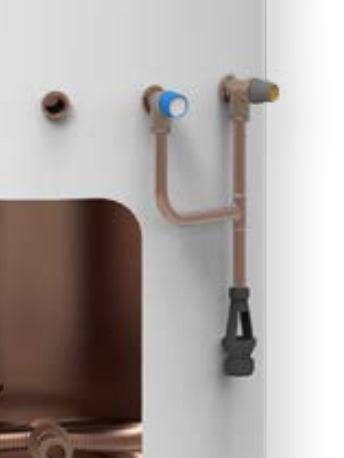
-
Sorting out expansion vessel and overtemperature valve
jack replied to jack's topic in Boilers & Hot Water Tanks
Right, I've had a bit of time this morning to look more closely at this. It's actually the pressure relief valve that's failed. The 15 mm pipework from outlets of the PRV and the PTRV joins before the tundish (I assume that's acceptable?), so it isn't possible to tell which one's failed without disconnecting the pipework from the valve outlets. The failed valve is a Reliance 102-series 3.5 bar PRV. Apparently that's a "cold water only" valve. I think this was the valve originally supplied with the cylinder, but it's also possible I asked that it be replaced at the same time I had the TPRV replaced a few years back. Either way, it doesn't appear to be the correct valve for this application. Annoyingly, none of the Reliance valves designed for hot water systems come in a 3.5 bar variant. There's 107 series that is allegedly for "cold water use only", but it has a 110° max working temp. Shame I didn't realise what was going on yesterday or I could have given their technical department a call to see what the deal is there. On the assumption that I shouldn't increase to a 4 bar version, and a 3 bar version is too low given I'm already having issues with the 3.5 bar version, I may need to look elsewhere. Annoyingly, I can't see any obvious options with the same form factor, inlet fitting, and outlet fitting. If the Reliance 107 model mentioned above isn't suitable, it might be time to replace both valves with a different brand and adapt the outlet pipework to suit. Anyone have any thoughts? -
Sorting out expansion vessel and overtemperature valve
jack replied to jack's topic in Boilers & Hot Water Tanks
I'd need to check, but definitely nothing like 90 deg. The issue is that the immersion is quite low on the tank (the upper immersion died and I've never gotten around to replacing it). By the time that lower region of the tank gets hot enough to turn off the immersion, there's been a lot of time for the water at the top of the tank to get very hot due to convection. That was my thinking when I mentioned a destratification pump. -
Sorting out expansion vessel and overtemperature valve
jack replied to jack's topic in Boilers & Hot Water Tanks
Did it ~15 times aggressively but no luck. Any recommendations for an alternative brand? What's "big" in this context? It's a 22 L tank for a 250 L unvented cylinder. Minimum appears to be something like 4-5%, but rule of thumb is 10%, so it's above the minimum but a little short of the rule of thumb. The bladder on the original one died a few years ago, so I replaced it with a new one with a replaceable bladder. I'd ideally rather hang onto that than replace it again, although if it's important, I'm pretty sure I have the space for a larger one. Any brand you'd recommend? -
Sorting out expansion vessel and overtemperature valve
jack replied to jack's topic in Boilers & Hot Water Tanks
Thanks Nick. I tried that a few times earlier, but could try it a few more times and see what happens. No HRC circuit. I just checked and the expansion vessel had no pressure. Bah! So likely that, possibly made worse by the immersion diverter. I need to put a reminder in to check the pressure in the expansion vessel more regularly.