

.jpg.c21f3ac78c9b7efd90cbdcb312744dc5.jpg)
jack
-
Posts
7352 -
Joined
-
Last visited
-
Days Won
38
Everything posted by jack
-
.jpg.c21f3ac78c9b7efd90cbdcb312744dc5.thumb.jpg.7adcad4c0e384f5ecd7d56b0618df6e5.jpg)
Essential standby equipment, energy use and solutions
jack replied to ProDave's topic in General Alternative Energy Issues
It doesn't worry me, I quite enjoy the process and the chat. -
So plumb for the outdoor shower and decide later. The cost of the plumbing is a few quid at this stage. If it's cold and wet outside, you've already been walking in it with the dog for God knows how long. A few seconds extra for a quick rinse isn't going to hurt you. Worst case, you have the indoor shower anyway, so use it when you want to.
-
Essential standby equipment, energy use and solutions
jack replied to ProDave's topic in General Alternative Energy Issues
But yours will look very different to mine, in a way that probably can't be distilled into a single meaningful number. Perhaps "baseload" is not actually that useful a term. -
Okay, I was confused by you saying you were going to wash him down outside and then put him in the shower. If I had an outdoor tap, I'd just skip the shower bit entirely and avoid the clean-up.
-
Essential standby equipment, energy use and solutions
jack replied to ProDave's topic in General Alternative Energy Issues
Yes, exactly. There's no point me saying my baseload is 300 W if we don't all understand whether that includes intermittent devices like fridges (intermittent but pretty regular) and cookers (intermittent and less predictable/regular than a fridge). -
Essential standby equipment, energy use and solutions
jack replied to ProDave's topic in General Alternative Energy Issues
Is there a formal definition of "base load"? If it means the absolute minimum, then we're somewhere around 300 W. I recently realised that I'd disabled the UFH pump switch controller in our home automation setup when doing some testing a couple of years ago, so it's been on continuously since then. I need to reprogram it so that it's only on when: the ASHP is running there's a significant difference between the slab temp in the kitchen (which gets more solar gain than anywhere else) and the slab temp in the TV room (which is under carpet and gets zero solar gain) there's a significant difference between the supply and return temps on the UFH manifold. That should save 20-30W a significant proportion of the time. -
I have one of those bellows-type toilet plungers in the downstairs shower, and just give the drain a good plunge now and again. Used properly, it pushes everything through the trap, even sand and small stones. The really annoyance is rinsing down the tray and surrounding walls after she's been rinsed down. If I had an outdoor tap, I doubt I'd put the dog in the shower afterwards very often. At the moment, we need to rinse her off most days when she comes back from walk due to how wet and muddy it is. You shouldn't wash (in the sense of using shampoo) your dog anywhere near that frequently. At a guess, ours is washed properly less than 1 in 10 times.
-
Wow, spooky. We've lived in our house for nearly 7 years, and I yesterday referred to the shower in the boot room as the "dog shower" for the first time. On the topic of dog washing, I wish we'd followed through on our original plan for a warm water tap outside for the dog. It's all well and good rinsing the dog down in the shower, but the amount of mud, sand, and other horrible stuff that comes off ours when we've gone for a walk in the wet is ridiculous. It gets stuck in the drain and generally makes for a fair bit of work cleaning up after the dog's been rinsed down. If you haven't considered it and can still run the pipework, an outside warm-water station with hand shower attachment (even just a standard garden hose type) lets you rinse the worst of the crud off outside. I'm with you on large utility rooms. We thought we were being overly generous with ours, but having lived with it for a while, it would definitely be better if it were larger.
-
All of this sounds like someone looking for an easier way to do a job that I just don't have any interest in doing at all.
-
It'd be a massive chore, which is why I've avoided cleaning or external venetians for 7 years so far. We chose a shade of grey that really just doesn't show the dirt unless you're very close, so they look fine.
-
You've hit the ground running with having a design ready to go if/when the sale goes through. Was the plan off-the-peg, or was it designed for the plot? I only ask because off-the-peg designs often fail to take into account the plot, including things like orientation (sun), views, access points etc. I imagine being on a corner plot raises extra concerns/possibilities when it comes to design. Also, you're talking about lining up builders, groundworks, etc, but has planning been granted for what you hope to build? And have you worked through issues re: CIL? It takes very little onsite activity to accidentally trigger formal building commencement, which can't be undone, and might leave you paying thousands in CIL you might have avoided. That said, I don't know much about CIL. Perhaps the fact the plots are serviced means that's all been sorted already?
-
I completely agree with that. I visited a friend on a cold day in winter after they'd finished their massive refurb. Left my shoes at the door, and then had my feet sweat uncomfortably through the next couple of hours. That said, we have UFH throughout our ground floor, which is 90% concrete. Even when it's very cold outside and the flow temp is at its highest (27 deg, C, I think we have it set at), the floor temperature is never uncomfortable underfoot.
-
Ah yes, that's exactly the type I was looking at. I only learned these even existed about a year ago when I was helping my electrician with some rewiring in the cabinet (new dimmer) and realised how difficult/ridiculous it was having so much wiring cluttering it up. My electrician did a fantastic job overall, but I think we missed a trick on this particular point. Edited to add: Perhaps the cheaper outlet I was trying to terminate to was Cat 5 (not 5e) then? Whatever it was, I couldn't reliably punch the Cat 6a wire down into it. Good to know Cat 5e 110 block will work, thanks.
-
I can't add much, other than to say we used solid core, Cat 6a wiring throughout. Paid a bit more for LSZH cable. I don't know whether copper-plated aluminium is a thing in Cat 6a cables, but worth checking you're getting solid copper. One slight downside to Cat 6a compared to Cat 5e is that you have to use Cat 6a sockets, which from memory were a fair bit more expensive than Cat 5e sockets. Same with patch panels, although in the scheme of things these aren't expensive items. Like everyone else, I wish I'd run more cable to and between certain areas, but I suspect an even a better approach would have been more ducting. The main thing I think I got wrong with Loxone wiring is the termination of cables as they come into the Loxone enclosure. What I should have done is terminated every cable on a massive patch panel (possibly outside the enclosure) and then run double insulated twisted pairs from that to the various inlets and outlets. Instead, the wiring is a rat's nest of Cat 6a cable squeezed into the cable guides. It's something I plan to improve when I have the time and funds available.
-
I didn't know that - interesting, thanks. From his description, it sounded more like resistive heating. 1200%? That seems optimistic. You mentioned not needing an ASHP, but you'll still be paying for the heat pump in the unit you're looking at buying. The main advantage would seem to be system integration.
-
So it's resistive heating, which is currently several times the cost of gas (I guess 2-4 times the cost - not sure tbh) per unit of energy delivered. You say your house isn't going to be super-insulated/airtight. I think you'd really want to do your sums before committing to this approach. Your heating bills could be absolutely terrifying!
-
Ours have holes for the strings and a small (few mm) gap either end of the slats. Together, these let in enough light that we find them unsuitable for bedrooms, especially those with east-facing windows. I'm sure some potential miscreants look at them from a distance and assume they're security blinds, but they're completely useless for that. You can easily lift them up in the rails with one hand. I imagine you could tear them off without too much trouble - they're only aluminium with plastic end guides in the rails. They do rattle a bit in heavy winds. There's a recommendation to raise them into the housing during strong winds, but we've no longer bother after never having had any damage even during the worse storms. Might be different if you lived in a windier area than us.
-
Supplying all of your heating via MVHR will likely require a much larger volume of air than you would otherwise be exchanging with an MVHR system set up for just ventilation. The system design is quite different and you may need a much larger MVHR unit. Having worked in offers where heating was provided via the air conditioning ducts, I personally really don't like air as a heating method. If you aren't using an ASHP to provide the heat, what will you use? If resistive, then be prepared to pay 2.5-4 times as much per delivered unit of heat. And what will provide your hot water?
-
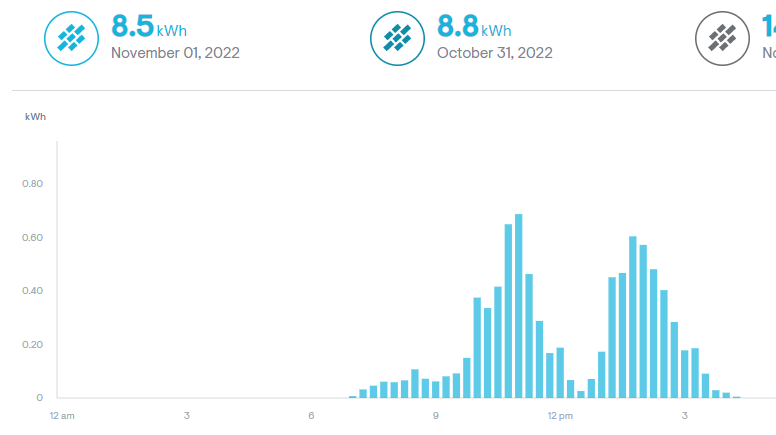
8.5 kWh for us yesterday, from an 8.5 kW array. Can you spot when the storm came through?
-
How to get an extra 2 SAP Points?
jack replied to Andeh's topic in General Self Build & DIY Discussion
I stuck a temperature probe into the trap after showering this morning. The temperature was 34.6 ºC. You might lose some heat to the drain before the water enters the WWHR unit, but 27 ºC doesn't sound unreasonable for modelling purposes. -
Polished concrete - timelines in your own experience
jack replied to KillyfadNewBuild's topic in General Flooring
I'd generally take the specialist's opinion over that of your contractor, unless your contractor has a lot of experience working with polished concrete. -
Search BuildHub for the term "hereditament" and you'll find some useful threads about when a council can legally charge council tax. The completion certificate may be the trigger for some councils, but they won't necessarily wait to see that before trying to charge you council tax. We didn't get our completion certificate until years after moving in, but they seemed to figure out the month we moved in, and we paid council tax from that point.
-
How to get an extra 2 SAP Points?
jack replied to Andeh's topic in General Self Build & DIY Discussion
If we accept the 80% (or even up to 90%) recovery figures for MVHR at a high airflow rate and a typical temperature difference of perhaps 15-25 deg C, 50% recovery in a heat recovery system of this type given a temperature difference that's typically at least as high doesn't seem so unlikely. The main thing that bugs me about the idea is the likelihood of biofilm building up on the inside of the pipe, which would reduce performance. I'd planned to inspect and clean mine every year or two, but have never managed it in 7 years. Perhaps I'll do some experiments if I get the time in the coming weeks (Narrator: "There's no way he'll get the time") -
Polished concrete - timelines in your own experience
jack replied to KillyfadNewBuild's topic in General Flooring
Just the polishing process? We had a two man team in (after their colleagues laid the concrete a few days before) and it didn't take them a full day. They did around 160 m2, although the studwork was in place, so there was a lot more faffing about than if it was just a single slab. -
I seem to recall that another member - maybe Jeremy Harris? - did something with thin ply over a frame when he had very limited space to build a wardrobe. He was surprised at how stiff and strong the whole thing turned out to be.

