.jpg.c21f3ac78c9b7efd90cbdcb312744dc5.jpg)
jack
-
Posts
7352 -
Joined
-
Last visited
-
Days Won
38
Everything posted by jack
-
Watching my wife try to use a cordless drill to drive in screws is one of the most frustrating things I've ever experienced. When you've been doing it for decades you don't even have to think about squaring it up, how hard to push at what point to avoid cam-out, etc, but it takes time to learn those things. I was there the first time my wife tried and I had to leave the room in the end. It was that or murder (touch and go whose murder, to be fair).
-
My OH jokingly calls me "Captain Sensible". In my opinion, the fact that she thinks I'm "too concerned about safety" is a very good reason to to actively discourage her use of anything sharp, and particularly anything connected to a powerful motor!
-
... even when you say clearly in the entry that you won't deliver! I once had someone offer me £5 to deliver across town a crappy old Ikea coffee table that probably wasn't worth £5.
-
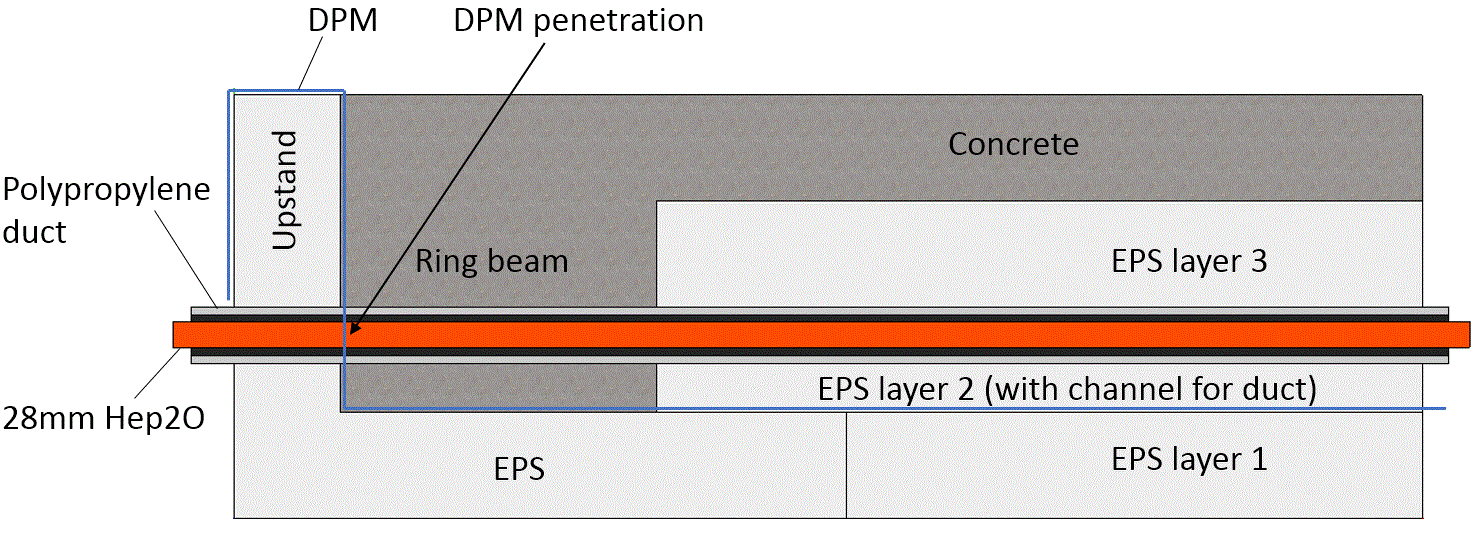
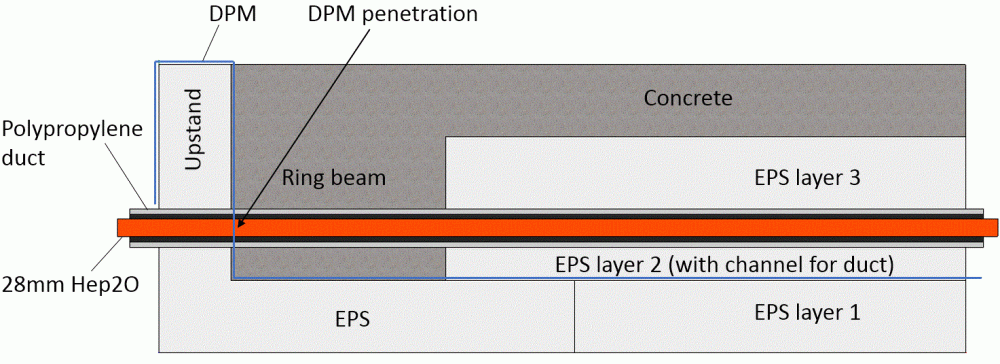
Right, I understand now. Yes, ours went through the DPC at the inner surface of the upstand, like this: I believe we cut a circle in the DPC (see arrow) so that the duct was a tight friction fit, on the assumption that there was nowhere for the water to track to this point once the outer DPC was sealed around the ducts anyway. If you were paranoid, you could use a sheet grommet of some sort attached to the DPC to provide a more resilient seal, but that felt like overkill to me at the time.
-
@MikeSharp01, we didn't go through the DPC. We just lifted it out of the way where the ducts disappear into the EPS upstand at the side of the slab. The ducts go through the EPS upstand and ring beam at the level of the middle insulation layer (of three x 100mm). Let me know if you need a diagram.
-
I stand by my earlier assertion: at one level or another it's all physics (a lot of which is admittedly maths!)
-
.jpg.c21f3ac78c9b7efd90cbdcb312744dc5.thumb.jpg.7adcad4c0e384f5ecd7d56b0618df6e5.jpg)
Humidity and MVHR
jack replied to lizzie's topic in Mechanical Ventilation with Heat Recovery (MVHR)
If you use an ultrasonic humidifier, it helps to have a fan beside it to disperse the droplets into the air. I've used these in the past, and if you aren't careful, the area around them (floor, furniture) gets damp. Because there are moisture sources inside the house (eg, people, cooking, showers, plants) that add moisture to the air. The more you ventilate, the more of that moisture is lost to the outside. For example, turning off the MVHR completely would result in nearly all internally generated moisture accumulating in the house over time. Obviously that's not a desirable situation, so it's a balance between fresh air and keeping moisture levels at a reasonable level. When the weather is cold, you also get a larger drop in RH as the (often already relatively dry in winter) incoming air is heated. -
Humidity and MVHR
jack replied to lizzie's topic in Mechanical Ventilation with Heat Recovery (MVHR)
When it's dry outside, over-ventilation is the main enemy. Can you turn the MVHR down to a lower setting? As an example, we're supposed to run ours at something like 180 m3/hr, but it was on for a year at 50 m3/hr with no issues at all. Another possibility is pollen screens for windows. I have no idea how effective these are, but could you get at least some windows covered with these so you can open them and get some flow-through ventilation overnight and when it's not too hot? Edited to add: large pot plants are also supposed to help. Edited to add: example of pollen screens: https://newblinds.co.uk/pollen-screens -
Well, with spring now well and truly upon us, it's clear we're going to need more watering capacity for the plants we installed over winter. I thought we might make do with some soaker hoses, but it's clear that a more permanent system is going to be required. I've looked at various consumer irrigation systems (Hozelock and K'archer), but there are all sorts of other brands and types. Has anyone had experience with any of these systems? Anything to look out for or avoid? What about drip v microspray? The drip systems seem to provide water in a very localised way - I can't help but think that for larger plants, a spray would be better. Thoughts?
-
Does self building improve health?
jack replied to epsilonGreedy's topic in General Self Build & DIY Discussion
I always, always do this now. It's not that I don't trust them, but GPs are expected to have such an incredibly wide range of knowledge that it isn't surprising that they aren't perfect. Trust, but verify! -
Does self building improve health?
jack replied to epsilonGreedy's topic in General Self Build & DIY Discussion
Yup. All covered by the "etc" -
Does self building improve health?
jack replied to epsilonGreedy's topic in General Self Build & DIY Discussion
Have you ever looked into eating fermented foods such as kefir, sauerkraut, etc? Supposed to be good for people who've been through antibiotics and have yeast infections. -
You can't criticise the scale of the man's vision(s).
-
And that's assuming nothing goes wrong! Our ASHP blew a control board before Christmas. Cheapest I can find a replacement board: £170 It's highly recommended that you change the pump at the same time, because it's the most likely reason for the failure, and isn't easily tested. Cheapest I can find a replacement pump: £380 Then there's the cost of troubleshooting the problem and doing the repair. I haven't had this priced separately, but I can't see anyone with the relevant qualifications doing it for less than a couple of hundred quid. Let's call it £750 in total. The ASHP itself only cost £1700! By way of background, I've had an authorised Panasonic engineer check our setup and installation and he confirmed that everything seems fine. The only potential issues are that we hadn't been running glycol (now fixed) and it was spending several months completely idle over summer due to our Immersun covering all hot water over that period. There's a setting that turns the pump on for a couple of mins a day whether or not heating or cooling is needed, to keep things moving - that might help longer term. The installation was only 2.5 years old. Installations done by an authorised Panasonic engineer come with a 5 (sometimes 7, if you get them during a promotion) year warranty, so possibly worth paying the extra up front. But back to your point @TerryE, yes, an immersion-only system is looking very appealing to me at the moment!
-
Interesting, thanks. I remember hearing about this a while ago but didn't realise it had launched. Shame it's Leaf (+ that commercial vehicle) only - that's too big and expensive for what I want/need from an electric car right now.
-
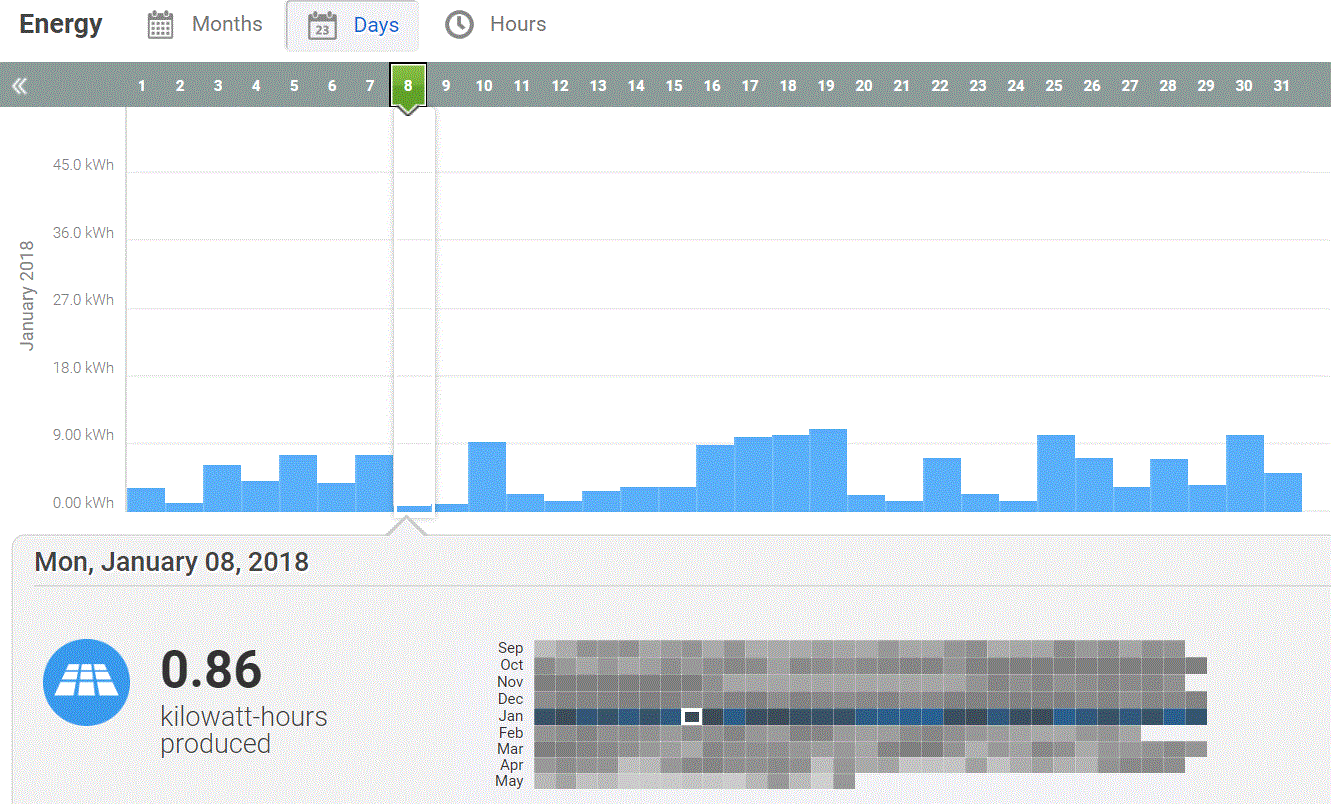
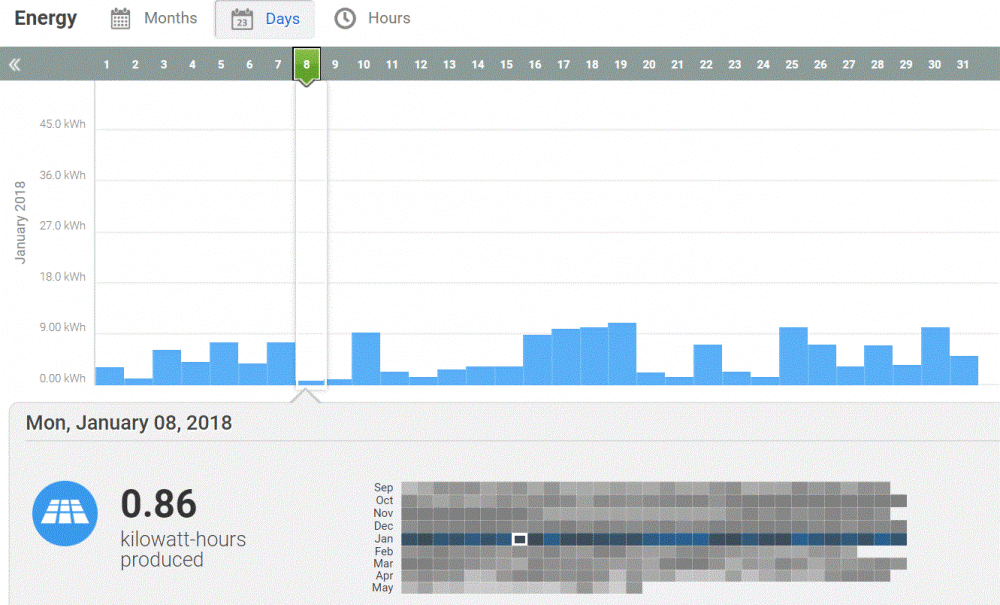
As an example, here's the daily generation for January this year on my 8.5kW system: There were 14 days that generated less than 4.8kWh, and that's ignoring charge/discharge inefficiencies, SoC limitations, and the fact that at least some of what was generated will have been consumed and therefore not available for storage. I just checked, and December was worse, with 19 days that generated less than 4.8kWh. Remember, this is an 8.5kW system. A 4kW system would have generated less than half what's shown above. In fact, a 4kW system at my location (Hampshire/Surrey borders) would only have managed 5 days above 4.8kWh in January, and only 1 (and only barely!) day in December.
-
I think these calculations need thinking about. Our winter generation is at times virtually zero for days on end (edited to add: we have an 8.5kW system]. I'm also less sure that there will be a lot of days where you can recharge several times. Unless I'm missing something, the only way that can happen is for you to charge up, then use some of what's been charged, in time for there to be further charging. However, the chances are that if you'd just consumed the PV-generated energy as you went, you'd get the same benefit. It's hard to really model how you'd do without a year or two of good generation and consumption data, maybe on an hour to hour basis.
-
As Dave says, for us the numbers don't quite add up yet. From memory, we use around £900 of electricity per year (we have no gas, so that's heating, hot water, cooking - everything). We do have a nasty habit of using the dishwasher and washing machine overnight, so I'm sure we could reduce that, but I need to do some more analysis of what we produce compared to when and how we use it to figure out the price point that would make storage financially viable. For the moment, and for our family circumstances, I think an electric car is a more useful way of absorbing excess production. I reckon we can save well over £1000 a year in fuel and other costs by replacing our small car with an electric car. This does ignore capital costs - there's no doubt we'll need to pay more to get something we'd want to hang onto for a few years. I'd love it if someone would cobble together a system that let you use a proportion of your car's storage to provide time-shifted power to the house in the evenings. I know there are long-term smart grid ideas that take this concept further, but as a country we can't even manage a roll-out of basic smart meters, so I'm not holding my breath for smart grid functionality arriving in the next decade.
-
Yeah, just messing. It's very easy and fun, really.
-
At the start, yes!
-
That opinion may change as the build goes on!
-
It isn't just developers. I suspect that the small family firm I engaged to do the plasterboarding at my house cut corners when fitting ceiling insulation. It's an attitude - they either have it or they don't. If you find someone with the right attitude, stick to them like glue, and cheerfully pay them a bit more than the alternative if necessary.
-
One approach would be a pinned post at the start of at least major sub-forums (eg, foundations, windows), with a summary of what people have done, and links to relevant posts. As @recoveringacademic says though, this would be a massive undertaking. Another option, which I've mentioned in the past, is to set up a self-build wiki. Again, summaries of what people have learned, with links (onsite and offsite) to relevant content. Again, a massive undertaking.
-
Very 1st draft of my dream home
jack replied to Youngredders's topic in New House & Self Build Design
I think it's fair to say that some architects will save you money, but that isn't the universal experience of people who've used them. I say that as someone who used, and was very happy with, a local architect for our self-build (well, after we fired the first one who, it turns out, had no idea about planning considerations and wasn't actually able to design houses!) -
Back to Buildloan (groan)
jack commented on curlewhouse's blog entry in Sips and stones may break my bones...
Jesus, what a clusterfark of an organisation. How hard can it be?