


Rob99
-
Posts
330 -
Joined
-
Last visited
-
Days Won
1
Everything posted by Rob99
-
I've seen lighting designs where a row of spots is positioned closer to the side wall and washes light down the wall. Can be quite effective.
-
The classic approach of a Monopoly - completely stifles innovation (jobs for the boys too!!) There's nothing random about a Loxone system (just ask all those on here who have one!) and contrary to your generalisation, it works exceptionally well when properly set up. On the contrary, there are three distinct zones on the ground floor but he's choosing to just install a single room thermostat controller. True, randomly turning the heat pump on and off is not a way to operate a heat pump system efficiently, but having sensible configurable control of your room temperatures is an efficient use of that energy, and there's nothing random about it with a comprehensive HA system like Loxone.
-
I have a client installing Loxone and he's come up against exactly this issue with his builders heating engineer. Naturally he wanted to use Loxone to control his heating system but no amount of discussion or logical arguments would sway the heating guy from his ASHP design and installation approach. I offered to explain Loxone control to him and work with him to implement a comprehensive solution for my client but it was the proverbial head and brick wall. Kept insisting that only his designed system could be installed and if any changes were made to controls after install then my client would lose his £5k grant. Worse than that for me is that he intends to use a single room thermostat downstairs to control the UFH heating and upstairs rads will all have manual TRV's.............the guy must be a time traveller as systems like that were being installed 20 years ago!!!! Final comment - I definitely think the MCS monopoly just means installers are fleecing consumers by adding £5k to what they would have quoted pre-BUS. Another example of the government getting it completely wrong!
-
@Kelvin @Thorfun Yes, that is something I can do, amongst other services. Drop me a PM if you want further info. Aside from that I'm happy to chip in on here with bits of knowledge and advice on Loxone stuff.
-
Based on what you have suggested is going in your second cabinet you will need a Loxone Link connection for the relay extension, a Tree link for the RGBW dimmer and a Tree Turbo link for the stereo extension. That would be 3 pairs in a single cat6A might be pushing it as you'll only be left with 1 pair spare as back up if wiring issues occur in future. You could add in a Tree extension which would only then need Loxone Link and Tree Turbo cables, but you might prefer to just run a couple of cat6A cables to give you some comfort from a bit of redundancy and future options. I presume it's only one stereo extension your're putting in. And just to confirm what others have mentioned, you definitely don't need a second miniserver.
-
In the projects I've been involved with there's always a mixture of mains/24v lighting. Very much a case of one size "doesn't" fit all.
-
I agree it's a good solution, especially with limited panel depth. One of the better products to come out but a little pricey. You can get a couple of decent 20A power supplies for around £300, so it'll come down to whether the additional functionality of the PSUB (!) is worth the extra £350. If you balance it against the higher cost of a deeper enclosure then it starts to look a bit more affordable too. My home setup has a standard depth panel and needs 40A so I might be tempted at some point to get one.
-
Yes, it's an LXN6-D panel. It will power a dozen or so 24v circuits with LED strips using RGBW compact dimmers and also has 5 RGBW tree dimmers in the panel powering quite a few WW Loxone spots using seperate channels. Regarding lighting power usage, Loxone's project planner says it assumes a load factor of 30% for lighting when calculating power requirements. I think that's way too low but is probably part of their assessment as to how big the new power supply and backup product was designed. I always sit on the "over engineered" side of the fence and wouldn't like to see power supplies at max capacity. Loxone installers will just design and install and not worry about future requirements whereas I think it's always good practice to have a bit of spare capacity.
-
They're fitted in a FA LXN6-D enclosure and literally just fit behind the cover plate. They are fitted on a standard 7.5mm deep DIN rail bolted directly to the back plate of the panel. They have sufficient ventilation in the panel as there is plenty of air space around and through the slotted trunking. They do run pretty cool anyway. I've had a couple fitted in my home system now for about 4 years running 24/7 and they never get much more than luke warm. I couldn't find the standby current on the spec sheet but measuring them in the cabinet with no load they draw about 0.18A each.
-
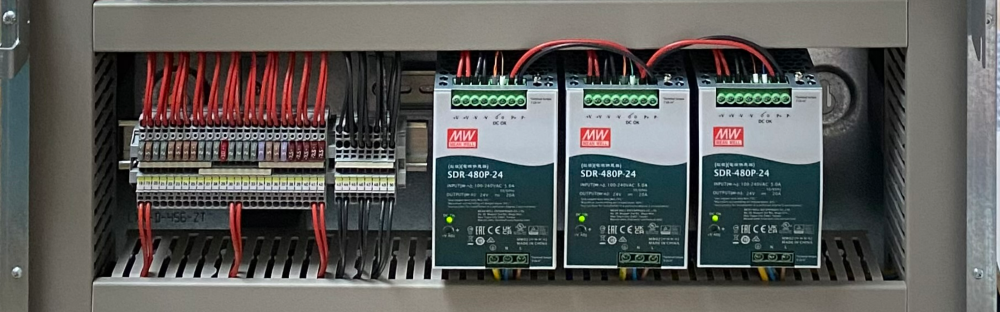
I have a preference for using larger power supplies connected in parallel and then seperately fusing each 24v circuit. This balances the load and provides some redundancy. Also means you don't have to define which circuits are fed from which power supply so much more flexible and if one dies (rare I know!) you can disconnect and swap it out without half your circuits not working or needing to rewire anything. This is how I generally do it..........
-
I have the RGBW dimmers in my Loxone cabinet and then run a 3C&E and a T&E to each light circuit to give me the 5 cores needed. I did this a few years ago before Loxone launched the compact dimmers and if I were doing it now I would definitely use the compact dimmer trees located remotely near the LED strips. You then only need a single T&E (for the 24v) and a cat6 tree connection to each dimmer. If you have the dimmers in the cabinet you need at least 1mm2 cores to the LED strips.
-
I'll second the use of gel crimps. Cheap and very easy to use, you don't even need to strip the cable.
-
There's no termination resistor required for tree cabling. Main thing to remember is that you can't have the tree bus connected as a closed loop anywhere. Also, for every retractice switch (assuming it's a single pole push type) you will need to feed it +24v (from orange tree wiring) and then take the return from the switch back to the panel as a digital input using one core of the cat6a cable. This means you can have a maximum of 4 digital inputs (e.g. retractive switches or door contacts) per cat6a if it is used as a tree cable but that you also then have no spare cores in case of any wiring issues later (e.g. plasterboard screw through cable!!) I love that you have a dog shower in your boot room.......
-
@jack to keep all your cat6 type cables nicely terminated you could fit a 110 block outside the panel to terminate all the cables and then just bring in the pairs/cores you need. This one does 300 pairs (so 75 cables) for about £40. Yes, it's designed for cat5e but there's only a 0.06mm2 difference between 24awg cat5e and 23awg cat6/6a. Much cheaper to do it this way than using patch panels or the Weidmuller 8x8 DIN rail blocks.
-
When I originally started with Loxone about 5 years ago I used their own version of Cat7 for all my wiring at home. Now I tend to recommend cat6A as it's more than up to the job. Interestingly, Loxone used to push their cat7 cable advising it was always better because it was fully shielded etc, but when they started marketing their "Tree" cable funnily enough there's not a sign of any shielding!!
-
Hi @Thorfun thanks for the mention ☺️ My thoughts……….. The general principle I use when designing wiring layouts is to run a tree loop around each floor connecting the presence sensors as they will all usually be within ceiling voids so easy to cable to. I then take branches off and drop down to switches which usually means only one cable at each switch. There are various options and it may come down to how easy it is to run cable in a particular space. The cat6/6A/7 debate is always interesting but I would tend to go with cat6A as the most recent IEEE ratified standard (AFAIK cat7 isn’t an IEEE standard). Colour coding is a sensible approach as you’ll end up with dozens, if not hundreds, of cables! Do not use the Loxone suggested tree cable. It is designed purely to provide partner installers with the quickest installation method but in my view is the worst option for cabling an installation as it completely cuts out any future options without re-wiring. The two 1.5mm cables are only suitable for extra low voltage fittings (e.g.24v) and do not meet requirements for fixed wiring under BS7671 (AKA 18th Edition wiring regs). I would always run min 1.5mm2 t&e to every light circuit as this will give you the option for any type of light fitting (24v/230v etc) as you can decide what you throw down the cable and even change it later without much hassle. Using t&e meets wiring regs for mains wiring so will never be an issue later. Don’t run t&e to switch positions as it’s unnecessary if you already have a cat cable/tree connection. If some future buyer gets stroppy about not having “normal” light switches, you can easily swap out the touch switches for standard looking Quinetic ones and fit the switching receivers in each circuit. You could probably sell the touch switches for more than the cost of the Quinetic gear 🤣😂 As I supplied all your kit, I'm always happy to offer any other advice, just ask.
-
Drop Adam (the owner of LocalBytes) an email on adam@mylocalbytes.com and i'm sure he'll be able to answer any technical questions
-
They do now - the UDM SE.............. https://eu.store.ui.com/products/dream-machine-se
-
No idea - don't have time to follow the market and I'm still very happy with my Ubiquiti set up so not looking to change. If I were starting from scratch now I'd be doing a whole heap of research, as I do for most things so that I get the best solution for the price I'm prepared to pay.
-
A good option but unfortunately, when I contacted Mike at White Wing a few weeks ago to enquire about the AC dimmers he advised that due to component shortages they are unlikely to be available again until next year. Cheap chinese ones may be an interim option.
-
Where to buy Loxone kit (DIY)
Rob99 replied to Hilldes's topic in Networks, AV, Security & Automation
The demo case would save you about £80 if you were intending to re-use all of what I call the "usable" elements - Miniserver; Tree Extension; Air Base Extension; Touch Tree; Presence Sensor Tree and RGBW Dimmer Tree. Effectively the other bits in the demo case would then be free and might be useful to you. The advantage of the demo case when you're learning is that it's all in one place, plug it in connect to the wifi router in the case (or cable the MS to your home network if preferred) and away you go. The inputs and outputs are also connected to LED's and switches so can help with just seeing how it all works, although LIve View in Config pretty much does the same thing. If you don't think you will re-use all of the equipment (especially those I listed above) then buying seperate bits might be more cost effective for you, although you could sell some of the stuff online as there is a market for it. As with many things in life, neither option is a bad choice, especially as you're committed to having a Loxone system anyway. -
It seems to me the objections will get nowhere, although it does look like they're hinting heavily that what they really object to is that they don't want some sort of air BnB type thing in the future. Asking for a condition that it is re-converted back to a garage later is unreasonable and I don't think has a basis in planning, except where you're asking for temporary permission, which you're not. The layout does seem to waste a lot of space with a long walkway from the front door to the rear living area. You could consider moving the shower room so that it sits across the full width of the garage either at the front or the back which will give you a much more flexible "squarer" living space with space for a small sofa or chair. I don't think you need 2 doors either, a single door is probably more sensible and, whilst not suggesting you concede anything to your neighbour, they would see it as a minor victory for their "complaint" and could be seen as you taking on board their comments and being a good neighbour. I would put the door facing your house, or leave the existing opening where it is. Good luck.
-
Building an extension near the foot of a retaining wall
Rob99 replied to Edward's topic in House Extensions & Conservatories
Definitely sounds like party wall legislation applies here. Speak to your neighbour about it as they may not know. Lots of people think, oh it's my land and I have planning and building control permission, but don't always know about party wall stuff. It's worth remembering that all costs of surveyors etc for dealing with the party wall matters are your neighbours responsibility, including any surveyor appointed by you. If you can agree on a joint surveyor it's cheaper and easier all round (assuming you have a good relationship with your neighbour). Also, I would make sure that whoever is doing the work carries full insurance as, if anything happens to the retaining wall during the works, your garden and the garage could end up in your neighbours garden!! -
I'll reiterate my previous point as to how on earth a non-governmental and non-statutory body are able to completely f*** up the legal and statutory framework for planning in England with a piece of guidance which appears currently to have no statutory backing. I acknowledge that these issues need to be looked at and considered but ffs who on earth decided that such a knee jerk reaction was at all appropriate. I really do think the whole planning system is becoming more stacked against anyone who wants to do anything in this country, much more than is currently the case which is bad enough (except Graven Hill of course where you can build anything you like!!). I now hear that there are proposals being considered which will effectively allow neighbours and/or community groups to decide whether you can build an extension on your house. Words fail me....!!!
-
Plans in for approval keep having to be changed
Rob99 replied to Deejay's topic in Planning Permission
It seems like your architect hasn't kept up with current thinking and also doesn't seem to understand what the LPA will consider acceptable in the location. Don't fall into the trap of sticking with him and ending up with a compromised design "that will do" but isn't really what you had hoped for and which you may regret later. Your comments about his 10m high option for a new build to replace existing also suggest you would be better seeking out another designer (not necessarily an architect).


