Rob99
-
Posts
330 -
Joined
-
Last visited
-
Days Won
1
Everything posted by Rob99
-
Quick question if I can - are optimisers worth it?
Rob99 replied to MrTWales's topic in Photovoltaics (PV)
I thought panels these days were very good at dealing with shading on their own so you would only lose around one third output from the partially shaded top left panel and probably all output from the partially shaded bottom left due to its landscape orientation. The other panels should be pretty much unaffected. -
I don't currently have a smart meter but am just about to switch to Octopus and then get them to do the smart meter
-
The only thing I would change is to switch to Octopus first and get them to fit your smart meter
-
Thanks @Thorfun, that's good to know. Is that 10kW export on a single phase? Our road has loads of houses with ideal south facing roof slopes but only a couple have bothered with any PV. I'm quite surprised. Yep, as don't want to pay any leccy bills if I can avoid it, even when the sun don't shine 🤣 Yep, I have a mahoosive excel spreadsheet. Battery payback is around 5 years but that's not my main motivation for having them
-
Anyone been able to get approval for G99 8kW export with UKPN in Sussex? It seems like they would automatically approve 5kW export but I'd like to go to 8kW as I'm planning on a lot of PV and batteries.
-
Do you mean an actual meter or is this the CT clamp I see on installations?
-
Maybe I'm getting things confused between DC and AC side! (I did say it was a bit of a brain dump - my head hurts with so much information to process LOL) At some point I'll likely have up to 20kWh of storage so I want to be able to charge or discharge within a 3 hour window which with a nominal battery voltage of 55v (if my maths is correct) is around 120A. Of the specs I've seen the limit on most is well below 100A and some as low as 30A. This may seem like I'm over-engineering my requirements but I don't want to get 3 years down the road and find I may need to upgrade the invertor to cope with larger battery storage. How does this work in practice? For example, if I have a 8kW invertor, and DNO export limit is 5kW, is this a setting in the firmware?
-
I was making a general point. I intend to export so I will only have a compliant invertor installed.
-
Already started that process and registered with my DNO (UKPN) to submit a G99 application. They will automatically approve 5kW but I may submit for 8kW anyway and see what happens. I'll be posting seperately about the G99 application in due course as I think I will need some help on some of the questions!! Yes, I've been checking the ENA lists but with invertors being added and dropped off the compliance list daily they are a bit of a moving target so checking every possible invertor won't make sense. It doesn't help that some non-compliant invertors are still being sold and installed in the UK. I've seen some posts on FB groups where people have had systems installed by "proper" MCS contractors where the invertor is no longer on the ENA compliance list (as it's an older version) so their DNO is refusing connection. One to watch.
-
Loxone question: So many dimmers...
Rob99 replied to BartW's topic in Networks, AV, Security & Automation
Sounds good. I had a client who did exactly that with 5 RGBW dimmers in the cabinet for 17 white 24v lighting circuits. I also had a fancy LED pendant light in my dining room which when I checked had a 24v transformer so I stripped that out and connected it up to a spare RGBW channel, so it's always worth checking inside. -
Loxone question: So many dimmers...
Rob99 replied to BartW's topic in Networks, AV, Security & Automation
Yep, that'll do the job nicely. 👍 -
As a minimum I want to be able to pull real time data out of the invertor into Loxone (preferably not via a 3rd party bit of kit e.g RPi etc). PV generation, battery charge level, battery charging/discharging info, house usage and export power feed into the Loxone energy management functions, for example to decide when to divert energy to immersion and how much, all linked to house usage. It would be useful (but not essential) to be able to ping stuff back to the invertor for example to tell it when to charge/discharge the batteries and when to export. With Octopus Flux there are fixed daily periods for low/normal/high rates but in future (already happening in Europe) there's likely to be more tariffs with day ahead half hour pricing and this can be managed with Loxone.
-
Hi All Unfortunately not been responding to anything last month, had a few family issues to deal with so not much free time!! Also, apologies in advance for the long post (and possibly repeating myself from earlier posts)……..bit of a brain dump! Anyway, back to questions about PV etc. and thanks again to those who replied previously 👍 Panels I’m now pretty much OK with so I’ve been looking at invertors and it’s just a minefield out there. I’ve joined a couple of facebook groups recently thinking it would help but I think I’m suffering from information overload now. As I see it, it seems to be a bit like choosing anything else (houses, cars, TV etc), they all do what they’re supposed to do but you have to delve into the detail to work out if it does what “YOU” want it to do. It's likely we’ll end up with around an 8.5kWp PV array (split East/West) so I’ve been looking at invertors which will cope with what PVGIS estimates is our maximum PV generation of around 6.5kWp. As you’d expect there are lots to choose from but getting some of the detailed info on them can be difficult. One of the biggest issues for me is that invertors (even ones stated as 6.5k) often have a maximum pass through rate of 3.6kW. Whilst this appears ok as they will use your max generation to charge your batteries, once batteries are full they will start clipping the output, so even if your panels are generating 6kW you can only use 3.6kW either in your house or for export. I suspect this is to do with the “standard DNO” cutoff point of 3.62kW export and I guess is designed for the hundreds of installers who are just wacking in small PV systems and are probably the biggest chunk of the invertor market. What I want from an invertor is that it will pass through as much power as my PV generates and will only start clipping output when batteries are full and usage plus export has maxed out. If my system is generating 6kW, my batteries are full and I’m using 3kW in the house, I want the invertor to then export the remaining 3kW. Seems very logical and sensible to me but I’m not finding it easy to identify a range of invertors that work that way. Following a post by @Nickfromwales I took a look at the SunSynk invertors and so far seem like they might fit the bill, or maybe it’s just there’s more information on them compared to other makes. I was quite impressed with Victron but they seem twice the price of many others so may not be an option. In addition to not wanting the invertor to throttle my AC power availability I also want to be able to communicate with it through my Loxone system. I’m not expecting a massive level of integration but would like Loxone to be able to control schedules for charging/discharging batteries, heating HW, grid export etc. I don’t particularly want to rely on programming the invertor by hand or through the manufacturers cloud based App as much of this stuff is more than just time schedules. Loxone will be able to do it all in the background, especially when half hourly electricity tariffs become much more common. Maybe I’m asking too much, but when I’m looking at dropping £15k or so on a PV/Battery system I’d like to think that I will be able to get what I want. So, at the moment the SunSynk invertor seems to be top of my list (thanks @Nickfromwales), subject to it being “Loxone friendly”, but would welcome any and all comments about what others have or would recommend, especially those of you who have Loxone and may have successfully integrated it with your invertor.
-
new wiring, all sockets tripping charging a phone !?
Rob99 replied to connick159's topic in Consumer Units, RCDs, MCBOs
If he didn't do this I'd be very worried. If he did and there's still a fault I'd still be worried! I'm also wondering why, on a full rewire, he's still using an RCD? Most electricians now are moving to using RCBO's instead and soon it will be mandatory. To try and isolate the fault you should investigate one circuit at a time. Turn everything else off then check every socket in turn. Same for lighting circuits. Another thought? Do you have a faulty RCD unit? Does happen occasionally. -
Steady, there's more of us than you might think.........🤣😂
-
I'm pondering this exact same question at the moment in planning for a PV and battery system. The information out there on inverters is quite detailed in the technical specs but the simple questions like "can I use all my PV generation as AC power for house loads or grid export" aren't very obvious.
-
Thanks @SimC @Marvin @S2D2 & @Dan F Some great comments, I'm away now until Friday evening but will try to read and digest everything by then 👍
-
So, I think I’ve got my head round panels although still need to decide on which ones and work out the ideal combination of size and output to max out the installed array. Looks like I might get between 8 and 9kWp on the roof which would be good. I’ve now had an initial look at inverters. I have a pretty good grasp of most things, especially engineering or electrical related but at the moment I’m completely confused about the variety of inverters out there. In simple terms a solar PV installation is a DC/AC split system with PV and batteries on the DC side and house consumption and Grid on the AC side. Analogous to East and West Berlin with the inverter being Checkpoint Charlie connecting the two sides. Can I assume that the DNO and the rest of the outside world don’t give a hoot about the DC side and therefore you can have as much PV and battery storage as you like – fill yer boots! On the other hand the DNO do want to know what you have on the AC side of the inverter as that is what you connect to the grid for export. Anything exporting up to 3.68kW gets automatic approval (G98 install and inform) and anything above needs some sort of additional application and approval (G99/G100) prior to install. This seems nice and straightforward so far. However, when it comes to the inverter, how do you size it correctly? Presumably based on your PV array size but then it also has to be able to export what surplus you produce (or may discharge from your batteries). So, lets say generation is 6kWp and your batteries are full, does this then all get output as AC power, some of which (say1kW) will be used and the remainder (5kW) exported. If your DNO approval (or restriction) is 3.68kW what happens to the “spare” 1.3kW? Also, if your inverter has a max 3.68kW output due to DNO restriction, does it only output a total of 3.68kW to be split as usable power and export (if any left) regardless of the DC input. This scenario doesn’t seem right to me so I think there must be a different explanation. For example, do inverters have separate outputs for export and for consumption? The export output being the one of concern to the DNO. Unfortunately, lots of inverters don’t really make it very clear either. I think I need another lie down………!!!
-
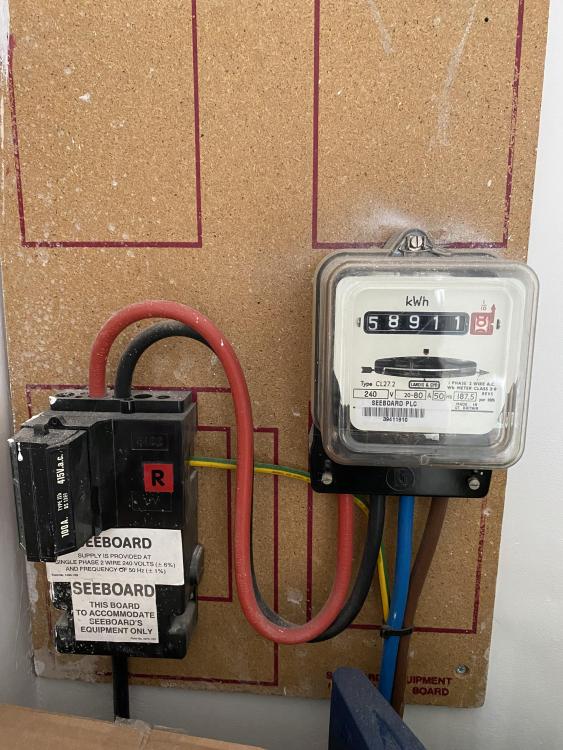
Yes, that's technically a DNO cutout, it's the incoming main with a 100A supply fuse. I was referring to the type of DNO cutout which is a double pole isolator installed after the meter so that fixed wiring/consumer units etc can be isolated without touching the meter/supply fuse (which technically you're not supposed to as it's not yours.
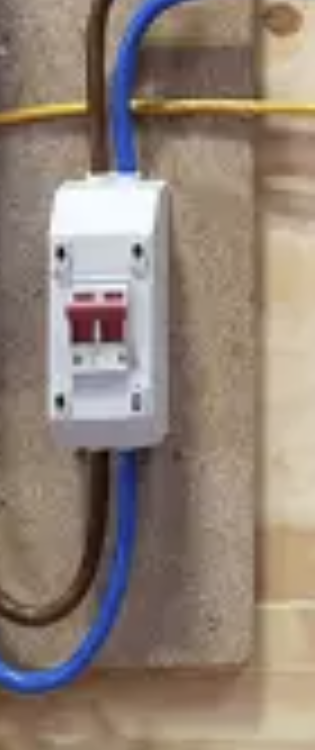
-
Here you go. Pretty much as it was when we bought the house in 1995, except for the upgraded meter tails the electrician did a few years ago when we extended and had a new consumer unit installed (hence the missing seals!)
-
That would've been great but I've been one of those cynical types suspicious of the motives of energy suppliers so always refused a smart meter until it would benefit me. Seems like now is that time 👍 Just on that - should I get one fitted by my current supplier now, or would it make more sense to have it done after I sign up to Octopus? Is there a lead in time for meter changes? Also, as my meter installation has never been touched since the house was built in 1995 it doesn't have a DNO cutout and I'm guessing I'll have to have one fitted. Will the meter people sort that or will they turn up, sharp intake of breathe then "sorry mate can't fit your meter as no DNO cutout" and then scarper?
-
I'm just at the stage of working out what I want and system configuration........... https://forum.buildhub.org.uk/topic/32871-planning-a-solar-pv-and-battery-system/
-
Yes, that's also true as I've been measuring hourly consumption over the past month when it's all been on BST. I now have a pretty accurate model of our hourly, daily and monthly usage. To ensure accuracy with matching usage to generation and timed tariffs like flux I have shifted all the PVGIS generation figures forward by an hour between April and October so that they match BST during that period. It's actually made a difference to the modelling, especially with Flux. Not a huge difference but my OCD wouldn't allow me not to change it 🤣
-
Couldn't find any reference to UTC on my downloads but when I look at the historic data for today (Apr25) the PVGIS data shows no solar generation after 7pm whereas sunset is at 8pm (BST) so it must be using UTC.
-
Initially I just needed something to use as an estimated array size in PVGIS and those panels are what I was quoted for by an installer previously. Having looked at lots of panels in the past few days I know there are lots of higher power ones now but they are also different sizes. Some of the larger output panels won't fit on my roof in 2 rows so wouldn't be suitable. I've also noticed that even the higher power panels generally seem to produce the same power per m2, usually around 210-220 W/m2 so it'll be all about matching panel size to the roof to maximise the kWp output. I just wish you could get triangular panels to fill in the corners too....!!! I'll be doing a lot more research when I look at panels as I also want something completely black if possible. The Perlight Delta panels look very nice. I think they are also the new "shingle" type ones too.