Rob99
-
Posts
330 -
Joined
-
Last visited
-
Days Won
1
Everything posted by Rob99
-
Looks fine to me 👍
-
Which SSR's did you go for?
-
1.5mm2 tri-rated is rated at nominal 21A but you should derate that if you are bunching cables together. Sounds like your sparky knows his stuff though. Besides you have to keep below 16A if you're using the Loxone relays, or 10A on the miniserver relays.
-
Yes, all the earth connections are made with the earth bars fitted to the back plate of the enclosure at the top/bottom. The main issue I see is that you need a way to distribute the RCBO feed to the relays but without the triple height blocks you can't do this at the terminal block end. It's not an ideal solution but one option would be to take the RCBO feed and loop it across to one side of all of the relays which link to that RCBO so that when you wire the other side of the relay back to the terminal block you are effectively feeding switched live into each terminal block. Your neutral would then be commoned across the terminal blocks.
-
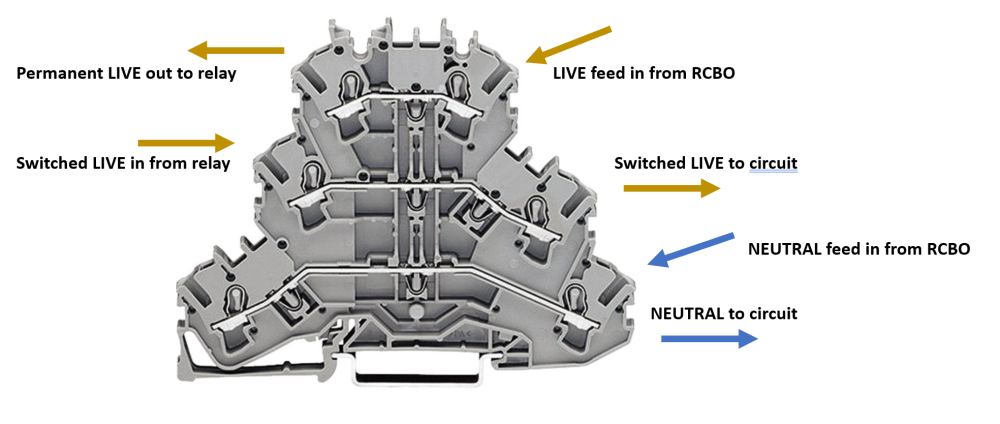
If those are double height terminals on the top DIN rail then you won't be able to use them to distribute power from the RCBO, through the relays and out to the individual circuits as there aren't enough connection points. I use triple height blocks for RCBO fed circuits. The Live connection sequence needs to be....... RCBO >> Terminal Block >> Relay >> Terminal Block >> Circuit. To achieve the correct connections, the RCBO Live feed goes to the top level and is commoned across all terminals at that level. The RCBO Neutral feed goes to the bottom level and is commoned across all terminals. The Live to each relay goes from the top level out to the relay and returns to the middle level. Circuit connections on the outgoing side are then made at middle level for the switched Live and bottom level for the Neutral. Hopefully this might help:
-
If there's no connection of those cores at the other end I just keep them the same length as the Orange/Green pairs and then coil them round the screwdriver shaft and tuck them into the back of the box. If they're left inside the back box they are easy to find later if needed. If they are behind the box in the wall space then you might need to remove the box to get at them, possibly damaging your decorations.
-
Yep, you can just push them in and out once and they should snap off cleanly, no cutting needed
-
I always do ferrules at both ends. Keeps it neater and straightforward for anyone else making wiring changes later on.
-
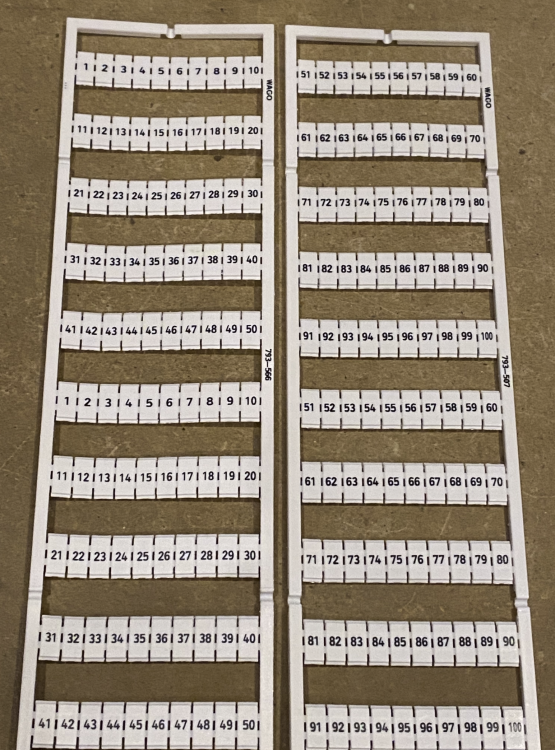
These are the labels I use
-
I've never used the label holders. I just use the standard individual pre-printed number tiles which click into the top of each block. I seem to remember it was a pain to identify the correct wago product reference as there are several different types and most online stores also get confused about which ones fit the 2002 series. I'll have a dig around in my panel build box and check which ones I used.
-
My triple height Wago's are 70mm.
-
The triple height Wago 2002-3201 that I use will fit in a standard depth FA enclosure if you mount the DIN rail directly on the back with no spacers. The last LXN5 I built was fine with these Wago's and there should be clearance of about 10mm behind the front cover. Also, you can gain another 7.5mm of depth by swapping the standard 15mm deep DIN rail for a 7.5mm deep one if necessary
-
@Dan F makes a good point here. Usually it is necessary to mount the top DIN rail closer to the back panel so that the 8x8 blue/grey cat6 terminal blocks don't foul the front cover which would leave much less space behind the top rail to get your cables down to the next DIN rail. Where I've used two rails for terminal blocks it's usually been a 6 rail cabinet which is much deeper than standard. This allows me to mount the top 2 DIN rails on shorter standoff brackets (30mm standard depth panel ones, as opposed to 70mm deep panel ones) but still leaves plenty of space behind the rail to get cables through. I have found it possible to feed cables behind a DIN rail, even if it's on 15mm spacers, but it's a bit awkward. You also have to consider how you're going to get the cables past or through the cable trunking after all your internal wiring is in place.
-
Ah, bugger! Might be worth contacting Mike at WW to see if you can parallel 2 channels.
-
Although different colours usually have slightly different wattage, in most RGBW strips the variation between each colour will be quite small so I wouldn't worry about individual channels, just go with 3W/m for each colour. Split the LED strip into 2 and then connect each one to a seperate whitewing output, the 2 DMX actuators can then be commoned to a single lighting output in config so will act as a single strip. Extra tip, if you can, have both ends of each strip connected as that should prevent any slightly "dimmer" areas furthest from the power supply.
-
It's a while since I did anything with DMX but as far as I can remember, all colour options/moods etc are configured within the Loxone lighting controller and the controller takes care of what is output on the various output circuits (Lc1,Lc2 etc). For DMX I think it is just a case of adding the "DMX RGB and W actuator" device to your DMX extension (which itself will be configured to send DMX signals to the whitewing module) and attaching the actuator to the Lighting Controller output. The actuator type in Loxone should show up as SMA (smart actuator) in config.

-
Yes, the Miniserver relays are rated at 10A
-
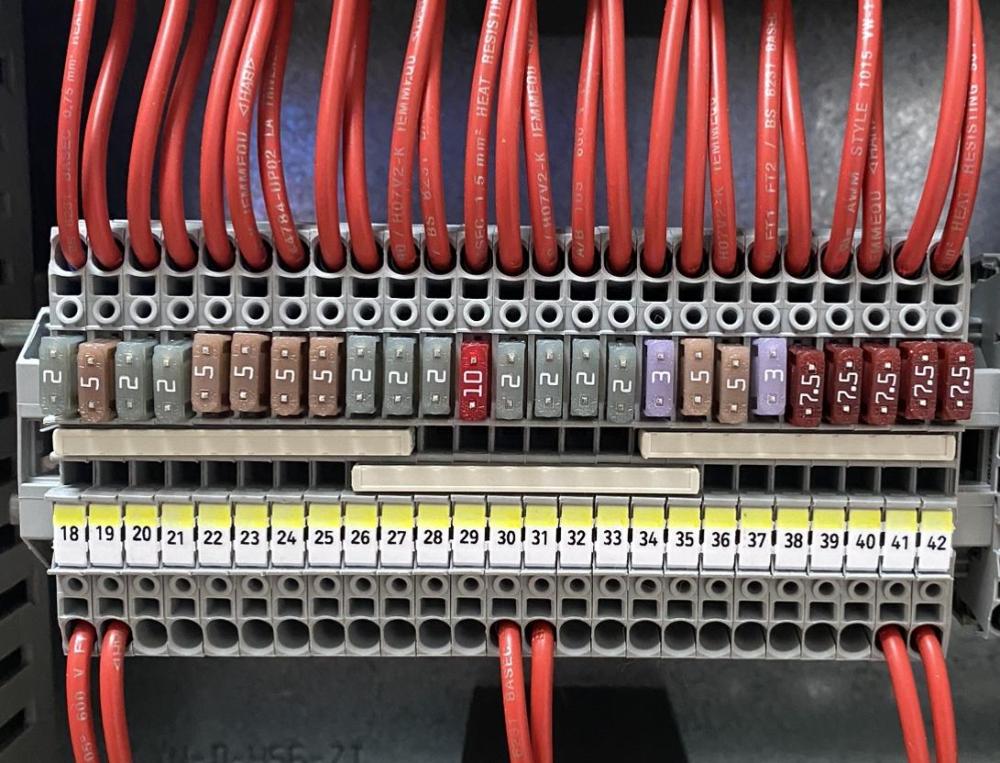
Example of overlapping
-
Each terminal block has 2 slots at each level for cross connectors so if you need to connect more than 10 terminals then just overlap the cross connectors. I always overlap by at least 2 ponds to make sure of a good connection. just a thought on your RCBO’s, I’m not sure as I haven’t used one yet, but I think the WhiteWing dimmer only has a single neutral connection pass through to all dimmer circuits so will probably have to all be on the same RCBO to balance.
-
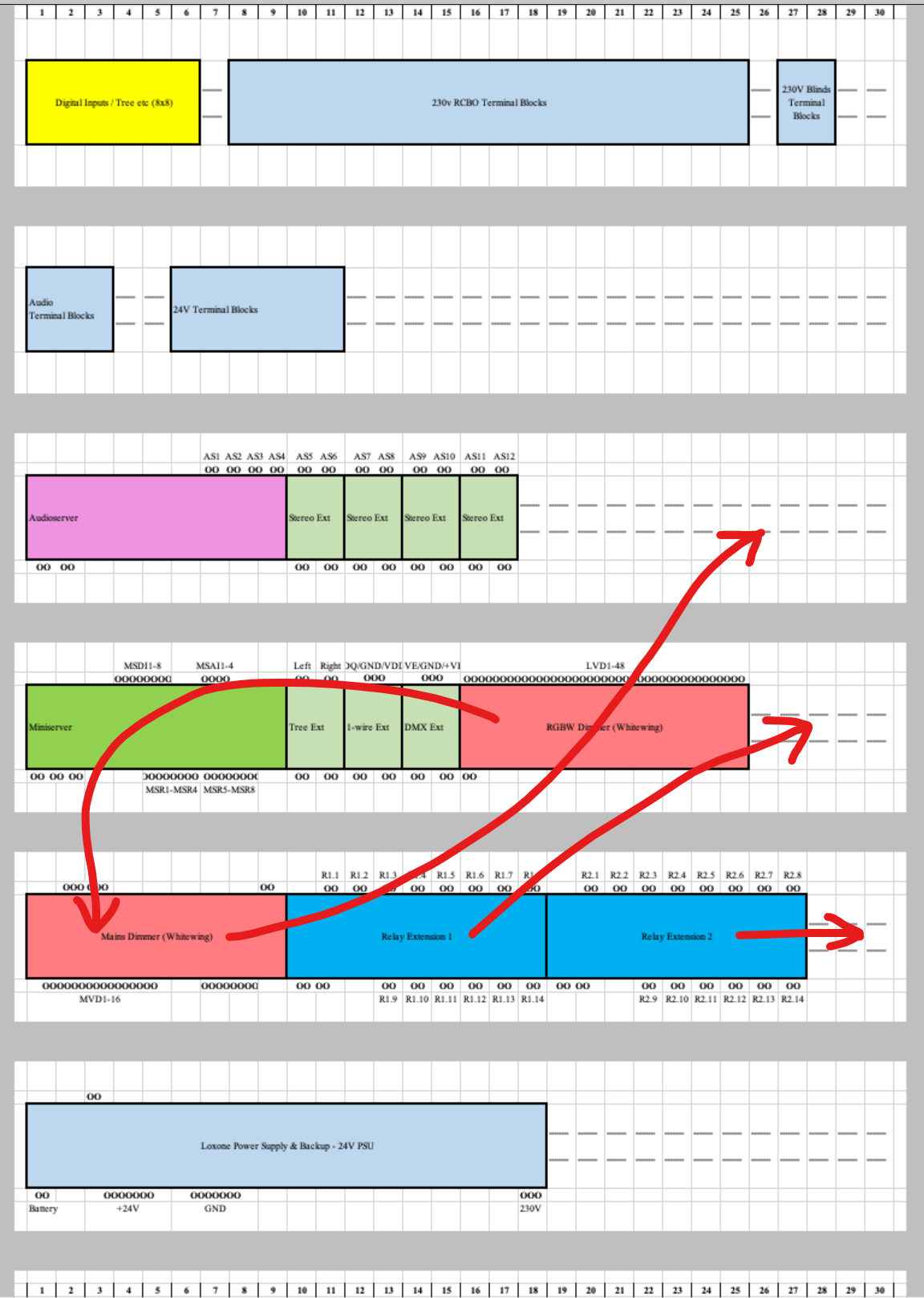
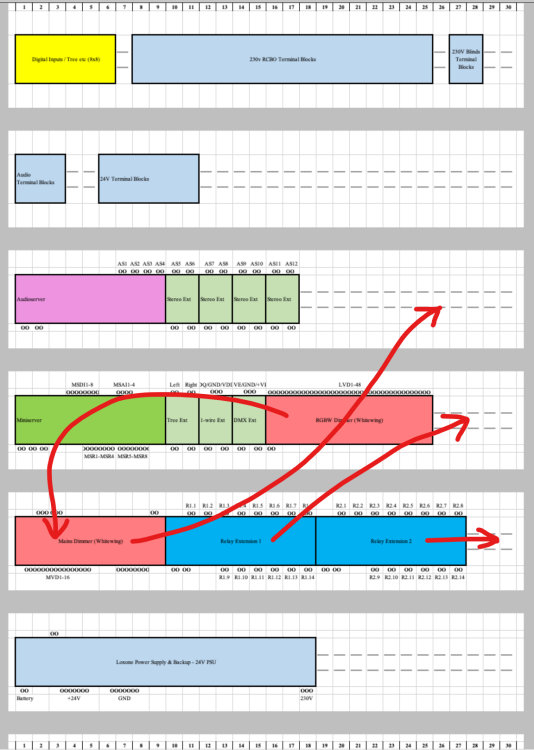
Might make sense to swap the 2 whitewing units round, so that the 24v RGBW unit sits below the MS. Then run the WW mains dimmer and two relay extensions down the right hand side of DIN rails 3,4,5. It will shorten some of your wiring and keeps the mains voltage and low voltage wiring nicely seperated, in the right and left trunking. Sketch attached.
-
No special tools required, just a screwdriver to insert into the release hole on the Wago blocks and to push the release button on the Weissmuller 8 level. Solid core cables should push into the wago without any hassle, stranded (e.g. tri-rated cabinet wiring) should be fitted with bootlace ferrules. As the 8 level blocks use smaller gauge wire I find it best to push the button first then insert the cable.
-
The cross connectors are not designed to be cut to length as that would leave an exposed end. I buy whatever sizes I need to use but usually buy in small batches. I don't bother with coloured terminal blocks or cross connectors, just buy the standard grey. You seem to have a lot of end plates on your list, I'd be surprised if you needed that many. I've never found a single supplier who was able to source everything I needed so always have to place several orders. EIB market came close and cheap but they are in Europe and won't now sell to UK since Brexit. I found Hub good for some of the Wago stuff, and a decent price. I think they are local to you too. The CPC/Farnell price thing is bizarre as they are the same company. Have you tried RS? I find them really cheap for some stuff (e.g. DIN rail terminal block end stops) Not specifically terminal block related but I have found Digi-Key very competitive on other components like power supplies. Even shipping and customs from the states (which is all included in their price) they were 20% cheaper than I could buy from any UK source.
-
All those terminal blocks should work fine together. I use most of what you've listed in my cabinet builds. I don't use the 2003 series as I never see the need to connect the earth of any circuit to the DIN rail, preferring instead to install large earth bars at the top of the cabinet. The cross-connectors/jumpers can be bought in 2-10 way variants. Which suppliers are you sourcing your terminal blocks from?
-
I have always built cabinets with RCBO feeds coming from the main DB, not included within the Loxone cabinet. Having RCBO's within the cabinet and as the only form of circuit protection and isolation in my view would not comply with current regs. Using RCBO's or MCB's in the Loxone cabinet as a secondary means of circuit isolation I would say is fine but not something I have done for any clients.
-
Can't honestly remember now why I chose Wago, possibly they had a better range at the time for what I needed. Since then have had no reason to change so guess its a personal preference now. I know some people use Weidmuller and some Phoenix Contact. Yes, should have said Grey interconnected terminal blocks not Blue (it was quite late!!!)