

Ed Davies
-
Posts
1674 -
Joined
-
Last visited
-
Days Won
1
Everything posted by Ed Davies
-

Ownership / Copyright of Planning Design and Drawings
Ed Davies replied to davidc's topic in Surveyors & Architects
That's right in Berne Convention countries (most of the world, now) and has been for a long time (since the late 19th century for the original signatories including the UK). However, the US didn't accede to the Berne Convention until the 1980s so, before that, copyright needed to be more formally registered there, consequently some people still think that registration is required. Stating copyright is potentially useful in case of a dispute but is not required. (Spot who was peripherally involved with some IP matters in the UK labs of a US multinational in the 1990s. ? ) -
Yes. What I was wondering was if there was any way to warm the gasses returning to the outside unit but, on reflection, I think they'll still be quite warm as the expansion nozzle will be in the outside unit.
-
Pity the heat pump can't take heat from the room, somehow. Can it?
-
That would have been a planning requirement, rather than building control, wouldn't it?
-
No idea. People witter on about thorium, etc. Frankly, it's up to the nuclear industry to prove it. Great if they can but it'd be stupid to make any serious bets on it until there are a few reactors up and running.
-
My back-of-the-envelope calculations say the opposite so I'd be interested to see some numbers for that.
-
If one assumes that within a few decades the world will need to supply something like 9 to 11 billion people with energy [¹], say, about 3 kW per capita, about the current amount used in the UK [²] so maybe 30'000 GW, then it's difficult to see an alternative to renewable resources. Fossil fuel production would have to be ramped up tremendously to meet that demand. Current production is, last I looked, floating around 80 to 90 million barrels a day. One barrel of oil is around 6 GJ (~7bbl/tonne, 42 GJ/tonne) giving 6250 GW of primary energy which gets converted to final energy with varying efficiencies. OK, there's gas and coal but it's still not even in the right ball park to give the human population of the planet a decent standard of living even if there weren't the immediate health problems with their use and the climate change problems. Similarly, can anybody see a world with 10'000 Hinkley Point-sized reactors operating? Uranium is not currently mined in difficult places around the world because there's so much available to be just picked up where the reactors are already. I'm not sure that nuclear could be run on anything like close to that scale at all and think it's very unlikely without breeder reactors with all the reprocessing considerations: safety from accidents in transport and processing and from diversion to weapons.There are something like 400 reactors or power plants around the world now and we've been running them for something like 60 years. Two have popped off causing major disruption to the surroundings so that seems like once per 12'000 operating years (quite a good record) but with 10'000 running one would go off roughly once every 14 to 15 months. So any policy which relies on fossils or nuclear is essentially racist: it assumes large swathes of people in the “third world” can be made to do without energy which we deem essential to ourselves. I think renewables are the only plausible option (with update saying it's actually a bit more plausible than my first version). So what should the UK do? Wind, both onshore and offshore obviously, but PV can help a lot particularly to reduce the storage requirements because PV generates a bit most of the time and particularly when it's less windy. Some PV in the UK is probably best on solar farms but putting significant quantities on suitable domestic and commercial roofs seems like a no-brainer to me. I totally agree that the UK government made a mess of the FIT scheme. The start up rate was too high and the way it was reduced was completely ham handed. It should have been brought down to some moderate level a lot quicker then tailed off over a much longer period with a lot more clarity about what the plan was. It's also worth pointing out that the main reason PV prices have come down is the high uptake in Germany as a result of their, also generous but better managed, FIT scheme. Ditto the various schemes which have expanded wind power there and in Denmark, Austria and so on. The UK FIT scheme has made a contribution, too, of course. For the individual builder, installing PV seems like buying insurance against that lot further messing up the energy industry and causing higher prices yet. [¹] Note, that's energy, not just electricity which tends to be about 1/10th to 1/6th of a country's energy use. [²] I.e., slightly more than the EU28 average of around 2.8 kW/peep and roughly half that used by USians or Australians.
-
PV is well worthwhile in the UK as a good complement to wind. It's the countries in southern Europe with less that we should be laughing at.
-
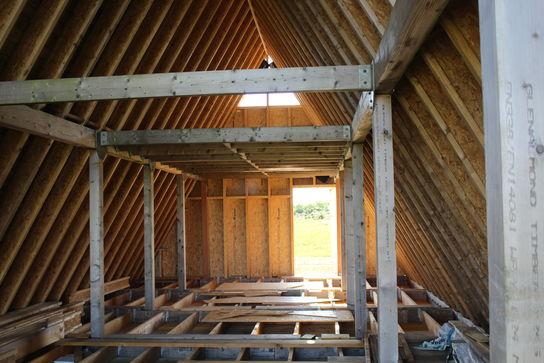
My build is sort-of-Segal post and beam with timber I-beams over the p&b forming an A-frame. I wouldn't do it that way again on this exposed site; I totally underestimated how much the weather, the wind particularly, slows down the work especially when doing stuff on your own. Also, the time consumed making up the blocking for the I-beams. I think I'd get an MBC or similar frame put up to weather tight with the minimum internal stud-work needed for structure then do the fitting out myself.
-
That's a very weird circuit. In addition to what @JSHarris says, the lack of a resistor on the base of Q1 is cause for raised eyebrows, I think. Also, I'm not sure how it's intended to be used but I assume the idea is that the relay switches the radio off. Good luck finding a relay which can consistently switch more powerful devices like circular saws of a size that can reasonably be fitted in hand tools.
-
Interesting, it's obviously more complicated than what was explained to me. Still, I think all the nails I've bought (Paslode packs specifically for the IM360ci) are clipped head. The other thing that swayed me towards the 360 was that it can do 90mm ring nails whereas the 350 can only do 90mm round/smooth ones. Actually, the 360 does struggle a bit with 90mm ring if there's some tougher wood in the way. E..g, the other day I was doing some JJI beam blocking firing them through 2x18mm ply + 3x9mm OSB3 and about half the nails needed a few taps with a hammer to get them right in. Same layers but all OSB and that very rarely happens. That table says “Power (impact force):” 82 J for the 350 and 105 J for the 360. Apart from that being “impact energy” (joules don't measure power or force) that would explain the difference.
-
Is that the 350+? Saw them the other day but didn't investigate. As it was explained to me, the 350 and 360 take the same nail types but they have different gas cartridges. You buy packs of nails and cartridges together (e.g., 2200 90mm nails + 3 cartridges). I think you can buy cartridges separately but they're so expensive that you can't save money by buying them and nails from another manufacturer. At the time I bought mine Montana did nail packs with cartridges compatible with the 350 but not ones compatible with the 360. The Montana packs were about half the price of the Paslode ones. I should have checked the other day to see if they now do ones compatible with the 360 but, given there's a li-ion version of the 350 out now I suspect they won't. Ugger. BTW, the chaps who did my sarking last year used Makita nails guns. They dropped quite a few half strips of 50mm Makita nails around the site which I picked up and have used in my Paslode with no problem.
-
“Oh”, indeed. Probably with another word after it. Bit courageous to try two batteries, though. But I suspect there was something wrong in the way it was connected up if nothing happened with the hedge trimmer. Wired properly, I think you'd only knacker the Makita batteries by over discharging. It's a pity they work that way (switch off in the tool) really as I'd quite like to rig up something to run my work lights or telescope off my Makita batteries but don't really want to take the risk.
-
I have the IM360ci. Done about 6000 or so nails with no problems. But, yes, the nails are the same as on the 350 and you could use clone nails but the gas bottles are different so you're stuck with buying Paslode packs for all practical purposes. Got another 2200 90mm ring nails the other day for £54 (+VAT). When I bought it two years ago I dithered between the IM350 and IM360. I knew that I could get cheaper (non-Paslode) nails for the IM350 but they had the IM360 on special offer so the actual gun was cheaper, having a Li-ion battery was attractive and my thinking was that by the time I'm done the 360 might have a better resale value. Not sure now if that was a wise decision but probably not a terrible one.
-
Isn't the usual thing to fix vertical battens to the sheathing, then put horizontal battens across if needed for the cladding, to avoid damming any water that runs down the sheathing?
-
Haven't had any problems in the cold with my Paslode nailer. Probably partly because I'm a bit of a wimp about working in the cold anyway but I was nailing the sarking under my floor during the “beast from the east” weeks last year
-
Yep. AIUI there is a fuse but it's for a huge current (100A). If you blow that the battery's officially dead so it's just a last ditch protection against a fire: https://youtu.be/AsTJKSH7mCU?t=224 Bit about the switching being in the drill: https://youtu.be/AsTJKSH7mCU?t=317 The follow on in the video about using it to start the truck is mildly entertaining, too.
-
Do I understand correctly that you intend to use Makita batteries on these other tools? If so, won't this leave the Makita batteries vulnerable to over discharge and hence a very short life? AIUI, with the Makita system the battery determines when it's discharged as much as is good for it and sends a signal to the tool to inhibit operation. Even when it thinks it's flat the battery's terminals still have voltage on them; the little work light on my circular saw comes on even when the motor in inhibited for a flat battery.
-
The schedule is presumably definitive so the map's wrong. Best bet would be to write to the council and tell them as that might avoid future unpleasantness.
-
Why would the plates of an electric heater need to be any warmer than those for a water heater? OK, you can get away with smaller, higher temperature, plates for an electric heater but they're not necessary and, as you say, could result in burnt dust so just use plates as large as needed for low temperature water and run them at the same temperatures.
-
Duct cooler? But @Nickfromwales mentioned a duct heater/cooler, I'm assuming as a combined unit. You wouldn't be using the heater with bypass so placing it for heating seems reasonable. Apart from the frost protection possibility I don't see any point in putting a heater or cooler in the inlet (outside→MVHR) duct.
-
I'd agree with @joe90, that seems a weird thing to do. If the MVHR is 90% efficient, for example, then you'd be throwing away 90% of the heating or cooling achieved via the exhaust duct (MVHR to outside). Much better to put a heater or cooler on the house side of the MVHR presumably in the supply duct (from the MVHR to the house) though there might be reasons to put it in the extract duct (house→MVHR) with only a small loss in efficiency.
-
The Great Thermal Mass Myth................
Ed Davies replied to Jeremy Harris's topic in Boffin's Corner
With a U-value of 0.1 W/m²·K but no decrement delay that 15 °C will give just under 15 W for a few hours a day to a 2.4 m-high room with a 4 m long external wall. That's not very significant compared with the hundreds of watts coming through any windows. -
The Great Thermal Mass Myth................
Ed Davies replied to Jeremy Harris's topic in Boffin's Corner
This is a completely different thing from the thermal time constant of the house. See my explanation further up this thread. You could, in theory, have a house with a very long thermal time constant because it has a lot of heat capacity inside but very little decrement delay because the walls have very little heat capacity. Imagine blockwork internal walls with aerogel external walls. (To be honest, I'm not at all convinced that decrement delay matters much in the UK climate most of the year for a well insulated house as the diurnal temperature variations just aren't that large. The only exception, really, is direct surface heating on a few exceptionally sunny days where the air temperature might not vary that much but the temperature of into-sun dark surfaces might. Maybe slightly more important in New Mexico or wherever.) -
The Great Thermal Mass Myth................
Ed Davies replied to Jeremy Harris's topic in Boffin's Corner
13 hours is pretty short. Are you sure that's right? That would mean that if it was left unheated overnight it'd get down to about half the temperature it had relative to outdoors by morning.

