
Ed Davies
-
Posts
1674 -
Joined
-
Last visited
-
Days Won
1
Everything posted by Ed Davies
-

MT-TUA-17S-11-9240 not responding to input signal
Ed Davies replied to readiescards's topic in Other Heating Systems
Reading the manual (https://www.europacomponents.com/pdfs/Relpol_Multi_Timer_Instructions_Final.pdf)) it seems that the range knob sets the general scale of the time. Yours is set to one minute in the photo. Then, I think, the top time knob sets the proportion of that to be used. Yours is set to 0.9 so 0.9 × 60 seconds = 54 seconds. Why are there two pairs of wires at the top of the unit? I'd expect either just a single line/neutral pair (for the Wu setting) or line/neutral and control if using one of the settings which use that input. Trying to measure something with one of those is likely to be pretty misleading (and very dangerous if you're ever tempted to rely on it for checking that a circuit is dead). Much better to use at least a multimeter. It doesn't have to be an expensive one but it'd be better if it's one with a “Cat” marking for at least some level of mains safety. -
Ah, sorry, misread/misunderstood your original post. Mine will also be similar to yours in that I'll have a separate porch/greenhouse on the western end with its floor level with the house floor. The porch/greenhouse will be enclosed but more subject to possible leaks, spills or condensation than the main house so I'll isolate its floor from the main house structure by continuing the ventilated cavity behind the cladding of the west gable of the house right down to the bottom of the house structure except for a short ”bridge” of decking at the front door into the house.
-
My house is a bit like that though on a flat site: post and beam on steel brackets on concrete foundation pads [¹]. Never though there was any need for a DPC. Why would there be? Or, perhaps you could think of the steel as the DPC. [¹] Some of the picture on https://edavies.me.uk/2018/03/some-flooring/ incidently show the construction of this part.
-
My understanding is that the extra pins on the 40-pin header include some which are used to identify the HATs (via an I²C EEPROM or something) so whether one with 26 pins will work depends whether the software needs that identification for setup.
-
UFH manifolds, etc, presumably need as much maintenance as TRVs. The main reason radiators need maintenance is because they're made of metal, not plastic. Why don't we make them out of plastic?
-
Dew Point - What is it and why does it matter
Ed Davies replied to Triassic's topic in Boffin's Corner
Hi Steamy ? I only partly agree. For some renovations where you're stuck with materials not selected with further insulation in mind then it's probably true that you need to play with WUFI or the like to get much confidence. With a new build, though, a simple equation should be enough to see if the build up is robust, that is if any liquid water gets in in some way then it's likely to evaporate and disappear reasonably quickly. In the absence of any further input from @Triassic the particular rabbit hole @TerryE and I went down was whether or not the straight lines in @A_L 's March 11th graph was reasonable. It might be worth going back to attempt to address @Triassic's original question, though. -
Why would you want to do that?
-
Or use a less conductive material? I'm quite partial to cork tiles for bathrooms and even bedrooms.
-
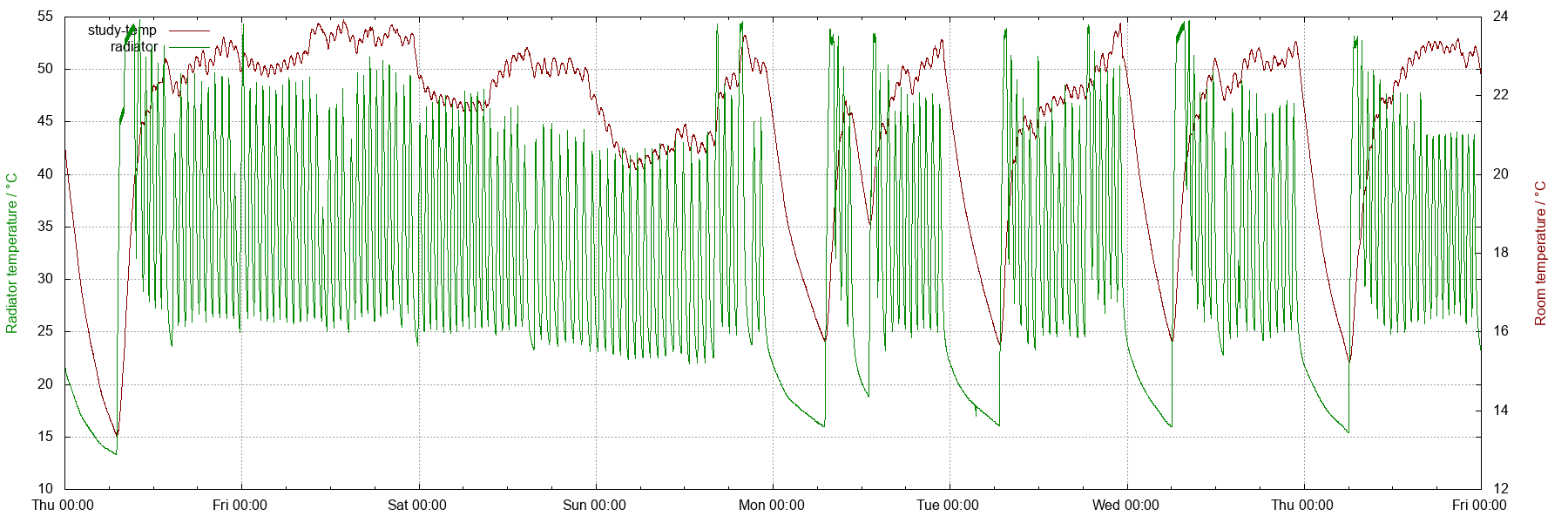
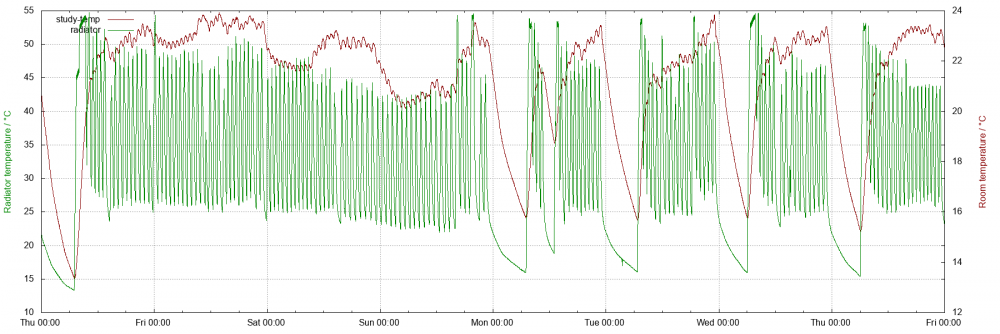
Indeed you can run UFH at lower temperatures than radiators but I'm not entirely convinced that it makes that much difference in a well-insulated house if you run the radiators for long periods of time. E.g., in the leaky Edwardian house I'm renting at the moment the average temperature of the flow to the radiator in the study over December 2018 and January and February 2019 was 30.46 °C to kept the room around 22 °C most of the time it was occupied. (Maximum was 54.75 °C). Here's a particularly cold period from January 17th to 24th when I left the heating on overnight for the first few days (Thur, Fri, Sat, Sun). There are only a few short periods, when the house is heating from cold, where the radiator runs continuously; the rest of the time the heating is cycling on and off. For the days when the heating was on continuously (Fri 18th to Sun 20th inclusive) the average radiator temperature was only 29.17 °C. Radiator output is not quite linear with temperature so the output if it's just held at the average value will be a bit lower than if it's cycling up and down but I don't think this makes a huge difference, certainly not a much at the T⁴ effect that some people obsess on.
-
Save the world, install an LPG tank.
Ed Davies replied to epsilonGreedy's topic in Environmental Building Politics
China's making huge efforts to clean up, though. Not primarily for CO₂, though partly that, but mostly for particulates, NOx, etc. E.g., Shenzen has more electric buses (16,359) than London has buses (9396). https://qz.com/1169690/shenzhen-in-china-has-16359-electric-buses-more-than-americas-biggest-citiess-conventional-bus-fleet/ https://en.wikipedia.org/wiki/Low_emission_buses_in_London I did read Shenzen introduced more electric buses in one year than London has buses in total but that's not immediately obvious in my search results. However, for the whole of China there's this: https://www.weforum.org/agenda/2018/04/china-is-adding-a-london-sized-electric-bus-fleet-every-five-weeks/ -
Thanks both, but what would the actual harm be? For example, @Onoff's reference says: So, what's the difference between using a TT earth which just happens to also be connected to an exported PME earth and using a PME earth which is connected to an extraneous conductive part which maybe has just as low an impedance to earth as the TT's rod (assuming the CSA requirements are met)?
-
Would there be any actual harm in connecting the armour to the earth at the garden room end, as well? Just thinking of the practicality of the normal SWA termination connecting the armour to the box. If that's metal…
-
Save the world, install an LPG tank.
Ed Davies replied to epsilonGreedy's topic in Environmental Building Politics
Sorry, I missed in your initial post that it was contiguous US data only. For such a small area of the planet (about 5%) no trend would “disprove” climate change. I don't know the specifics of this one to be sure but if it's the one I think it is he (Tony Heller) was not area weighting the data (or not doing it properly) so the apparent decrease in the raw temperatures was a result of more weather stations being added to the network in the northern parts of the US during the time period. Taking just your Telegraph link, Christopher Booker is not a reliable source for this sort of thing: http://variable-variability.blogspot.com/2015/02/evil-nazi-communist-world-government.html Edit to add: An example of Tony Heller/Steve Goddard doing that sort of thing (not area weighting): https://tamino.wordpress.com/2018/08/08/usa-temperature-can-i-sucker-you/ though I'm sure I remember a similar article from longer ago. -
Save the world, install an LPG tank.
Ed Davies replied to epsilonGreedy's topic in Environmental Building Politics
So why are you so busy spreading this counter opinion rather than addressing it? The problem is that there are many thousands of scientists who have looked at climate science (it's probably been reviewed more thoroughly, both formally and informally, than any other branch of science - rightly, because it's important) and broadly accept its results. Sure, many will have quibbles with one aspect or the other but I really think that if there was any fundamental flaw it would have been widely publicised by now. Even if there's some sort of closed shop in the climate science publishing area (which I doubt) anything significant could have got published elsewhere, in some geology and astronomy journal for example, easily enough. An example of outsider review: you mentioned the supposed manipulation of the NOAA dataset. As well as the NASA GISS, HadCRU and Japanese datasets there's also BEST (Berkley Earth) by Richard Muller and co, a physicist who doubted the accuracy of the existing datasets so set up a project to create a new, better, one, funded by the Koch brothers because they thought it would disprove AGW. Here's what he has to say afterwards (in less than 5 minutes): https://www.youtube.com/watch?v=kTk8Dhr15Kw -
Save the world, install an LPG tank.
Ed Davies replied to epsilonGreedy's topic in Environmental Building Politics
It's the ones where he stood up before a congressional committee and predicted warming over the coming decades. You know, Al Gore and all that. Lead to the formation of the IPCC and so on. But obviously something somebody seriously researching the subject could easily miss. -
Save the world, install an LPG tank.
Ed Davies replied to epsilonGreedy's topic in Environmental Building Politics
Then it sounds like you've read some utter bullshit. I'm less familiar with the NOAA data than the NASA GISS and the UK HadCRU datasets. The GISS and HadCRU datasets take historical meteorological readings of temperatures since the 1800s (different start times for the different datasets) and apply corrections because of known problems with the way measurements were made such as the effects of stations being moved and times of observations being changed, changes to the way water temperatures were measured by ships and so on. They then use this corrected data to work out temperature anomalies (differences from the average temperature in a baseline period) for different areas of the world and thereby come up with temperature anomalies for the whole globe, each of the hemispheres, land and ocean, etc. This corrected data indeed shows a general warming trend over the last 100 years or so. Guess what? If you take out the corrections they apply, just using the raw measurements as input the data shows a somewhat larger increase in temperature. -
Save the world, install an LPG tank.
Ed Davies replied to epsilonGreedy's topic in Environmental Building Politics
Many existing turbines are smaller but most being installed now are about that size and are expected to be larger soon. E.g., the 82 turbines installed/being installed outside my bedroom window are 7.7 MW each. Yes, it's well understood that storage and flexibility of consumption needs to be part of the equation for widespread use of renewables. Now tell us something interesting. That sounds a bit on the low side. The Beatrice field will have 82 turbines and employ 90 people full time. The cost of employing approx one person per turbine would seem likely more than $ (or £) 48k/year. Whatever, at 5p/kWh the turbines would be earning a revenue of slightly over a million a year so even double that maintenance cost isn't going to make much of a dent. -
Save the world, install an LPG tank.
Ed Davies replied to epsilonGreedy's topic in Environmental Building Politics
Some, a large minority even then. For a very short time (a few years). They updated their views quickly when new evidence was found. Since then all but a few outliers have been predicting warming. Hansen's predictions from the 1980s have been pretty accurate. None of the predictions of cooling from various alternative views have been realised. -
Save the world, install an LPG tank.
Ed Davies replied to epsilonGreedy's topic in Environmental Building Politics
8 MW turbine. Capacity factor (conservatively) 0.35. 24 hours in a day. £0.05/kWh. Daily revenue £2940. Time to generate £40k: 13.6 days. Only somebody who is very daft or enumerate would mothball a turbine for that. -
Save the world, install an LPG tank.
Ed Davies replied to epsilonGreedy's topic in Environmental Building Politics
The same argument could be made about fossil fuel technology. Currently this is, in effect, subsidised by not getting it to pay for the various harms it does (through local pollution as well as the more global effects) not to mention the political hassles it causes, e.g., the west having to, essentially, take oil at gun point either directly or through proxies. I agree, though, FITs are not the right answer. They're like trying to prevent speeding by paying people when they drive past a speed camera slower than the speed limit rather than fining them when they drive past faster. That is, the backbone of any reasonable climate change policy should be a significant carbon tax though we've probably left things to the point where that alone would not be sufficient and further regulation to stop it just being a case of the rich paying would be required. In particular, a significant proportion of the money raised should be spent on helping people reduce their energy use (e.g., insulation of homes, better public transport, etc) though such schemes are difficult to run without perverse effects. -
Save the world, install an LPG tank.
Ed Davies replied to epsilonGreedy's topic in Environmental Building Politics
That was possibly a reasonable argument two decades ago. It's not any more. There are so many separate lines of evidence supporting the general conclusions of climate science in this area that it would be ridiculous to ignore them all. -
Save the world, install an LPG tank.
Ed Davies replied to epsilonGreedy's topic in Environmental Building Politics
There are lots of sources around which talk about the history of CO₂ in the Earth's atmosphere. That AGU fall conference video I linked to is probably one of the most mainstream scientific presentations you can imagine short of the IPCC reports. Whether the media see that as an important point to present to the public or not is a different matter; I can see why they would think it's not so important, human civilization didn't arise under those conditions and isn't adapted to them so they're not awfully relevant. The non-linear effect of additional CO₂ is absolutely built in to almost all discussions of climate change in that there's widespread discussion of the climate sensitivity (in terms of temperature increase) for a doubling of CO₂ concentration. This implicitly assumes that the increase is roughly logarithmic: double CO₂ from 280 ppm to 560 ppm and you get a certain rise in temperature (2.5 °C or whatever it turns out to be), double it again to 1120 ppm and you get about the same increase again. Whether that equates to “risk” tailing off non-linearly is a different question. It could well be that a certain amount of change is fairly easy to adapt to but after a certain point the combined effects add up to the point where the ability to adapt breaks down. That's also implicit in the public discussions such as the Paris agreement based on holding to 1.5 °C or 2 °C levels of increase. -
Did you try cycling them again to see if they'd accept more charge?
-
Save the world, install an LPG tank.
Ed Davies replied to epsilonGreedy's topic in Environmental Building Politics
Why do you wonder that? It not something I've come across in all my reading on the subject. If anything, the airborne fraction (proportion of CO₂ emissions which remain in the atmosphere rather than be absorbed by the oceans and the land biota) is expected to increase rather than the reverse. Indeed it doesn't. But why would it? Even assuming it's true (I've no idea as I've not come across that idea either) it's not terribly relevant to the points he's making and not an issue for us for at least a few thousand years. -
Save the world, install an LPG tank.
Ed Davies replied to epsilonGreedy's topic in Environmental Building Politics
It seems like you're still not getting the timescales, here. Weathering-type feedbacks work over millions of years. We're currently mostly worried about effects happening over decades to small numbers of thousands of years. I've long been nearly as frustrated with Greenpeace and the like for ignoring the science as with the climate change deniers. The current Extinction Rebellion, while very much a good thing, similarly often goes too far in their claims. This blog post popped up in my feed list this morning and seems to summarise my understanding of the science and perception of the views of the bulk of climate scientists very well: https://simpleclimate.wordpress.com/2019/04/22/why-we-should-be-wary-of-12-years-to-climate-breakdown-rhetoric/