


Crofter
-
Posts
3484 -
Joined
-
Last visited
-
Days Won
11
Everything posted by Crofter
-
In the last house I went Hep2O throughout, very happy. This time around, I'm renovating a kitchen and need to shuffle a few things about. I can't get all the fittings I need in Hep20, some are out of stock. Would it be a disaster to use a JG fitting if necessary? OK so long as I use the matching inserts? And on the same topic... I'm on a tighter budget this time around... I see Screwfix are selling very cheap 'FloFit' plastic pipe, but they don't sell inserts to go with it. My understanding is that the inserts should match the pipe, rather than the fittings, as it's all about the inside diameter. Starting to think I may be over-thinking all this, worrying over nothing and maybe I can just use any old pipe, fittings, and inserts. But if anybody has a firsthand disaster story, then I won't.
-

Plasterboarding and Finishing recommendations
Crofter replied to revelation's topic in Plastering & Rendering
By good luck we found a plasterer at the right time- they're like hens' teeth up here- and he had our little cottage done in five days, about £900. That was a plaster skim over plasterboard. I then painted the walls/ceiling myself which helped keep the budget in check and the finish was superb. Every other house I've had has been a taped and filled finish- it's pretty much the standard in Scotland. And those houses have all needed wallpaper on every surface, to hide the imperfections. Maybe a pro can get tape and fill good enough to paint over the top, but in my experience you always see the transition from filler to the plasterboard surface, no matter of sanding will make that go away. -
I hadn't thought about the insurance aspect. I had assumed that it might not be an issue in practise until the time came to sell or rent out a property. For how long has it been mandatory on new builds?
-
Of the three stoves I have had, the C4 is my favourite. It just works. Glass stays clear unless you throttle back too much. I also have a Burley which is a much cleverer design, supposedly the most efficient stove you can buy- but far fussier in actual use. Probably something to do with the installation, but I do wonder if squeezing the last few percent out of the combustion process has some drawbacks. A bit like a modern diesel car...
-
Stove Hearth/Chamber Inspiration
Crofter replied to canalsiderenovation's topic in Stoves, Fires & Fireplaces
I'm afraid I can't remember the exact tile- it was three or four years ago now- but I think pretty much any tile would do. We didn't have an 'inside' as the stove is free-standing, although I have tiled the inside of a fireplace in a previous house and that was fine. -
Stove Hearth/Chamber Inspiration
Crofter replied to canalsiderenovation's topic in Stoves, Fires & Fireplaces
IIRC with stoves that sit up on legs you can get away with as thin as 12mm for the hearth. Lots of options, but insisting on a single piece of anything without joins will make the price skyrocket. We were going to go with tempered glass, but it was a bit pricey. Then looked up slate from Topps Tiles, who steered us towards a slate-effect porcelain tile instead. Much cheaper, and they said it was less liable to staining from ash spills. We had to have a join in it but you don't really see that. For lining the inside of the fireplace it's hard to beat tile. Slim, easy to work with, cheap. And of course totally fireproof. -
Thanks, IKEA looking good so far. SWMBO has decided that solid wood is the right look for the worktop, I have to agree but it kind of blows the budget. Somewhat cheaper solid oak worktops available from other suppliers but when you need the extra depth for an IKEA kitchen that narrows the choice greatly. On a different note- what's the general consensus on the best types of doors? My feeling is that vinyl wrap is the cheapest and nastiest, painted MDF probably much better, and then there are various other options like solid wood, veneer, melamine, etc. But I also suspect that there will be variation in quality between different suppliers.
-
Yes SWMBO has reported back and is not impressed. She's keen on IKEA, but as far as I can tell they only do short worktops. We need a 3.6m. I'm aware that IKEA worktops are deeper than standard, so I looked in to getting a breakfast bar to cut down, but nobody appears to do that combination of depth and length.
-
Been in touch with Wickes but I have to go through a design consultation appointment, which means a two week wait, quite annoying when I know exactly what I want. So far DIY Kitchens look like the leaders on price, but I would actually prefer flat-pack. There are loads of online retailers with similar offerings- all using 18mm Egger board, e.g. discount kitchen factory, kitchen warehouse, kitchens4uonline, etc etc... would be interesting to hear first hands accounts if anybody has any. SWMBO is going to look at B&Q at the weekend, but last time we tried them we couldn't agree on anything.
-
So, Howdens got back to me and they've come in at about double what I was hoping for. Maybe I was being unrealistic as my idea of prices was based on what I did four years ago, but still... Travel is such a palaver right now that I could do without a day trip to Inverness. Might go down the route of getting samples posted out- I see DIY offer that option.
-
Yes we were in our local branch yesterday and have asked for a quote, they reckon if we can sign next week they can get it through before the end of the sale. Definitely going to be the easiest option. I've got a rough idea of what an acceptable price will look like, would prefer a couple more quotes but time may be against us. I wonder how genuine a Howdens 'sale' is. If they agree a price with us now, will they watch us walk away from the same deal in a month's time? For those who have tried both, how do Wickes and Howdens compare on price? The Wickes kitchen we got last time was their 2nd most expensive.
-
After a seven year wait we are now renovating our own house (in my defence, I spent three years of that time building the wee house). Currently shopping for a new kitchen. It doesn't need to be high end, and I''m avoiding expensive things like pull out units or a million drawers etc. In the wee house we went for Wickes, units and doors came to about £700, and I was very pleased with the ease of build and the quality. The new kitchen will be slightly bigger and I know that prices will have risen since 2016. Waiting on a quote from Howdens, who will be the more convenient choice by far. Given our location I'm assuming that any of the non flat-pack options (Wren, DIY) are going to be prohibitively expensive due to delivery. Ikea could be an option; I have no stores within a day's return drive, but a couple of local man-with-a-van options for pickup. I've had a B&Q kitchen before, from memory it was one of their cheaper ones, it did the job but I'd prefer to go a bit higher quality than that. I know they do different ranges, what are the more expensive ones like?
-
That's certainly comprehensive!
-
Well the glazed unit fitted just fine with the tape in place. I have to say I've been surprised how fitting these uPVC windows is utterly different to the alu-clad units I put into the new build a few years back. Those came with the glazing installed, and everything felt sturdy and square. The empty uPVC frames are quite floppy, but there's lots of wiggle room when installing the glazed unit as well. I started with the smallest one and, going against the instructions, fitted the glass first. That way I know it's square. I won't be able to do this on the bigger ones since they'll be too heavy.
-
Thanks. There goes my night off... ?
-
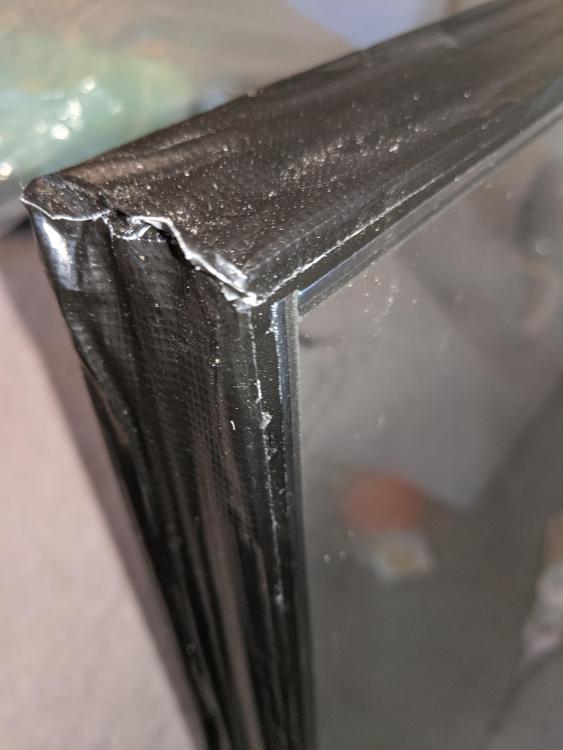
It will certainly not be visible after the beads go on, but it looks exactly like bog standard duct tape, and it's not especially neat. Hence my first impression that it was just there for packaging...
-
After seven years I have finally started replacing my ancient single glazed windows. The new uPVC units arrived and my measurements seem to be OK, so far, which was my biggest worry. The sealed units have what appears to be duct tape around the outside. I am 99.99% sure that this is just for protection in transit and it should come off. But it's stuck really, really well. To the point where I'm having a tiny bit of doubt about whether to remove it, since it seems to want to pull strong black gloop off the edge of the sealed unit itself. Can anybody reassure me that I should just crack on and rip the tape off? I should probably do the sensible thing, down tools and phone the supplier in the morning, but the old window is already out and SWMBO would rather not have a gaping hole in the wall overnight!
-
Self build offgrid strawbale house in Scotland
Crofter replied to Pord67's topic in Introduce Yourself
Really interesting project. How did you get on with Building Control with this construction method? -
Most of the property is hard surfaces (bamboo flooring) but there are big tweed curtains. I'm sure that the virus struggles to survive on rough surfaces like that, and actually lasts much longer on smooth surfaces. So things like door handles, lightswitches, and remote controls are all very high risk and will have to be disinfected. We are working on our risk assessment at the moment, hence the question.
-
With lockdown being eased, we are tentatively opening up our holiday cottage for new bookings. Guidance suggests that we should leave the windows ajar between changeovers, but I was wondering if the MVHR might do a better job?
-
My ten+ year old 'Parksde' (Lidl) SDS drill seems to have finally bitten the dust, in a literal sense I suspect. I've re-bushed it once, but the new bushes didn't last very long and in use it is very, very, sparky, or just fails to work at all unless given a tactical thump. I've resorted to opening it up and pushing the brushes into place a bit more firmly, but that gets very tedious and I now only get a few seconds of running time. I could probably buy new bushes again but they weren't all that easy to find last time, and given what I spent on them, and the time it took, not really worth it. I've got a medium-sized job coming up- replacing a bunch of windows and doors- so need something to chisel away mortar. Doesn't have to be anything too fancy, but just thought I'd ask if there were any particularly good buys to be had at the moment?
-
Hello all, just dipping my toe in the water...
Crofter replied to Reiver's topic in Introduce Yourself
Welcome aboard- sounds a bit different! I sort of see the appeal of a tower, although it obviously won't be the easiest or most cost effective way to go. Maybe think about a big utilitarian shed with your PV on top, and keep the tower house separate? -
Welcome aboard. Whereabouts are you building? Must have been a good holiday for you to want to stay permanently
-
Whether it's worth doing lots of DIY depends on how much your time is worth. I wasn't in regular work for the duration of the build, so my time was more or less free. Bear in mind that an experienced tradesperson will work much faster than your average DIY builder, so if you are considering taking time off work to do jobs yourself the sums might not add up. But then there's also the hassle of actually finding someone. I've hardly employed any trades on any project I've done, because it worked out quicker and easier to just get on with it myself. On my wee house my build route meant I wasn't subject to building control, and was able to do almost everything myself, including: - drawing the plans, submitting the planning application, organising all of the service connections - surveying the site and setting out - digging the founds (by hand!) - doing road trips to collect materials where necessary - stick building the frame on site, erecting it, installing the windows, membranes, cladding, entire roof structure - interior insulation, vapour barrier, partitions, plasterbooarding, painting, doors, skirtings etc, bamboo flooring - kitchen design and assembly, tiling, painting What didn't I do? - most of the groundworks was done by a contractor, although I did hire a mini digger at the end for tidying up - septic tank and treatment system was installed by the supplier in combination with the groundworks guy. This was the only bit of the build that was signed off by building control and was the aspect I had the least involvement with. It was also the only bit of the project that failed- I had to dig up some pipework six months later where it had been improperly back-filled. - I had a sparky who planned out the wiring and installed it, although I laboured alongside him to speed things up and lower the cost. - I had a plumber to install the UVC, as that's a legal requirement. I did all of the other plumbing myself. - I was fortunate to find a plasterer whose contract had fallen through and was looking for work. It was an extra £900 that I hadn't budgeted for but worth every penny, and he took less than a week. I would have taken much longer to tape and fill and achieved nowhere near the same standard of finish. In hindsight I think it would have been worth buying a digger. It would have been incredibly useful to have one on site all of the time. If you're lucky, you sell it for the same as you paid, but of course you might get unlucky and a major component fails during your ownership. I also wish I had sourced some or all of the electrical components myself, the 'trade' prices I was invoiced by the sparky for basic stuff like light fittings and sockets was eyewatering when compared to even readily available MK gear from Screwfix. With a bit more shopping around you can save hundreds of pounds.
-
Porch, internal door and building regs
Crofter replied to clickclick23's topic in Building Regulations
Hard to tell from the photos, but does the current wall buildup have any sort of vapour barrier? Assuming it does, my concern would be that simply adding extra insulation on top of what's there would lead to condensation forming behind the dot and dab PB, and you can't add a vapour barrier on the inside of the new insulation because that would make a sandwich, trapping moisture. However if there is no vapour barrier in the existing walls, then possibly you could insulate on the inside of them. I presume you intend to dot and dab a second layer of insulated PB. There might be a limit as to how much weight/thickness you can hang off the previous dot and dab layer.

