


Crofter
-
Posts
3484 -
Joined
-
Last visited
-
Days Won
11
Everything posted by Crofter
-
Thanks, so basically it's the same as most wiring then- don't be an idiot! And the requirement to get it done by an MCS company still stands if you want to get paid for export?
-
Sorry I was assuming that it would be at that point that I would be rumbled and they'd all me who was installing it.
-
I like to DIY 🙂
-
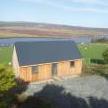
I'm playing around with various ideas just now. Full picture: We have two properties, either side if the road from each other. Both on electric for everything, no mains gas here. The older one is a 3 bed bungalow, with ample space behind it for a ground mounted array, and E/W roof. The roof is made from some delicate looking felt type tiles, and I really don't want to mess around with it. The other house is the one on my profile pic, 1 bed built under the 'portable building' exemption so no building warrant (it does have PP). Also has E/W roof. It's corrugated steel on battens and I'd be quite happy to mess around up there and add panels- I did design and build it, after all. At the moment both are used as holiday lets, because we're living on our boat (how's that for off grid 🤣). We're likely to move back in to the bigger house for a while and then, hopefully, go back to boat life again in the future- for the summers at least. So anything I install should be idiot proof and need no manual intervention. The primary aim is to get the bills down. I also think it would be a good selling point to be able to offer free EV charging, although I'm not convinced the ROI adds up there. At the moment I'm thinking about a ground mounted array on the bigger house, and roof mount on the other one. Both designed to feed a 16A diverter which would offset daytime loads and use the immersion heaters as a dump.
-
You say after the event... what happens if you 'forget'? Would it just come up when you came to sell the house?
-
Another question: If I get my panels, inverter, and diverter, what regs, rules, notifications etc are involved? I understand that without going MCS I can't get paid for export? And I believe on systems larger than 4kw you have to notify the DNO? But assuming I don't go down the MCS route, what else do I need to do? BCO sign off? Qualified electrician to connect grid tie inverter?
-
On E7, it makes sense to feed the house first, because I'm replacing 40p/kwhr electricity during the day. If I don't get the tank heated up, it will just boost overnight at 16p/kwhr.
-
Just spotted that on another thread. Looks like a good bet. So a basic system is looking like panels, grid tie inverter, diverter. Job done?
-
The Solic seems to be coming up as a reasonable budget option for diverting PV to DHW- but without the ability to use the same immersion element for a timed/scheduled boost from the grid. I could use the Solic for the upper element and crank the thermostat right up, but it seems a shame not to be able to heat the whole tank. Presumably clever things can be done using relays, to allow a single immersion to be switched and powered from different controls and sources?
-
I've got a small house used as a (mostly) summer holiday let. It has a direct UVC currently heated by an overnight immersion on E7, with a higher level boost immersion that is manually switched as needed. The tank is 170l and the house is one bedroom. Can I install say a couple of panels on the E/W facing roof slopes, a grid tie inverter, and then start feeding the immersion from that? I'm starting to get to grips with the basics of domestic PV but I think there's still a lot don't know. E.g. I'd only want to be heating the tank during the day when I have output from the PV- the rest of the time it would revert to E7, not sure if the inverter is clever enough to do that. Apart from the panels and inverter, what other gadgets would I need for this system? And roughly what kind of sized system would make sense? I'm quite far north in Scotland so don't have the best weather- but we do get really long days in summer, which is when the demand is.
-
Solar - Where to start?
Crofter replied to DazRave's topic in Energy Efficient & Sustainable Design Concepts
Interesting thread. I'm starting to realise how little I know about all of this. In the spirit of being an absolute dummy, am I right to think that the most basic system would comprise panels, MPPTs, and a grid tie inverter, plus necessary isolators etc? Would there be any need to even tell the electricity supplier? Is the inverter clever enough to sort out how to share the loads around? (I know a reasonable amount about off grid PV, because I'm currently living off grid on my boat, but I'm a total novice when it comes to grid tied systems). -
Howdens vs DIY Kitchens - which one to go for?
Crofter replied to johnhenstock83's topic in Kitchen Units & Worktops
I thought you had to have a remote (worktop level) switch and either a hard wired FCU or single socket for each appliance. That's what I did anyway... -
The nice thing about T&G is that any mistakes or damage affect only a limited area, and it can be fairly easy to swap out for a new length. With ply it's a much bigger area you're dealing with. If you look at the boatbuilding suppliers (e.g. Robbins of Bristol) you'll find all sorts of veneer options- sapele, teak, mahogany, or teak and holly strips for flooring. Just make sure you're sitting down when you see the price.
-
Howdens vs DIY Kitchens - which one to go for?
Crofter replied to johnhenstock83's topic in Kitchen Units & Worktops
Can't really fault our DIY kitchen. I remember reading somewhere that they remove any negative reviews, hence the universal praise. But my own experience was positive. -
Seriously, some landlords deserve misery.
Crofter replied to CalvinHobbes's topic in Housing Politics
I'm struggling to see why it's a bad thing to have more owner occupiers and fewer people renting. -
Seriously, some landlords deserve misery.
Crofter replied to CalvinHobbes's topic in Housing Politics
And what happens to them? Do they lie empty? -
Seriously, some landlords deserve misery.
Crofter replied to CalvinHobbes's topic in Housing Politics
Surely a glut of properties on the market will have an impact on prices? -
There must be more than one route in to gaining a telehandler ticket. I've got one, and all I needed to have before doing the course was a driving license. Btw I would second the suggestion of getting the delivery lorry to do the lifting. They have way more reach than a telehandler.
-
It's much better to go 12->19v than 12->240->19v!
-
I have, and it works. But it wouldn't run my Makita charger- not enough oomph. Of course for charging a laptop from 12v you really want a dedicated PSU but that will cost you £20. Considerably more efficient.
-
Timber cladding (Scotland) what would you use and where to source
Crofter replied to Grian's topic in Building Materials
Must admit I only know about house building, nothing specific to huts etc. But they are facing the same conditions so I'd be wary of diverging too far from what works on a house, unless the space and weight cannot be tolerated. You absolutely will need a drainage void behind the outer cladding. Even if no rain penetrates, you will have condensation. I suppose vertical tin straight on to the OSB could work but it's not ideal. I take it you'll have a breather membrane in there too? If you can afford another 50mm of wall thickness, you then want vertical and horizontal battens to provide a fully drained void. -
Timber cladding (Scotland) what would you use and where to source
Crofter replied to Grian's topic in Building Materials
If you want the painted look, you don't really want an oily wood. Definitely have a decent overhang and gutters on the roof to protect those walls as much as possible. If you go with tin on the walls, I would definitely use a 90⁰ angle strip up the corner. Just keep it neat, e.g. 50x50 rather than the chunky stuff you'd use on a roof. There will be a drainage void and breather membrane behind it anyway so a little driving rain getting through won't be the end of the world. -
Timber cladding (Scotland) what would you use and where to source
Crofter replied to Grian's topic in Building Materials
Interesting, when I bought direct it was less than half the cost of the BM stock. And I didn't want to use the BM stuff anyway because it was (aesthetically) too chunky for my small build. Always shop around. -
Timber cladding (Scotland) what would you use and where to source
Crofter replied to Grian's topic in Building Materials
I went to my nearest sawmill and they made up planks to my spec (100x20mm from memory). It was very cheap, about 75p/m but that was about six years ago. At that time, it was quite a bit cheaper than the wriggly tin, per m², that I ordered around the same time. The tin wasn't the cheapest possible, it was 0.7mm plastisol coated and the m² price included fixings and flashings. So you could possibly get tin a little cheaper if you went for 0.5mm galv finish without the extras. And I believe wood has shot up in price too. -
Replacing storage heaters with ASHP/A2A
Crofter replied to Crofter's topic in Air Source Heat Pumps (ASHP)
I'm a long way from that. 1970s bungalow, built to Department of Agriculture design, back in the days before airtightness was a thing. Does that have any impact on my choice of heating system?? Obviously I'm going to work on gradually improving the insulation and airtightness but I'm not kidding myself that I'll ever get to a high level.
