MikeSharp01
-
Posts
5693 -
Joined
-
Last visited
-
Days Won
16
Everything posted by MikeSharp01
-
 I am just about to start the cladding, fibre cement tiles hung on the wall with battens, and I wonder if I need the BS5534 battens or just treated battens as nobody, in their right mind - given that the scaffolding is there for them to stand on, is going to stand on the battens. I cannot see anything definitive in the above standard or the HSE TB33 document. Any knowledge out there?
 -
That feels like enough time but in some aspects it is a 'long time'. For example tastes change and you cannot judge yesterdays tastes (as they will be in 15 years time) by today's standard - but people do and you don't want your dearest friends leaving your brand new pad being driven, by their self drive car, away and saying to each other - 'Lovely house but oh so very 2021'. Lifestyles change similarly. Yesterday and perhaps today the fashion was/is for open plan. The pandemic has taught many that having just one open space where in the 1930's there would have been three isolated spaces is a severe restriction if two of you are working from home. You may argue that as you have retired you won't be working from home but you will still have your pastimes and if those are indoor a space for them might turn out to be valuable, my other half's sewing machine would be one such device I would not want in the open plan space - but we haven't specifically built her sewing room in the new house as she has only taken it up since the pandemic (in fact - and don't tell her, I put a special power supply into the garden room to allow her to have have a kiln for her pottery work if she kept up her passion for it, looks like sewing has taken over.) So perhaps spend time looking for 'timeless' ideas and don't get hooked up on today's technologies as so many of them are already in the laggard phase and there will be a whole new crop along by then.
-
The sun, our Eddi and my SunAmp: keepin' me guessin'
MikeSharp01 replied to ToughButterCup's topic in Energy Storage
So you are effectively measuring consumption and assuming it was topped up at the start. Wonder how their gizmo does it? -
The sun, our Eddi and my SunAmp: keepin' me guessin'
MikeSharp01 replied to ToughButterCup's topic in Energy Storage
How? -
How do you fancy this new house
MikeSharp01 replied to recoveringbuilder's topic in Bricklaying, Blockwork & Mortar
I think there may be, just wait to you hear the queens speech tomorrow on planning and building safety. -
Havent done the math although I think the load might actually be quite low but the pad is on sand so is thick to allow it to spread the point load hence the reinforcements and the area is big because of the bearing capacity of the sand being quite low. Its a scenario your SE can explain but if it is all about area there might be other ways of achieving it. IE make it deeper with more reinforcement and longer and thinner. (More like a beam than a pad.) The low load, if this is the explaination - others are possible, also helps with the beam across the space.
-
Weather resistant cladding in coastal location
MikeSharp01 replied to Homer's topic in Introduce Yourself
Good point. -
That is a massive pad! So there must be some serious load there and I am reminded of the bible story about the chap that built his house on sand. Talk to the SE about a capped screw pile pad. That might be possible in a tighter space for the same load bearing capacity.
-
Weather resistant cladding in coastal location
MikeSharp01 replied to Homer's topic in Introduce Yourself
I think thats powder coating. As soon as you get close to the sea all the guarentees start to wither. Have a look at the fine print. We will have powder coated aluminium gutters and the manufacturer - very reputable, won't offer more than 10 years corrosion guarentee cos we are within 1km of sea. Normal would be 30 years IIRC. -
Is that a new requirement more generally. IIRC because all developments that extend the envelope of the community need to provide access. I think it came up on a grand design prog, or some such programme, and in their case they had to provide a footway all the way back to the village.
-
Hello, welcome to THE forum for self builders and like minded individuals, and as @Jilly says ask away.
-
Do you mean timber frame with brick skin? If timber throughout cannot see how it could be worse for the environment than block and brick.
-
Suggestions for new 12V gel lead-acid 200Ah+ battery?
MikeSharp01 replied to DamonHD's topic in Energy Storage
This is an interesting challenge. Is now quite an old piece of research, doubt that much has changed greatly for batteries, but charging sources (Solar / Wind / ???) have moved on so the overall equation might now be a bit better. However the guarantees have not really kept up with expectations - wonder why this is? Is it because charging / discharging control technology to maintain battery life of these systems is so diverse - and you need care when charging Lithium, so they don't feel able to offer longer as they have no control over the surrounding kit. You cannot expect to need to replace a £1500 battery every couple of years and so having longer term confidence would be a buying decision game changer you would have thought. -
Newbie heating timer question
MikeSharp01 replied to Farmer_Terry's topic in Central Heating (Radiators)
Yes but you need to know where to start and what all the guff you get back means / implies. We can help with the interpretations perhaps. -
I think somebody else here tried to move a bus stop and found out that although they are only a sign the invisible red tape was difficult to break.
-
22mm sounds like loads doesn't it but I guess the weld adapter is all about connecting simply into typical waste pipe sizes and if you do have a 22mm run you will still need to wrangle a way to connect that into the waste system somewhere. I think that I am saying perhaps best to stick to waste pipe sizes so you can get adapters, there must be small sized waste pipes out there I think the overflow from our roof tank is about 20mm but 32mm is the most common.
-
Me too - but welcome none the less.
-
how to tidy up skirting boards filled with polyfilla! help!
MikeSharp01 replied to TryC's topic in Decorating
Might be worth thinking about replacing the skirting board if it is too bad, chipping out the lower plaster and using something like easy fill to replace it - depends on the level of crispness you are up for. -
A decent MIG will do ARC as well while ARC makes thin material welding challenging.
-
lining paper ...vertically or horizontally hung!!?
MikeSharp01 replied to TryC's topic in Decorating
To paint vertical and horizontal for papering over IIRC. -
Thrashing out a threshold
MikeSharp01 replied to ToughButterCup's topic in Rainwater, Guttering & SuDS
Looks like the outside slopes down towards the house! If there is a reasonable area of path up the slope then in a real down pour that slot drain probably won't cope and you will get water coming in the door. Might it be valuable to arrange it so the tile up to the door slopes down towards the drain and to lower the last few path slabs so it is level OR arrange a run off the path across wise so some of the water get directed elsewhere rather than channeled to the front door? -
If anything goes wrong or needs moving then its simpler if you can get at them. I am a great believer in little access panels everywhere, much to my other half's annoyance, so I can get at things easily - like the underside of the bath, through the wall behind it in the corridor. The deal in the new place is that there won't be any other than in the utility room so I will have to think very hard and test every connection before covering up!
-
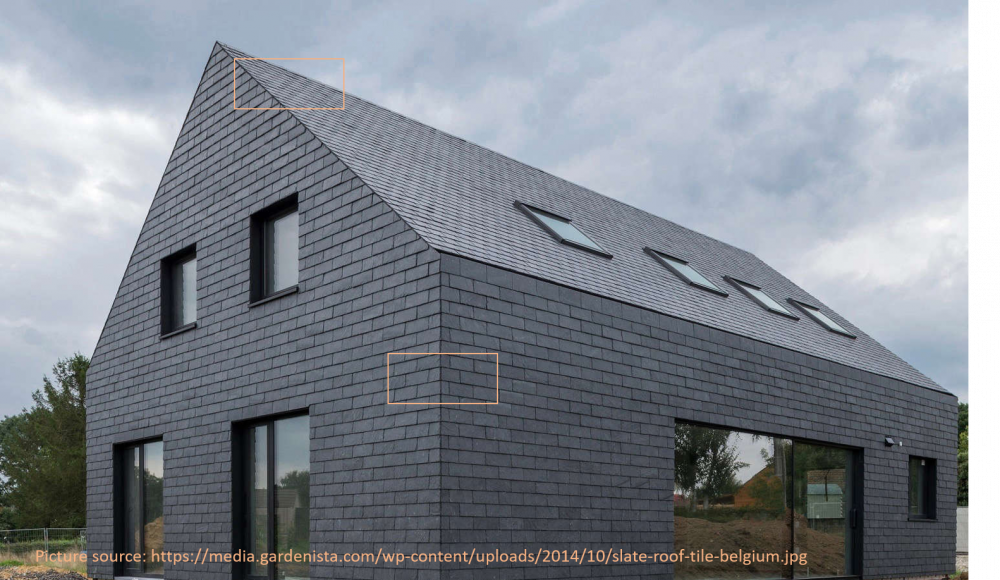
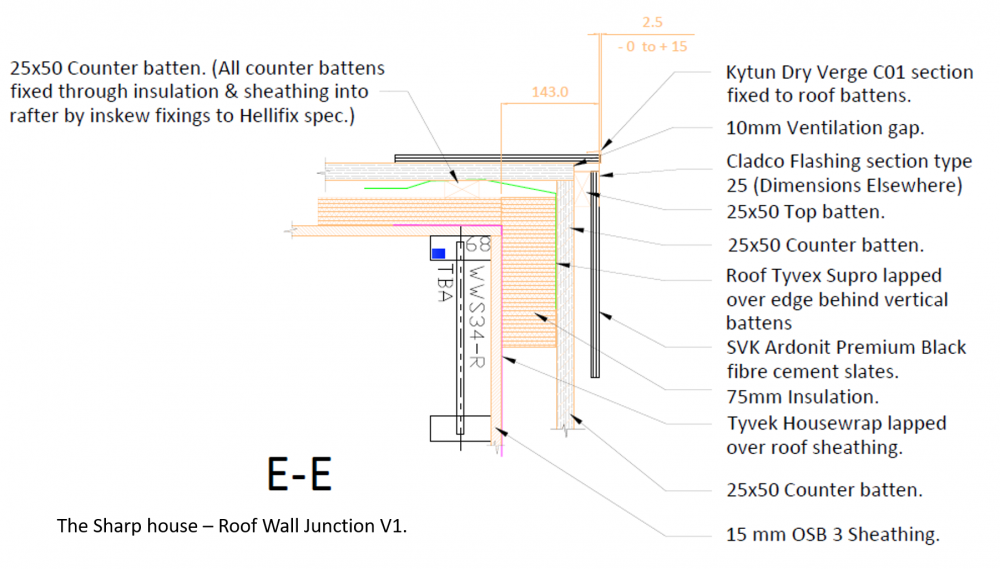
We are trying to resolve the details of the junctions between the slate hung walls and the slate roof. We want a crisp junction but have not managed to find a detail for it. The one we have uses a dry verge and secondary trim (The vertical junction is basically the same without the air gap), as in pic but I would like to get to something more like the Belgian house below. Any ideas very welcome.
-
It must be getting a command from somewhere, does the new unit have any unconnected inputs. It may be that noise on these inputs, or indeed the relay input which maybe fed from an output with some sort of pullup / down resistor in the new models controller, is triggering the mode change and latching it. Is there a wiring diagram for both units. On another note I guess you are telling us that Heatrae Sadia don't support 3rd party servicing very well so we should take note! In the light of the right to repair movement(s) I think we should start asking that full circuit diagrams are available prior to purchase of such equipment.
-
Sounds like a great place to work, until you get called back into the office! Enjoy the forum and all it has to offer.