


MikeSharp01
-
Posts
5693 -
Joined
-
Last visited
-
Days Won
16
Everything posted by MikeSharp01
-

Are any TV 'Architects', Architects?
MikeSharp01 replied to Ferdinand's topic in Surveyors & Architects
This is the essential point about low energy home design in that function, how good it is at keeping the energy requirements down, has to go hand in hand with form otherwise you get a house that wont have low energy as its primary functional focus beyond being a machine fir living in. As I have said above I was happy with our architects but I acted as the energy consultant and kept a model in PHPP for each design to ensure they were in the envelope and where not they adjusted the design. So in the end we worked up three designs all of which were in the energy ball park before we chose the final design. -
I am sure the U value will be the same but its not the I-joist bridges we are dealing with its the 220x310 gluelam and KERTO ends that butt up to the sheathing in a number of places it is designed to deal with. Today we have found evidence of a solution, used elsewhere, that involves drilling / punching holes in the foils. Given all this is helpful speculation I have engaged a WuFi professional to work it through.
-
Yes the walls, well parts of them - I joists and sheathing, are up on the sole plate and that is seriously nailed down.
-
Thanks for this Jeremy. Sadly we need the kingspan on the outside to deal with the cold bridges created by the large timbers in the structure extending to just inside the osb sheathing in several places. I have now sought out a firm to do a proper wufi analysis to check this out once and for all.
-
Consider it blown off! I liked working with our architects as they basically did a good job where we needed it and listened to what we told them. There are a couple of well known challenges they have: Firstly they don't do money, well / if at all. There are reasons for this, but essentially they see their role as giving the clients a vision of what the architects have gleaned from discussions with the client rather than an outcome that can be achieved within budget which is usually elastic anyway. Secondly the construction world is even fuller with new ideas than the academic world so expecting any one person or practice to have a grasp of all the ideas that are out there ... - I guess its why GPs refer you on to specialist consultants. Thirdly, perhaps most importantly, they are fallible, so the expectation, though not theirs, is that any issues will be picked up by the next part of the processes - the builder. Mike
-
Take a look through some old YouTube episodes of the Addams Family and you will get some great gate ideas and how to dress the rest of the place so it looks like the family that lives there is really 'out there'.
-
Yes - sorry Peter - I was only there last week and we talked about the possible array, should have remembered.
-
On another wrinkle - I have been looking at these in roof systems but I am struggling to get the panels flush with our fibre cement (Thrutone) tiles, this is similar to the problems I am having getting a water tight design for the roof windows flush with the tiles.
-
Where do you have yours, or are you running on micro inverters?
-
Hmmm... this is turning into something of a nightmare, we have all the insulation on site although we don't yet have the membranes - was on my list for this week. Anyhow the RIBA product selector sheet indicates this: "Joints between boards will facilitate the passage of water vapour under normal conditions of temperature and humidity." It is this that I had hoped would do the job for us and mean that water vapour could escape faster than the internal VCL. As I have not yet procured the VCL I could switch to 'AirGuard smart' which according to its blurb "lower sd-value of 0.05m (=25MNs/g) and an upper sd-value of 30m (=150MNs/g) for its adaptable AVCL DuPont™ Airguard® Smart." and should push it through in winter conditions. Alternatively I could run a lawn pricker over the sheets to puncture the foils!
-
Have not used it yet so still a chance to play with the details I guess.
-
Well its fantastic - great, you must be riding the getting close wave now. Have you started to wonder what you will do with yourself when it is finally finished?
-
Bosch induction hob fitting in quartz worktop
MikeSharp01 replied to dannyboy123's topic in Kitchen & Household Appliances
How does it grip the hole? -
Bosch induction hob fitting in quartz worktop
MikeSharp01 replied to dannyboy123's topic in Kitchen & Household Appliances
I think you can get little threaded inserts you can drill the quartz, carefully and with the correct drill, pop in the insert and the action of the screw expands the insert. Its a bit like a short rawplug but the ones I have used, albeit, 20+ years back, were metal. This is the sort of thing. http://www.npfasteners.com/composites/keep-nut.htm -
Cross Laminated Timber and other Engineered Materials
MikeSharp01 replied to puntloos's topic in Timber Frame
We are using Fin Joists (FJI). these use cross laminated timber, thick plywood, for the flanges of the joists and OSB for the webs. This makes them dimensionally very stable and weight for weight (I won't use mass in case...) stronger / stiffer / able to span longer gaps.... We also have a large number of KERTO (CLT) beams as the major structural elements - Ridge beam etc. We went for engineered timber for a number of reasons: We liked the idea of using sustainable materials. We wanted as much of the frame to be as dimensionally stable as we could make - I hate the way wood straight from the tree is able to warp, swell, shrink etc. To my engineering mind I wanted to keep the structure simple and open which is easier using I beams than SIP panels. Cost was an issue but because I am the major source of labour on our build I wanted something I could manage without help and that suited my limited ability with the wet trades - Brick/Block laying in particular. Thermal performance and simple foundations as a deep and lightweight frame provides the ideal structure for a lot of insulation with limited cold bridging that can sit on a simple (relatively) passive slab. Although I am doing it myself we spoke to a number of TF assembly companies and they were all happy to work with the FJI joists & KERTO beams. -
Does it have units then? Or A. is it mascerading as something else that got the units already or B. An amalgum of units (ie other concepts combined) that could be simplified to something else that has units or C. Is it just a non unitised concept used a simple hook on which to hang more complex thinking / discourse. I guess that, in the end, the words are the things that resonate with people as most people understand the ideas of Thermal and Mass, which they probably think of as 'a mass' rather than the fundamental unit 'mass'. This may be at the root of our comprehension problem as the actual unit mass of something tells you little, if anything, about its ability to store heat until you combine it with its heat capacity per unit mass. So one is forced back on the presumption that while thermal mass might be a useful idea in facilitating a focus / context for a problem it is probably not useful in providing calculated solutions in building physics.
-
Yes there is a reasobable explaination of this here http://www.greenspec.co.uk/building-design/thermal-mass/
-
Yes it should say VCL really - it was a thread yesterday that prompted me to check as I was merrily working away on the principle that the housewrap was on the outside I agree I think the architect got it wrong for some reason. I will drop him a note to check his thinking but it is on every section drawing in this form so his cad package, Archicad, just linked it through everywhere. No but there is a reason the PU is on the outside of the sheathing so as to ensure the cold bridges of the I Joists and the ends of things like (only) the ridge beams have insulation beyond them. You are right it seems a bit daft to have the permeability the wrong way around but I surmised that as long as the VCL is less permeable than the PU (Even though it is foil backed) and I don't foam the PU edges tight the water vapour will pass out of the structure.
-
Way back in 2016, during our design exercise, which you all helped with here: I thought the build up of the wall (inner to outer) was: 12.5mm Platerboard 35mm service void. Air tight barrier. 300mm I Joists filled with DRITHERM .032 insulation 12mm OSB (4) 40mm Kingspan K12 Tyvek UV breather membrain 25mm Verticle battens (Ventilated) 25mm Horizontal battens (Ventilated) Marley Internit Thrutone cement tiles. However I have now double checked the architects drawings, and those submitted to BC and the build up is now: 12.5mm Platerboard 35mm service void. Air tight barrier. 300mm I Joists filled with DRITHERM .032 insulation 12mm OSB (4) Tyvek UV breather membrain 40mm Kingspan K12 25mm Verticle battens (Ventilated) 25mm Horizontal battens (Ventilated) Marley Internit Thrutone cement tiles. You can see that the Breather and KingSpan have swapped places. Simple question, does this make any sense putting the breathe membrane before the PU Kingspan, which is foil faced, as I don't get how the vapour can get out of the breather if it is covered by foil faced PU, or am I worrying about nothing?
-
Alternative VCL to DuPont AirGuard Control
MikeSharp01 replied to Constantine's topic in Heat Insulation
We used this on the Garden room part of our build in Whitstable, easy to use and relatively cheap (£70 per roll +VAT). Following your prod @Constantine I will revisit our wall / roof build up as I have noticed that the breather (not the VCL) is after, on the way from inside to out, the main insulation but before the metalised PU. -
Alternative VCL to DuPont AirGuard Control
MikeSharp01 replied to Constantine's topic in Heat Insulation
Be a bit careful, we went through this in our design and are about to go through it on our build. Using vapour barriers as the air tight layer - EG sheets of polythene is a risky option as it does not allow any vapour to pass through thus making it more likely that moisture can build up in the wall fabric. Hence your architect has specified a VCL as the air tight layer on the inside of the walls. Naturally on the outside you will have a breather membrane as a secondary water protection layer behind the tiles / cladding. As I understand it, others are more knowledgeable, the breather must be more permeable to moisture than the VCL so as to drive moisture out but it must be possible, when the conditions are right, for vapour to pass through the VCL back into the building - usually in the summer. -
No, in our case we have 250mm (2x100mm = 1x50mm) this was because the slab designer was worried about some of loads in the middle of the slab and after they did the sums they chose 250 rather than pockets down to 100 in all places where the loads were.
-
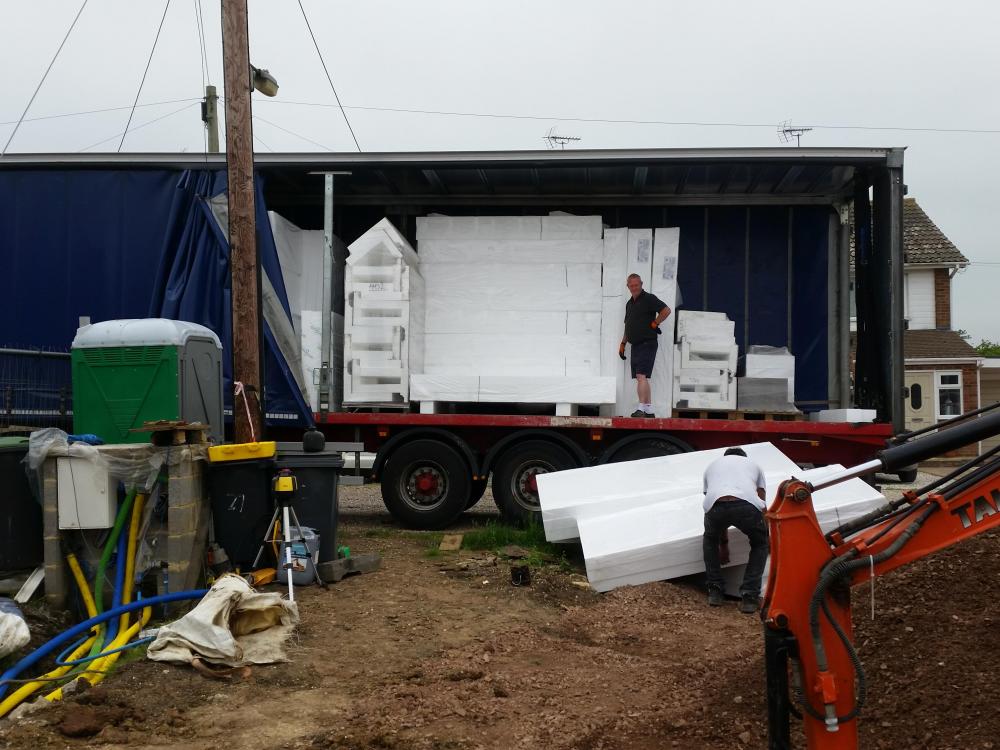
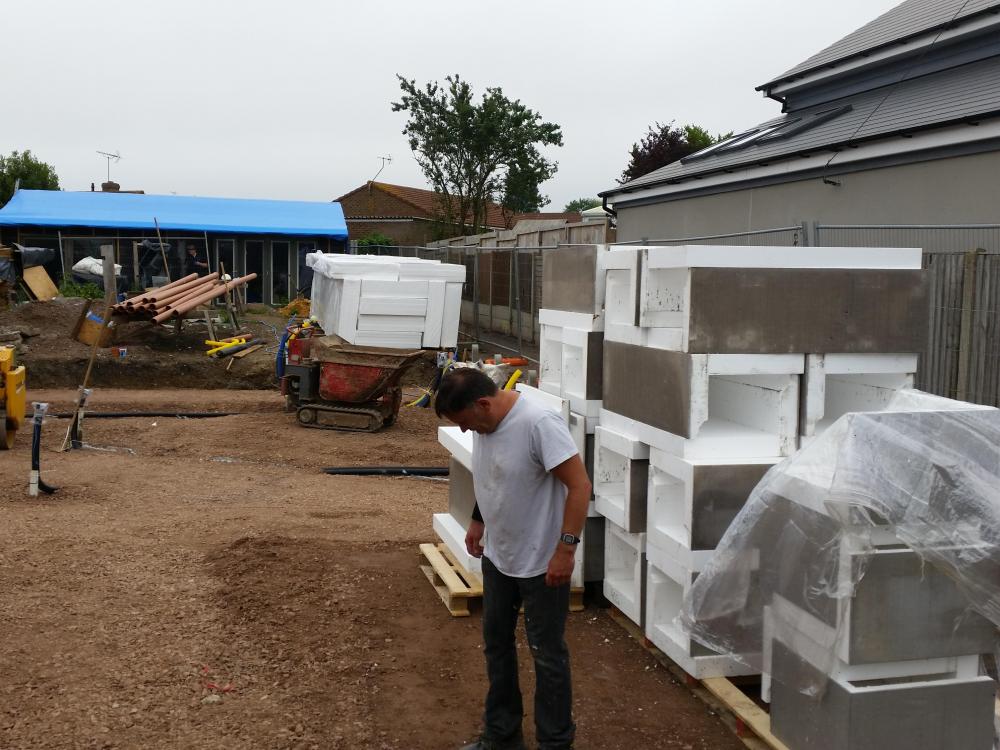
It was basically loose in the lorry but packed tight. Three of us hand balled it off as packs of 5x100x2400x1200 EPS or 10x50mm and then the edge pieces one at a time all of which weight nothing and could be carried by a child privided they could get a grip of the packs / pieces. It took about 20 minutes. I piled it all up and then sheeted it over and tied it down as the one thing it does really well is blow away at the slightest breeze if left unrestrained and it does get attacked by UV if left exposed for an extended period.
-
Our system was not from Kore but very similar. Our slab is 100m2 and it was 3/4 of a cirtain sider artic but weighs nothing except the outer sections with, in our case, the render on.
-
I am not sure TF is more expensive than brick and block once you do a fuller cost accounting exercise and its all timber rather than brick skinned timber frame.


