Iceverge
-
Posts
4487 -
Joined
-
Last visited
-
Days Won
32
Everything posted by Iceverge
-

Warm roof - which vapour control layer and which PIR?
Iceverge replied to BotusBuild's topic in Flat Roofs
I prefer the idea of not trapping timber between two impermeable materials. A recipe for failure in my opinion. The tissue pir is better. Do you think the boards shrank? You could consider a hybird roof easily at that pitchI would say. -
High fuel prices, through raw material price changes or something like carbon taxes would create a systematic change I think. Folk would figure it out. The sums differ depending on your starting point. When I lived in London I had a car that maybe ended up doing 2,000 miles per year. Once i factored in parking, tax, insurance, maintenance and fuel it was an expensive way of travelling vs the train. I sold the car after a year.
-
I too would like one but the kids would have to sit on the roof. I've been keeping my eyes open for another fiat panda which I miss but they've gotten expensive. High fuel prices will sort it all out. There were many smug EV owners running on PV last summer. An in-law who installs solar is booked out until next year. This has everything to do with the cost of a bought in kWh and little with individuals desire to mitigate climate change.
-
EVs are fine . They work, not as easily as ICEed vehicles if you regularly need to charge away from home but otherwise they're fine. Most who complain have never had one.
-
Close all UK airports bar 3 by 2029. That's 5 and a half years from now. It took us about as long from the first sketch to actually move into our house.
-
Should I return this immersion heater?
Iceverge replied to Radian's topic in Electrics - Kitchen & Bathroom
You could just add some solder. It would probably take less time than returning it. -
@lineweight Often forgotten but a suspended timber floor is still an option. For instance a 240mm I-beam with 10mm hardboard below, chipboard above and 50mm screed full fill with mineral wool or cellulose will have a U value of 0.15 for a thickness of about 320mm. The screed is optional if you're really tight for space.
-
I assume ground conditions not allow a slab?
-
Digital shower questions and feedback?
Iceverge replied to VickyBH's topic in Bathrooms, Ensuites & Wetrooms
From a laypersons point of view a digital shower seems to be a very expensive way of adding unnecessary complications. I imagine you would need an additional power supply for a digital shower too. Just use a neat thermostatic mixer like below. It can be serviced without going near the tiles too.

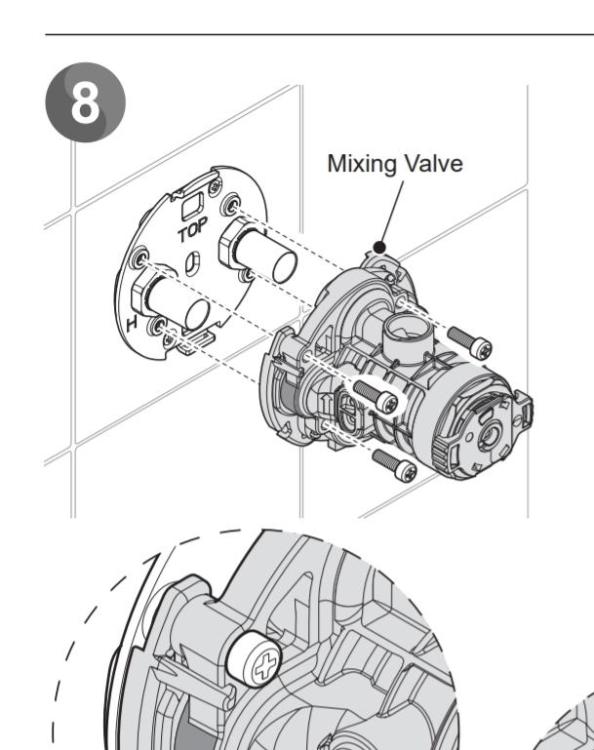
-
Strange... Up or down? Yes we have 150mm concrete over 200mm EPS. There's "some" give but it's still too hard for my gentle tastes.
-
Good work. Couple of curious questions. How did you accommodate the pipes where they crossed the battens? Is the OSB completely floating where it's attached to the battens? How does it feel underfoot? I'm long of the opinion concrete floors are too hard but I don't want every cup on a table rattling if I walk past like a bouncy suspended floor.
-
Mineral wool and other batt products is that they will fluff out against the sides and each other, really reducing any convection within the insulation layer. Similarly the timber will expand and contract with changes in humidity and temperature and a flexible material will accommodate. With PIR, on the other hand, if you have a 5mm gap at install this will remain for all of time so I would make sure it was foamed with a permanently elastic foam in any case. Yes no issues with this so long as you still have a clear ventilation path below of say 50-100mm. If you wanted to do a small bit of woodwork you could go as deeper with a few rips of 9mm OSB tacked onto the sides of the joists to keep it all in place.
-
Therm isn't that sophisticated. At least not in my hands. It's a static model. Yes point losses are really tiny. Especially if spread over any distance above a few cm. I did the calcs on our 250mm cavity wall for SS wall ties Vs Teplo and there was almost no benefit.
-
Easy enough in our case. The builder ordered a 25t lorry of sand, tipped out at random on the site and a 2t pallet of cement. And a few bags of lime. Reorder as soon as it got slack. Plenty of suppliers who will do both next day near us. One of the advantages of building with common materials I suppose. A more useful reply..... 226m² at 25mm is 5.65m³ . Add 1/3 wastage (plastering is messy) and you get to about 7.5m3. At 3:0.25:1 sand lime cement. This breaks down to 5.3m³ sand is about 8t 0.44m³ of lime is about 1.1t 1.76m3 of cement is about 2.7t of cement. Otherwise ask @nod for someone who actually knows!
-
In terms of energy use it may be significant. I'm away from my laptop for a few days. I might try to do a therm model if I get a chance at the end of the week.
-
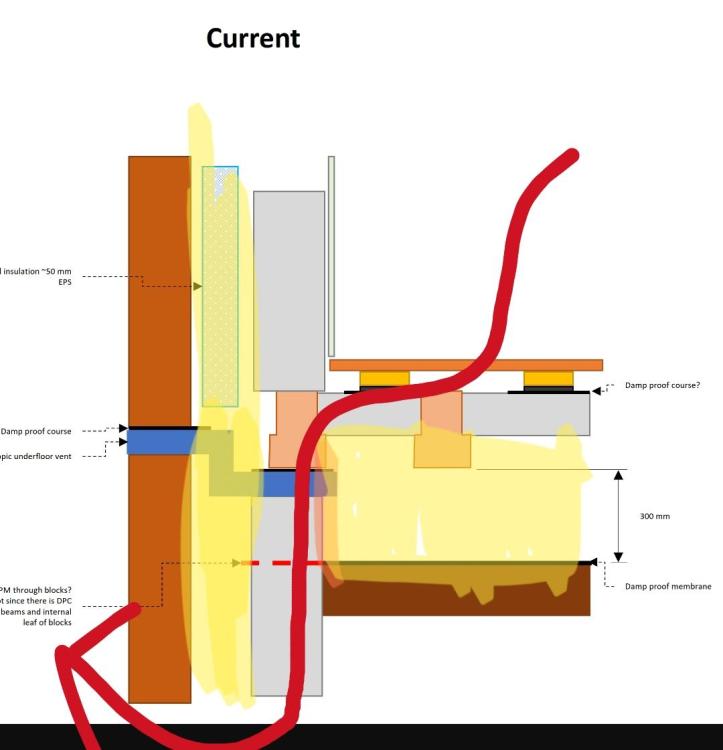
I was thinking about this. Maybe it would be pragmatic to include some insulation above the block and beam just at the perimeter. Say 300-600mm from the walls.
-
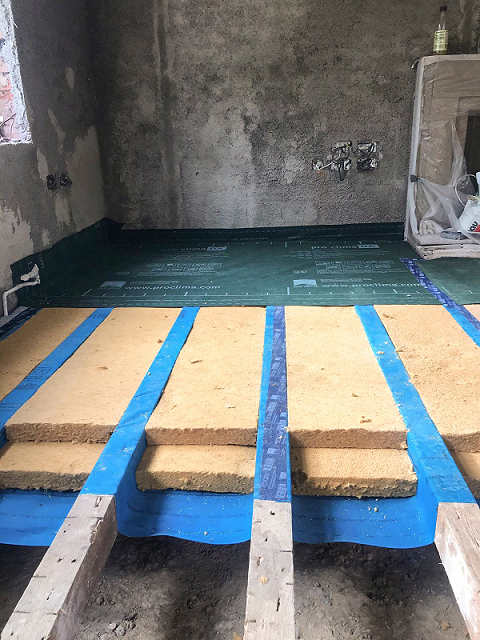
Look at the above picture from the ecological building systems website. It's a good system in my opinion. The thermal resistance of a material is mute until you make sure you can install it properly. The above system makes sure no wind can blow through or around the insulation. PIR will perform worse than the cheapest mineral wool if it's not installed well and the mineral wool is. I would put. Breather membrane draped between joists. Stapled square to the bottom of the joists with all joints taped and returned to the external walls and sealed here too. Good performance mineral wool fitted between the joists. T*G chipboard glued and screwed over the top. If you have space put a layer of PIR over the top of the joists under the chipboard. This will need to be between battens and all joints foamed and taped.
-
How has that worked out? Any pics?
-
Ah. The expelled gasses including water vapour will dissipate pretty quickly once outside and any slight breeze should prevent almost all of the steam from getting into the vents. Cooking is a pretty sporadic event with a fan running maybe 15mins per day, that's only 1% of the time. For decades gas boilers have been expelling steam under soffits, many hours per day and I've never heard of any issues. I can't see your situation being a problem.
-
And what is the issue exactly? Are you worried about steam getting into the attic?
-
Not quite. The residual wall cavity below the block and beam level. Like this to make the heat have the longest most difficult path to leave the house.
-
For PV integration I would have 2 X thermostats on the tank. Have a good thermostat mixing valve (TMV) on the tank too. Have one thermostat on E7 set to cut out at 50 Deg. At 300l this will give about 7kw of storage. Plenty to ensure you're never without water. Then set one for the PV at 75-80deg and this will give you another 9kw of storage for the PV. This will be enough to never get to the point of needing E7 most of the summer. If you bumped to 400l tank then you could have 12kW of storage but then cylinders get much more expensive. If going this route you might be better off with smaller cylinders in parallel.
-
I would say this is fine. The beads don't wick water and if it's dry now it won't get wet later. No. They will provide an escape for any gasses that may find their way I to the beads. A U value of 0.11 is excellent for the main part of the floor. Unfortunately this means the thermal bridge at the perimeter will be really significant. Can you fill the cavity to below the level of the block and beam with EPS beads too?
-
I'm glad it helped. edit: Bugger just spotted a mistake. PV reduces the cost to £260-£180 so you're on the right track.
-
Ok excellent. We have somewhere to work from. Option 1. UVC only Option 2. ESHP only Option 3. UVC plus solar. Assuming UVC and solar last 20 years and the ESHP lasts 10. Option 1 . UVC 300l costs £700 plus annual cost for 2200kWh ( all on TOU ) is £330. Adding the cost of the cylinders over 20 years is £365/year. (300L stored at 70deg is about 14kWH so plenty of capacity to ensure TOU is used only) Option 2. ESHP costs £2500 and runs at a COP of 3, annual cost of £110 ( all on TOU) . With a 10 year lifespan the annual cost is £360. Also a 270l ESHP at 49 degrees will only store 6kWh so any more use you would move to day rate which would wipe out any savings. Option 3. UVC plus PV. (No feed in tariff) Assuming a 4kw array with a diverter would cost £6k. You should be able to use about 2700kWh per year in the house with some timed dishwashers etc. The difference from option 1 will be 500kWh of energy you don't need to buy at 15p/kWh so a nett positive of £75/year. (£6000/20 +£700/20) +£75 is an annual cost of £410. If you get a feed in tariff of equal to E7 rate you could make that £335/annum. TLDR 1. 300l UVC. £365/annum. 2. ESHP £360/annum 3. UVC plus PV £330-410 per annum. No wonder you're confused, it's far too close to call and for the price difference of a bottle of nice wine it isn't worth worrying about. I would get a 300l UVC with a timer switch and forget about it. In fact, that's what we did!!