

Iceverge
-
Posts
4487 -
Joined
-
Last visited
-
Days Won
32
Everything posted by Iceverge
-

Are my windows fitted correctly? Help and advice welcomed.
Iceverge replied to muzgabrak's topic in Windows & Glazing
+1 to the FM330. Maybe put some masking tape over any frame faces you don't want to get foam stuck to. Much easier than cleaning it off later. It looks a rushed job. Have you paid them in full? -
Seems a strange method. Did you get the levels for the floor wrong first day? Have you done any calcs as to the benefit of the extra 50mm EPS Vs just a thicker screed and more heat capacity in the slab? In any case I wouldn't put another layer of DPM under the insulation. You'll end up with 4 X separate layers of impermeable plastic in the floor buildup. I can't see any justification for this.
-
What we really need is an option like buying a toaster. Pay one person, get one product. If you could find a good company this is a good route. Not terribly entertaining for someone like me who wants to get stuck in however.
-
The commonality between the failure of people to grasp climate change and ASHP operations is the delayed feedback. Take an instant feedback system like burning your finger on a candle. Instant result. Well understood. Similarly if it's not instant result but there is a good display of what's happening people understand it. Filling a bath is my example. ASHP for most individuals have no meaningful instant feedback. How about a face that tells you "hey I'm working on that 22deg you wanted, it'll be another hour mate".
-
Use a suitable breathable membrane then and go for it I say. Don't forget about the airtight attic hatch.
-
Why not an A2A unit. Instant response. If only they had some less complex controls.
-
This is really should be as difficult as it gets. It's what we do in the living room in our house in the evenings. Turn on the electric rad and close the door. Very soon it's 24 deg, up from 20. We turn it off when it's too hot.
-
It'll work but it'll be very expensive to to install and run. If you can provide €10K for an ASHP and carbon free electricity at 10c/kWh then it's fine. The leakier the building, the more economical it becomes to heat them intermittently. Intermittent heating relies on being able to deliver a large amount of heat quickly. To do this you need a large emitter area or a large delta T. Most old FF powered CH systems are gauged around high temp so intermittent heating with 50 degrees would result in a larger amount of delivered heat being wasted.
-
Like @ProDave says, the juice needs to be worth the squeeze. We could have bought somewhere nice ourselves for about €220k in 2015 before the house prices went so mental here. Had we then chucked 50k at thermal upgrades, we'd have been done. Could have had plenty of time for going to the seaside with the kids. In reality I really wanted to build a house, always have done. I enjoyed the research, the discussion the learning etc etc. We had a mortgage of €300k and a builders bill of about €220k. We could afford to rent all through the build and I was able to do lots myself. However I still got mega stressed towards the end. The feeling of banging my head against a brick wall while trying to get it over the line, being physically exhausted, toddler being a toddler and Mrs about to pop number 2 really was too much and in hindsight it really took from the enjoyment of building. If you had added living with parents and not having a comfortable budget it wouldn't have been worth doing, possibly to the point of causing some permanent mental or physical damage to my health. @Katie AG please proceed with caution.
-
Top of my head. Something that will deliver enough energy through small bore pipes to small rads before all the heat blows straight out through the uninsulated suspended floors and rattily single glazed sash windows again. I tried in my parents house to run the rads at 50deg. It worked, BUT only if the wood fired Rayburn was kept fired for at least 16hrs per day. I wouldn't like to see the utility bill for the equivalent energy if bought in.
-
I would rather live in the site skip and I get on quite well with my parents and in-laws.
-
I don't think A2W ASHP is the solution. Not until there's a bolt on replacement for £1000 that'll provide 70⁰ water at a COP of 3. That seems unlightly. Many users here have great success with ASHP but most of that can be attributed to tackling the fabric first, not the ASHP.
-
Improving cavity wall insulation (rockwool)
Iceverge replied to bmj1's topic in General Construction Issues
Yeah, or the product name or a pic of the label. -
Improving cavity wall insulation (rockwool)
Iceverge replied to bmj1's topic in General Construction Issues
Do you have an exact spec of the rockwool product used in the wall? -
How good is the vapour control layer below the insulation going to be? There's a risk with this approach if you don't get it 100%. We have a sealed cold attic as per the TYVEK detail and the attic has zero condensation but I did the airtight/vapour control membrane myself and got it (and tested it) to zero leaks.
-
I wouldn't worry too much about the mold. So long as it's not behind something that prevents airflow, like fitted furniture.Especially if you have MVHR. If your contractor has substituted the lintels on every window and they had clearly been specified as thermally broken I would be expecting them to find a solution to fix the problem. If you have say 20m of lintels at a PSI of 0.55W/mK Vs a thermally broken lintel at 0.05W/mK that's an additional heat loss of about 20m X 0.5W/mK X Dt20deg or about 200w extra peak heating load. I don't know how this fares in your overall scheme but it'd be 14% extra for our (passive) house.
-
This yo-yo method is the only way I imagine most could afford to get some heat into their houses. Most houses could get by on electricity today. An A2A or two and an immersion for the hot water, maybe an ESHP for high DHW users.
-
https://www.eco-home-essentials.co.uk/how-to-install-insulation.html There's some reference to this method from this company.
-
What is your roof construction as is? It's easier to tape a suitable breathable roofing membrane above the rafters.
-
Unlike a house the school was unlightly to be unoccupied during the hottest months of the year and nobody has to sleep there. Did you ever take any post install temperature readings? Similarly with the nursing home, high temperatures can be dangerous for the elderly. I've had the displeasures of staying in an attic room with a pair of veluxs. The internal blinds blocked all the light but simply turned into radiators themselve being inside the glazing. There's only so many layers of clothes you can take off. Adding dramatic amounts of shading post construction is a failure of design in my book.
-
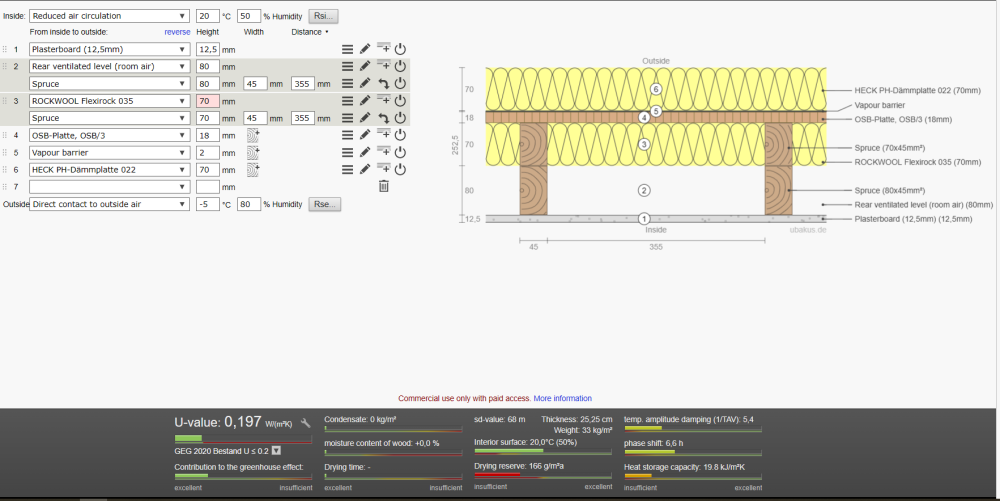
That's fine where it is. Bit slack on the U Value. Wouldn't cost much more to go for 100mm Rockwool plus 100mm PIR for a U value of 0.14
-
Caution on the financial aspect unless you are downsizing. It's tricky for a self builder to come out better off on a house build Vs just selling the site. You've done well with your mortgage rate but I've heard 4-5% being more likely the norm until the end of the decade. Wages will have to rise significantly to accommodate this however because too many people would be out of a home otherwise, basically if you can afford your house now, I'd say it'd be a fair bet to say you could afford it in 4 years time. Have you looked at an upgrade to the fabric of your current house to counter the running costs? Many members here have done amazing things with their older places. Similarly an extra french door somewhere may be enough to help you get in touch with the garden. Halving your garden to do a self build may not be the only way forward.
-
If its a separate pair of lintels then it should be thermally superior. Just make sure the bit between is well insulated.
-
I did away with all the isolating valves when I replumbed our house. Considering how irregularly they'll be needed the inconvenience of turning off the mains for an hour while I fix a tap really wasn't worth the extra point of failure or cost in my opinion.
-
hi @Katie AG, What's the driving motivation behind building a new house? Accessibility? Desire to self build? Live somewhere of high thermal comfort? Lower running costs? What is your current house not doing well for you?


