Iceverge
-
Posts
4487 -
Joined
-
Last visited
-
Days Won
32
Everything posted by Iceverge
-
When the stove is up to temp its thermal conductivity will only be the same as PIR . If you could sub 15mm of rockwool you'd be in the same place. Is it a twinwall flue?
-

Airtightness tips for dormer loft conversion
Iceverge replied to ectoplasmosis's topic in Heat Insulation
Depends on the roofing felt/membrane re full fill. How tight are you on space? 100mm PIR is probably as cheap as 80mm. -
Airtightness tips for dormer loft conversion
Iceverge replied to ectoplasmosis's topic in Heat Insulation
Too slow to get a good fit. Lots of cutting and waste. Differential shrinkage of timbers and PIR. Poor for noise. -
Christmas challenge: Faking a stove's radiative feel
Iceverge replied to Sparrowhawk's topic in Boffin's Corner
This would stand very nicely behind out TV pointing at our faces, beaming beautiful IR radiation into my pores.
-
Christmas challenge: Faking a stove's radiative feel
Iceverge replied to Sparrowhawk's topic in Boffin's Corner
How about one of these bad boys.
-
Airtightness tips for dormer loft conversion
Iceverge replied to ectoplasmosis's topic in Heat Insulation
Groan...... Just use some mineral wool and a layer of PIR under the rafters. -
Clean Heat Market Mechanism to incentivise heat pumps
Iceverge replied to LnP's topic in Air Source Heat Pumps (ASHP)
Lol. I wondered if someone was going to ask. As many as you can pull without burning out the fuse. Obviously you'd need to stagger the free hours. -
Clean Heat Market Mechanism to incentivise heat pumps
Iceverge replied to LnP's topic in Air Source Heat Pumps (ASHP)
Back to the title of the thread. How about making electricity bills simpler by doing away with standing charges. Its a regressive charge anyway. Offer a free hour of electricity per day. People would soon figure how to maximise it. -
Tiling Battens - Coloured or Clear??
Iceverge replied to MrMartin's topic in Roofing, Tiling & Slating
The houses in Cambridgeshire being knocked had NHBC building control. Agreed that it may not have been building controls problem but the NHBC stamp wouldn't necessarily fill me with confidence. -
What was itemised in the quote, was it inc vat? Unfortunately it might not be completely outrageous as you'll probably need a replacement cylinder too. (I assume the current cylinder is integrated to the GSHP?) That's lightly to be an ASHP for €6000+€2500 for a cylinder. There'll be a bit of messing with electrics, manifolds and pumps and controllers. That's probably nearing €10k in parts. As said before the payback case for an expensive heating system in a low energy demand house is almost always questionable. We paid €3000 for a 180ft well in 2020 so about €55/m. Yours is only €52/m so that isn't too expensive either I'd say. Other left field options come to mind. 1. Contact Mastertherm and see will any of their ASHP units swap nicely into the indoor unit of the GSHP. 2. Do you have a steam or pond nearby that you could extract some heat from to continue running the GSHP. 3. Buy a cheaper ASHP from Donedeal or of a "no-name" brand and jerry-rig it into your current cylinder. If it's cheap enough I wouldn't worry about a small ASHP as it'll cope with DHW all year-round and give the space heating a significant enough haircut to justify topping the rest up with night rate direct electric.

-
plant room Plant room Design
Iceverge replied to openthegate's topic in New House & Self Build Design
Like @JohnMosays that's fine, it moves so much air that unless you can move it to the south of France the north side will make little difference. Kitchen tap (run in 15mm) is the one you need to consider. Run basins in 10mm pipe and you'll have tiny dead legs. Washing machines almost exclusively use cold only feeds nowadays. I wouldn't consider this vital but would ensure that any leaks could drain via floor level drain. UVC will need a tundish and discharge. A pull up drying rack is always nice. External MVHR ducts can be noisy so consider this. What is your planned construction type? -
Opinions on best way to drop a ceiling
Iceverge replied to Thorfun's topic in General Construction Issues
I would consider upping the batten size to 38*50 or 25*75mm as the smaller ones might split. On our ceiling we didn't use end noggins, just allowed the plasterboard to sail between battens. It was held up by a 20mm sand cement layer on the walls however. -
Welcome. Welcome. Pics and sketches always welcome for our nosiness!
-
I got one of these as a present. It's too bloody heavy to take anywhere, smashes your shins and the handles prevent it from closing until they're upright. Every bloody time.

-
Clean Heat Market Mechanism to incentivise heat pumps
Iceverge replied to LnP's topic in Air Source Heat Pumps (ASHP)
They're micromanaging whilst being demonstrably ignorant. Personally I think about 99% of the housing stock should be given a JCB makeover. Many members on here have gone really down the rabbit hole of upgrading their existing houses. Really impassioned renovations taking absolute care in all the details yet most are still far short of an MBC new build or similar. Asking the average punter to insulate their way to nett zero is unlightly to happen. Planning reform is badly needed. How about you can knock and rebuild your house so long as it fits in the same dimensional box. Is visually deemed acceptable to the planners ( same day service of course) and must be completed to passivhaus plus standards. Works must be completed with 12 months of starting. -
I've long been suspect of GSHPs. They're effectively an interseasonal solar store, harvesting sunlight during the summer and releasing it in winter. However given the variability if water levels, thermal conductivity of soil, moisture content of the soil, vegetation on the above ground, direct sunlight on the ground above it's a massive mess of variables. To call it an accurately engineered solution would be a stretch. More lightly to just oversize it a bit and hope for the best. Localised freezing can occur, moving the soil and mechanically stressing the pipes which are already embrittled due to prolonged low flow temperatures. I'm not surprised they sometimes crack. An improved COP is their selling point but once you're above about 3 the maths start to look poor. For example going from a COP of 3 to 4 looks good on paper but it only saves you a further 9% of your original bill. Going from 4 to COP 5 Is worse, it only save 5% of the bill. Heat pumps only make sense if you can keep the initial purchase cost sensible, GSHPs almost never are.
-
Here's some running costs. ( Electricity prices from switcher.ie, standing charge and other elec usage excluded, 65% usage on night rate tariff, rural user) €2299/yr direct electric on a 80% usage night rate tariff. Capital cost €400 for Willis heater/immersion. €935/year on cheaper monoblock ASHP( COP for SH/DHW of 3/2). Capital cost of €7000 € 728/year on an expensive split ASHP(COP for SH/DHW of 4/2.5) . Capital cost for AHSP+ cylinder inc install is €12,000. €728/year for GSHP with same COP's. Cost of borehole and pipes €6000. €1169/yr on Oil. Capital cost say €4000 for new boiler/tank and external store Here's a quick table of total costs based on my above guesses. As you can see direct electricity wins for years 1-3. Then oil for year 4. Then a GSHP repair for years 5- onwards although the cheap ASHP is a not far off. The expensive ASHP never catches up. Although it's rough and ready you can probably discount oil, and an expensive ASHP and direct electric. You're back to 2 options. A cheap ASHP and fixing the GSHP. I would get some accurate quotes,revert and I can redo the sums. PS. What was the spec you were quoted for the ASHP for €12k?


-
The electricity savings would have taken 25 years to pay for the capital cost of €7k+VAT at the time (2019). The ASHP would have broken long before that. That case has changed since with electricity prices since. Hence the A2A HP being installed at the moment. At a total installed costs of <€2k it should have itself paid for in 3-4 years. I want to put some PV for DHW at some stage. A heat pump for DHW is a much harder payback case as it's COP suffers a lot once you get above UFH temperatures. Sounds similar to my route but I did PHPP for myself. The lack of knowledge among "professionals" is nearing negligence. It might be fair to say you probably use 3300kWh like us in DHW in that case too. That at a COP of 2.5 for the GSHP would be 1320kWh of energy @COP of 4 used per annum for DHW. That leaves your space heating at 1680kWh/yr at a COP of 4 is 6720kWh of primary energy demand for the Space heating. It's about 23kWh/m2/yr vs 15 for a passivhaus but as you're running at 22deg that'll increase the figure quite a bit. TLDR: Use 6720kWh/year for heating and 3300kWh/year for DHW. That gives something a bit more solid to work on.
-
Do you have your PHPP from the passivhaus designer? How many occupants for DHW ?
-
We have a 185m2 passive house in Cork with 2adults and 3kids. Operating on direct electric only we use about 3300kWh for DHW and the same for space heating. Higher than PHPP predicted but still only 18kWh/m²/year per year or 37kWh/m²/yr total. Scaling it up to match your house size it would be 10700kWh/yr for DHW and space heating. That's a COP of 3.5. Your numbers look about right.
-
Clean Heat Market Mechanism to incentivise heat pumps
Iceverge replied to LnP's topic in Air Source Heat Pumps (ASHP)
Its too simple a solution. Stupid people would never believe it could work. -
@Nially what model of GSHP do you have installed at the moment, it may be useful to get an idea of your alternatives? Is it an option to mend,isolate, or bypass the broken ground loop and carry on as is? An ASHP is the obvious solution. A split unit can have an external unit quite a distance away out of sight if you have an viable option to install the interlinking pipework.
-
Nudura window reveals with timber cladding
Iceverge replied to Andrewb's topic in Insulated Concrete Formwork (ICF)
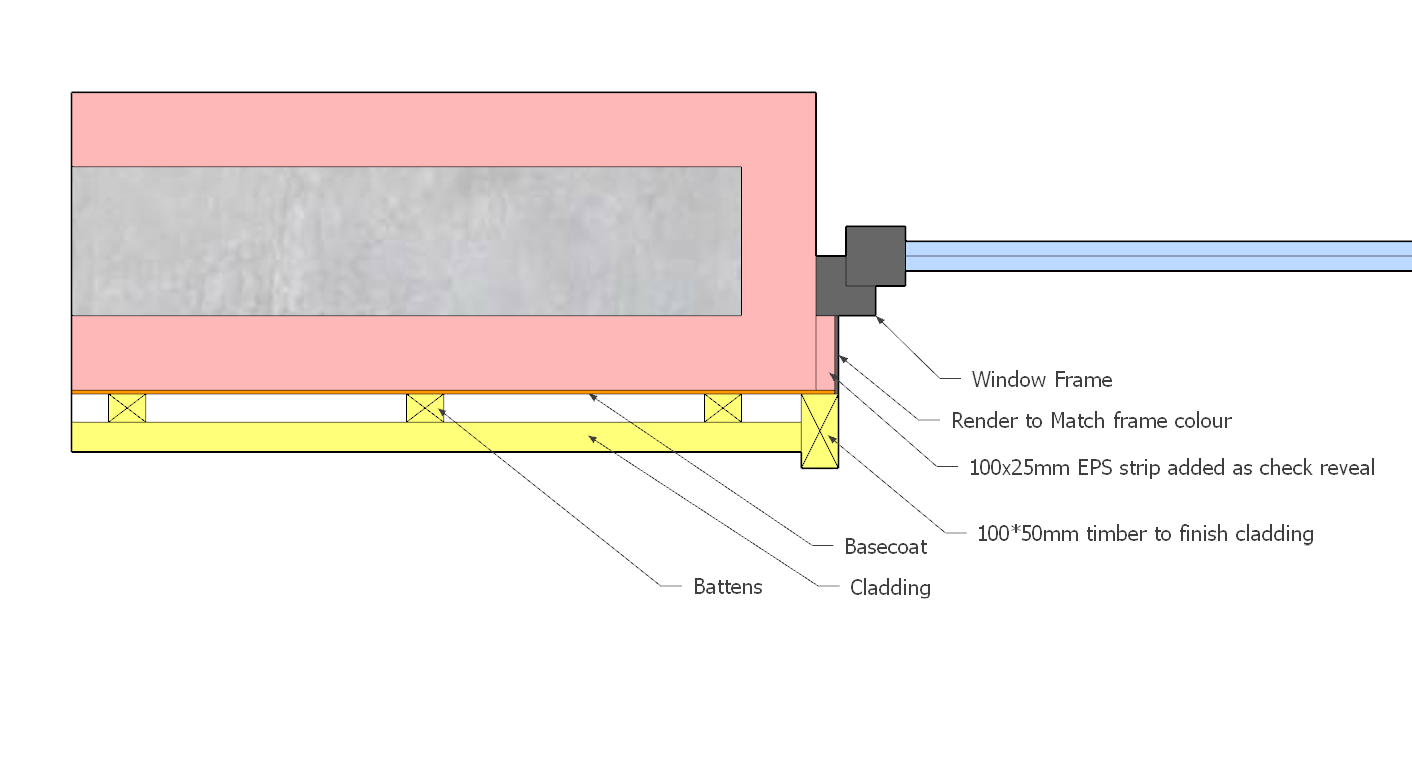
Nice one @FM2015. See my idea for @Andrewb. Should be easy to execute and would be thermally superior to the first detail. I would do wider than 25mm frame overlap if I could. Use one of these to add the render.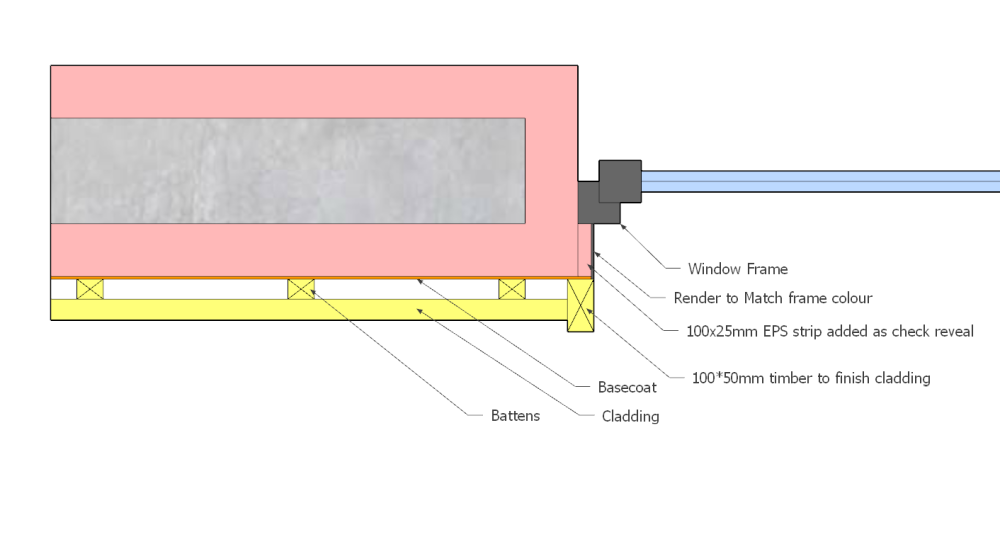
-
Nudura window reveals with timber cladding
Iceverge replied to Andrewb's topic in Insulated Concrete Formwork (ICF)
Indeed. I'm a big fan. I know your company supplies them. I'd be interested in seeing an example of what it's like. As advertising isn't allowed maybe a pencil sketch? -
88 new houses near Cambridge to be demolished.
Iceverge replied to Temp's topic in General Self Build & DIY Discussion
Leaving aside the incorrect construction for a second I think it's a fundamental problem with the way we build houses. They're completely inflexible. Any movement and they become structurally unsound. Timber, R/C concrete, steel and even old lime mortared buildings can take a fair bit of movements without damage.