Iceverge
-
Posts
4485 -
Joined
-
Last visited
-
Days Won
32
Everything posted by Iceverge
-
Yup, they create closed "boxes" which is easier to get a good densepack of the cellulose. There's the square root of zero thermal bridging through the OSB webs of an I joist. I would counter batten underneath for a service cavity though. Something like. Tiles Tile battens Counter battens Breather membrane 11mm OSB 350 mm I joists with Cellulose. Membrane 20*70mm battened service cavity Plasterboard Skim. U value about 0.11. Alternatively Tiles Tile battens Counter battens Breather membrane 11mm OSB 220mm sawn joists with Cellulose. Membrane 95*45 mm battened service cavity with mineral wool or cellulose Plasterboard Skim. U value about 0.14 but all off the shelf material from your local merchant and lots cheaper to boot.
-
The more I read the more I think woodcrete is irredeemablly compromised. If you want solid feeling walls go for masonry and full fill cavities. If you want speed go for factory TF. If you want DIY go for stick build and cellulose. Line with Osb behind the plasterboard for ultimate solidity. Add a masonry skin for 500 year durability.
-
DO NOT DO THIS!!!!!!! JJI joist ( or cut lumber) roof and blown cellulose is the biz.
-
Aerobarrier is a buildhub thing. Typically seems to be used by people to go from "Very good"---> "Excellent" . Anyone who's not aiming for "very good" already is too stupid to understand and should go back to sniffing solvents. I don't think it's going to cure an absolute leaky bucket of a house but it's certainly the icing on the cake. It can be redone in an old house but requires Statzi levels of masking to avoid contaminating Aunt Janes prize doilys. I think it really shines where you've screwed up some element of the design process and want to get the number down. Properly planned and executed airtightness isn't that hard for the non glue sniffers out there.
-
Of course you could. The diffusion scaremongers will along shortly to theorise us to death about how structures need to "breath" outwards no doubt . This completely forgets thehuge relative disparity in magnitudes of diffusion driven moisture and moisture carried by air leaks. It's often hundreds of times more. It's like worrying about a drip in the ceiling of your pleasure yacht when there's a hole in the hull as big as a my boot. An immaculate Airtightness layer can go anywhere in the wall and it'll work fine The OPs plans are quite straightforward though. No silly unbuildable details. An external AT layer without a rain screen cavity is asking a lot around penetrations though. Your sealing will be doing the job of weather tightness and Airtightness and will submitted to drying and wetting, high and low temps. If I was to do an external a/t layer I would at least have it behind a rain screen, preferably some insulation too to keep it dry and temperature stable.
-
The wonderful world of bricks is something I know nothing about but am I missing something: Bricks price onlines = 64p Brick slips = £1. Why would this not be a much cheaper and more durable option?
-
I assume with EPS ICF it's just a hot knife for services and then plasterboard straight to the EPS? How do you stick the plasterboard? Is it screw to the ICF webs or glue it on? How do you fix to it? Is it a matter of drilling through to the concrete core? @Jenki @Nickfromwales @FM2015 or any other ICF aficionados. Yes please do. Live experiments are always appreciated.
-
Lightweight blocks are pants for fixings. Are you not facing the same issue with having to batten out and plasterboard as per @Nickfromwales difficulty in chasing woodcrete above. Out of interest what did @JohnMoand @ToughButterCup do for services? Chasing or a service cavity?
-
Kingspan rep gets a nice holiday once more. 😵💫 Those boards are £62/m2 plus waste plus fitting for a U value of 0.018. Rigid boards in walls are a rubbish plan. Mineral wool batts or EPS beads every time. 6 times cheaper and twice as good. A 200mm cavity with full fill mineral wool batts for the same U value is £11/m² and almost zero waste. No thermal looping unlike those stupid boards too. Lightweight blocks are a con too. Add almost zero to the insulation value and are far harder to fix and plaster to and cost 3 times as much as normal blocks. Fair enough with ICF, if your mind is set. Why woodcrete and not EPS?
-
Vacuum glass is new on me. I must google it. I'm a big uPVC fan when it's done well. if it was more expensive more people would consider it. Fair enough. What model are you considering. I thought Charnwood stoves were good when we were looking before I decided against it. To be honest this has got wide cavity masonry wall written all over it. Brick facade. ✅ Sensible design with no silly overhangs, corner windows or upstairs walls held up by magic ✅ Desire for solid feeling wall ✅ Same airtightness precautions as ecobrix. ✅ Just copy the spec and details of this one and fit as much insulation as you can. I would be more than happy with good uPVC and SS wall ties however. https://passivehouse-database.org/index.php?lang=en#d_5319 There's far more savings to be had in a build via DIY in areas other than building the walls from ICF as concrete blocks and bricks are dirt cheap and a good mason will be very quick. Infact I reckon if you labour for the brickie/install install the batts then it'll be far more of a saving than DIYing the ecobrix.
-
Yeah I was in the same camp. Cost of UFH and ASHP. Stubbornness, cheapness at the time of electricity as backup. In fairness passivhaus never said houses don't need heating, just that the heat demand is so low it can be provided by heating the MVHR supply. I would at a minimum put pipes in the ground floor and ducting and wiring for a mono block ASHP. Just do a couple of UFH pipe runs, you can leave them unconnected and suck it and see to begin with. You'll have the option later too of treating the whole floor like a storage heater on direct electric like @TerryE then too. @terry
-
Online 350mm EPS70 is almost exactly the same price as 200mm PIR for the same U value. 0.11 W/m2K is £25. Seconds and co is £17 though. It'd be £800 over a ground floor. Might buy a nice chair.
-
Nice plans. Not a lot I'd change really. If you build those bifolds as shown they'll loose as much heat as the rest of the house put together. They're very very drafty. I would opt for lift and slide windows or more French doors with fixed side panes. Be cautious of the window design too. Lots of transoms and mullions can look nice but loose a lot of heat vs a single pane. How committed are you to the woodstove? Do you have a free supply of timber and enjoy the process of preparing it? I do, but yet we opted not to install one as the labour involved was troublesome having lived with one before. There's an air quality thing too ( internally and externally) which has been hashed to death on here so perhaps have a search if you're curious. I'm not a fan of parapeted copings on roofs. They will leak decades before a plain oversailing gable. Otherwise very nice layout and plenty of thought gone into it. If you husband can do that blocks will be a doddle. ( I can do blocks FFS and I'm trained in exactly nothing!) What U value were you hoping to achieve for the walls?
-
There is some absolute crap out there so be careful what you believe and as usual the devil is in the detail. Corner your architect and find out the exact model number, the installed house heat demand and the usage patterns. Without these their info is more akin to hearsay than professional advice. The A2A is probably even more dependant on getting the right model than an A2W HP as there is tens of thousands of models and most of them are focused on cooling. The wrong model will ice up very quickly in heating mode. We got a Daikin FTXM25R after a lot of research. It makes noise. Probably as much as a desk fan. I wouldn't want it over my bed head but it's fine in the hall. The only place you feel air blowing is if you stand directly under the fan unit. Ours runs from 4pm until 8 am so 16hrs per day but for most of that it is modulated right down or even stopped sometimes. Like a canal barge the house takes very little energy to move at a constant rate but a lot of time to speed up or down. A little continuous heat input is best for maintaining comfort. UFH has even more of an advantage here as it can very slowly release heat to the room if the pipes are buried in concrete or a thick screed. This can allow you to run your ASHP intermittently and best of all do the heating solely on night rate. I suspect you are drawing your UFH experience from high temp systems which are chronically inefficient. A well setup UFH system will be imperceptible to touch vs a well insulated floor as the floor surface will typically be only a couple of degrees above room temp. There's nothing to stop you opening all the windows and pretending to be Peig in the miserable Irish weather if you like. Spoiler - You won't
-
TLDR. Passive house. Initial use of electric only was dearer than expected so installed an A2AHP. This is proving economical.
-
In Ireland here too. Didn't install any heating whatsoever at the beginning. Designed and built to passive house standards. Actual measured heat demand was 17kWh/m2 over 186m². (3200kWh/annum) We just used a free plug in radiator. So long as you ran it for long enough it was fine. If it was anywhere downstairs it didn't make much difference, the house was warm. However I had hoped to do all the heating on the night rate which was then 8c/kWh. At my estimated €250/annum an ASHP would never have paid back before it broke or wore out. However in reality we did need to turn the radiator on earlier as the house wouldn't be warm enough by 6pm-midnight otherwise. This took half our usage outside the night rate electric and with the electricity price increases our annual heating bill was about €750. I bought a new Daikin A2A unit from eBay Italy for €1100. (Post Brexit everything UK sourced has Vat and Customs duty) It's running at a COP of about 3.3 so our annual bill for heating is back down to €230. It'll pay itself back in 3 years including install costs. Our actual measured DHW demand is about 3500kWh per year for 2 adults and 3 small kids. With a direct 300l cylinder it all gets done on night rate and costs €440/annum. We have no solar yet. I also installed €50 pull cord heaters in the bathrooms for extra comfort post shower. These work well. I think on balance the fan type is better than the infrared type but it's a little noisy on a stud wall. If I was to do it all again......... If I could find a way to get a 5kW ASHP with UFH installed for about €5k I think I'd do that. Otherwise a central placed A2A €1500, 3X fan heaters €150 and a direct UVC €1000 and spend the other €2.5k left over on solar PV would be cheaper in the long run.
-
It depends on your heat pump size Vs house heat loss. If you could manage to find a giant 30kW ASHP and pair it to giant radiators then you could run it pretty much exactly like a gas boiler. If you could have a 5kW gas boiler then you would be faced with the same issues as a 5kW ASHP.
-
How long are you running it for per day? It will behave very differently to a gas boiler which are typically 5 times more powerful. Suppose you have a 7kW ASHP Vs a typical 35kW boiler. And your house needs 10kWh added to heat it from 10-20 Deg. Meanwhile during the heating up phase let's say your house is loosing an average of 5kWh. The heat pump is supplying 7kW -5kW so with the excess of 2kW the house takes 5hrs to heat up. It will use 35kWh to get up to temp. The boiler on the other hand has an excess of 30kW so will supply the 10kWh to heat the house in 20 minutes. It will use 10kWh to get up to temp. Now they're both up to temp and requiring 5Kw the boiler will run for about 5mintues every half an hour and the heat pump will modulate and supply 5kw continuously. They'll use the same evergy per hr. In both cases the house will be warm but the initial heat up phase will take the ASHP much longer. With this you're faced with running it continuously, or with a very long lead in time to when you need heat provided. That's why they are less economical in intermittently heated houses than boilers. If you like to continuously heat the house both methods are on par.
-
200mm full fill cavities with EPS beads are standard practice in Ireland with about a decade. 150mm is fine too but the cost difference is small. Maybe €10 per m2 of wall. Get the brickies to turn a hose into the cavity wall for 5 mins before clocking off and knock off the mortar drop into the bottom of the cavity. Counter the dropped mortar by extending the cavity by one extra block below the floor level. This way the droppings will never get high enough to be an issue.
-
Separately on the raft Vs strip foundation detail I think theoretical and individual examples aren't representative of the broad reality of building. As I remember @IanR was a specific case. A client with great knowledge and motivation and a very very large slab. On the whole you're dealing an industry that doesn't like thinking much. ( Buildhub is gladly a shining exception) Even though there's no technical reason for an insulated raft to be more expensive you're likely to be met with extra charges for forcing some long dormant brain cells into action. The overall best method is likely to be whatever is being used on local production building sites but slightly adapted to deliver high performance. That's what we did, strip foundations and a concrete slab. We extended the insulated cavity below the floor insulation, (the GBS DenbyDale detail), included some extra floor insulation and put some GRP thresholds in. Over all nothing that scared the builders so no added cost but still a high performance floor.
-
Great discussion this. Welcome @lizzieuk1. Sounds like a nice project. Do you have any plans to share? Without your name location etc of course. Different designs are more suited to different build methods, even on the same site.. Moving more concrete inside your thermal envelope isn't going to make your house better. Even the slab perimeter bridging detail isn't the biggest issue. Airtightness is really everything in a low energy house. Regarding woodcrete ICF it is much the same as masonry regarding airtight measures. As your hubby is a mason I think blocks are the logical choice. Passivhaus is easily possible and quite economical with masonry but requires some thought. Our actual heating demand is about 17kWh/m2 per annum.
-
Ok, learning here. Correct my understanding if I'm wrong. Both composite lintels and non composite lintels operate effectively the same way. They enclose some steel to do the "tension" bit. They have some concrete above to do the "compression bit" However a composite lintel gains lots of strength by having some masonry built above, all bonded together, acting monolithically to do more "compression" increasing the load that can be carried?
-
In a masonry build lintels are often misunderstood. All they do is. 1. Hold the bricks in place until everything sets. 2. Support the bricks that are below an imaginary "arch" line where everything above it is in compression. That's why they're often very slender vs what intuition might suggest.
-
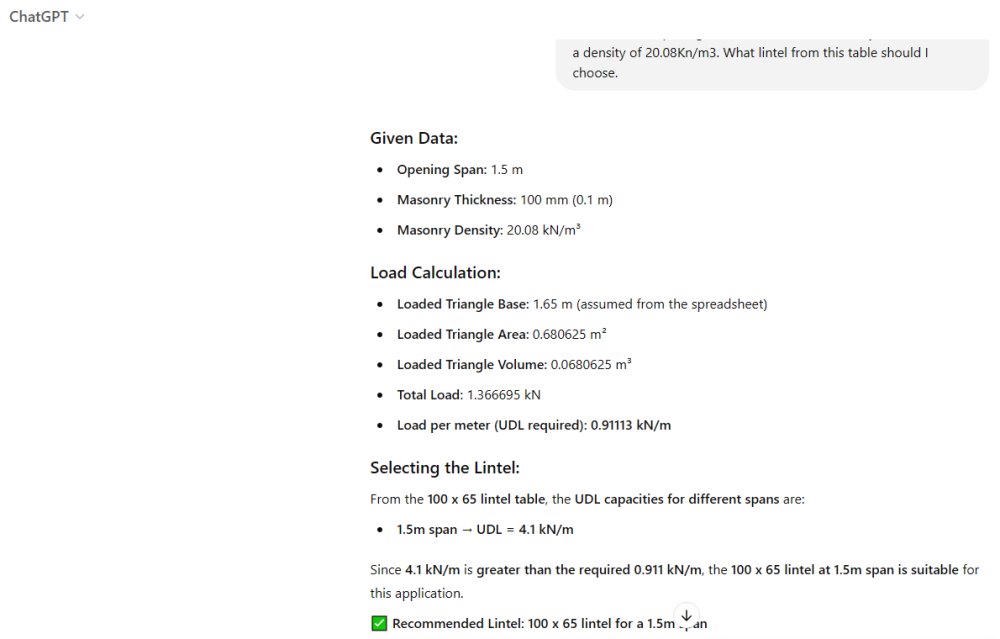
The computer super brain thinks you're right. II just dropped your question in there and the image of the span tables. Me on the other hand have no idea without eyeballing it on site and jumping up and down on it. EDIT. I notice it just read the span table incorrectly!!! If in doubt always jump harder on member in question.
-
 Apparently the company owner was German and particular about such things. "Hella" is stamped on the handles but I think they're Kommerling profiles. I'm only guessing though , I wasn't even alive.