Iceverge
-
Posts
4485 -
Joined
-
Last visited
-
Days Won
32
Everything posted by Iceverge
-
I would say that unless the pipes are very warm, say 50deg+ then it's unlikely that they caused an issue. Vacuum the cobwebs out of the rear of the fridge radiator and make sure the drains are clear . Don't push it quite so close to the wall either and I bet it'll be fine.
-
Vapour..... It's like worrying about fog when rain is the issue. Airborne moisture carried by leaks through poor airtighness is the elephant in the room.
-
Install cross battens as a service batten and keep wires out of the roof!
-
Where the cost and time of past efforts make it mentally impossible to change course.
-
Mechanical ventilation of some kind is a must. Then airtighess. Then insulation. Do these 3 well and heating becomes an afterthought. Keep it as simple and efficient as possible. Another vote for rads. I would avoid tiles on the floor in any case. Horrible, slippery cold things.
-
Welcome welcome. UFH in a boat! I'm thinking downward heat losses might be an issue. How about warm to touch flooring instead like lino or carpet.
-
Not crazy about this. You're sandwiching layers of very low permeability. AKA foil faced PIR and the VCL. Yes in my preferred flat roof makeup with ventilation above the insulation. Any cheap breather/felt will do to throw any drips off the PIR.
-
Any pics to see what you're dealing with? The strip out and trouble you've gone to with planning thus far might lead you down the sunk cost fallacy. Beware.
-

Teething issues with MVHR
Iceverge replied to Tom's topic in Mechanical Ventilation with Heat Recovery (MVHR)
Is the unit itself directly on the floor? Maybe some rubber feet or paving slabs wouldn't go amiss. -
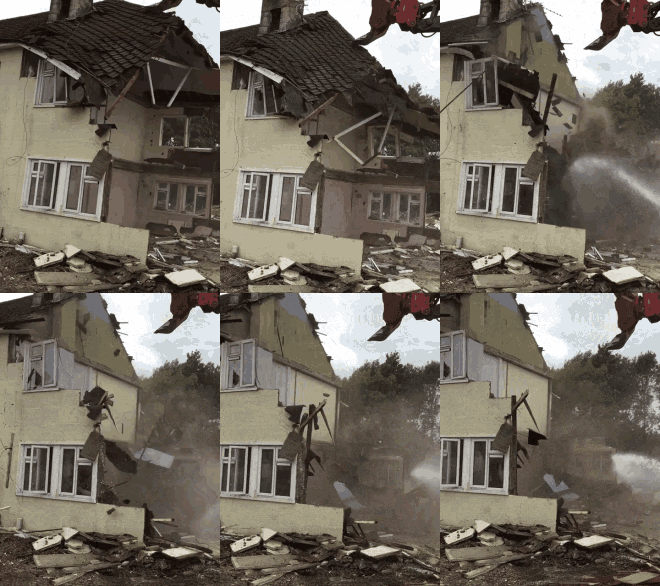
I helped my mate for free with the build, pouring concrete, groundworks, airtighess and some basic carpentry. I didn't do any of the fooling with the manual demolition though. I've learned the long way my time isn't worthless. I did offer to drive my digger straight through it though.
-
I cannot emphasis this enough. There'll always be more work to do than one person can manage and you need a metric to value your time. £ or € or $ is a pretty good one. Let me give you some examples. I stupidly chased our walls with a 9" grinder ( because I had it) rather than pay €120 for a days rental of the proper tools. It took me about 20 hrs of pure torture. My mate rented the machine and did his house in an afternoon. At €20/hr it stupidly cost me double what his did. I can lay blocks, but I'm slow and I don't like doing it for more than a couple of hours as I'm too soft. I reckon about 10/hr would be average. That come to about €2/block. Maybe that makes some sense for small projects but no way for a large house. Gains can be made where you do the donkey work of someone who's more highly skilled. Like UFH pipe laying or pulling cables for wiring. Plumbers and sparkles are expensive laborers. Another example, my mate, extended a cottage. 4 men took 2 days to crowbar and sledge down an old stone chimney. All unpaid, family, mates etc. then they took the same again to break out the old floor. Then the same to take off the roof. Had they hired a digger and demoed the house their mate time could probably have saved them multiples of the cost later in the build.
-
I'll reiterate my point buried in my earlier post. The worse thing that any self builder can do is value their time at zero. You need to put a £ figure on every hour you spend on site. Say £20. Re taking down the leaf of a cavity wall. @Gus Potter and @saveasteading might be along to discuss why this is a bad idea. As far as I understand the two leafs when ties together act more like a wide solid wall, like a "H" rugby goals. When you take away half almost all of the lateral strength disappears.
-
It's a bore hole pump. Think it's about 3-4bar, will check .
-
Any pics of the outside? Don't drop your phone!!!!!
-
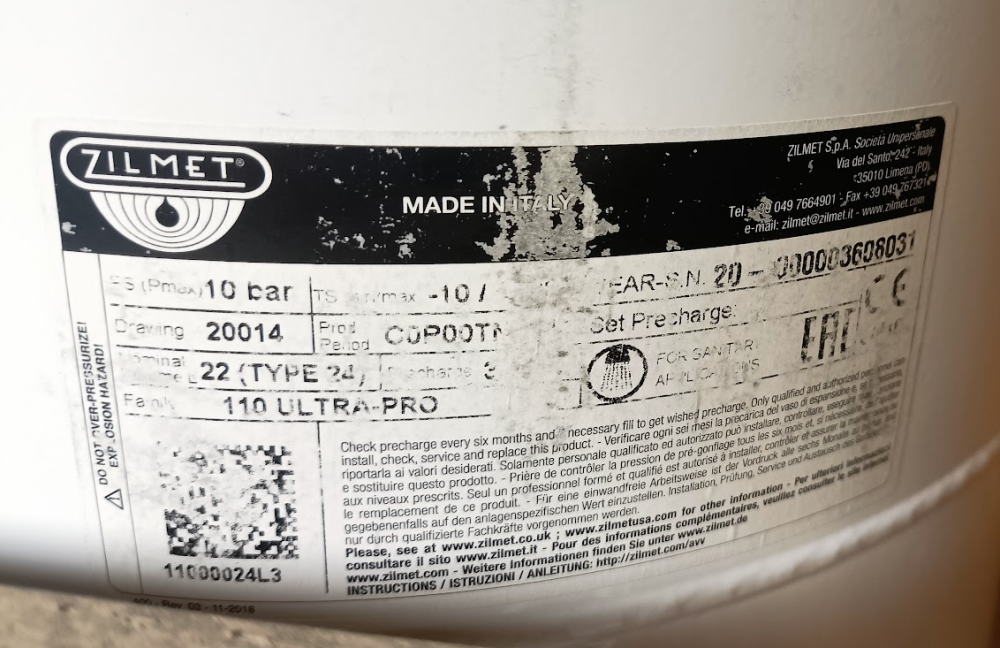
I don't know if you remember. The plumbers originally installed it horizontally and didn't install the multibloc at all. I got them to "fix" it but the water system still wasn't satisfactory. After a year I took it all apart and put it all back together with Hep2O. I've been doing my own servicing. G3 doesn't seem to exist in Ireland. Annually I've. 1. Cleaned the strainer in the multibloc. 2. Tested the over pressure valve. 3. Tested the over temp valve. 4. Got a bicycle pump and topped the accumulator back up to 3 bar. Have I missed anything? Anyhou I've bought a cheap Chinese stainless steel unit from eBay. Will see how it fairs when it turns up.
-
@allthatpebbledash, I hope I wasn't poking too much fun with my above post. Sorry if I was. Practically what you are proposing is possible but very uneconomical. It's been alluded in the above posts that with lots of DIY that it could be cheaper. I made the mistake in our old build of not valuing my time enough. I embarked on circuitous routes because of it and it pretty much burnt me out. If you really want to avoid a knock and rebuild then I would step back from the bleeding edge of performance a little. Dig out the ground floor and replace with 300mm EPS. Pour a slab with UFH or float an OSB floor on top. Suck out the mineral wool in the walls, replace with EPS beads. Parge internal walls and apply good airtighess to all joists and wall penetrations. Apply a battened internal service cavity with mineral wool insulation. Plasterboard and skim Install good quality 3g PVC windows and doors. Apply an airtight membrane to the ceiling of the existing roof. Pump 3-400mm of cellulose in there. Install dMEV or ideally dMVHR if possible. You'll get to about 30kWh/m²/annum like this I reckon and it can be done piecemeal. Otherwise knock and rebuild.
-



.gif.92cd606ce8436b49ddfac97fc053c130.gif)

-
Our multibloc is preset to 3 bar so I just matched that with the vessel. Was this wrong?
-
Yes although @Nickfromwalessuggested just replacing the whole thing in a previous thread due the lightly hood of internal corrosion tearing the new one.
-
Forget about vapor diffusion. It's absolutely miniscule. Completely insignificant compared to moisture carried by air leaks. Like thousands of time less moisture gets transferred this way. It all gets carried by drafts. I would aim for a complete sealed airtight layer. "Reduced" or "good enough" is like "kinda" fixing your puncture on a car. If you do this you can implement a sealed attic too with ventilation above the rafters and no ventilation through the eaves. It'll prevent wind washing of your insulation.
-
Do you need to have a vapour barrier on the interior of a warm flat roof?
Iceverge replied to plockhart's topic in Flat Roofs
Ideally you'd be able to join the roof polythene to the foil facer of the PIR. Not practical now of course. I would use the OSB (sorry for the earlier typo) as the roof airtight layer. Tape it to the joists and tape the perimeter to the boards. -
100mm cavity - Full fill?
Iceverge replied to iSelfBuild's topic in House Extensions & Conservatories
It'll keep getting out! Cavity boards suffer worse as they're smaller and have more exposed edges. Anyway this is far from the biggest issue. I've yet to see anyone installing any rigid boards to any satisfaction. It's just not practically possible. -
Do you need to have a vapour barrier on the interior of a warm flat roof?
Iceverge replied to plockhart's topic in Flat Roofs
Airtighess is the real issue rather than vapour diffusion. Air leaks take the airborne moisture where it shouldn't go orders of magnitude more than diffusion. You need a continuous airtight layer throughout the building. At the moment that is in your plastic sheet above the 18mm OSB. This will be tricky to join to the inside walls at this stage. I would probably just make the roof airtight layer the SB. Tape it to the joists, and the walls then. Including another membrane wouldn't be ideal in my view. -
This has lasted the miserable total of 4 years. 95% of my underwear is older. Now the kids are bathing in grimy brown water which for once isn't of their filthy doing. Can someone please suggest one that I can swap in that will outlive the next ice age please.
-
100mm cavity - Full fill?
Iceverge replied to iSelfBuild's topic in House Extensions & Conservatories
Still impossible to get them tight enough to be wall to prevent thermal looping. Whilst you're at it mark the K value of the boards from 0.022W/m2K down to about 0.033 as the blowing agent will escape from all the cut non foil sealed edges in a few years to be replaced by air so you're basically back at mineral wool or EPS anyway. Full fill mineral wool batts will be far far cheaper and easier to work with and result in less heat loss despite the headline worse insulative value. Airtighess is mega important too. I would recommend wet plaster internally. I was going to suggest to suggest stick framing with a blown or flexible insulation for the extension. What's your plan for the SIPs? Are you going to clad them in brick?