Iceverge
-
Posts
4485 -
Joined
-
Last visited
-
Days Won
32
Everything posted by Iceverge
-

Help needed setting timber frame window hole sizes.
Iceverge replied to G and J's topic in Windows & Glazing

-
Help needed setting timber frame window hole sizes.
Iceverge replied to G and J's topic in Windows & Glazing
What wall build up have you gone for in the end? Does it include a block fasade? Mount the windows flush with the sheathing and put strip of dense mineral wool or the outside lapping over the frame and the timber frame studs. It would perform better and be far easier to install. Much like an EWI install. The as drawn detail will have lots of heat loss as I have shown. Then Screw J beads to the window, slot normal plasterboard in and have perfectly cheap and tidy reveals.
-
1. Install mechanical ventilation. Even replacing a bathroom fan with some dMEV for £60 will do. 2. AIRTIGHTNESS. The single biggest and cheapest thing you can do. Get some airtight silicon/foam/tape and go draft hunting. This may include taping the bifolds closed for the winter! Beware, good airtightness without a proper ventilation plan isn't a good idea. 3. Some loft roll would help.
-
Veka Softline 82 upvc passivhaus windows installed by local company. €500/m2 in 2020 inc VAT (13.5%).
-
The important thing is a gap and the some fluffy something somewhere. 100mm is plenty. Think of it's function like dealing with a splashing raindrop. It just deadens the impact and stops it bouncing about. Making sure the insulation is continuous is important, the density of it really isn't as it's only a couple of extra grams per M2 over cheaper stuff. Really really get fastidious with air sealing every gap. Once you've laid the floor. Then some decoupling if you can and then mass. Use as much as you can.
-
Arches still work....
-
First timers attempting an ICF and Oak Frame house in Devon
Iceverge replied to MCoops's topic in Introduce Yourself
There's something in my head that still can't warm to the idea of ICF and oak frame. Perhaps it's the six times differing thermal expansion coefficients of oak and concrete. Maybe it's the idea of minding the oak frame from the sloppy work of filling the ICF with concrete or bracing the inside of it during construction. Trying to get a clean finish on the internal walls in the joint between the oak frame and the flat plasterboard seems hard too. You could leave a gap but how exactly would you deal with this between floors for fire and sound transmission etc. I'm still sure there's a solution in my head somewhere, if only it would come out..... -
First timers attempting an ICF and Oak Frame house in Devon
Iceverge replied to MCoops's topic in Introduce Yourself
I know of a house like that. They even passed the airtighess test. Apparently all the gaps in the walls were just big enough to slip some £50 notes into the testers pocket..... -
First timers attempting an ICF and Oak Frame house in Devon
Iceverge replied to MCoops's topic in Introduce Yourself
What sequence do you plan on building the oak frame and the ICF @MCoops? What comes first? -
First timers attempting an ICF and Oak Frame house in Devon
Iceverge replied to MCoops's topic in Introduce Yourself
Proper compression seals are key whatever you choose. Sliding seals don't work well . It's not solely a woodfiber issue. The houses I saw were EPS ICF. Amvic brand I think. Woodcrete is a different beast to woodfiber and I've never seen it in person. @JohnMo and @ToughButterCup have used it off the top of my head. In any case I would batten the ICF (before the pour to avoid drilling into concrete afterwards) and then fit cement board externally for to create a cavity for the rendered section. What's your plan for decorating inside the ICF? -
It's the load they need to take. Steel is defaulted to buy many structural engineers as it's easy to spec and there's suppliers in every town. I would prefer concrete. Easier to plaster etc after.
-
Joinery question. how best to make stick-build frameworks.
Iceverge replied to saveasteading's topic in Timber Frame
I hope in the afterlife that I can go and stick frame nice buildings at my leisure in a summer meadow. -
With the sole exception of Christmas decorations there is no recorded instance of any human in history storing anything in the attic what didn't rightfully belong in a skip.
-
I need one of these!
Iceverge replied to Nickfromwales's topic in General Self Build & DIY Discussion
Not cheap. My toddler is would love to play with that stuff. -
First timers attempting an ICF and Oak Frame house in Devon
Iceverge replied to MCoops's topic in Introduce Yourself
@MCoops Welcome to the site. Congratulations on planning and a balanced straightforward design. For the large glazed windows facing south I would favour something like French doors and avoid bi-folds as they're very drafty. I really love OAK frame but the pauper in me doesn't like the reality of doubling up on the structure. I'm fermenting an idea that could be economical to execute though. I'll sketch it later if I get a chance. I'm not a huge fan of SIPs, so I can see why you've decided against them for the walls. Why have you decided to keep them for the roof? ICF ticks lots of boxes but it's not without it's pitfalls too. The one I'm concerned about most is the exterior render directly onto the EPS in damper climates. There's some quite new houses near me where it's failed. @ProDaveunfortunately had a similar situation over his woodfiber. The transition between rendered surface and cladding on the facade will need some consideration too to avoid a very large step. Keep posting and good luck. -
Suspended timber floor with shallow joists: an indecent proposal
Iceverge replied to tenovus's topic in Heat Insulation
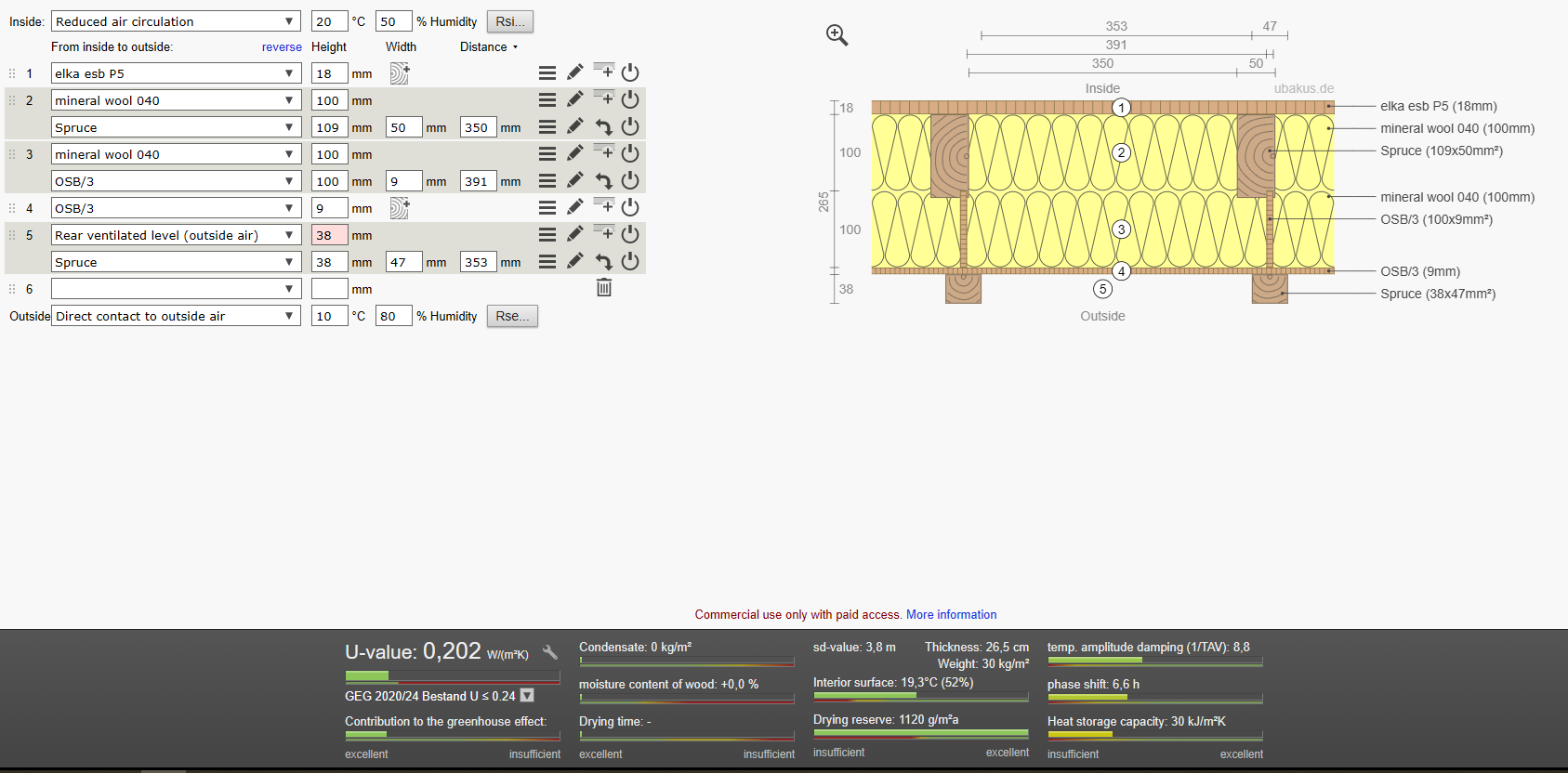
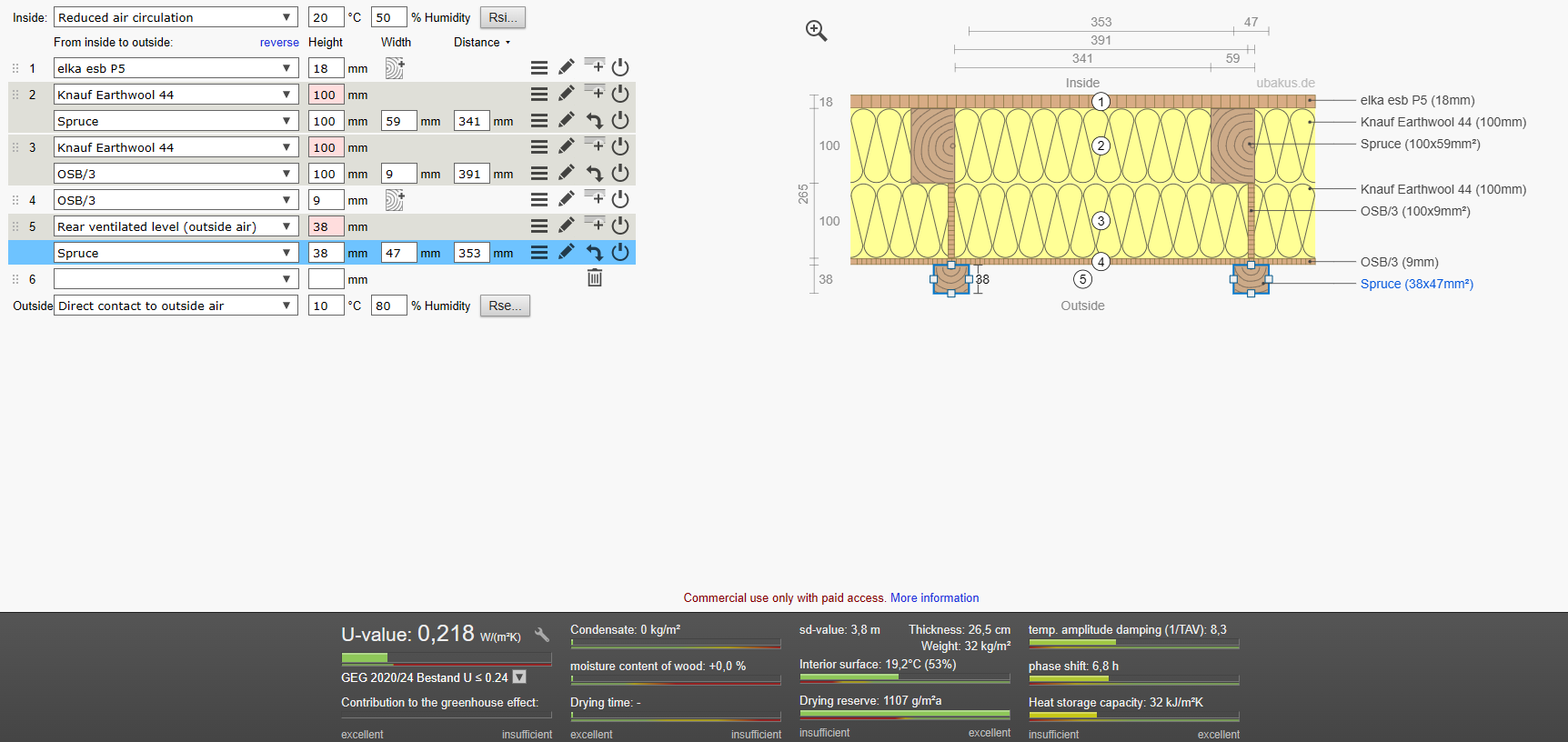
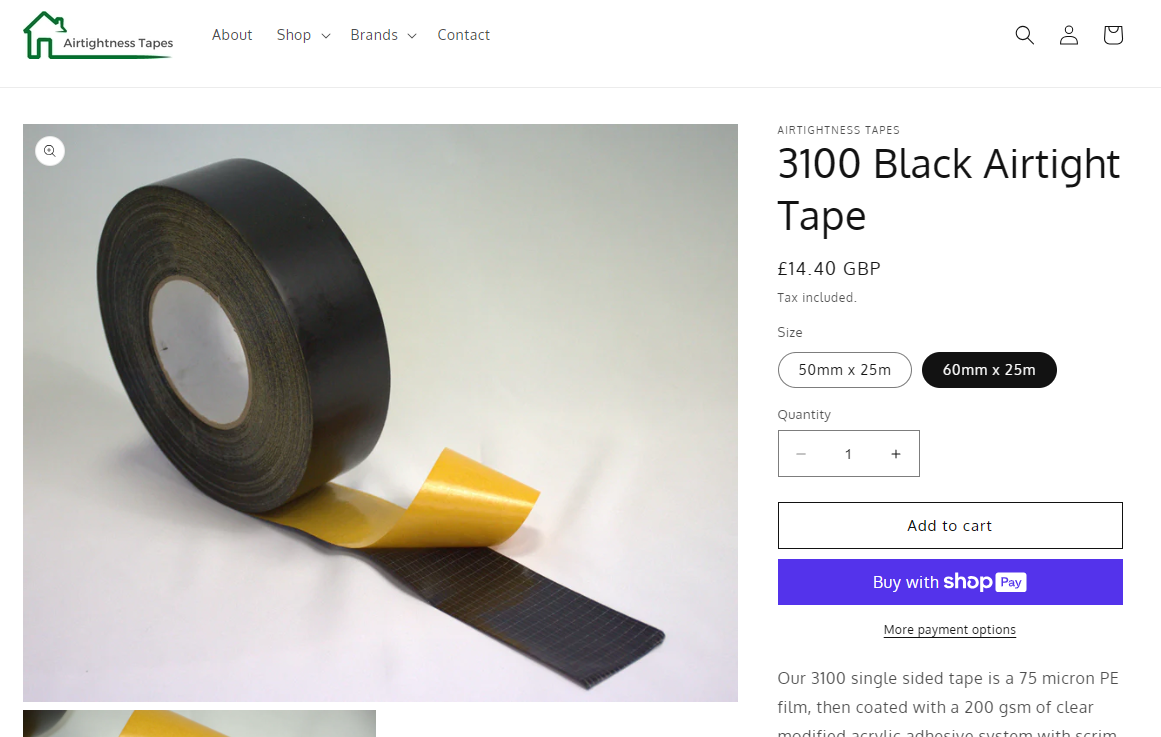
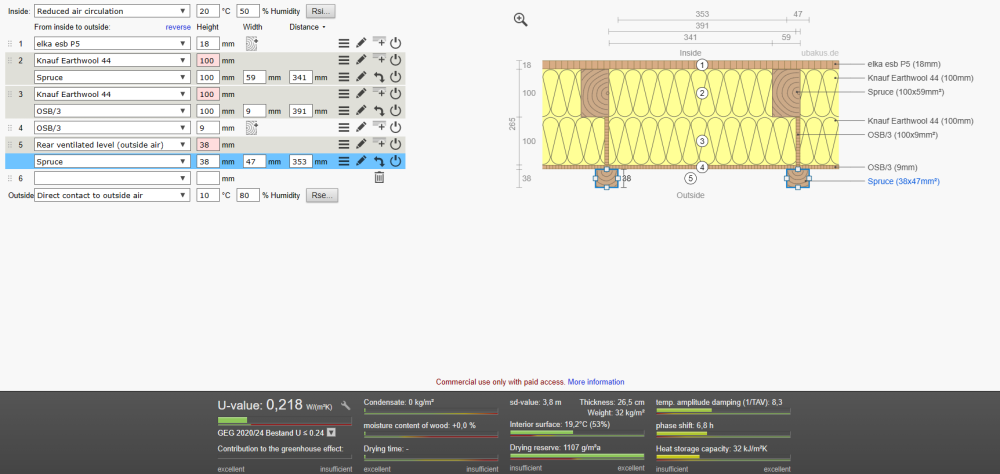
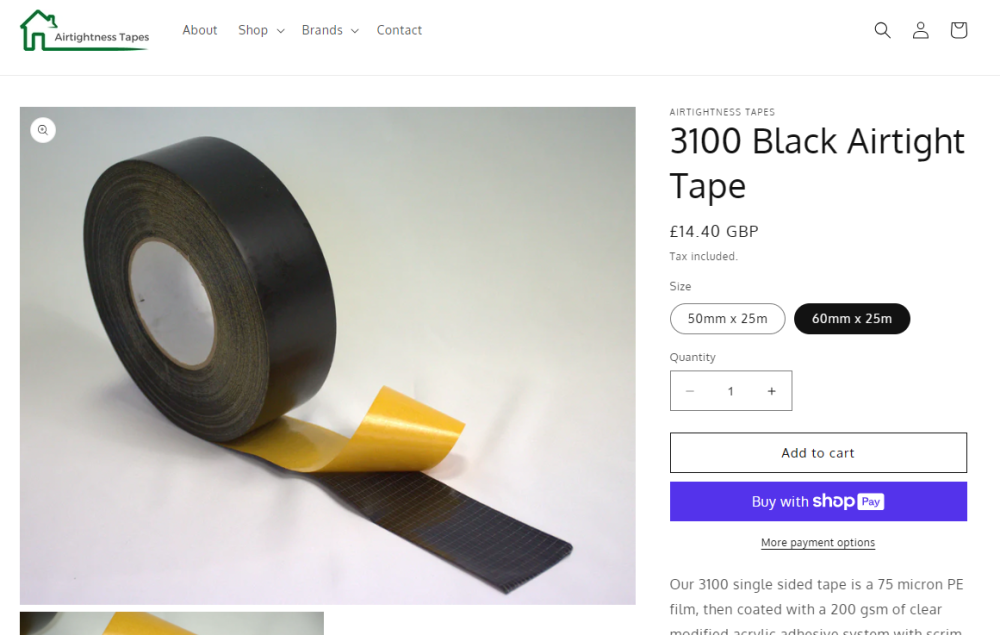
Here's my idea. It's hard to show the OSB as described above in UBAKUS but it's useful for a U value comparison anyway. 9mm OSB is £10.56 per board. Use 200mm as the verticals and 400mm as the horizontals, its 600mm per bay, and 2.5 bays per m2. It all cuts nicely so no waste. £5.50 per m2. Next use 19x38mm battens at 45p/m nailed to both sides of the web to create the flange. you'll need 5m per m2 so £2.25/m2. D4 glue will make the whole thing much stronger. Lets be generous and use 100ml/m2. say £1/m2. Nails will keep everything in place nicely. £4.26 per 1kg which is about 700 nails of 40mm x2.65mm galvanised ones. Say 40 nails per m2. £0.25 pf nails per m2. ( nails are really cheap!) Next insulation. I have found in my experience loft roll doesn't quite expand to the desired thickness when installed in a timber frame. I have used it in walls but it was unsatisfactory. However in this situation where it is lying flat I would instead opt to install 150mm + 100mm and then compress it very slightly to fit the gap. The cost of is it £6.72 per m2 and there won't be any wasted offcuts. Airtight tape the corners would make a really pucker job of it. No need for any fancy tapes. This stuff is fine. 5m per m2 again so £3.16 per m2. Lets do some adding. OSB £5.50 Battens £2.25 Glue £1 Nails £0.25 Insulation £6.72 Airtight tape £3.16. £18.88 per m2. Labour of course is the variable but it depends on how good a result you want. Access to a small nail gun would make it immeasurably faster too.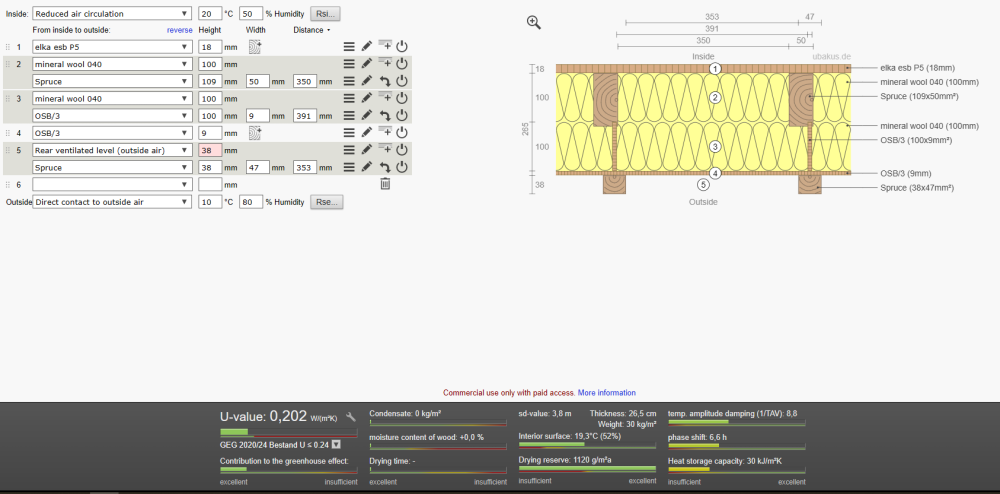
-
Suspended timber floor with shallow joists: an indecent proposal
Iceverge replied to tenovus's topic in Heat Insulation
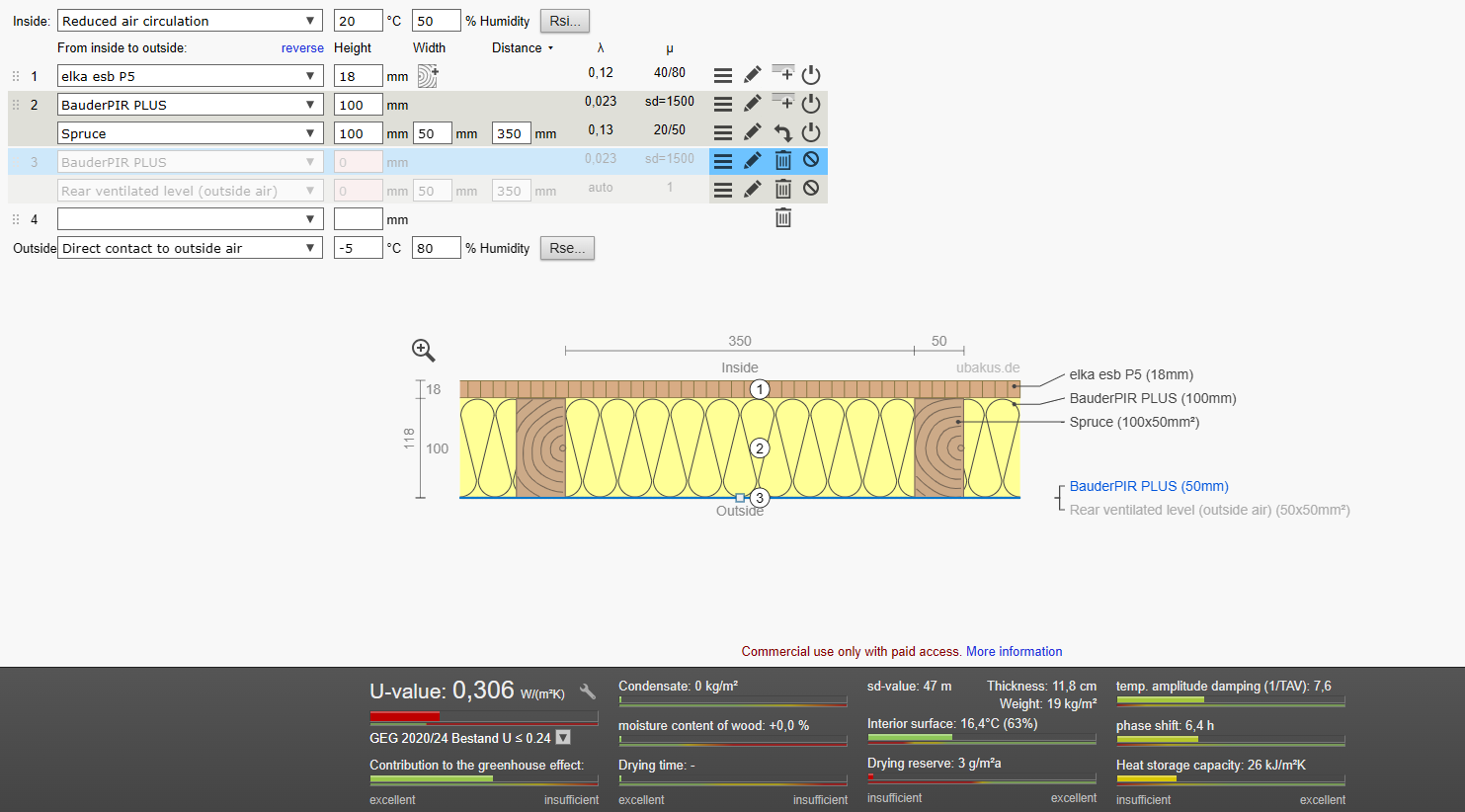
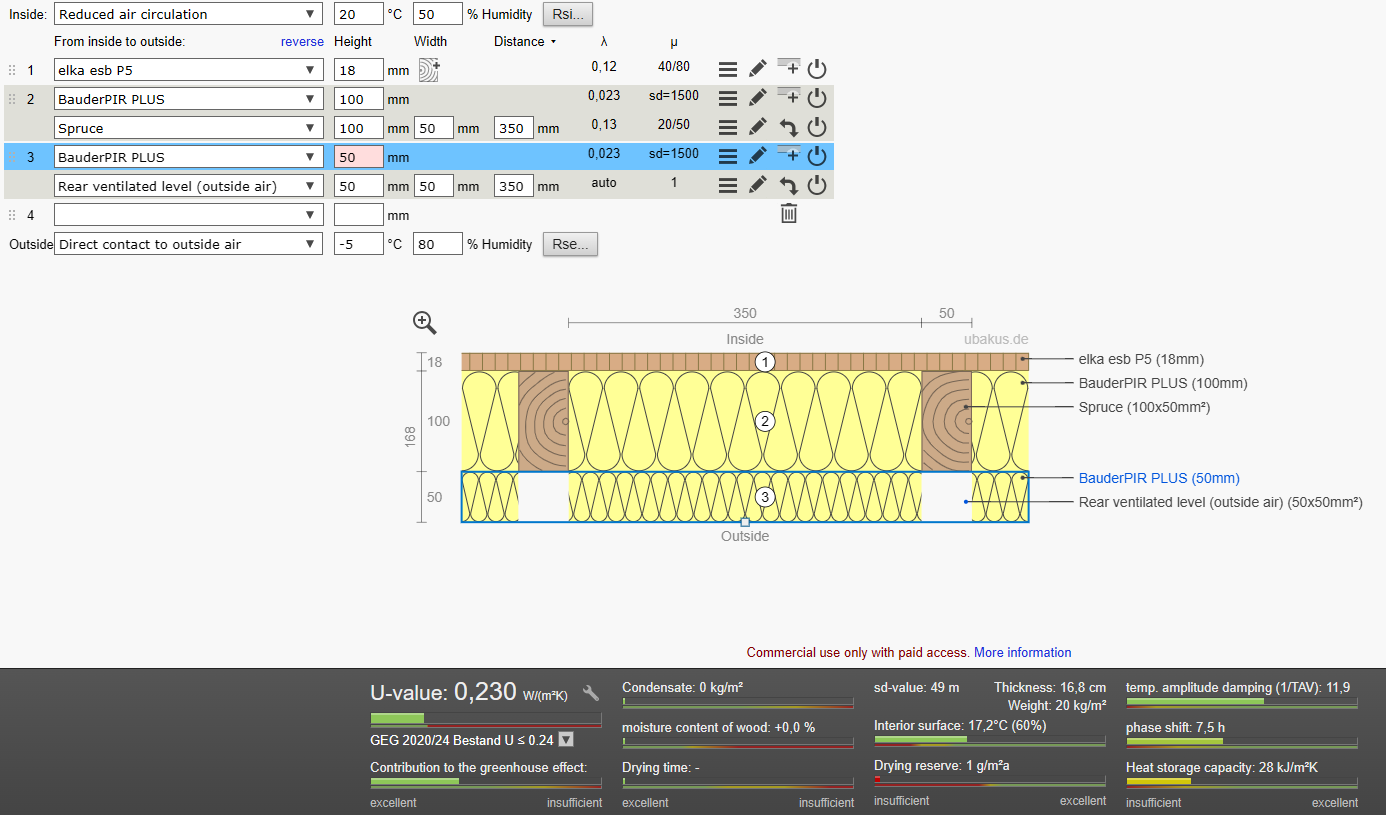
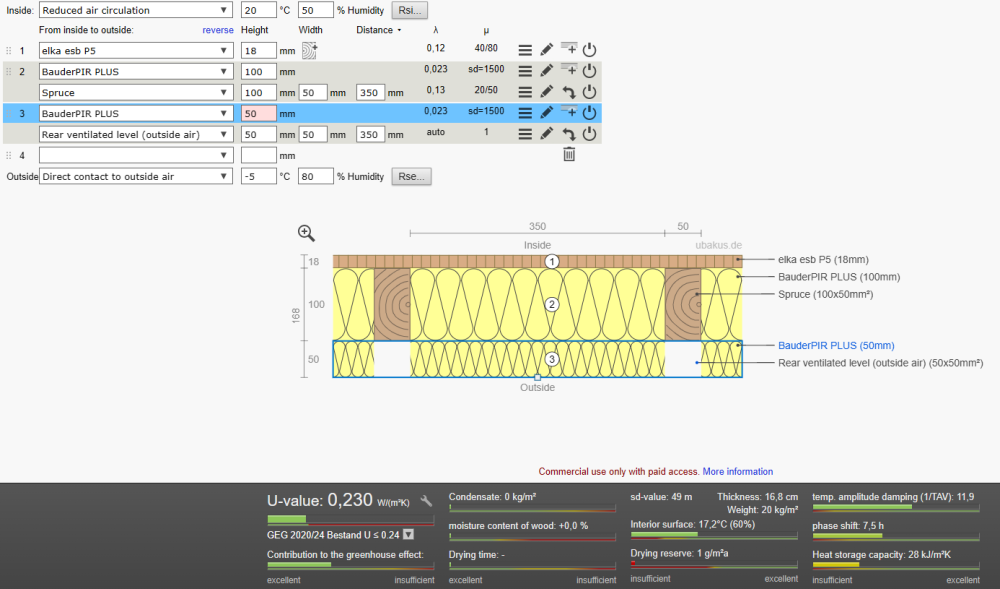
As I'm avoiding doing real work I though it might be interesting to do a cost comparison for a PIR between the joists vs my above method. First lets look at the PIR wedged between the joists with foam and foil tape. Here's the normal arrangement. However with a little thinking and extra spend on PIR and just let it extend below the floor joists you can get a good improvement in U Value. Here's 150mm between the joists. Ubakus won't let me show the PIR as a single board) Lets work from this. A 150mm board is £56. However because of the way you need to cut it you'll loose 0.36m2 from each board. Maybe you can use some of these offcuts so lets be generous and say you get 2.6m2 from every board £21.54/m2 for PIR but you have to account for the spaces taken up by the joists so the PIR will cost you £18.84 per m2 of your room. FM330 foam is £12 per can and lets say you make sure it's done well and use 1 can for every 3 boards. That comes to £1.5/m2. 150mm Foil tape is £2.20/m to bridge the top of each joist and give 50mm coverage on each side overlapping the foil face of the boards. You'll use 2.5 linear m per m2 floor so £5.5/m2 Total cost per m2 for the above arrangement is £18.84+£1.50+£5.50= £25.84 per m2. Add a little more waste in the tape and call it £26 per m2 For a U-Value of 0.23W/m2K. Nicely done. ( until the foam shrinks in 5 years and the insulation falls into the ventilated floor that is!) I'll split the post here.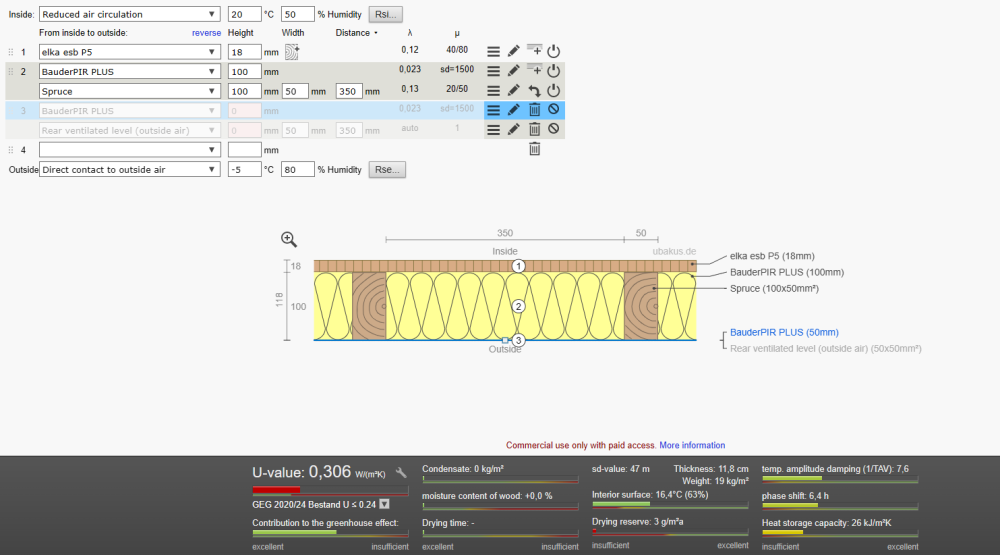
-
The roofer will lightly have had to tuck the lead in between two courses in the brickwork so maybe have come a little higher than you expected. It's probable they did a proper job on it though. It looks completely normal to me, and if you hadn't highlighted it, I doubt most of us picky self builders would even have noticed. To miss quote Shawshank Redemption. "I mean, seriously, how often do you look at a man's roof?" Live with it for 6 months. Then you can either change it or paint it. I guarantee you won't, you'll have forgotten all about it.
-
Suspended timber floor with shallow joists: an indecent proposal
Iceverge replied to tenovus's topic in Heat Insulation
Sketch it for me please what you're thinking. You really need to have the bottom of the membrane quite taut or else you'll end up with baggy droopy bottoms empty voids in the insulation which isn't good. The deeper you go the harder this will be to execute in practice. -
Suspended timber floor with shallow joists: an indecent proposal
Iceverge replied to tenovus's topic in Heat Insulation
Of all the foam products, EPS is my favourite. Not great in a fire, but then I don't suppose any foams are. Form personal "laboratory" fire testing it seems to give the least funky gasses too. -
Suspended timber floor with shallow joists: an indecent proposal
Iceverge replied to tenovus's topic in Heat Insulation
Where does EPS sit in this equation? -
Suspended timber floor with shallow joists: an indecent proposal
Iceverge replied to tenovus's topic in Heat Insulation
Airtighess is the key. Not vapour diffusion. Hundreds and hundreds of times more moisture is carried by air leaks than by diffusion. You have to have a complete airtight layer. The chipboard floor will be fine but ensure you seal every joint and seal it to the walls too. -
Suspended timber floor with shallow joists: an indecent proposal
Iceverge replied to tenovus's topic in Heat Insulation
I think all foams shrink calling @SteamyTea? PIR is never a good choice between timbers in my opinion. The headline lamda value sucks people in and theres little regard given to the performance and overall cost of the system. -
Suspended timber floor with shallow joists: an indecent proposal
Iceverge replied to tenovus's topic in Heat Insulation
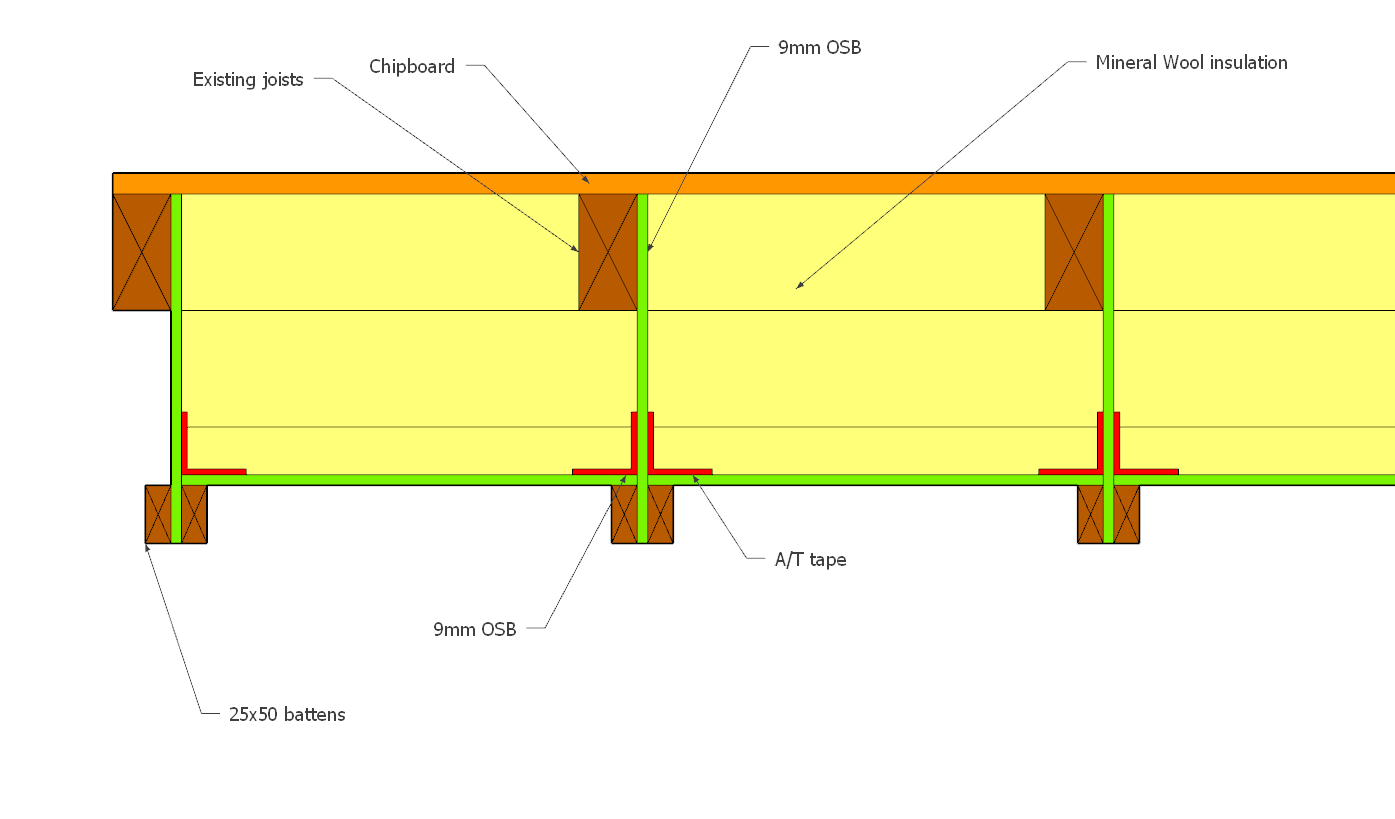
My suggestion. U Value about 0.16. Rip some 9mm OSB, nail 2 x battens to either side of the bottom to create a flange. Nail it to the sides of the existing joists. Drop in a bottom piece of OSB to create a box. A/T tape the corners to make it completely wind proof. This is very important the performance as your insulation will get wind washed if it is not sealed. Drop in the mineral wool/woodfiber insulation. Lay the Chipboard on top and fastidiously foam glue all the joints. This will be your internal airtight layer. This proposed arrangement can all be done without the bother of getting into the crawl space at all. If you add some glue to the OSB and the battens you would effectively be creating an I beam which would massively strengthen the floor too. I never like PIR between joists. Too many reports of it shrinking and coming loose over time.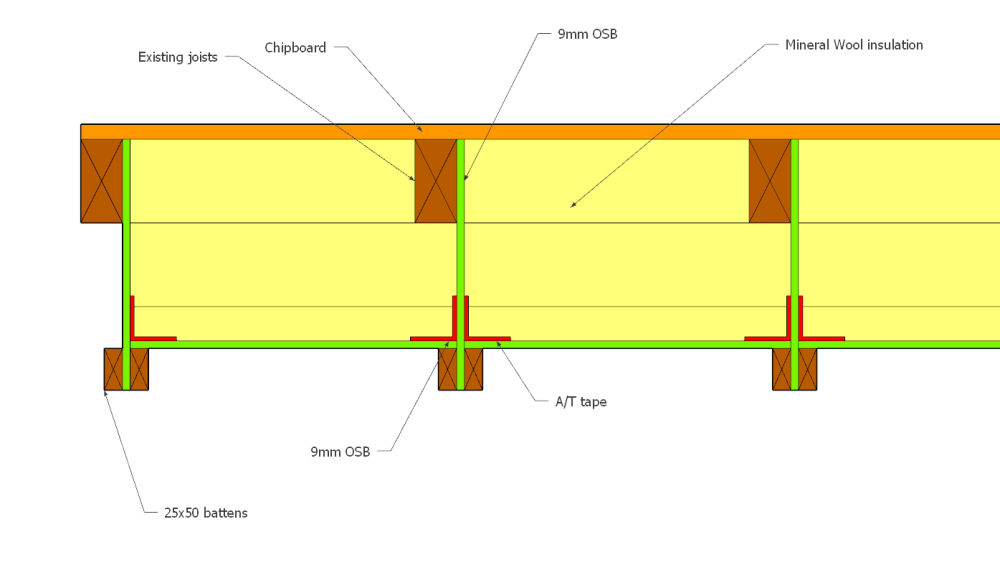
-
40 Insulation companies banned in UK
Iceverge replied to Marvin's topic in General Construction Issues
Unless you design out this bit with a little bit of physics at the design stage. Our single A2A is purring in the hallway and the house is nice and warm.