Iceverge
-
Posts
4381 -
Joined
-
Last visited
-
Days Won
31
Everything posted by Iceverge
-

Heating required
Iceverge replied to stubiff's topic in Mechanical Ventilation with Heat Recovery (MVHR)
You'll achieve the same cheaper with straightforward electric heating. A couple of towel rads in the bathrooms maybe. In general asking anything to do something that's not its primary function is always more expensive and less satisfactory. -
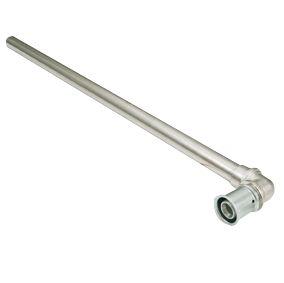
We have no heating at the moment. Maybe forever. The mixer bars have these buried behind them in the stud wall. The wastes are cleanable but they can leak. I think that’s what’s leaking in our bath ? Plastic pipes are the business. On the farm there’s a mix of copper, brass and plastic. The copper lasts about 10 years on average, The brass maybe 30 and the plastic pipes never ever leak apart from at the joints. My ideal system would be an electroweld all plastic one. I don’t know if it even exists.
-
Sorry I should have been more explicit. No pipes buried under concrete. Service hatches for the back of shower mixers. Pipes run under cabinets or in accessible service cavities. Have some kind of removable ceiling tiles to access the underside of the upstairs shower waste. I almost managed it. But the plumber was a moron and managed to install extra fittings where they weren’t needed hidden inside stud walls. Also there’s a small amount of water appearing from under the bath and I’ll need to remove some skirting board to take off the shower panel. Grrrrrrrrr
-
Things I'd definitely do again. Airtightness. insulation, 3g and MVHR. Amtico glue down tiles. Nice villeroy and boch porcelain and German taps. 100% wool carpets. 2 dishwashers. One clean one dirty at all times. French drain and gravel between footpaths and house wall. Splayed window reveals. uPVC windows. Plain laminate kitchen worktops. Things I wouldn't bother with. Ensuite. 3 baths in 3 beds are wasted. Floating LVT floor. It's not near as nice as the glue down one. Slate shower tray. Expensive and makes the shower dark. Precast concrete first floor. Things I'd do differently. Timber frame rather than block built. Dedicated office space or alcove. Insist on warm LEDs for fixed lights rather than the cool ones the electrician installed. Make all plumbing accessable.
-
Minimum Reasonable wall width for good U values?
Iceverge replied to puntloos's topic in Heat Insulation
Is it the 'plaster' or the 'board' part that's rubbish? It's the plasterboard, sheetrock drywall whatever you want to call the sheets of gypsum that attach to the wall. It does not seal the porous blocks and leaves draughts blow through any openings for sockets and behind skirting etc. Plaster typically is a type of paste or slurry that is wet applied with trowels and dries on the wall. Not at all. Lots of energy required to manafacturer cement and concrete off gasses CO2 when curing. If you want to have a low CO2 house you should build it out of plant material like wood and hemp. -
Minimum Reasonable wall width for good U values?
Iceverge replied to puntloos's topic in Heat Insulation
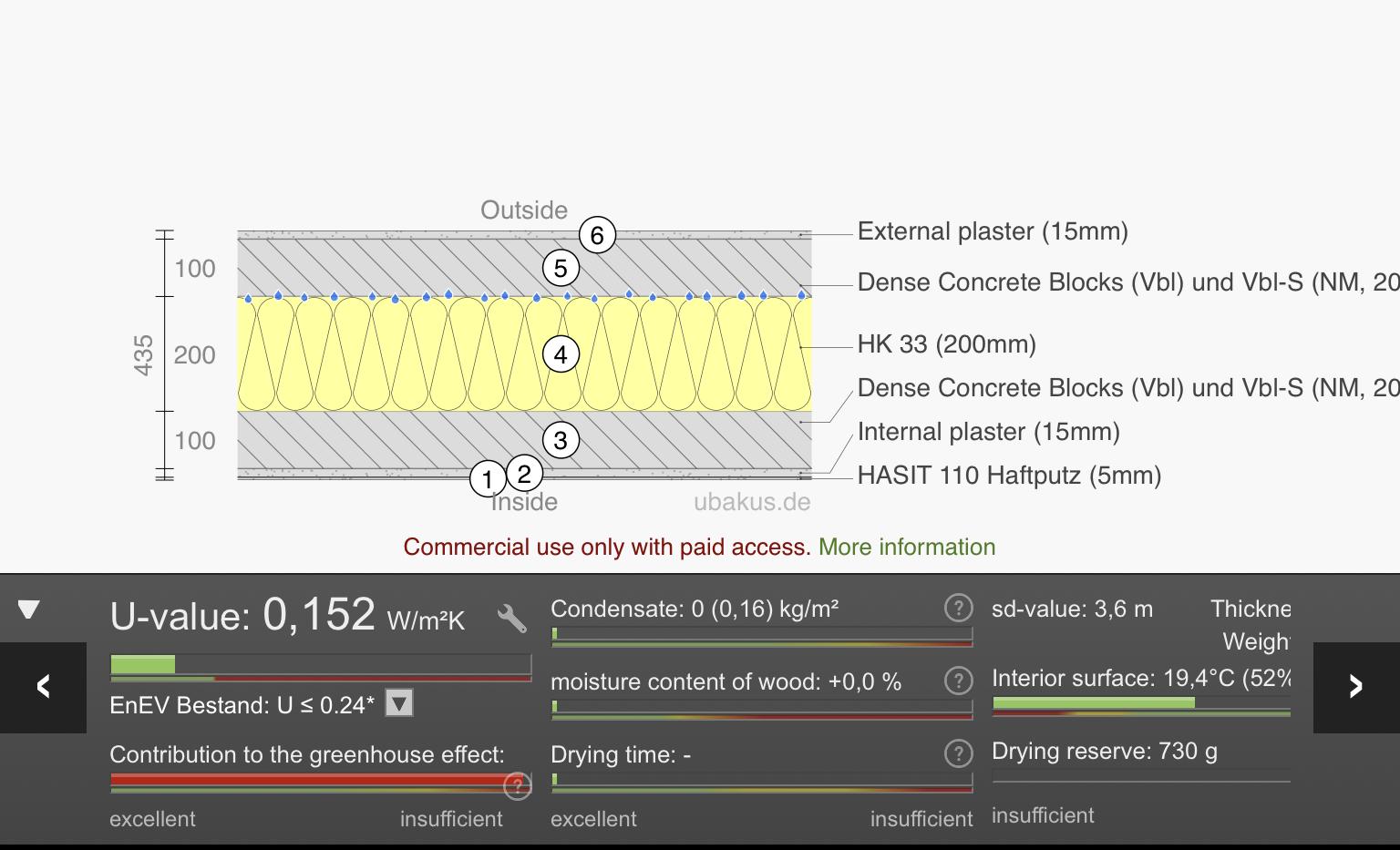
ditch the plasterboard. rubbish for airtightness, skim 5mm sandcement plaster 15mm medium block 100mm EPS blown beads with stainless steel wall ties 200mm medium block 100mm sand cement render 15mm if you search my last few posts you’ll see how little a difference chasing the last few decimal places in wall u values makes. Unless you’re aiming to make a true air heated passivhaus or need certification your efforts are better aimed toward airtightness. As for the mortar snots. extend your cavity as far below the ground as you can. this will stop droppings building up and bridging above dpc level (i’ve seen it happen). otherwise as long as your brickies clean the ties before the mortar sets EPS blown beads are pretty fool proof. just make sure all your through wall ducts are done beforehand as the bonding can be hit and miss.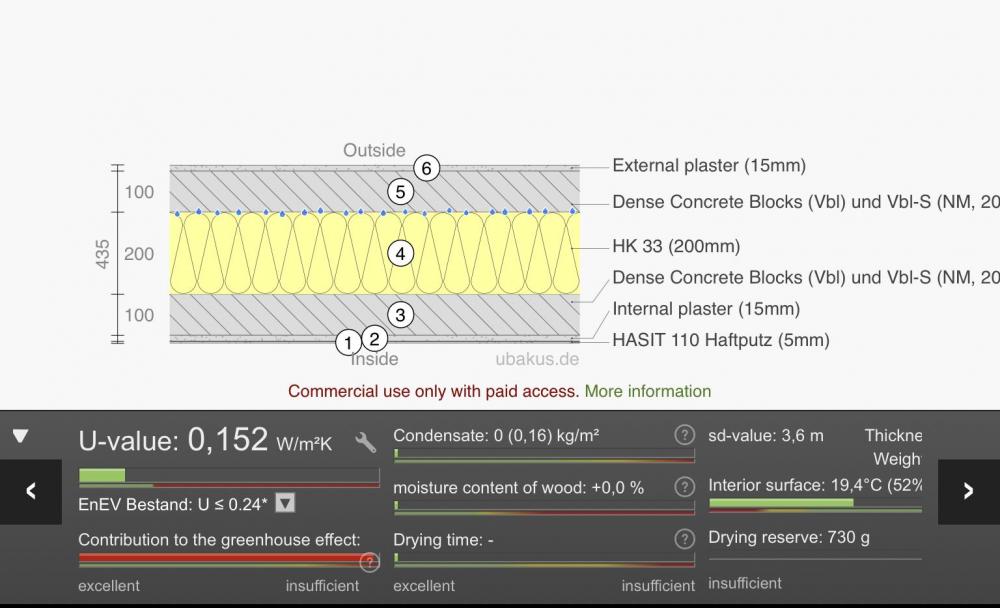
-
For Clarity this is the overall improved overall window U value with glazing at 0.5 W/(m2K) This is when you drop to double glazing (1.2 W/(m2K) with the same passiv certified frames.Most double glazing frames would be worse. We didn't use any PIR as I think it's entirely overrated. EPS in the floors and walls and cellulose in the roof. Agreed, detailing is everything with low energy houses. I modelled all the junctions in our house myself. We compromised on some of the detailing such as placing the window at the outside of the cavities instead of the middle where they would have been most thermally efficient. It made it easier to build and secure a good wind-tight as well as an airtight envelope. Putting in a little extra insulation elsewhere to compensate was relatively cheap. I left plenty of fat in the overall design to account for shortfalls in the build process. ( I think i allowed for 1.5 ACH to reach 10w/m2 heating load) As it was we achieved 0.3 ACH50. We moved in 3 weeks ago and the house is performing well with only an intermittent 2kw rad for space heating. Hopefully when the house dries out properly we can do away with this other than in just the most extreme situations. On a large project or complex house shape chasing the gains made by ideal thermal detailing is certainly worthwhile. However my builder and I were first time passivehousers and the peace of mind granted by sticking close to known detailing and spending about €3k extra on insulation was the road we chose. As a result I suspect that as built performance will exceed 15kWh/m2a and 10W/m2.
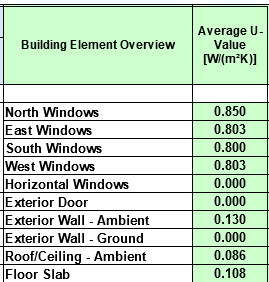
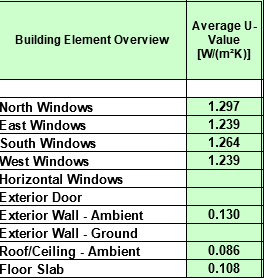
-
Above is a spreadsheet from my energy planning. All figures taken from messing around with PHPP. Location is set to the South of Ireland. I used the backstop Irish values for my starting point and passivhaus with a small margin for the finish. Granted Airtightness may not be that bad to begin with. I didn't bother changing the u value for the window frames so they're probably better than cheap double glazing. I also left the G factor at 3g for ease of calculation. Glazing is split 58% S 16%W 16%E and 20%N. My main takeaways were: 1. The drastic effect of airtightness followed by MVHR and triple glazing. 2. If your energy cost is very low there's little benefit in improving insulation beyond regs. (I know Ireland has tighter standards here than the UK) In the first table the two figures are the total heat demand per year per meter and the second figure is the heating load. Note: These figures only work for one specific house in one location but should still give a general picture. If you live in a hotter or colder region or build a house of a drastically different shape the picture will be different.
-
Inprovement from Building regs Airtightness Before 7ACH Gross Floor Area 150m2 After 0.6ACH MVHR Before 0% Efficiency 2 story 12m x 7.5m footprint After 90% Efficiency Triple Glazing Before 1.2 W/m2 (Glazing) (36.6m2) After 0.5 W/m2 (Glazing) Walls Before 0.21 W/m2K (210m2) After 0.13 W/m2K Roof Before 0.16 W/m2K (90m2) After 0.086 W/m2K Floor Before 0.21 W/m2K (90m2) After 0.106 W/m2K kWh/(m2/a) W/m2 75/42 AT AT/MV AT/MV/3G AT/MV/3G/W AT/MV/3G/W/R Airtightness 48/20 XXX XXX XXX XXX XXX MVHR 60/37 33/16 XXX XXX XXX XXX Triple Glazing 68/39 40/18 25/13 XXX XXX XXX Walls 68/39 40/18 25/13 18/11 XXX XXX Roof 72/41 45/19 30/15 22/12 15/10 XXX Floor 73/41 45/20 30/15 23/13 16/10 13/9 Annual Heating Cost (€) (4c/kWh) 450 0 AT AT/MV AT/MV/3G AT/MV/3G/W AT/MV/3G/W/R Airtightness 288 XXX XXX XXX XXX XXX MVHR 360 198 XXX XXX XXX XXX Triple Glazing 408 240 150 XXX XXX XXX Walls 408 240 150 108 XXX XXX Roof 432 270 180 132 90 XXX Floor 438 270 180 138 96 78 Annual Heating Cost (8c/kWh) 900 0 AT AT/MV AT/MV/3G AT/MV/3G/W AT/MV/3G/W/R Airtightness 576 XXX XXX XXX XXX XXX MVHR 720 396 XXX XXX XXX XXX Triple Glazing 816 480 300 XXX XXX XXX Walls 816 480 300 216 XXX XXX Roof 864 540 360 264 180 XXX Floor 876 540 360 276 192 156 Annual Heating Cost (16c/kWh) 1800 0 AT AT/MV AT/MV/3G AT/MV/3G/W AT/MV/3G/W/R Airtightness 1152 XXX XXX XXX XXX XXX MVHR 1440 792 XXX XXX XXX XXX Triple Glazing 1632 960 600 XXX XXX XXX Walls 1632 960 600 432 XXX XXX Roof 1728 1080 720 528 360 XXX Floor 1752 1080 720 552 384 312
-
You're dead right. I had a look last night to see if I was remembering my figures correctly. I wasn't. Airtightness is number 1
-
390m apparently ? https://en.wikipedia.org/wiki/Woodingdean_Water_Well#:~:text=The Woodingdean Water Well is,later%2C on 16 March 1862.
-
From my research they're the cheapest, biggest improvement to energy savings shortly followed by airtightness and MVHR. Go for it. We have white uPVC and I'm very happy with them
-
@Haku Trickle vents and extractor fans have a poor record of maintaining an acceptable level of air quality. Over ventilation in windy weather cools the house and occupants close window and wall vents. Noisy extractor fans get turned off. This is seldom rectified in still weather leading to high humidity, high CO2 and high VOCs through under ventilation. Poor occupant health and decaying buildings are the ultimate result. In essence it is a manually controlled system. It can work with very diligent house owners who have appropriate knowledge and time to alter the vents as required. Unfortunately most people don't understand and don't have the time The simple answer is continuous mechanical ventilation of some sort. This can suck out blow in or both. Simply replacing basic extractor fans with humidity controlled ones which run at a low level 24/7 is only a small price increase but will make a noticeable difference. No maintenance or knowledge required. We used to run the kitchen extractor in our old rental cottage when we were out. It made a measurably difference to mould and damp. Remember, as a developer,poor ventilation also makes sick buildings and you're more likely to have call backs from your new neighbours if you don't take care of it at construction. We installed MVHR. Cost <€3k Inc vat for 186m2 DIY. Wouldn't be without it. No cold spots, no drafts. No noise from outside. TLDR. Natural ventilation doesn't work in practice. Continuous Mechanical ventilation keeps occupants and buildings healthy. MVHR does the above, improves comfort and saves energy
-
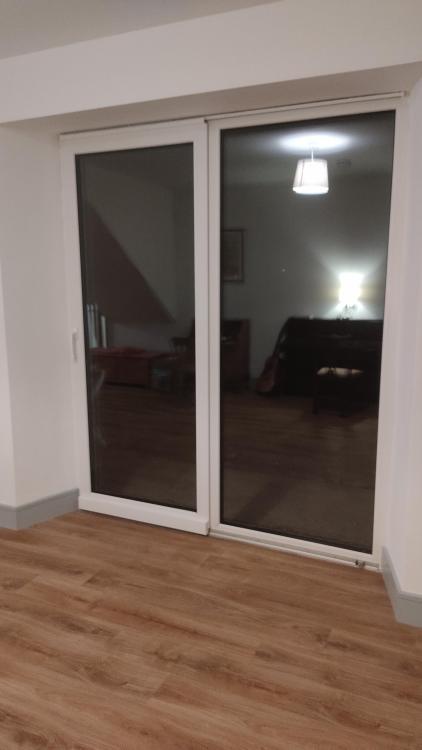
2.0m x 2.4m Veka triple glazed uPVC tilt and slide doors here. Overall U value 0.73 W/m2/k. Good compression seals meant me a 0.3ACH blowerdoor test result. About €3k installed Inc VAT.
-
New build ph design now - add ph extension later
Iceverge replied to goatcarrot's topic in New House & Self Build Design
Have you considered building a bungalow and then converting the attic at a later date. You could have your envelope sorted on day 1. -
Sorry I didn't see this until now. Yes 225mm it looks ok as we fitted deepish guttering. The trouble is though its just not perfect! Just do it as thin as you can manage and it'll look well
-
Great thread here that'll answer your questions. https//forum.buildhub.org.uk/topic/12676-mvhr-is-largely-bogus/
-
Spray insulation for timber framed new build?
Iceverge replied to davejura's topic in Heat Insulation
Looking at your whole wall build up it is actually 5 mm narrower with my suggested buildup as I didn't realise you had a service cavity. Insulation has little to do with airtightness. It's the vapour control layer that does that in your case. How much of the work do you intend to do yourself? Do you have anyone with a good knowledge of the main principles to hand? -
Slimline water harvesting unit inside wall cavity?
Iceverge replied to ashthekid's topic in Rainwater, Guttering & SuDS
Just to add to your worries what are you planning to construct the guttering from as is? It looks like a custom piece of metal/fiberglass? As is what happens when it leaks/overflows? I'd be suspicious that if it fills up with crud at the moment the only place for it to overflow is into the roof structure. Maybe I'm paranoid but the idea of an internal RWP gives me the shivers! Is there any option to route it anywhere else? I echo the above comments, rainwater is best left for watering the garden in summer. -
Spray insulation for timber framed new build?
Iceverge replied to davejura's topic in Heat Insulation
By the way dritherm/frametherm are trade names for various mineral wool and glass wool products. The site I used is Ubakus. -
Spray insulation for timber framed new build?
Iceverge replied to davejura's topic in Heat Insulation
I reckon your original buildup had a u value of 0.2 W/mK so the mineralwool 35 betters at 0.19 it albeit with an additional 20mm wall thickness. A quick Google suggests material only the PIR is £23.65/m2 and dritherm 35 is £8.60 ex vat for the above buildups. This excludes the faf of cutting foaming and fitting the boards. It's worth getting a handle on the numbers or you risk just doing whatever makes the architects life easiest. When it comes to insulation architects very rarely overspec the design. Many were educated in the oil era when infinite cheap energy was the solution. They can often outsource SAP calculations with a "just make it pass " requirement. -
Small, efficient SIPS build in Midlothian
Iceverge replied to catrionag's topic in Introduce Yourself
Lovely plans. I think if we were to start at zero we might go for something like this. -
Small, efficient SIPS build in Midlothian
Iceverge replied to catrionag's topic in Introduce Yourself
welcome. any plans to share? your approach to heating sounds fine,. we only have a 2kw electric rad at about half on the dial all day today and our 186m2 house is plenty comfortable. i just checked , it’s 20deg in the hottest room, 18 deg in the coldest and about 7deg outside blowing a gale, -
Spray insulation for timber framed new build?
Iceverge replied to davejura's topic in Heat Insulation
I agree. -
Spray insulation for timber framed new build?
Iceverge replied to davejura's topic in Heat Insulation
In my experience of DEAP (based on SAP) here in ireland so long as you pass the backstop values and add enough PV pretty much anything would get through.