Iceverge
-
Posts
4382 -
Joined
-
Last visited
-
Days Won
31
Everything posted by Iceverge
-
A lot more expensive I'd have thought than wet plastering? Also poor for airtightness and hanging stuff from.
-
Welcome welcome. I have a thing for small simple projects on a tight budget so please keep us updated! Do you have any plans to share and an indication of your budget? When we built I costed everything to the last and nothing was cheaper than strip foundations, eps floor insulation, wide cavity wall with eps beads or mineral wool. Medium density blocks are half the price of celcon and don’t crack as badly. wet plastered inside and out. Trussed roof. PVC windows. There have been some horror stories of PIR board insulation in cavity walls on here recently. Personally i would avoid. Larch cladding is not cheap but ideally suited to timber frame. Have you costed block vs timber. On a small project it may not be as much difference as you imagine. A stick built house is an option to save money too. TF will save you lots of time installing services later on too. Carefully cost the ASHP. Unless I diy’d it l couldn’t make it payback in less than 25 years due to our very low heating requirement. A2A and an E7 cylinder and modest PV was the best for us. Airtightness is the best money you’ll spend, MVHR is a definite too. So nice to have a quiet draft free house full of fresh air. Good luck!
-
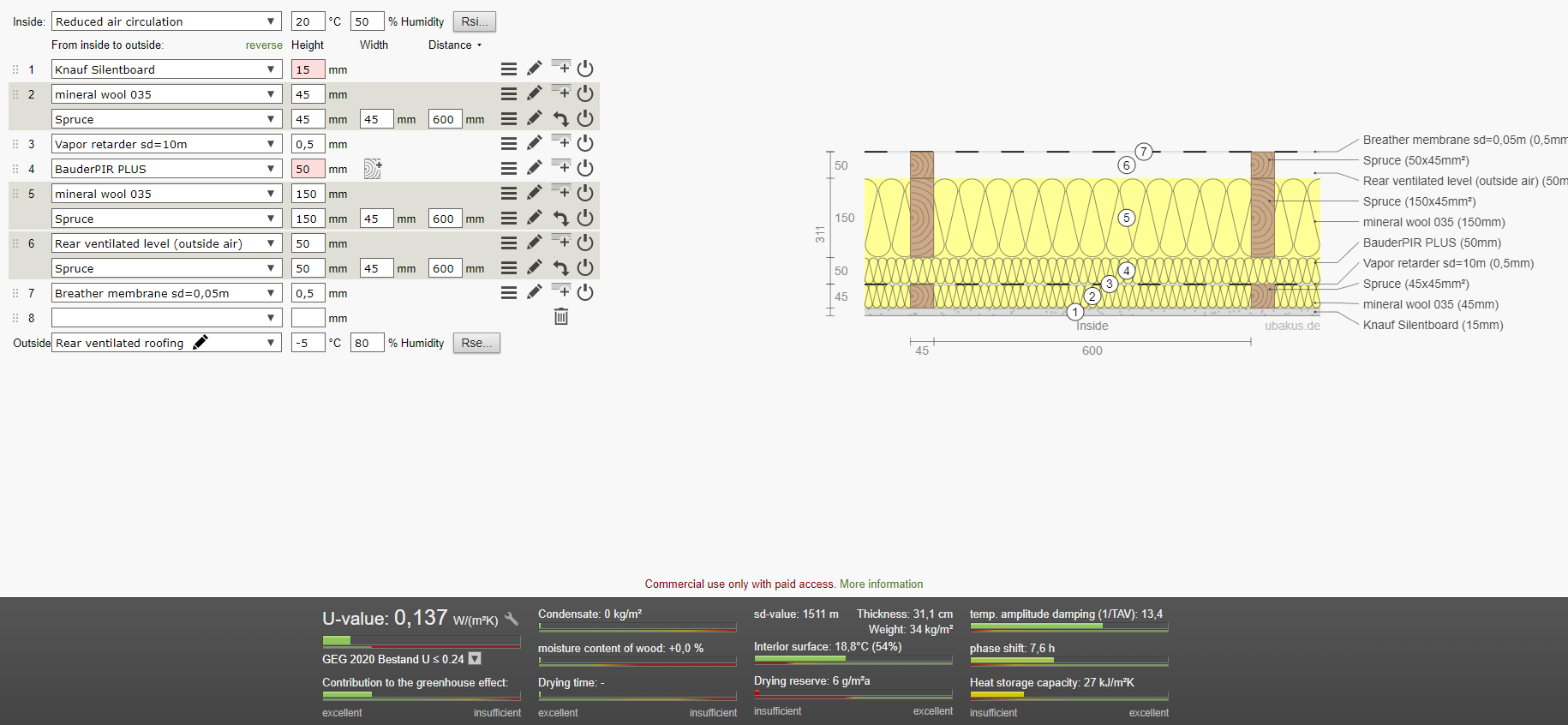
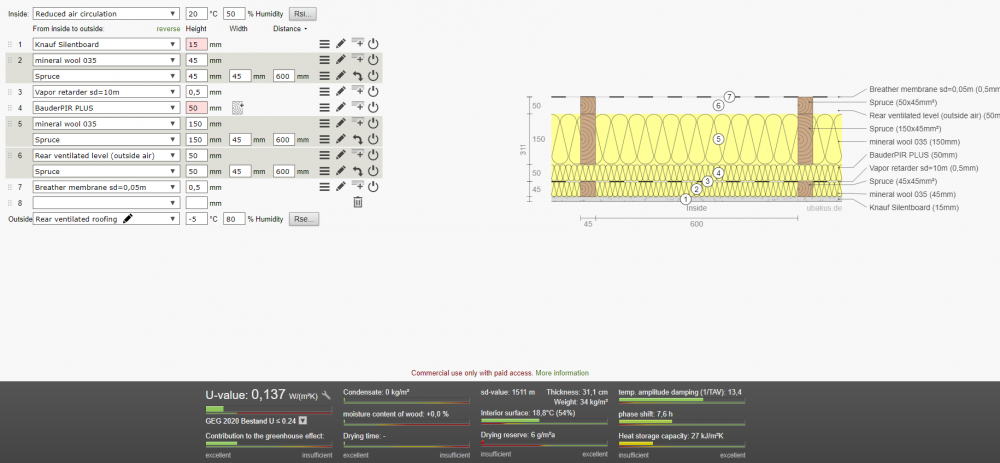
Have a quick look at the diagram including he labels and dimentions. its just the way i had to draw it in the calculator that it looks like a separate batten.
-
By the way have I assume you have't battened and counter battened the roof? If so you could ventilate above the membrane and full fill the rafters. Depending on the membrane used you may be able to do this anyway.
-
MIneral Wool and then Pir, then VCL then 45mm insulated service cavity. Swap out some of the PIR or mineral wool for woodfiber or hemp if you want better heat protection.
-
DIY fan for is. Airtight test was done at the earliest stage the building was actually airtight. Windows and doors in. No plasterboard on the ceiling. No insulation in the attic. Just a scratch coat of plaster on the walls before the final two coats.
-

Heat Pump Convectors with ASHP!?
Iceverge replied to richo106's topic in Air Source Heat Pumps (ASHP)
UFH an option? -
If its a floating floor I wouldn't put it under the kitchen legs. Ours has bubbled a bit.
-
I think this has more to do with aesthetics rather than anything else. People don't like the look of chunky twinwall flues. Wise to be cautious, however without measurement did you figure out if the sleepness was causes by low oxygen levels, high CO or CO2 or just the heat? The building regs has to cover all bases so a hole in the wall will suffice. In specific instances objectively it may not actually remedy the problem but just hide the symptoms. Thermally your best bet is to get the flue out of the heated envelope as soon as possible. Manufacturers certainly don't consider that. Combustion probably does continue in the chimney, especially if an already very hot fire is over stoked. A chimney won't last very long if that continues. Yes readily. Probably overkill for a 5kW logburner though! Yes. I contemplated doing this with a boiler stove and using the back boiler to extract heat only at a rate to ensure that combustion continued optimally. All stoves in Ireland AFAIK. After this discussion last evening I was overcome with a desire to start playing with matches so went to my parents house sparked up their rayburn and also the woodburner in the living room, both of which I installed. It was of course fun. Especially playing with the cooker and it's myriad of controls. The rayburn has a 150mm twinwall flue right from the damper box at the top of the cooker. It drafts really easily, even in a cold house. ( Fires draft better in warm houses due to the hot air buoyancy). Once the chimney was up to temp (the outside of the twinwall was getting warm to touch (10mins) ), i closed the damper while keeping the draft wheel open until the whole body of the cooker was warm ( took about 45mins) then I closed the wheel most of the way to throttle the fire. In this mode the twinwall will barely be hot but the cooker will make plenty of heat for DHW and cooking. If you forget to close the damper the cooker will burn lots more blocks and try to melt the chimney but not produce any more useful heat in the ovens or boiler. The previous rayburn had a change of "driver" about 15 years ago and the damper was subsequently rarely closed. It ruined a cast iron stove pipe and a concrete chimney and did more damage in that decade than in the previous 55 years. When refuelling it was almost impossible to do it in a method that prevented some smoke coming into the room. They are not precision bits of equipment and if you forget to open the damper when opening the firebox smoke comes out from every joint between every panel and from under the hotplate. cough cough. De-ashing is a mess of a process. Ash dust is extremely fine too. It can't be good for you. The wood burner is a far cruder affair and is connected directly to a concrete chimney. It takes a heap of kindling and newspapers to get it up to temperature. Once running it uses far more timber than the rayburn for less output, I assume due to the energy needed to keep the chimney warm enough to draft. ( A cold chimney may be able to cool the flue gasses to sufficiently to loose their bouyancy). This woodburner comes with a wide grate, maybe 500mm and a low height firebox, about 200mm. Rubbish design really for burning timber. The centre of the fire often burns out leaving unburnt logs at the sides meaning more pokering and prodding. The rayburn's tall and narrow firebox is superior as when the fire burns out only a tiny few embers will remain at the bottom. Anyway, after a hour or so I had burnt the basket of timber I had brought from the shed and the novelty had worn off so I shut down both the appliances and retired to out nice dust free passive house for the evening.

-
Sewage treatment plant - air blower electricity costs
Iceverge replied to David Essex's topic in Waste & Sewerage
I'm also interested. Ours is €127 per year. Do you have any further guidance on intermittently running? -
Unvented cylinder. No that was an accident. Didn't know that about split heat pumps re efficiency.
-
It's probably personal but concrete is cold and hard feeling. Timber is more sympathetic. Drilling for services was a PITA. Expense of MF ceiling although this was very quick and very level. Thick floor. Would have preferred more ceiling height instead or a less steep stairs. Awkward to get airtight. Mind you it's totally killer silent with carpets on top. ( Pros and cons as can't hear the small kids) Probably not too much dearer overall with the price of timber now. You can stand block walls as you wish upstairs. Ours had 75mm concrete with mesh poured on the 150mm slabs so it's super strong.
-
Yes. No idea. I wouldn't overthink it. A properly speced A2W with cooling is the best bet for a new build with a good budget. Provision for upstairs UFH (and cooling) and forget the A2A. Get as large a UVC as you can manage and run the DHW as cool as possible and you'll have a good COP. Something like this. https://www.daikin.ie/en_gb/products/edlq-bb6v3.html
-
https://www.ebay.co.uk/itm/Air-source-heat-pump-water-heater-air-conditioning-and-heating-/224649548830?mkcid=16&mkevt=1&_trksid=p2349624.m46890.l49286&mkrid=710-127635-2958-0 It's been done.
-
I think they're referring to BPC ventilation.
-
Welcome. Smashing site..very nice. Being so close to the sea windtightness and airtightness will make or break your house in terms of comfort and efficiency. U values less so as it's unlikely to ever get too cold. For that price you'll need to be building a simple shape and simple roof. No reason it needs to be unattractive or boring. @Donegalsd over on the west coast has a good example. I did the same sums about the PV and heat pump. I settled on A2A (not installed yet) and immersion and solar PV (not installed yet either). Maybe in hindsight I'd have done UFH heating and a Willis heater with option for a DIY ASHP later. Ask me next year when I'm finished monitoring the usage in our first year. What I will say is PHPP appears to be very accurate in estimating actually usage. I never considered oil. I suspect it'll attract more taxes. We paid the builder €1160/m2 Inc vat in the south of ireland but by the time we had paid everything else in march this year it was €1560/m2. It might have been another €20k if I hadn't done a fair bit. Completely rectangular passive house. Strip foundations. 250mm cavity with EPS beads. Wet plaster inside and out. Trussed cold roof. White pvc windows (3g). MVHR. Fiber cement slates. No stove. Concrete first floor (wouldn't bother again). No central heating. I would buy a 40ft container and some shop shelving next time and knock 30m2 off the house next time. So much of the building is full of stuff that would be ok dry stored outside in a nicely disguised container shed at €200/m2. Good luck
-
There are two markers to top efficiency. Minimum exhaust gas temperatures and maximum combustion temperatures. A 90% efficient condensing gas boiler has about a 2000deg flame temp and about 40deg exhaust gas temp. By allowing some of your heat to come from the flue you haven't minimised the exhaust gas temperature from the combustion chamber or maximised it within. Your fire will burn with more particulates and/or combustion will continue in the flue which it wasn't designed for. In short you should get a good quality small stove ideally with a damper and run it as hot as possible with a well insulated flue beginning as near as possible to the stove itself. You will still get the afore mentioned 5kw but just with less fuel, less soot and less dirt and wear on the chimney. This rather dramatic piece of equipment captures the principles well. https://www.youtube.com/watch?v=r8IGMwcyRNA&ab_channel=HydroToHeatConvertor
-
Another option would be to take your stove air feed via a duct so that it entered your heated envelope at the same height as your chimney. This way the air would be equally buoyant both at the cold and hot side of the stove (when it was unlit) and assuming you had a perfectly sealed stove and flue system (unlikely) there would be no airflow. Equally it would be important to collocate intake and chimney so as to avoid airflow due to differential airflows at the terminus/chimneypot. It's all highly theoretical of course and in most houses won't make a blind bit of difference. It was these marginalities that drove me to distraction when building our house. I was afraid of loosing that "feels like the heating has been on" feeling when you open the front door in the shoulder seasons and then having the satisfaction of realising we didn't have any heating on. I think the need for any external air for a stove is really just theoretical overcaution by the building regs. If you had a non particularly efficient 8kw stove in our passive house 175m2 ( 475m3) burning flat out it might use 5.2kg/hr (of 12% moisture ) which would correspond to about 20m3 of air per hour. We have very good airtightness at 0.31ACH50 but still PHPP predicts we would have 20m3/hr natural infiltration balancing this situation nicely. However with 8kw of output on the coldest day of the year our house would be 85deg according to PHPP. The modelling must run out at some stage and this isn't realistic but you get my point. I'm sure at some point before I was donning a full heat suit to approach the stove to add yet another log while our house was like a steel foundry my family would have had me locked away.
-
On another point I don't think that external air stoves are more efficient than room air ones. The stove will need to burn more fuel to compensate for the lower incoming air temperature to output the same heat to the room The main advantage is that you don't have a hole in the wall creating drafts. Unless you diligently close the air supply and damper on an external air stove when not in use the chimney will draft and draw cool air though the stove cooling the room so you'll still loose energy. I think you'd be better off with a normal operable vent near the stove. (Against Bregs obv) One way around this is a concentric insulated flue combining exhaust and intake and a completely sealed stove. Hard to get outside Germany and Austria. It is a mega expensive route though. https://www.poujoulat.co.uk/solutions/residential-applications/chimney-systems-for-residential-applications/twin-wall-insulated-chimney/efficience
-
I reckon an exposed flue does nothing to increase your efficiency. Rather the contrary. It demands more energy released from the stove to keep it at operating temperature and prevent tarring. Take 2 situations and 2 stoves. One with a single exposed flue in the room and one with a twinwall all the way from the stove to the ceiling Set both to run at 5kw. (Simplistically) assume you get 4.75kW from the twinwall stove and 250W from the twinwall flue and 4kW and 1 kW respectively from the single wall. The stove with the single wall flue will be running at lower temperature with consequently lower combustion temperatures and poorer burning efficiency. All you will achieve with an exposed (single wall flue) is taring and more logs burnt for equal heat output.
-
Recommended MVHR unit features?
Iceverge replied to iansr's topic in Mechanical Ventilation with Heat Recovery (MVHR)
I spoke to the manafacturers engineer (proair) about the difference between their certified unit ( certification has lapsed I think now) and their non certified unit. He said they were identical apart from some extra sensors and gadgets on the passivhaus one, I can't remember what. He suggested I was just paying more for something of no greater utility and more chance of failure. Having limited experience of various brands I am happy with it. I would suggest if you can to physically get your hands on a unit and poke at it before you buy. Remove the filters, play with the controls etc. Build quality is very tactile. I was disappointed with vent axia and domus but impressed with blauberg. -
Cutting vitreous flue for wood burner
Iceverge replied to rh2205's topic in Stoves, Fires & Fireplaces
Well done. Tasty job. Make sure the wood is bone dry. It makes a huge difference. Looking at your penetrations to the loft around your twinwall, is pretty well sealed? If the warm room air can rise up there less warm air is being forced via the stove up the chimney. -
For me my heart said yes but head said no. I was dead set on a bloody boiler cooker too. I couldn't make any financial payback with it. (37 years Vs A2A @ less than 3 in theory) That was with free wood too. Passive class house mind you. Really poor for airtightness. If your house burns down here, apparently you'll need to prove you had a chimney sweep before your insurance pays out. Interior pollution. It's immediate and apparent unless you're super diligent. I want to minimise my chances of lung trouble. Chopping timber is dangerous. It's a labour to clean and fuel the thing daily. It does give a sense of purpose to the day when older or idle. Much like milking cows or walking the dog. It's nice to be able to blast a room up to sauna like temperatures with little guilt of a high electricity bill. All my hard work with thermal bridging and airtightness would be thrown out the window by having a 5kw stove capable of heating the house to Sahara like temperatures with no effort regardless. Fire is natures TV. Theres a smugness and security about having 10 years timber in the shed. Preparing timber can be therapeutic. I don't miss having ash dust over every surface In the living room like our previous house. Chimneys are a weak spot in the roof. Good stoves and flues cost a packet. In well insulated houses they can become an ornament. Fire is a visceral caveman pleasure that had defined us a humans for millennia. Fire might burn the house down and kill your family. Fire is good for disposing of things you never want to see the light of day again. I'm rambling now..........
-
@Arnold9801. @Gone West sprayfoamed his original house with icynene via a contractor. IIRC it worked well but there was a lot of waste. When I priced it for our own house it was quite expensive. If done incorrectly it can shrink and leave gaps. My preference would be for mineral wool or ideally blown cellulose behind a membrane. What is your current roof buildup? What kind of roofing membrane did you use? Do you have any photos?
-
Well that's a poke in the eye with a pointed stick
Iceverge commented on LSB's blog entry in Little Stud Barn
@LSB. What a pain. I feel for you. Self building is tough on a greenfield site never mind having to deal with the issues of kicking an agricultural building, dragging and screaming, into a modern house. To me it seems absolutely ludicrous one cannot simple demolish and replace the exist structure with something externally identical. I suppose that's beside the point. Perhaps, given the reality of the works to be undertaken, the planners would now have some sympathy to this position? Secondly about the SE. If they are quite new to the role they are naturally very cautious, infact the exact right personality to be an engineer, however they may not have the experience to know exactly where the line is. Hopefully a senior colleague will have better news. As an alternative solution, maybe contact a local underpinning firm for a consultation. They may well have a cheaper solution that your SE will be happy with given their more in-depth knowledge of the situation. Good luck.