


Iceverge
-
Posts
4383 -
Joined
-
Last visited
-
Days Won
31
Everything posted by Iceverge
-
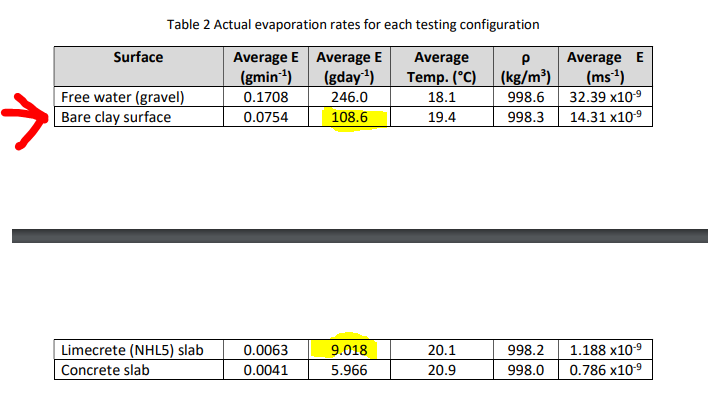
Any increase to the floor's permeability will push more moisture up through the structure. Limecrete is more vapour open than Concrete but nowhere as near as much as soil. It is not a solve all solution. I certainly I wouldn't put it over damp soil and expect the permeability change not to cause any issues elsewhere. Instead of a damp floor, you'll get damp walls. A table from the below shows my thinking . https://purehost.bath.ac.uk/ws/portalfiles/portal/203983214/Phillips_et_al_2019.pdf I think a french drain dug around the perimeter of the house well below the level of the floor in the cupboard and always drained to a lower plain would solve the issue. Alternatively just put 100mm of gravel in the floor or make some kind of slatted base to keep your goods dry and leave the floor alone. You'll still need to remove the moisture through heat and ventilation. The elephant in the room here is of course the house design being tweaked and bent around a vintage staircase and now a damp 3m2 cupboard. I would fill in the cupboard, and knock the stairs, add some EPS and limecrete over. Expecting a sunken room, often below the (localised) water table in an old house made from nice permeable materials to ever be dry is optimistic at best.
-

Owner-Builder looking to build our family home!
Iceverge replied to AccidentalSkydiver's topic in Introduce Yourself
I'm nearly converted, just the money hoarding miser on my shoulder needs to be convinced. I really fell down a rabbit hole in excitement last night! I've been scouring the internet for prices of I joists and the closest I could come to a definite answer was from the US, a 2*12 TJI is about twice the cost of dimensional lumber there. Any better guide this side of the Atlantic? How about the Egger DHF? A polish website suggested it was roughly similar to OSB, is that correct? Reading back I see you used a raft @IanR. Soil dependant, a strip foundation is still cheapest near me. There's no reason an I joist/beam wall couldn't overhang a hefty upstand to the floor slab creating a superb wall floor detail with a strip foundation. How much faff is there is sealing the external woodfiber board, is it a no go in wet and windy conditions? Did you have any issues with the dense pack cellulose billowing out the plasterboard? Apart from the foil backing was there anything special about the plasterboard, was it a double layer or extra thick? Did you skim over the patched up cellulose holes or tape and joint? Any tips on doing this speedily as it would seem to be more difficult than just taping an airtight membrane. I'm aware I've queried some of this before. Thanks for you indulgence! -
Hi @Amateur bob This design isn't the best value. On a cost per m2 basis I would put it at a 6/10 on the value scale. Did you get around to any of the other questions? To give a proper answer the info is still too sparse.
-
I suspect that that moisture is being pushed up due to the fact it's below external ground level ( correct me if I'm wrong but I seem to remember steps below your stairs leading down? ) Either way I would do absolutly nothing to trap moisture there for the time being, including laying any kind of floor on top. Water has a way of appearing one way or the other. At the moment I think it may be acting as a drying sump for the soil beneath your house.
-
What is your current situation please @Amateur bob, I'm feeling we're not getting the whole story. The more you elaborate the more folk will be able to help. Can you cut and paste the planners verdict on the previous application? Where are you? an exact location isn't necessary but the more accurate the more likely someone will know the planning policy. Do you have an exact budget you can spend? We simply went to the bank and asked them the maximum a couple with our income could borrow and worked backwards from there. It was about 3.5 times income in Ireland so we used that figure -€75k for fees and furnishings. That was the amount including contingency we could give the builder. It worked well. Do you own the site? Do you have any photos? Have you any construction skills you wish to use? What is your timeframe? Have you committed to scotframe for some reason? Can you describe the neighbours houses?
-
Owner-Builder looking to build our family home!
Iceverge replied to AccidentalSkydiver's topic in Introduce Yourself
@IanR as I remember you built within an existing barn. Would you need extra racking strength on a stand alone build? Is the external egger your racking? Is it possible to test and fix air leaks as you build? @AccidentalSkydiver compare your build to @IanRs for thermal performance cost and importantly build time. Even using solid timbers , a small thermal break such as a crossbattened 45mm service cavity creates enough of a thermal break to shift the focus heat loss towards other areas such as external thresholds or ventilation ducting. -
Owner-Builder looking to build our family home!
Iceverge replied to AccidentalSkydiver's topic in Introduce Yourself
Make sure you have enough wall thickness in the plans, with a block exterior + stone I would be looking for an absolute minimum of 500mm. You could use a cement board over a cavity only as backing for the stone instead of block, It wouldn't be cheaper and may cost more in house insurance however. Do PHPP before the signoff too. The 37mm*37mm battens would be very bendy to try to work with. Typically people say unless it's at least 89*38 don't bother. OSB is not cheap. You have 2 layers. Also a lot of labour. As you plan on doing lots of the building yourself plan your time economically. It takes 3 times longer than you normally estimate in my experience. Lots of the North American construction is a little bit one dimensional. Happily installing a single paned vinyl window with terrible air sealing in an r30 wall makes no sense or putting an 18 inch twinwall on a slab with 2 inch polyiso screams of designers who haven't bothered to so the calcs. If you were set on the twin wall a double stud rather than Larsen truss could be easier to build on site as well as significantly cheaper. Here is an example. https://passivehouseplus.ie/articles/renewable-energy/on-the-plus-side With this you all but eliminate your wall-floor thermal bridge and the wall-ceiling. Your band joist area remains but this isn't as big as you think. You can drop to 1 layer of OSB externally for cost. I would still include an internal vapour barrier and service cavity. If you start playing with PHPP or even Jeremy's calculator here you'll see how much more important airtightness is than outright U values. Also thermal bridging is extremely important. It can take a bit of setting up but the free software THERM is a great free tool if you have the patience. On this also, an external layer of woodfiber will provide really terrific over insulation of window frames and is almost fool proof to get right unlike detailing internal thermal breaks in timber walls. Have you played with https://www.ubakus.com/en/r-value-calculator/. Again looking at your sketchup drawings I think you'd enjoy it! -
Fairly simple. Take your total floor area and multiply it by the ceilings height. Vaulted spaces can make it a small bit more complex.
-
Yikes, can you super insulate? £5k of extra insulation will last forever. £5k of oil will dissappear very quickly. At the very least price triple glazing. €800 to go from 2g to 3g for my neighbours bungalow. The UFH is your issue here. Slow responce time as it heats the structure and in a high heat loss house it'll use a lot of energy. Get a split A2A heat pump to heat just the air quickly when you need it. ( small outdoor unit, can be wall mounted) .You can get through the wall ones but the COP isn't as good. Consider an exhaust source heat pump all in one unit for DHW. Is solar PV a choice? You could run the UFH on a willis heater to a much lower temp just to make it more comfortable underfoot but not really to heat the house.
-
Installing sliding patio doors - what goes in the cavity?
Iceverge replied to richie9648's topic in Doors & Door Frames
Compacfoam would help thermal bridging. It depends on how good/bad your house is at the moment if it's worth it. Have you comitted to a sliding door? Does it have compression or brush seals? The latter are really drafty. Switch to lift+slide or tilt+slide or french doors if there's still time. -
Whats your building volume? Floor area X ceiling height will do. ACH is more universally used outside SAP world!!
-
Warm v's Ventilated Roof - Which Way to go ?
Iceverge replied to bob the builder 2's topic in Roofing, Tiling & Slating
I agree but it is more of an anecdotal thing. Any further reading to point me towards. I'm fond cellulose. Good air sealing is vital too here. Although you have described nice breathable makeup its important to stop air blowing through the structure. I would include a membrane internally with a service cavity. -
Ah, I would encourage rigging a diy blower door to try source as many of the holes as you can. It'll be a real pain once you're moved in to do anything about it. Its about your house being as comfortable as possible at the end of the day, not a test result. Even patching up a hole the size of a credit card reduced our test by 0.1 ACH.
-
That's really good news. Those timbers look sound. It suggests that your wall is pretty vapour permeable allowing it to dry out easily. The thermal bridging will really be sucking heat out if you do nothing and there is a high chance of bulk water damage (our wonderful Irish rain!) with the render as it is. If you want a stop gap solution make sure that the bottom of the internal walls have plenty of free airflow and you keep a close eye on the internal Relative Humidity. A RH meter is very cheap online. You need to aim for below 60% RH through ventilation and heating (it can be tricky without mechanial ventilation). Also patch up the cracks in the external render as is.
-
Warm v's Ventilated Roof - Which Way to go ?
Iceverge replied to bob the builder 2's topic in Roofing, Tiling & Slating
No. PIR isn't a wise choice. If I was to do this I would put, from the top down. U value about 0.14 1.Standing seam metal roof. 2.Closely spaced battens 3.Counter batten on the rafters to give a total 50mm air gap. 4.Roofing membrane taped at all joints. 5.Timber joists full filled with Rockwool, mineral wool, or blown cellulose if you can find it. 6. Airtight membrane. 7. Battened 44mm service cavity with Rockwool. 8. Plasterboard For added noise protection put a layer of OSB above the joists SE may require it anyway, or use thicker plasterboard. If you need better insulation the cheapest way is bumping the service cavity up to 75 or 100mm. Or thicker joists or a layer of woodfiber sarking. -
Owner-Builder looking to build our family home!
Iceverge replied to AccidentalSkydiver's topic in Introduce Yourself
Here's a pic of my favourite stick build as described previously. Cellulose, continuous external 22mm woodfiber insulation , robust osb airtightness layer, windtight by design, everything nailgun compatible, off the shelf timber sizes, generous service cavity, negative embodied energy, excellent decrement delay, completely moisture safe, U value 0.13 W/m2K. Yum Yum Yum!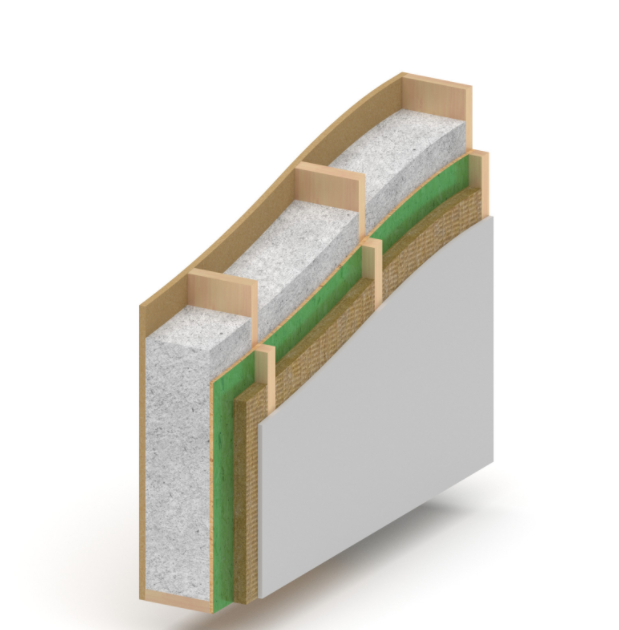

-
It would help but ultimatly not be the best solution. EWI suppliers will tell you it'll be fine but thats because of the generally terrible understanding of how thermal bridging works, and they don't want the hassle of digging and replacing footpaths etc. Have a look at the below post to see the difference with and without taking insulation down to the foundations. You're better off tackling this once and properly, treat it as not only remedial actions but a comprehensive thermal upgrade. Remember if it's left your house will gradually rot away and if done well you will have a much warmer and really cheap to run house. The wide soffit is good news. you should be able to do another layer of ewi without going near the roof. Assuming the wall structure is ok inside I would proceed as follows. 1. Dig out the footpaths. 2. remove the soffit 3.Apply another layer of EPS EWI outside the current one, the thicker the better . ( you may need to remove the current layer, you may not) Take it from as high up behind the soffit as possible to ensure it meets the roof insulation right down to the foundations. It may be 300-900mm below the floor level. This will have the benefit of defacto insulating your floor too. 4. Move the windows and doors out into the insulation layer if they're not there already. 5. make sure the insulation goes around all sides of the doors too including below You currently have some bad thermal bridging here. 6. Render the New EWI, replace the soffit. 7. Install a comprehensive french drain and gravel boundary around the house. 8. Replace the footpaths if you wish. If you could find the budget for new triple glazing and a MVHR unit you would have an extremely comfortable house that required almost no heating. That is of course at one side of the budget spectrum. At the other, keeping the air fresh and damp free through the use of constant mechanical ventilation will help avoid too much condensation. Something like this https://www.bpcventilation.com/pozidry-compact-479188 or better still this https://www.bpcventilation.com/vent-axia-mvdc-ms or best of all https://www.bpcventilation.com/vent-axia-mvdc-ms
-
Welcome welcome. Be sure to set aside some funds for airconditioning and/or external blinds if you haven't already. If the house is built as designed I wouldn't be terribly optimistic about small energy bills either. The good news is that you're early enough to do something about it. Looking at your architects drawings they're probably not the best source of advice. Perhaps query with them the cooling and airtightness strategy to test the water.
-
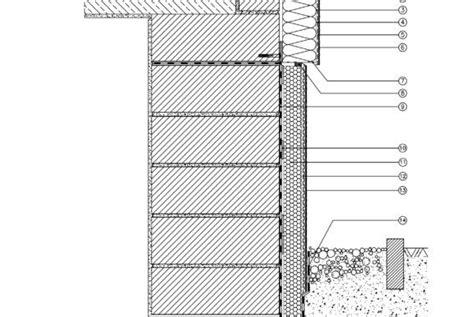
Note the overhang of the top part over the bottom part and the layer of insulation outside the foundation rising walls. Most installers will try to fob you off and terminate the external wall insulation 150mm above the ground. It is very important in your case to keep the bottom of the timber frame warm to prevent condensation. Below ground I would use EPS and then maybe XPS. Above ground EPS or Rockwool probably. Yikes, you'll be into structural engineering territory. Its hard to say but nothing is beyond rescue, for a price. Assumimg the wall buildup is as described I think it's a mess up first day. If it is a render board with a cavity then it would need a space for air to circulate but i don't think thats what is installed. Are you planning on remaining in the house? As you're going to have to do something anyway it would be a missed opportunity to 1/2 do it, and it might look quite ugly. Do you have any wide shots of the house including a pic of your soffit overhang? Get digging into the wall and analyse what you have also. You could cut a 20cm x20 cm hole out of the plasterboard (not below an electrical fixing or any pipes) in a discrete corner where there's damp and see whats there. Its not difficult to DIY patch up later.
-
Ok, take this with a pinch of salt as we can't see inside your wall or behind the render. I think the timber frame and insulation was erected flush with the edge of the concrete foundation. This should have been overlapped with a step to allow rain water to drip clear of the wall and not risk running down into the rendered foundation. Now it has gotten behind the foundation render and damaged it, either just thought water ingress or frost damage. However I don't think that any water has made its way into the inside of the house, rather that the soleplate at the bottom of the wall has been sitting directly on the cold foundation and has caused condensation on the skirting boards. There should have been measures taken to keep the soleplate warm or a vapour barrier and insulation in board to prevent condensation. It may follow that the soleplate is suffering from decay having been cold and wet for so long but without seeing inside the wall I couldn't say. I would take off the the skirting boards in a good few locations, drill a large hole in the plasterboard and investigate the condition of the soleplate, and the back of the OSB as well as the insulation to see if any of it is damp or rotten. Hopefully it won't be but it's impossible to tell without looking. Hopefully this survey will give positive results but only time will tell. If it does then you're faced with trying to fix the problem. There's two issues here. 1. Water getting into the wall 2. A cold soleplate collecting condensation. It depends how much money you have to spend but if it was my house I would reapply another entire layer of insulation (EWI) and render over the whole wall right down to the foundations and detail it properly with all bellcasts, drips and overhangs. This would solve both problems. If you're stuck for money you could endeavour to just do the bottom 600mm of the wall and right down to the foundations with EWI and detail it carefully to allow rainwater to be always directed down and out. I hope this helps.
-
Do you have the report, was it 4 ACH, 4m3/m3 floor area or envelope area?
-
Twin skin all the way if possible. Better draft, cleaner combustion. More control over the stove, less tarring, lower risk of chimney fire. @saveasteadingour builder used tyvek supro on the house but I actually preferred the protect vp400 I used on the garage. The price was similar.
-
Could you post some pictures of the skirting board please? I too am suspicious if it is cold bridging leading to condensation rather than bulk water ingress.
-
New Ventive heat pump/MVHR unit
Iceverge replied to markharro's topic in Mechanical Ventilation with Heat Recovery (MVHR)
Regulatory known as a compact unit. Normally more expensive than a standalone MVHR and ASHP. How much is this one? -
Thanks for sharing @ProDave. It looks like an efficent layout. I like the upstairs particularly. If one was really stuck for cash I guess the garage and sunroom could be omitted. Would you alter any aspect of it if you were to do it all again? It looks somewhat "overstoved" in the plans. I gather you reduced it to one. Where did it end up? Where is North in reference to the house?

