Nick Thomas
-
Posts
383 -
Joined
-
Last visited
Everything posted by Nick Thomas
-
The maths looks ballpark right to me 👍. I'm confused by trading off the land use against solar panels, though. It's not like we're short of land for either, after all. Straw bale gets some critique from the permaculture side - it's a byproduct of an agricultural process they want to go away, and so, they argue, building from it isn't a sensible idea in the long term because the supply of straw will dry up But in the here and now, it is available as a byproduct - a lot of it goes into incinerators at the moment, for instance - so an alternative way of tackling this is to ask how many houses/year we could build with our existing surplus straw. A brief search tells me we currently burn 200,000 tonnes of straw per year - at 120kg/M³, that's 1,666,666 M³ of straw, or about twice that in M². If we say a 100M² house needs ~150M² of exterior wall, that gives us ~22K houses/year, just from straw that would otherwise be burnt. The people who like burning it suggest they burn 3 million tonnes/year of straw without disturbing agricultural uses; we could take that and build ~330K houses/year - significantly more than are actually built. I suppose there would be a concomitant reduction in kWh generated, but I don't see much point in trading one off against the other. There are better ways to generate electricity. Ecococon / modcell means the stuff used for burning could equally be used for building - it doesn't need to be very much other than dry.
-

More foundation fun - straw bale garden room on clay
Nick Thomas replied to Nick Thomas's topic in Foundations
I had thought about something impermeable, but I'm worried about spills, etc, from above - I'd rather any water was able to drain away, rather than sitting around the joists. The plan is to have an air gap between the rockwool and the geotextile - they shouldn't be in contact. I'm going to have some strapping run perpendicular to the joists, which will support it from below and keep it from touching the ground. It'll also be friction-fitted, but I don't quite trust that to hold it in place. Rockwool does claim to be non-wicking, so it might be overkill, but I just don't like the idea of it being in contact. Originally I was going to have a nice layer of pebbles on top of the geotextile, but with the 2x8 joists it adds up to more digging than I fancy ^^. -
Oh, I'm being silly https://ecococon.eu/assets/downloads/ecococon-technical-specifications.pdf . Straw infill at 115kg/M³ - so not actually super-compressed (bales will be anywhere from 80-120).
-
More foundation fun - straw bale garden room on clay
Nick Thomas replied to Nick Thomas's topic in Foundations
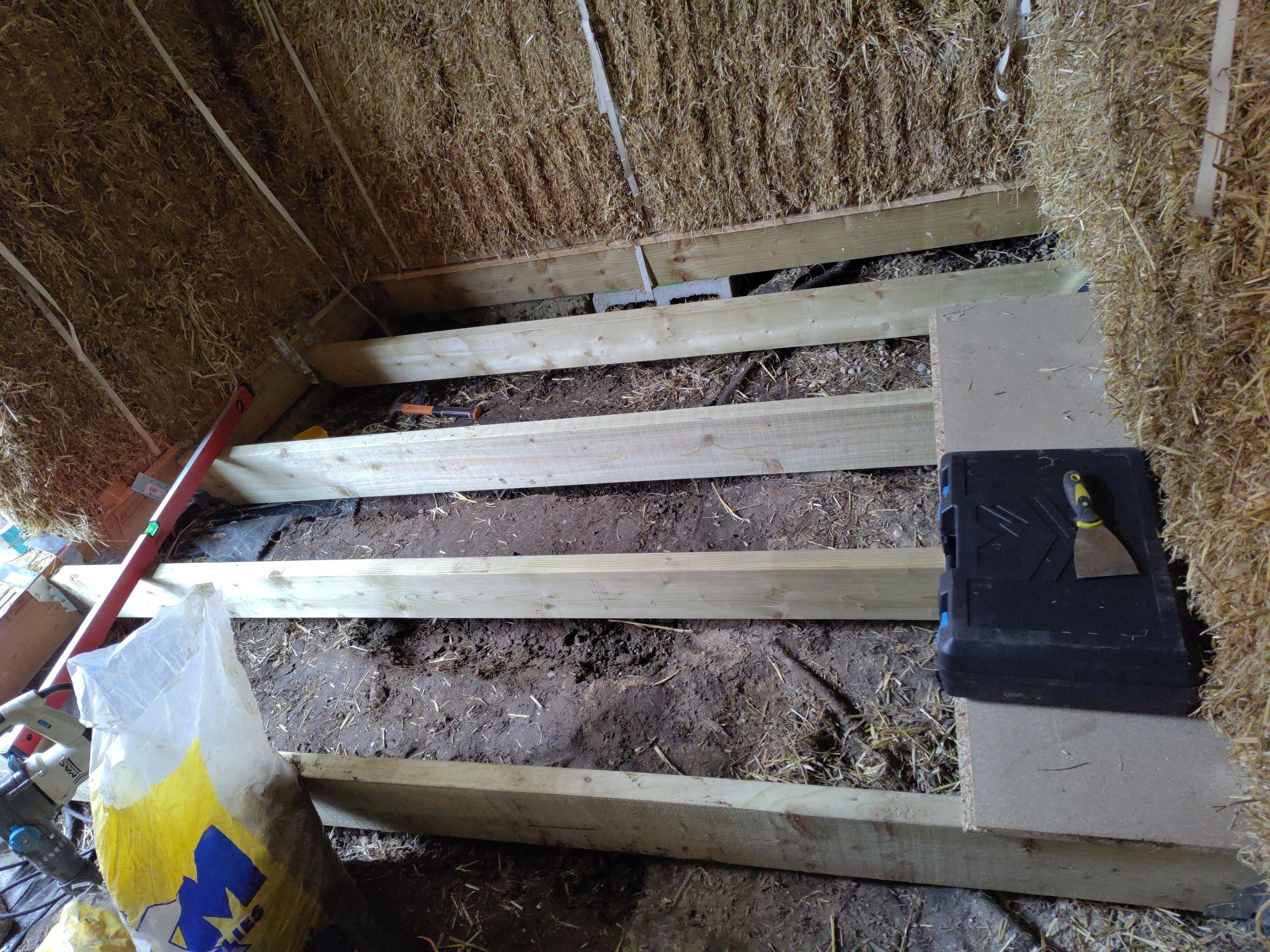
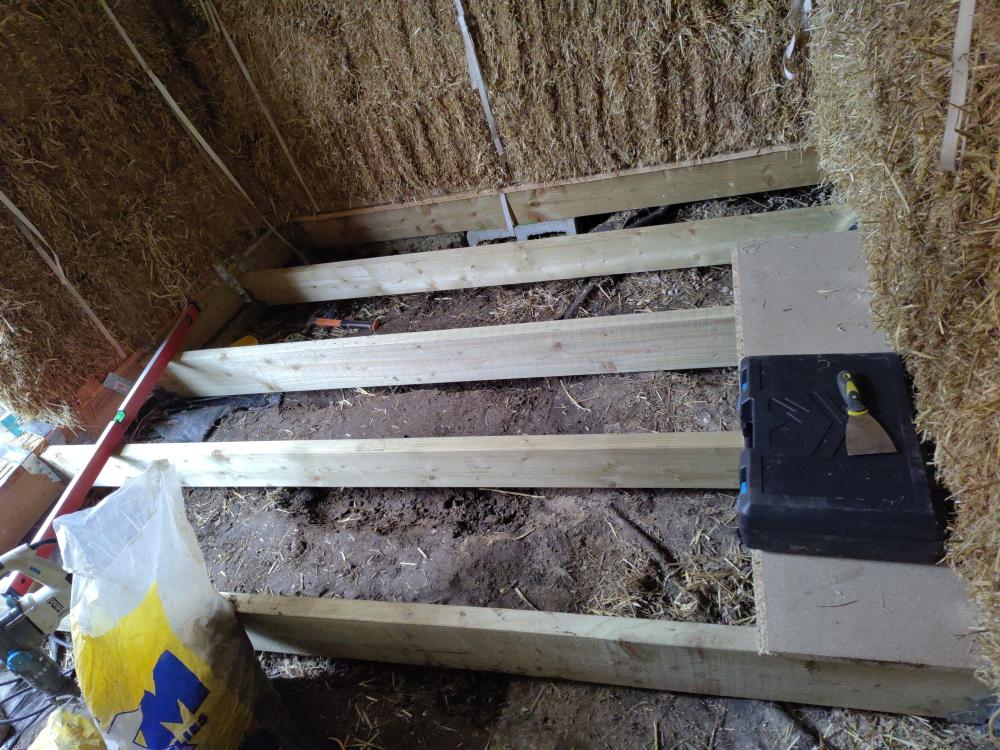
I did finish the ceiling 😅 but I've been ill pretty much the whole time since. Dragged myself out today to get on with some floor joists, though. I'll take halfway. It's a mix of 2x6 C24, and 2x8 C16 - I misremembered what I had left over from the roof. Oh well. Going for both joist hangers and screws, as I did with the roof joists. Having to dig out some more soil to get them clear; once they're all down and there's no more digging to do, I'll wiggle geotextile membrane underneath, then get the rockwool down on top of that. Should be able to keep it from touching the ground with some of the strapping I've got left over. It's coming up to my last chance to fill the on-their-side blocks as well 😬.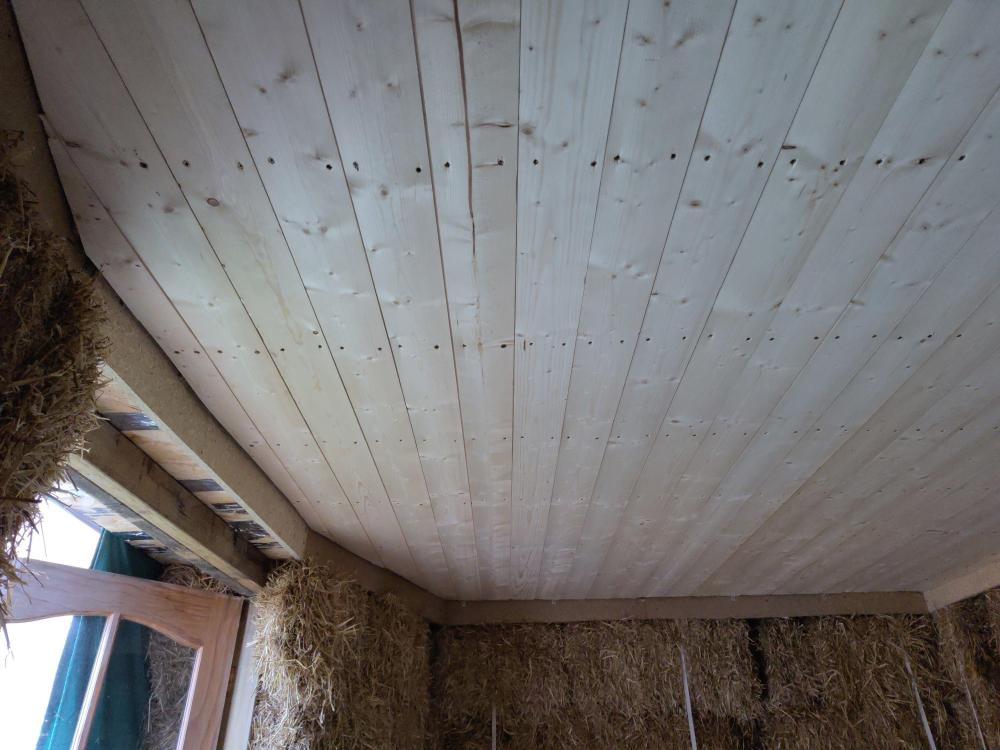
-
Yeah, they're just SIPs. The big thing they do is compress the straw - much more than in regular bales, although I can't remember the details offhand. The other company that tends to get mentioned alongside is modcell - https://www.modcell.com/ - same idea.
-
Congrats, definitely keep us up to date! Have you had any contact with straw bale professionals in the UK, been on any courses? There's a lot of good information, details, etc, available out there if you need it, and if you arrange things early enough you can sometimes get your build site turned into a course location - which means free labour and very qualified people providing oversight, checking your plans, etc. I'm finishing up a (load-bearing) straw bale garden room at the moment - hoping to move onto render in the next month or two. It's a much smaller-scale project, but it's been good fun. Number one tip - keep the rain off it. Number two - just make sure everything's square as you go up. As a brickie, I'm sure you'll be much more on that than I've been!
-
Excellent news. Now do England
-
People are out there constantly scanning everything connected to the internet for every vulnerability there is, and making money out of the devices they gain control of. In extreme cases that includes gaining access to them by compromising the cloud service they connect to. They don't even care what the devices are - just that they can get them to issue traffic on command. We have a running joke in the industry, which is that the S in IoT ("Internet of Things" - which definitely includes internet-connected inverters) is for security. Yup, it's not there. https://www.sciencedaily.com/releases/2022/11/221129134502.htm suggests this is just as true of inverters as it is of, e.g., IoT doorbells. The more local attack of someone stood next to your house controlling the inverter directly are much less likely, but still possible - why would anyone design a system that allows it? It's just weird.
-
I've got a LuxPower hybrid inverter one that *asks* to connect to the cloud, but can be set up not to, and can still be managed locally using https://github.com/celsworth/lxp-bridge (optionally + HomeAssistant). Pretty skunkworks, but it does at least work when there's no internet. Local security is also important. Some inverters set up an insecure wifi AP by default - prior to this one, I had a Solax that would throw up an unencrypted AP where the password was the SSID - so anyone can stand outside your house with a mobile phone and control your inverter. The LuxPower one was slightly better than that by default, but can be configured to act as a wifi client, rather than AP, which is much better - altough direct modbus, or even ethernet, would be better still.
-
Best fibreglass insulation for under floorboards?
Nick Thomas replied to Logan's topic in Heat Insulation
Yeah, the slabs are about 4x the glass wool, it's a significant difference. I got a load of Rockwool RWA45 recently because I was installing it from below and didn't want the glass fibres floating down onto me during insulation. I'd think reeeallly carefully about how you're going to protect yourself while doing it 😬. It's really horrible stuff, and you don't want it in your eyes, up your nose, down your throat, on any of your skin... full PPE? In a confined space? I got the rockwool slabs from insulation4less, which sells the fibreglass stuff too - https://insulation4less.co.uk/products/knauf-combi-cut is a fair bit cheaper than the wickes one per sqm, although there's a delivery charge below £300 (ex vat) which might wipe out the savings if you're only doing a small area. I think you'd need 150mm of this stuff to meet building regs for retrofitted floor insulation (U=0.25). -
A bit more on that limecrete floor option: https://www.mikewye.co.uk/product-category/lime-products/limecrete-floor-systems/ It doesn't envision standing the walls on top, but if they're lightweight, no particular reason why not, right?
-
So you'd to dig out the whole footprint and fill it with rubble? One thing I looked at for my own garden room build - was to dig out the footprint and pour foamglass into the hole, topped with limecrete. I didn't fancy the digging *at all* though, so ended up with very (too? time will tell) minimal columns of pea gravel, and plans for a suspended timber floor which I'm just coming round to now. I lost headroom by doing it that way, of course. One thing I didn't properly appreciate until it was pointed out to me was the risk associated with the building not being tied to the foundation in any way. More of an issue the more lightweight your construction is - but especially with a flat roof and a timber frame, you don't want the whole thing taking off. Rubble *trench* foundations are totally a thing, so I can't see why digging out the whole footprint wouldn't work, anyway. Weren't a lot of pre-20th century houses built on just that?
-
More foundation fun - straw bale garden room on clay
Nick Thomas replied to Nick Thomas's topic in Foundations
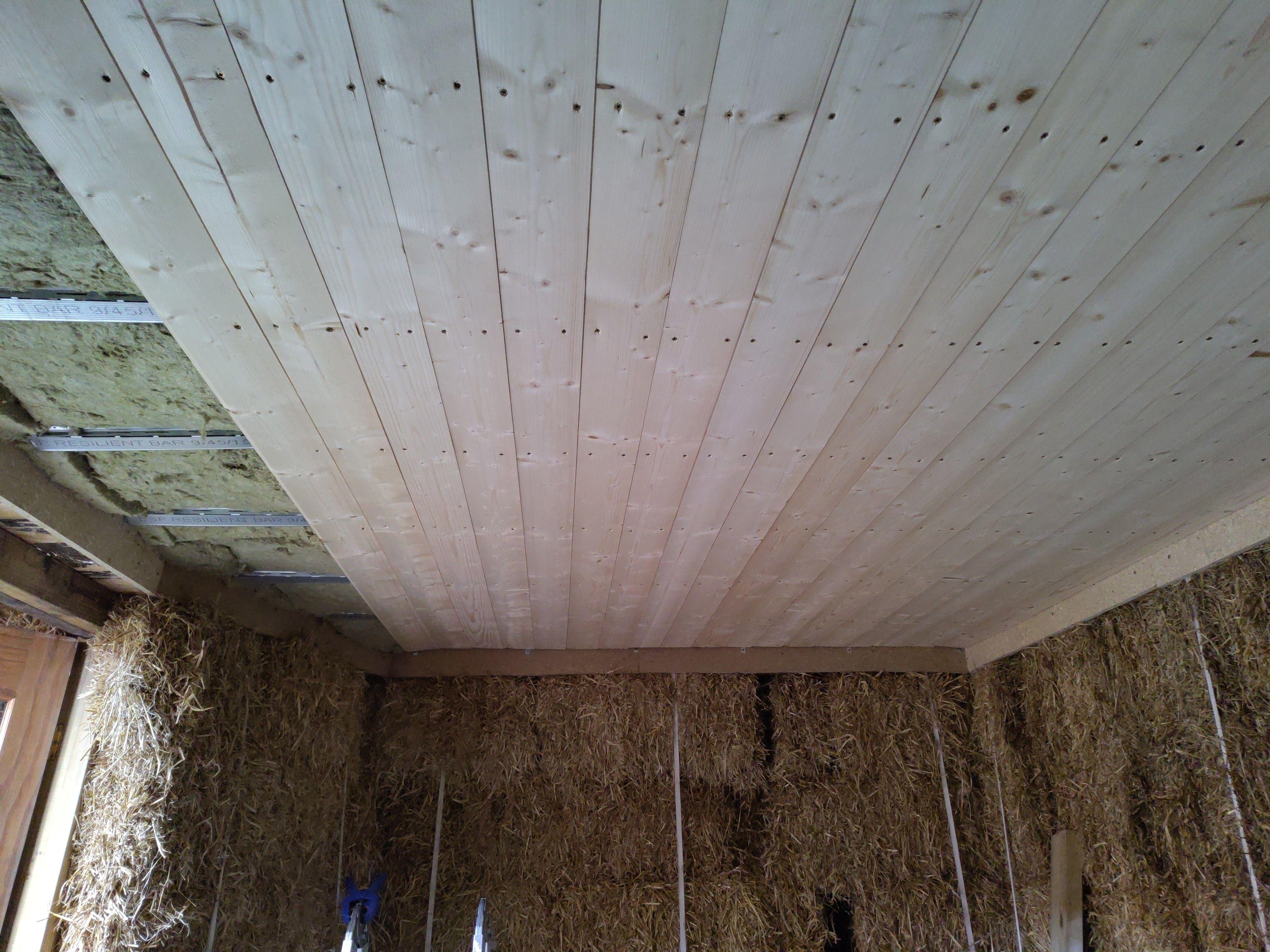
Bit of a palaver, but the ceiling is almost done. Pretty much the layout I mentioned above, except I decided to do without the membrane; fiddling with the ubakus calculator convinced me that condensation was unlikely enough that it wasn't worth the faffing - it might have been different if I were doing building-regs-compliant levels of insulation, but I just can't see it being 20°C and high-humidity in there while it's -7°C outside ^^. It's not as airtight without the membrane, I suppose; there's the expansion gap all around the perimeter, which I'm planning to tape with something then hide with some sort of moulding, and some(?) air will get through the t&g. No detectable draughts at the moment, though - and the wind was properly howling through before. I've left 50mm between the top of the insulation and the bottom of the roof deck, and that'll stay ventilated. I really should've gone to more effort to get the screws straight and evenly spaced, though - they look a bit amateurish, and I doubt they can be hidden. Pretty minor in the grand scheme of things. Just a few more boards to do - obviously, I left the tricky cuts until last - then I can get started on the floor. With that done, it'll be time for the lime render.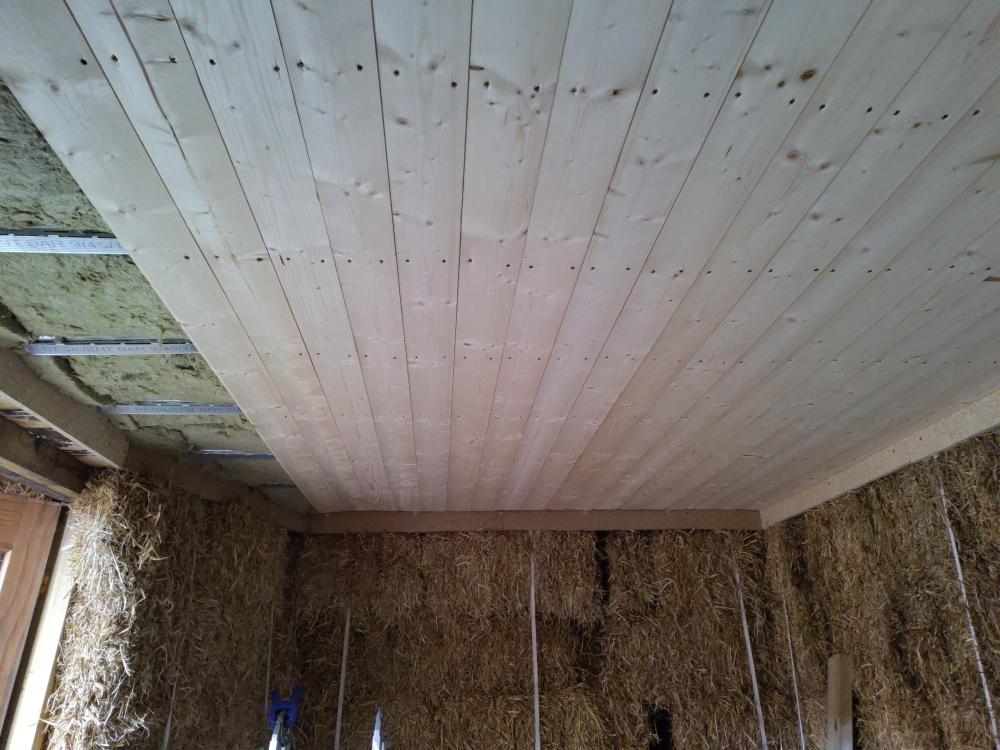
-
More foundation fun - straw bale garden room on clay
Nick Thomas replied to Nick Thomas's topic in Foundations
I've not looked at the house foundations - I've been working all the way over on the other side of the garden. I know that they're trench fill, but no more than that. I'm expecting the whole thing to move some, and hoping that either it'll take it in its stride, or it'll be slow enough that I can remediate. A not unlikely scenario would be that one of the piers differentially sinks down enough for a 1M span between piers to become 2.5M at some point, for instance - and if that happened seasonally, it'd be a right pain. I think the wood would be fine if that happened with one pier, and less fine if it happened with two in a row 🤷♂️. Ultimately it's small enough that I could just jack it up, re-do the foundations and put it down again - and cheap enough that even if I couldn't do that, I could write it off and turn it into some decent compost before building another one more sensibly 😅. I've bought just about everything I need now and it's around the 4K mark, ignoring various tool purchases. -
+1 to everything you said, but especially this. I did my first (3.8x5.4ish) EPDM roof in Jan, and the sheer weight of the membrane came as a big surprise. I went for the 1.5mm thick stuff and it weighed 46kg. Needed a lie down after getting it up the ladder. I'm pretty much a novice but everything about the flat roof has been easy to do, including the EPDM. It went up in a couple of days and was even... fun?
-
More foundation fun - straw bale garden room on clay
Nick Thomas replied to Nick Thomas's topic in Foundations
Aha. Resilient bars and acoustic membrane! -
More foundation fun - straw bale garden room on clay
Nick Thomas replied to Nick Thomas's topic in Foundations
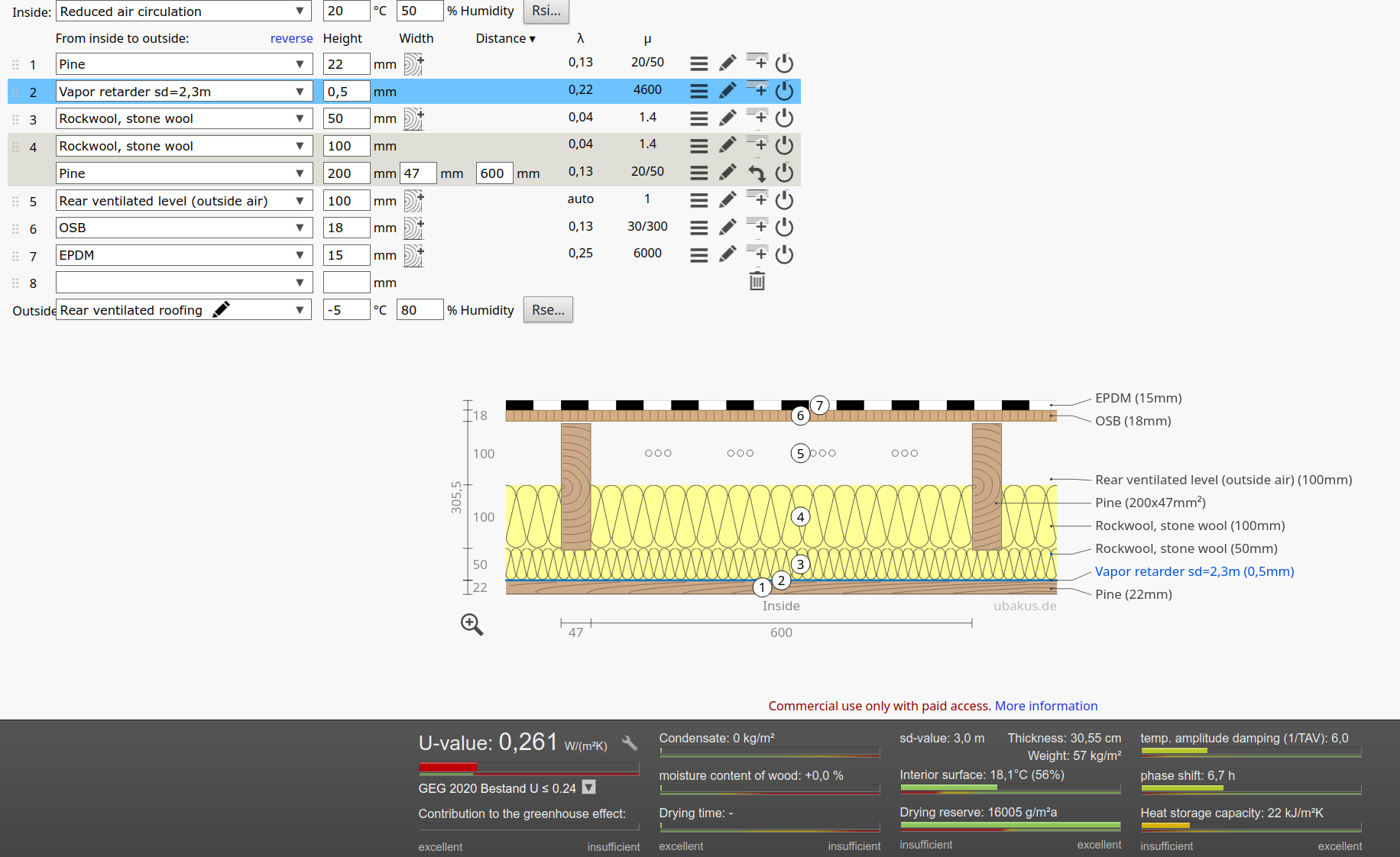
OK, I'm onto internal stuff now. It turns out some of the straw had gotten wet over Dec/Jan - rain soaking through the tarps, I guess - so I've had to dig out to a depth of ⅓rd in some areas. It's not fatal - they'll make nice niches and shelving, which I was planning to have anyway - but definitely not ideal. On the more fun side, I've got lots of rockwool and wood coming tomorrow for the ceiling and floor inside. I've decided to use rockwool to try to get decent acoustic insulation - as with the walls themselves, I'm not super-worried about the thermal side of things. I've got enough for 150mm depth (100+50) in ceiling and floor, but I'm trying myself up in knots about whether I should be trying to get a layer beneath the joists or not. A roof build-up like this: is only marginally better thermally than putting all 150mm inside the cavity (U=0.27ish) - but I imagine it's significantly better acoustically? Worth the hassle of (somehow) suspending the ceiling to create the 50mm cavity? I've seen other approaches that use 50mm celotex below the joists and just fixed through with long screws, but that focused on thermal, rather than acoustic, performance; what I read suggested that PIR might as well not be there from a sound perspective. The ceiling itself is going to be 12mm pine matchboard, with a membrane between it and the insulation / underside of the joists... I have lots of vapur-permeable Vent3 roofing membrane left over, but I assume that's inappropriate and it should be something that doesn't let vapour though, instead? I'm building regs exempt so don't *need* to hit U=0.14, but I do have space for ~100mm below the joists if I absolutely needed it. I can't imagine I'd be able to just fix through all that space with 200mm screws though. I've seen metal framing solutions for plasterboard, maybe something like that for timber if it came to it?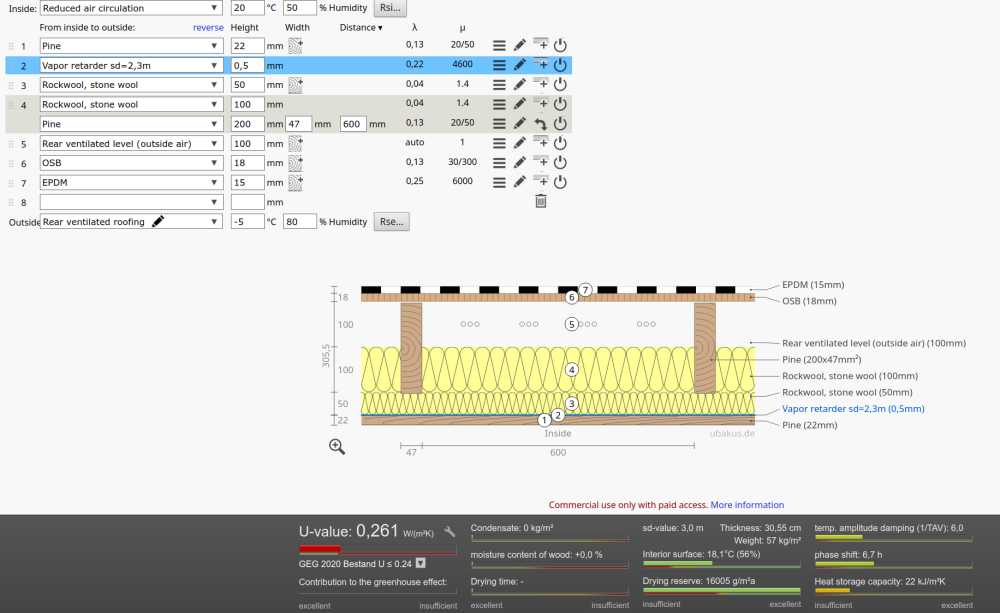
-
Pretty sure my cat's been reading this - he brought home a pigeon on Monday. These are wood pigeons, too, not the little feral ones. We didn't eat it, but the dog had a go.
-
You could go for proper window shutters and make a feature of it? Internally or externally. I used to dream of that regularly up in the Shetland house, with 80mph winds rattling the glass ^^. Random pic off t'internet
-
https://merlinenvironmental.co.uk/blog/pests/birds/can-you-shoot-pigeons-in-the-uk/ goes into a bit more detail. It's fine as long as you've tried non-lethal methods first and they've failed, and you also stick to all the rules governing air weapons (like not shooting beyond the property boundary).
-
Hah, me too. I think it'd be legal - just about - as long as I hit the target. Bit risky.
-
Hmm, I don't know, but am also interested - I was hoping to get something like this to pop in the loft and deter the pigeons that are eyeing up my solar panels as a nesting area! Rail stations in the region are using audible discouragement: https://www.yorkshirepost.co.uk/news/transport/northern-to-broadcast-hawk-calls-over-loudpspeaker-at-yorkshire-railway-station-to-fight-pigeon-poo-4371318
-
Garden Room - 'substantially non-combustable'
Nick Thomas replied to having a go's topic in Garages & Workshops
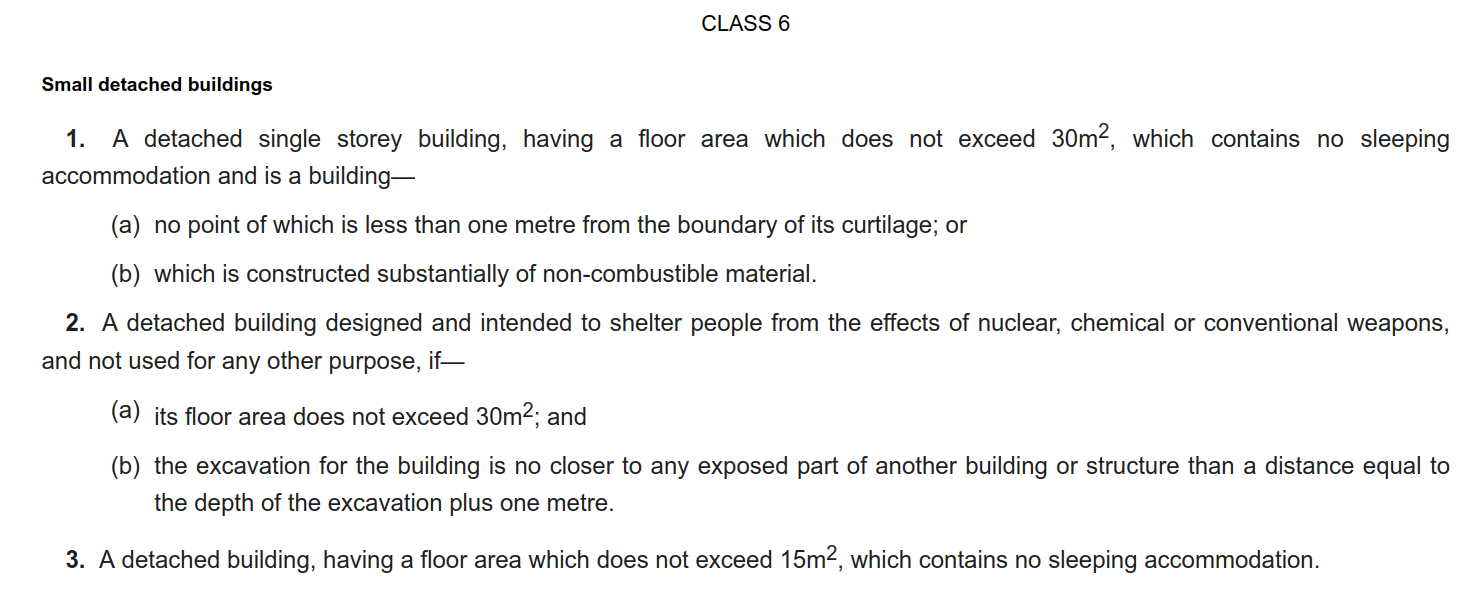
Feels like there's a lot of garden rooms going up at the moment ^^ https://www.legislation.gov.uk/uksi/2010/2214/schedule/2 is the legislation - basically, the different types of exemption you can get. You're trying to fit within Class 6: If you're within 1M of the boundary and the construction is timber frame, you don't fit into (1) on either count, in my view. If you're going to work from it, (2) isn't a goer, which is a pity. And you're too big for (3). ( https://www.legislation.gov.uk/uksi/2010/2214/regulation/9 describes how the schedule is used, and what building regs you do still have to comply with even if you manage to fit into schedule two one way or another)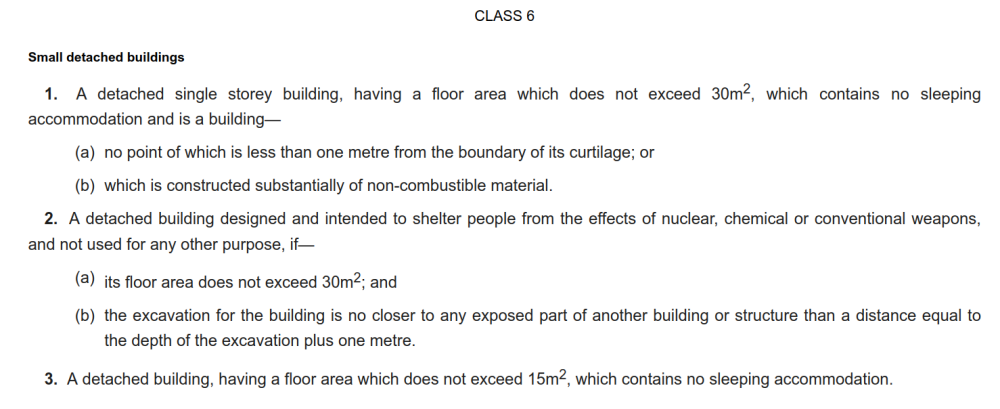
-
I used https://www.timberbeamcalculator.co.uk/en-gb/span-tables/flat-roof-joists - and I've been walking around on top of it since with no issues (although it said 2x6 C24 was fine, I bumped to 2x8 for availability reasons, so not the best test, I guess)
-
If most of the roof is dry and there's just a small wet spot, you might get away with it, or that bit might spread out significantly, then bubble up and annoy you every time you see it I was out today with a heat gun drying out some bits of wall... depending on the size of your wet patch, and the general inflammability of your build, this might be a good idea, or might not. In my case it was definitely "pushing your luck mate" territory. My backup plan if the EPDM didn't stick well, or got horribly creased or something, was to slap a green roof on top to hold it in place. Your joists would need to be sized appropriately though.