Nick Thomas
-
Posts
383 -
Joined
-
Last visited
Everything posted by Nick Thomas
-
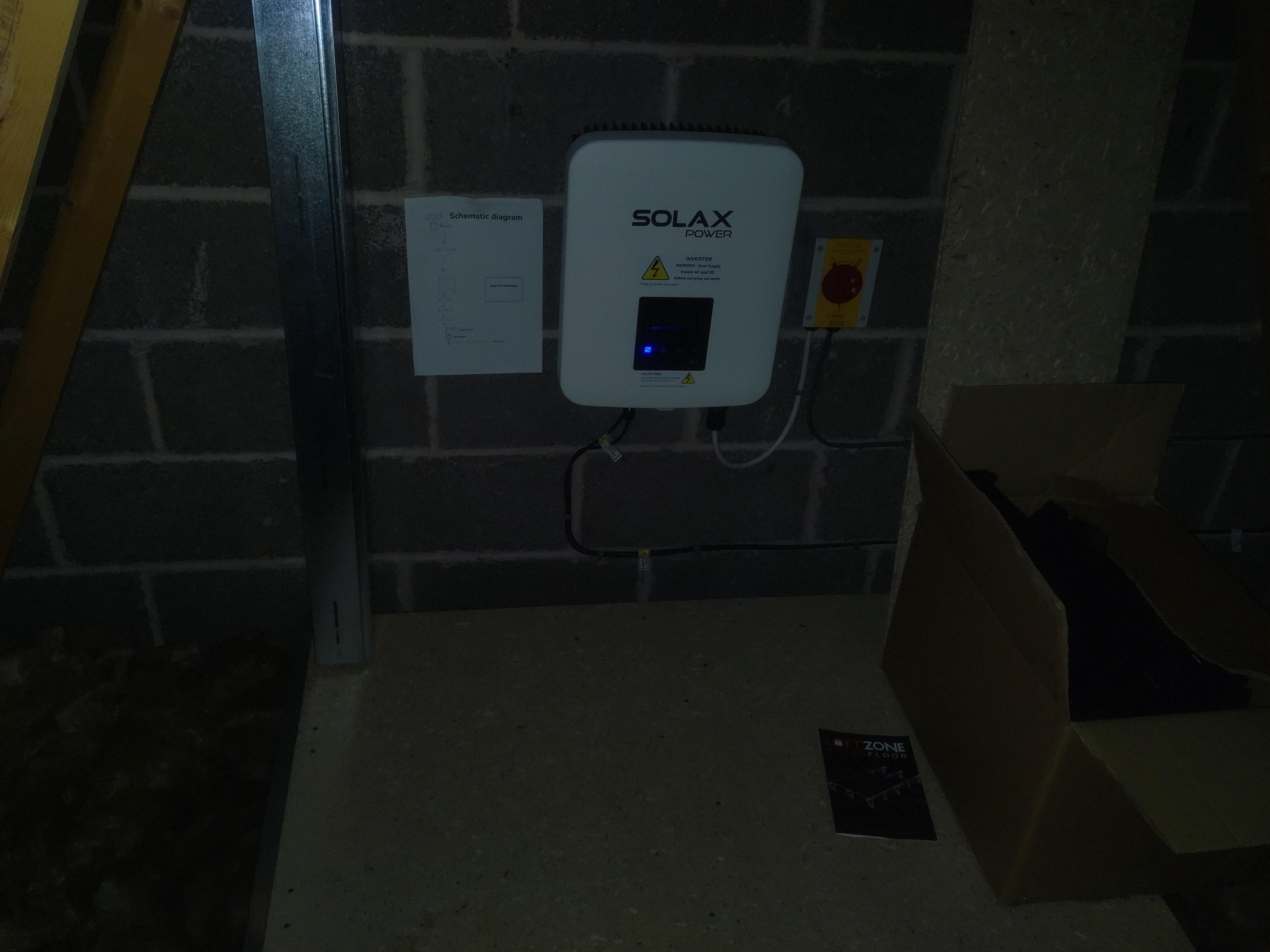
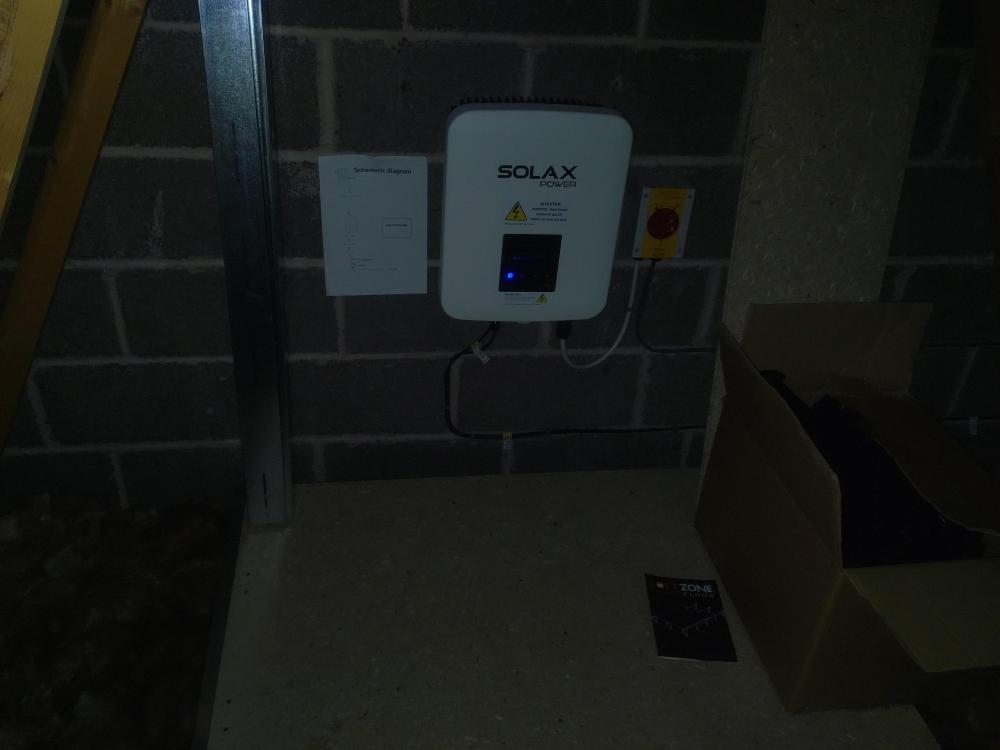
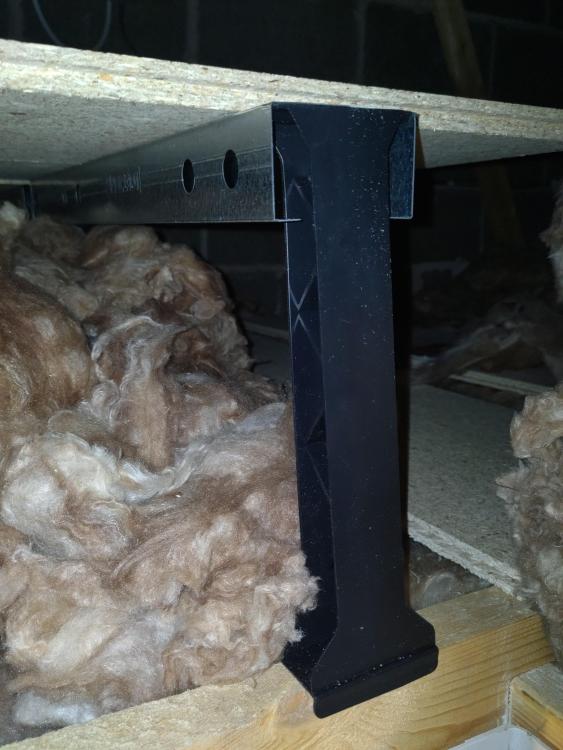
Just an update on this - the stuff came last week and I've fitted the initial platform in front of the inverter in the loft. The alu rails go crosswise to the joists, and there are two types of legs - triangular and stick. The idea is to use the triangular legs every other joist, then come back and reinforce with the straight legs under half of the missed ones, in a staggered pattern. I seem to have picked the hardest bit to start with though - the rails start flush against the gable end and come down past the hatch, which is > 600mm long so it interrupts one of the rails. Gable to hatch is just over 1.2M, and no room to use the triangular legs at either end so it's straight, triangular, straight, which also meant cutting the alu rails (they're slightly shorter than 1.2M) for that section in half. I'm not missing any joists out for this section, so I'm sure it's still plenty strong enough, it was just.. awkward. Next is the section where the loft ladder will be attached, so I have an L-shaped boarded area around the hatch. They suggest using some of the boards to cover the legs around the hatch (shown in the second picture), I guess I can just add some wood behind that to give the ladder something to screw into.
-
Assuming it goes ahead - very much not a given - https://www.unbiased.co.uk/life/homes-property/how-changing-epc-regulations-affect-landlords-and-tenants may help somewhat. It's not that likely to go ahead though, sadly.
-
National Grid pays the £3/kWh, rather than it coming from the company. it's not clear to me where natgrid gets the money though - general taxation? It's not very economical, but then, neither is burning gas to generate electricity in the dead of winter during an acute gas shortage, so, swings and roundabouts. On a single rate, you can benefit with the battery by dropping your consumption to 0 during the "saving session" without suffering any discomfort. One can also benefit by charging the battery during the 4-7pm peak on non-saving session days, so the benchmark against which the 0 kwh on saving session days is measured is higher. Something of a perverse incentive, and I agree it would make a great deal of sense to pay the same for export during the period, but there we go. Hmm. I wonder what octopus "agile outgoing" prices will look like. If they're willing to pay £3/kWh for reduced import, the wholesale prices must be absolutely sky-high; maybe they took that into account while designing the scheme? The sooner people realise that the appropriate solutions to this problem are not market-shaped, the better. Although I have been wondering for a while about an altered charging scheme where you pay based on peak (or p95/p99) wattage, rather than accumulated kwh, similarly to bandwidth. Feels like that would be way ahead when it comes to "incentivising" people to do things that the grid likes.
-
Seems they've decided on the branding for the national grid "pay you to load-shift" scheme: https://octopus.energy/blog/saving-sessions-faqs/ A few interesting points: - Export is ignored - Reward is calculated relative to a baseline of your last 10 weekdays, or last 4 weekends - £3/kWh (other energy suppliers are available, I'm sure) The baseline was always going to be a hard problem to solve, but with a battery and a single rate tariff, and with some certainty around the usual "saving session" times, they're rewarding load-shifting *into* the peak times on non-saving-session days, so you can effectively get twice your battery capacity out of each session. What a world.
-

Electric ovens with lower peak energy demand
Nick Thomas replied to Nick Thomas's topic in Kitchen & Household Appliances
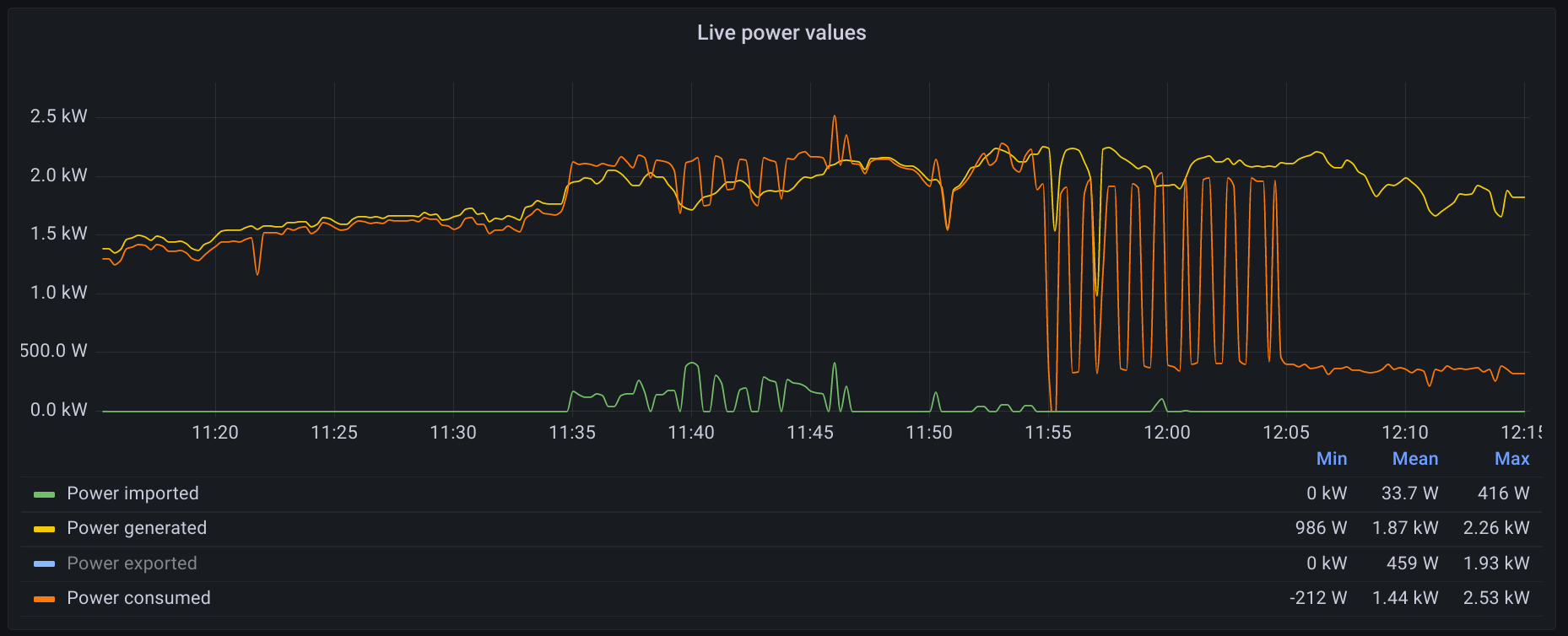
Yeah, here's the air fryer at work on some reasonable-ish fried chicken: It turned on at ~11:35; consumption and generation are coupled before then due to the PV diverter. So it does manage to keep its peak (mostly) below a good sunny autumn day's generation, but those final ten minutes are infuriating ^^. Interesting that the diverter seems to have given up; I guess it doesn't like that pattern either. edit: It started diverting again ~35 minutes after the on/off pattern ended. Call it ~0.75kWh exported for free (I don't have my export tariff sorted out yet) when it could have gone into my hot water instead. Grumble grumble.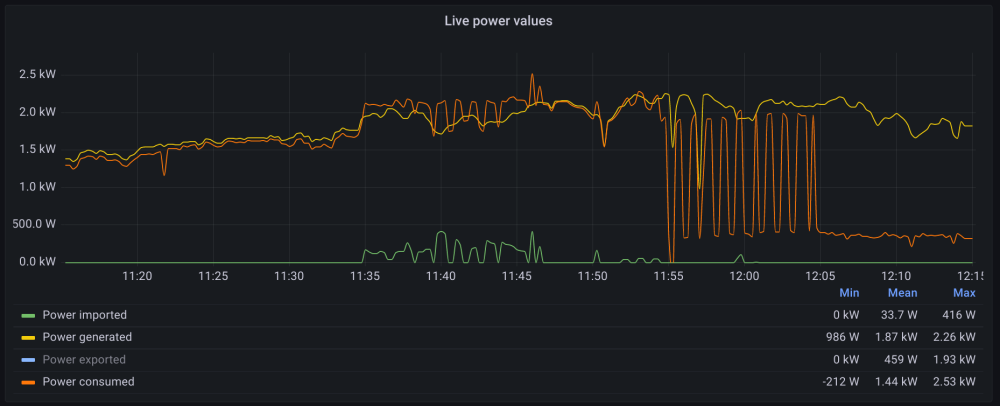
-
Checking to see if smart meter is on the SMETS2 network
Nick Thomas replied to Radian's topic in Electrics - Other
Worked for my DCC-enabled SMETS1 meter about a month ago; it's giving me an error right now though. Far more accurate than asking octopus support, when it's working anyway ^^. -
Electric ovens with lower peak energy demand
Nick Thomas replied to Nick Thomas's topic in Kitchen & Household Appliances
Yeah, I'm starting to conclude the same - they just don't exist. My searches have thrown up *patents* for the idea, but no products. "Modulating oven" as a term got me to https://cooking.stackexchange.com/questions/12666/do-all-modern-electric-stoves-have-binary-heating-elements - which has a bit more detail. Grumble grumble. I already have an air fryer, which is fine, but I'm sure it does the same thing - so you just wind up having the same discussion with a smaller number for the peak. Since I'm cooking for three, the smaller cooking area tends to result in it being more economic to use the big oven anyway 🤷♂️. The iBoost can do this for the immersion heater, which is the same kind of element, so it can't be *that* hard. He says, with no relevant electronics background whatsoever. -
Will energy storage be worth it if the energy price is capped?
Nick Thomas replied to George's topic in Energy Storage
...time to get a much larger battery 🤑 -
Electric ovens with lower peak energy demand
Nick Thomas replied to Nick Thomas's topic in Kitchen & Household Appliances
The difference is in the maximum power drawn at any one moment. If my panels are generating 1.5kW and the oven is using 1.5kW, all is hunky dory. If the oven is pulsing 2kW, I grab 0.5kW from the grid for the duration of those pulses. It all adds up ^^ -
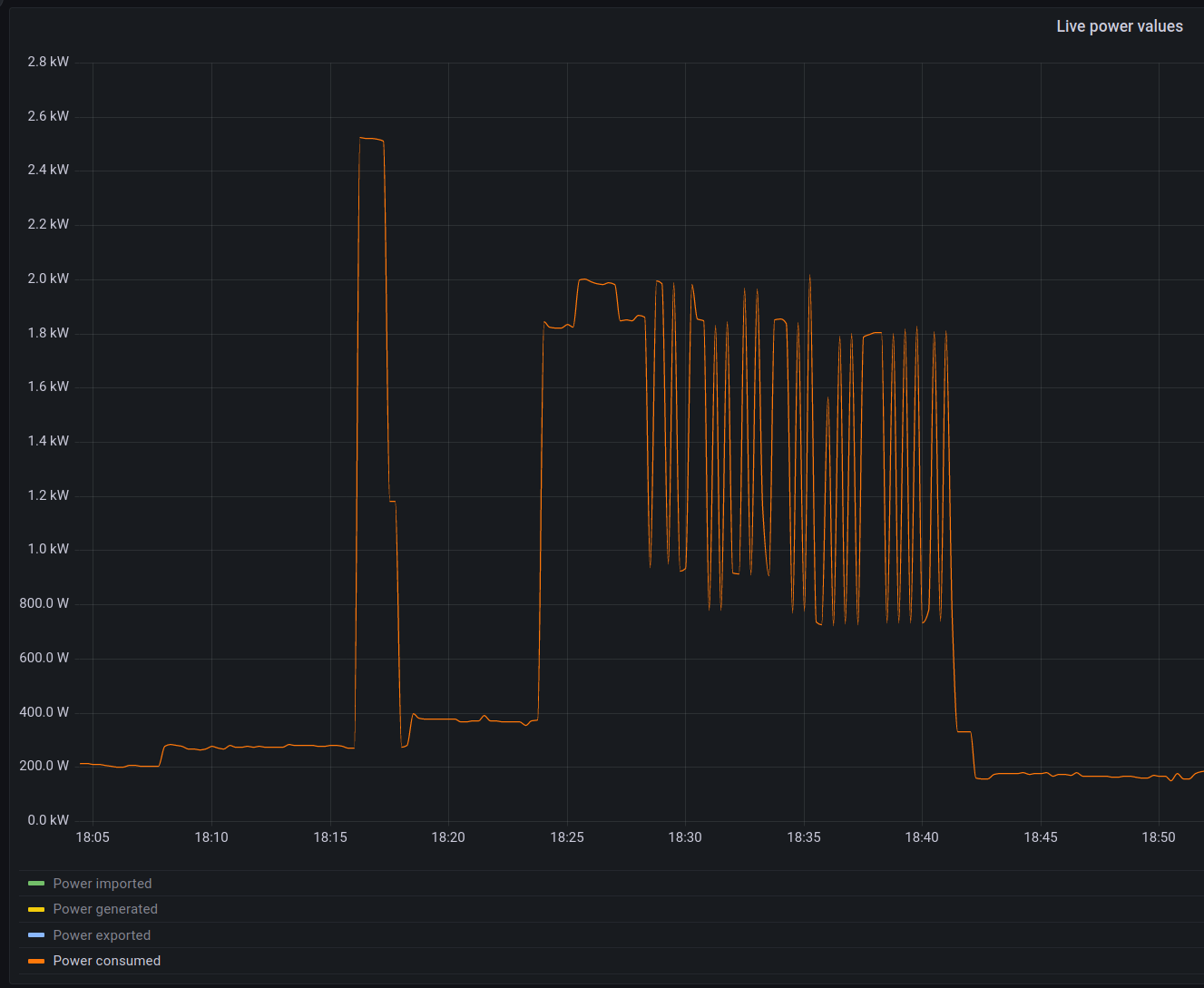
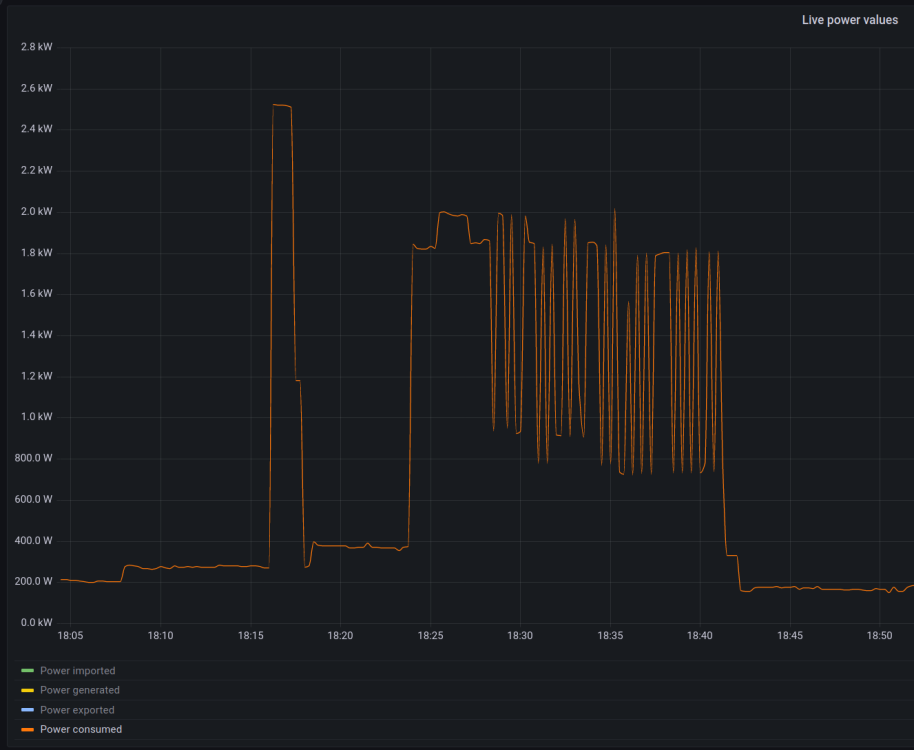
Let's say that this is a graph of my oven's power consumption: (I think it is, but I've not had it on for a few days so had to go trawling through history to find an illustrative pattern) In the spiky section, power usage averages ~1.5kW, but it's composed of lots of on-off peaks to ~2kW. What i'm looking for is an oven that, instead of pulsing 100% power into its element around a thermostat, will hold it at 75% (or 50%, or whatever) to maintain a constant temperature. The same number of kWh are consumed either way, but when my solar array is generating, I'll be more likely to be able to avoid importing power if the peak is lower. I tried searching, but I was really struggling with search terms ^^. "Smart oven" doesn't really get you into the right space. I love cooking, but I'm really starting to resent my oven ^^.
-
Yes. Read the section in bold: "All prices are the Ofgem Default Tariff Cap rates before discounts under the Government Energy Price Guarantee have been applied". Once those discounts are applied - and they will be applied - you get the rates in the PDF I linked.
-
Will energy storage be worth it if the energy price is capped?
Nick Thomas replied to George's topic in Energy Storage
Huh. Never mind the heat pump - even with gas, exporting 1kWh electricity at 15p lets you import 1.5kWh of gas (10p/kWh), which you can burn for ~1.5kWh of heat. What a world. -
(The actual rates EDF are charging E7 customers: https://www.edfenergy.com/sites/default/files/government_energy_price_guarantee_prices._standard_variable_deemed_and_welcome._credit_meters.pdf )
-
Will energy storage be worth it if the energy price is capped?
Nick Thomas replied to George's topic in Energy Storage
If you're with octopus you can get 15p/kWh export, which helps a fair bit. Again, with export at 15p/kWh, this all starts to look a bit different too. Feeding my heat pump to heat the water, the worst case is exporting at 15p to later import at 34p; I get a bit under 1.5kWh of heat per kWh solar exported that way, rather than the ~1kWh heat/kWh solar the diverter gives me. Mind you, payback on the heat pump is a whole other game. More generally, with import/export at these levels, the grid can be thought of as a battery with 50% efficiency. Since it's free, any installed battery has to compete with that, which makes payback a lot harder. I'm still getting batteries, though. They'll still be there when the grid fails! -
With a bit more research I've decided to go with the "LoftZone StoreFloor". With the boards, it works out at £40-50/M² for the kit; on a supply+fit basis, it's ~£100/M². I don't have a huge acreage to do so it hardly matters either way, but it seems like an easy enough project. Famous last words.
-
Thanks for the extra detail! Anything that goes near structural calculations is way over my head at the moment, but it's good to get chapter and verse nonetheless. Couple of other suggested options come up in https://www.theloftboys.co.uk/lofts/loft-boarding/ - they also suggest counter battens, and (presumably their proprietary) "LoftZone StoreFloor"™®© system, which is like the legs, but maybe a bit less work to install. I hadn't really thought about the safety aspect of batteries in the loft, but fixing them to the wall at least avoids the loading issues - I just need to improve the access and get some boarding down that they can use while installing. The batteries I'm going for are LiFePO4, so not incredibly high-risk from a fire point of view. They're DC-side wth the solar, so putting them anywhere *but* the loft would imply a ridiculous DC cable run. They and the inverter rely on convection for cooling, so boxing them in would probably do more harm than good. Worst-case, at least the fire wouldn't be between me and the exit, right?
-
The way I read it, the limit is not the loft legs, it's the loft itself, and would apply to literally anything you do up there?
-
Interesting product. I'm looking at boarding out my loft this month or next for better access to the solar inverter, and maybe adding some DC batteries. https://www.loftleg.com/faq has a bit on the 25kg/m² number: Perhaps the batteries can be fixed to the wall instead...
-
I switched to a new energy company this week. They insisted on quoting the uncapped rates, but were clear that I would actually pay the capped rates. It's a single-rate tariff but I assume the same will be true of multi-rate tariffs - after all the interventions, your blended rate will actually be ~33p rather than 50p or so. Fingers crossed, anyway.
-
Noise requirements and planning consent
Nick Thomas replied to JamesPa's topic in Air Source Heat Pumps (ASHP)
Not with the windows closed, no. If the window or door is open, sure, it's there as a background hum - I stopped noticing it quickly though. -
Noise requirements and planning consent
Nick Thomas replied to JamesPa's topic in Air Source Heat Pumps (ASHP)
Sorry, should have been clearer. The garden is 9M wide and about 10M long, with the house running along the width of it. The heat pump is butted up right against the house (under the kitchen window), but placed about 4.5M away from each of the two sides, i.e., at (4.5,0). It's not located centrally in the garden, i.e., at (4.5,5.0) 😅 The installers said the pipe run could be up to 10M. The pipes go straight up the house to the first floor bathroom and pass under the bath to get to the airing cupboard. So that's under 5M of pipe length. The pump definitely isn't in an ideal position - it's probably the coldest part of the whole curtilage - but it's in. -
Noise requirements and planning consent
Nick Thomas replied to JamesPa's topic in Air Source Heat Pumps (ASHP)
I was a bit worried about mine, although not as worried as the neighbours 😅 . The calculations snuck in at 42 dB(A), and in practice it's fine - if I go to either side of the garden, it's barely audible. Haven't caught the neighbours yet, but I assume they'll be compelled to agree. * It's a 65dB(A) heat pump (grant 6kW) * "two reflective surfaces" * "Partial barrier" (scratty garden fence) * "Assessment position" 8 metres (somehow - it's in the middle of a 9M wide garden with neighbours on both sides, detached in name only) A mid-terrace from the same developers would probably not come in under the limit. Really, it's a bit weird to have one per house. It's a shame district heating isn't more widespread. -
Hey all, I'm Nick, and the ~5 year goal is to self-build a home, or possibly to very-tiny-group-build a small number of them. I've joined mostly to learn, although I have some ongoing and planned refit projects that I could talk about as well. I don't have definite plans for how the house(s) should be, just a lot of buzzwords. We moved to a fairly-new-build in Yorkshire this year, in the middle of getting a 6kW ASHP + 3.6kWp PV system installed, replacing a 12kW gas boiler, in response to energy prices. Would love a critique of the system once it's all in (I know, that's a bit late to be making changes). ASHP should be finished this week; panels mid-September. We moved back from Shetland, where I've got a timber-framed house that's been a bit of a nightmare, honestly. Again, far too late for critiques to be useful in changing course, but would love to make sure I've learned everything I can from the experience. That's got an air-air heat pump in that struggles during the winter. The walls are insulated both internally and externally, but the roof is basically a giant radiator, and the place is really not air-tight. We moved *there* from a 1930s end terrace in York which has little insulation and a gas combi-boiler. My sister lives there now and is likely to need support getting through the winter. Lots going on 😅