Jeremy Harris
-
Posts
26430 -
Joined
-
Last visited
-
Days Won
360
Everything posted by Jeremy Harris
-

What is the effect of EPC changes?
Jeremy Harris replied to Ferdinand's topic in General Self Build & DIY Discussion
Right now about 16% or so of our electricity is coming from gas (the rest is coming from renewable generation, nuclear and interconnects) and total grid emissions are 0.088kg CO2e/kWh. Yesterday evening grid emissions peaked at about 0.148kg CO2e/kWh. Looking back over the past few days it seems the highest emissions were around 0.25kg CO2e/kWh, close to the figure now used in SAP. Gas generation emissions are around 0.499kg CO2e/kWh, so anything that reduces gas generation reduces grid emissions by about this much. -
Solar gain through glazing seems to be far and away the most significant cause of overheating, I think. Not really surprising, as it's fairly easy to get around 200 W/m² or more coming in through glazing, and for a house that needs no heating at all for a fair part of the year that's a significant amount of heat input. Even in winter we can really notice the effect of having guests here. Two people will add around 160 to 200 W of heat, more than enough to push the room temperature up a fair bit.
-
I'm pretty sure that installers have yet to pick up on this. AFAIK, it's probably only members of this forum that have discovered that floor cooling can be pretty effective in hot weather. Perhaps we're pioneers, in which case I suspect we might be collectively recognised as such when installers catch up with some of the things we are doing, in years to come.
-
Which ASHP are set up to cool
Jeremy Harris replied to Triassic's topic in Air Source Heat Pumps (ASHP)
Most ASHPs can cool as well as heat. They normally use the cooling function to defrost, so it's built-in. The manufacturers may not openly advertise the fact that their units cool as well as heat, but several of us have found that it works surprisingly well. I may have been one of the first to try this, with our re-badged Carrier ASHP (it has a Glowworm badge, but was also sold with a Kingspan badge, amongst others). I found it to work very well, so adapted our control system to include cooling (just meant adding a cooling room thermostat, really. -
What is the effect of EPC changes?
Jeremy Harris replied to Ferdinand's topic in General Self Build & DIY Discussion
It seems to be the difference between self-generation being counted as negative CO2, and consumption having a reduced CO2 emission under the new factor, so we've gone "more negative", as SAP just subtracts the self-generation CO2 equivalent from the consumption CO2 equivalent. The latter has reduced, so the overall negative CO2 has changed from -0.9 to -1.94 tonnes/year (I don't have the SAP worksheet on this laptop, but the self-generation was around -2,700kg/year). -
Rust Removal Adventures: Electrolysis, Acid etc
Jeremy Harris replied to Onoff's topic in Tools & Equipment
Bit of GRP over the hole? Coupled with a bit applied on the underside, bonded to the bit of the top, should seal it up OK. Might be quicker to just stick something over the hole with a bit of CT1, probably do a good enough job. One advantage of using phosphoric acid over citric acid is that the corroded steel won't get eaten away and thin. Once all the ferric oxide (rust) has been converted to ferric phosphate, it becomes pretty much inert to further action from the phosphoric acid. For something heavily corroded I'd be inclined to remove the worst of the ferric oxide with something like citric acid, but not go too far with this, just enough to get back to the original dimensions. Then wash off and dry the part and treat it with phosphoric acid (make sure it is properly dry before treating with phosphoric acid; water can form insoluble salts which appear as white powder and prevent paint adhering. When it's uniformly black, then remove the part and dry it as quickly as possible. Don't wash off the phosphoric acid from the surface, just let it dry naturally. -
What is the effect of EPC changes?
Jeremy Harris replied to Ferdinand's topic in General Self Build & DIY Discussion
I've just run our house through SAP again, using the new emissions factor for electricity, and the CO2 emission has changed from -0.9 tonnes to -1.94 tonnes per year. That's a change from our house being roughly equivalent to about 40 mature trees, in terms of effective CO2 sequestration, to it being roughly equivalent to about 86 trees. The impact of this on offsetting the CO2 produced when making the concrete in our slab is that the CO2 "debt" of the ~10m³ of concrete in our slab has now been offset, (assuming that each m³ of concrete released around 410kg of CO2 during its manufacture) so from now on the house will be pretty much CO2 negative for the rest of its life. -
What is the effect of EPC changes?
Jeremy Harris replied to Ferdinand's topic in General Self Build & DIY Discussion
The problem was that the emissions data being used to assess the environmental impact of electricity use was hopelessly out of date, and used data from the time when we had little renewable generation and a fair bit of coal and oil fired generation. The grid has significantly reduced its emissions, so SAP needed to catch up and use a more representative factor for assessing an all-electric house. This failing in SAP bugged me when I did our assessment, as being all-electric we were unfairly penalised. The assumption then was that our electricity imports generated 0.519kg CO2e/kWh, when the reality was that the grid was then running at under 0.3kg CO2e/kWh. Since then the grid emissions have reduced still further. -
I think I'd want to concentrate on avoiding all the wasted heat from inefficient systems first, as that makes more sense than creating a problem and then trying to fix it with a more complex installation. There's no good reason for lighting controls to waste more than a very small amount of energy, and the same applies to modern AV gear. It certainly was the case years ago that AV kit was pretty inefficient. Back in the early 1970's my Linsley Hood class A power amp used around 180 W or so, all the time it was powered up. A more modern, efficient, design can deliver the same quality with far better efficiency, wasting a great deal less energy and so needing a lot less cooling. The same goes for things like satellite boxes. The first Humax HDR I bought years ago wasted loads of energy, and ran pretty hot, even when in standby. The one I bought about a year ago uses much less power than the old one, barely gets warm when running, and is cold when in standby, has a snappier user interface and greater recording capacity.
-
A quick look at how much air needs to be shifted to be able to extract a given amount of heat might be useful. The heat capacity of air is as @SteamyTea says, about 1 J⋅g−1⋅K−1, and the heat capacity of water is about 4.18 J⋅g−1⋅K−1, so if you want to heat, say, 200 litres of water from an incoming cold water temperature of 8°C to a hot tank temperature of 60°C, then you need about 43.472 MJ of heat energy. Ignoring the small heat input from the compressor in the heat pump, this means that the air flowing into it has to have around this much heat energy. Working backwards, using the heat capacity of air, and assuming that the air intake to the heat pump is 25°C and the exhaust is ~0°C (pretty typical for an EAHP) then you need to pump about 1,400m³ of air through it in order to heat the tank. You can easily work out how much air flow you can get through your cabinet and what that is likely to contribute. A pretty high air flow rate of, say, 10l/m, with a tank heating time of, say, 4 hours, would mean that the cabinet contributed about 2.4m³ out of the ~1,400m³ that the EAHP needs, or a bit under 0.2%.
-
MVHR DiY install?
Jeremy Harris replied to gc100's topic in Mechanical Ventilation with Heat Recovery (MVHR)
Same here. Even with multiple air lock doors to subdivide lab ventilated areas it was still a challenge to get the BMS to control airflow rates. Someone closes a fume cabinet door and the pressure drops in the extract system, causing flow rates everywhere else to change. My inclination would be to never try and use any form of moving air valve anywhere in the system, except, perhaps, for heat exchanger bypass. Balancing a system is hard enough with fixed flow valves/restrictors, especially if it's anything other than a dead still day outside. The slightest wind causes pretty wide fluctuations in airflow, something that I hadn't appreciated until the first time I tried to balance our system. I had to give up and wait for a still day to do it, and I know that, even though our system is balanced when there's no wind, the slightest breeze throws the airflow rates out by 50% or more. -
Looking for decent brightness, 60°, dim-to-warm downlight
Jeremy Harris replied to Chris S's topic in Lighting
Bear in mind that Part L1A doesn't state that every light has to be >400 lumens to qualify as low energy, plus all non-fixed lighting is excluded. This gives a great deal more freedom in lighting design. Well worth reading part L1A to get a view as to how compliance with building regs might be obtained, bearing in mind that there is no legal requirement to follow Part L1A, or any other approved document, as they are only suggested ways of demonstrating compliance with the regs, not the only way of doing so (you can use other ways of showing compliance if you wish) -
What do you call a thingy that ...
Jeremy Harris replied to ToughButterCup's topic in Tools & Equipment
It looks like there are two versions of the E-ON device. The one linked to on ebay earlier needs a TV remote to work, but there is another version that I think may have current sensing. Rather confusingly both are called the E-ON Powerdown, which doesn't help. I've taken a punt and ordered what I think may be the current sensing version, rather than the one that works from a TV remote, which I think has the reference number: DSK105EON -
Sorry, I didn't mean to imply anything about bills, it's solely the laws of physics and the true amount of heat that is available from any bit of kit that is delivering a service to the house, that's all. It's a hard fact that any lighting control system isn't going to generate a lot of heat, if it does then it needs sorting, as there is no need for any such control system to waste more than a tiny proportion of the power of the controlled lighting. The same goes for audio, or video. Audio amps shouldn't be that inefficient that they generate significant amounts of heat, in the context of a domestic environment, and safe levels of SPL. There's just a massive disparity between the likely waste heat from even a really comprehensive domestic audio/visual system and the typical heating/hot water requirement. This makes it really hard to justify spending any significant amount on heat recovery from this low level waste heat, as the probability is that the capital cost of the system will be orders of magnitude more costly than the true value of any recovered useful heat.
-
I appreciate what you're saying, but the heat produced is directly proportional to efficiency, and the standby power of domestic equipment has to comply with current regulations, so can never be anywhere near 19 W (check the current regs on this if you don't believe me). Older kit could consume a few watts on standby, but not anything sold in the past few years, as there has been a gradual clamp down on standby power consumption of all domestic kit. The size of the amps has little to do with their heat output, as in a domestic environment they just cannot deliver a high mean power output. For example, a decent sound system in a room of around 5m x 5m, will deliver an ear-splitting SPL with about 10W of audio power, so maybe 100 W of electrical power, and 90 W of wasted heat, with a poor efficiency class A amp. With a decent class D there may well only be around 5 W of wasted heat, not enough to bother about doing anything with, when you consider that an immersion heater is typically around 3,000 W.
-
Rust Removal Adventures: Electrolysis, Acid etc
Jeremy Harris replied to Onoff's topic in Tools & Equipment
Phosphoric acid is my favourite for de-rusting stuff, as it converts ferric oxide into ferrous phosphate, which provides a bit of further corrosion resistance, even before painting, oiling or whatever. It doesn't need to be heated to work well, and I'd be inclined to not mix it with anything, as it works very well on its own. The only snag is that it only really works well on stuff that's been very thoroughly degreased. -
The key thing is that the waste heat from the rack isn't really wasted, as it ends up inside the thermal envelope, so contributes to keeping the house warm. In effect, it just offsets the heating requirement, so is a direct, 1:1, saving from the heating bill. If the rack is so inefficient that it creates lots of waste heat, then adding forced air cooling from the room would help both cool it, and distribute heat to the house. It all hinges on efficiency, and I find it hard to believe that even a big house audio visual system would be so inefficient as to generate a useful amount of heat from the control/amplification rack. A pretty loud audio system is only going to deliver maybe 5 to 10 W of acoustic power into an average sized room (even that is probably up in the region where damage to hearing is likely). Even a crappy class A amplifier is only going to draw around 100 W to deliver that acoustic power level, a more common class C/B amp would draw maybe 30 W, and a decent class D might be less than 15 W. Of course, the peak power ratings will be a great deal higher, but the peak-to-mean ratio in music is pretty high, and it's the mean power that ends up determining the heat loss through inefficiency. Lightin system switching should be virtually lossless, so there will be near-zero heat recovery from the lighting control side of the system.
-
Rust Removal Adventures: Electrolysis, Acid etc
Jeremy Harris replied to Onoff's topic in Tools & Equipment
I reckon you might get a bit wrinkly if you bath in that... -
If the lighting is efficient, then there won't be any significant heat to recover from the control cabinet, so it wouldn't be worth the effort of trying to recover wasted energy from it. As an example, our 130m2 house has a total lighting power input, with all lights on, of less than 250 W. I'd expect any switching system to be at least 95% efficient, so that means that, with all the lights on, the wasted energy in the switches/control system would be around 12.5 W. Apart from this heat loss being very low, it ends up directly heating the house, so there is no real merit in trying to pass this through the MVHR.
-
Welcome, First point is what level of airtightness have you managed to achieve? Unless you've sealed up the house to better than around 3 ACH at 50 Pa it's pretty doubtful as to whether MVHR would be worth installing. Ideally, MVHR really need the airtightness to be better than about 1 ACH to reap significant benefits. This is a tough target to achieve; few houses built to current building regs will be this airtight. If the lighting system is so inefficient as give off lots of heat, then I think the first thing to do would be to change it for something less wasteful, as that would be both cheaper and more effective than trying to recover heat from an inefficient lighting system.
-
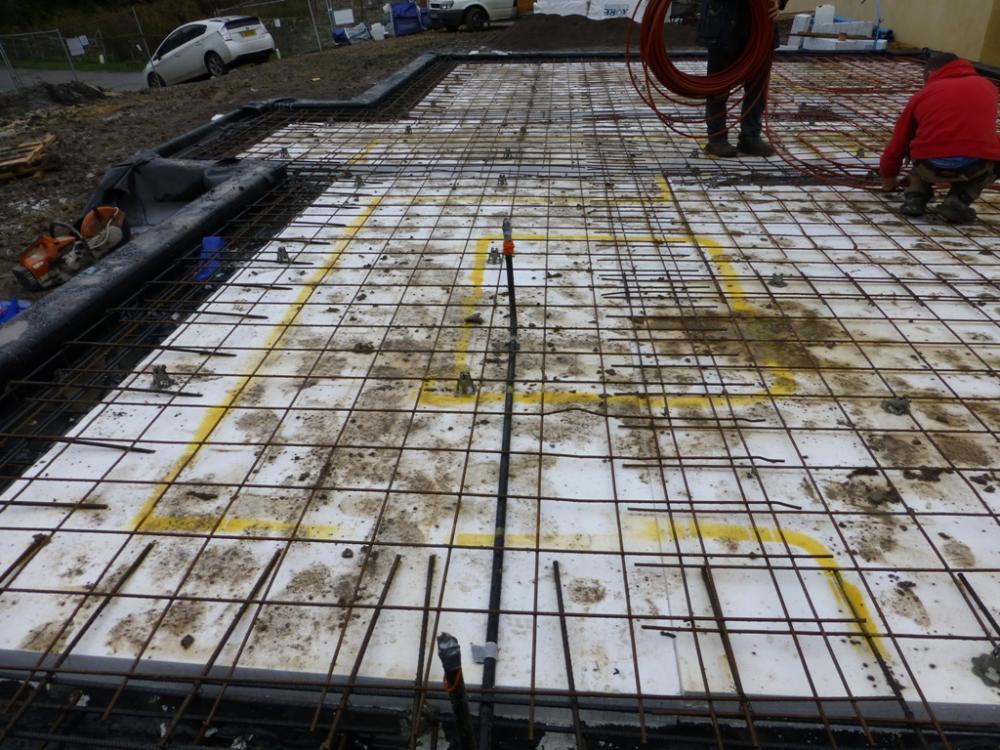
Our UFH pipes are just cable tied to the reinforcing fabric:
-
What do you call a thingy that ...
Jeremy Harris replied to ToughButterCup's topic in Tools & Equipment
A word of caution! The cheap E-ON Powerdown (the thing in the ebay links) only works with a TV remote control. Mine arrived today and it's useless for controlling a vacuum cleaner remotely... -
The law is pretty crystal clear, though, and I found that the legal chap in our local authority accepted it and instructed the council tax collection department that they would be acting unlawfully if they sought to impose a completion notice and start charging council tax. There is clearly some scope for interpretation as to what does, or does not, form a rateable hereditament, but it is clear from the case law that an absence of a potable water supply, and, in some instances, the absence of wiring and power, is sufficient to declare that the building is not a rateable hereditament, and cannot just be put on the VOA list. That doesn't prevent a local authority from attempting to submit a completion notice, and if they are allowed to do this unchallenged then the building, no matter what state it is in, may become a rateable hereditament. The key is to appeal any attempt by the local authority to submit a completion notice. This argument hinges on the length of time that the local authority give as a notice period. Usually this will be three months, which may be OK for a volume house builder, but there is a strong case for doing as I did, and argue that a self-builder cannot be reasonably expected to work as fast as a professional house builder.
-
No, I showed in 2014-2016 that the case law (which dates from 2011) had not been superseded by a more recent adjudication.
-
The law is clear about when a house is habitable in terms of council tax. Read the links I quoted earlier for the relevant case law that proves this beyond any doubt. For example: and also: Not having a potable water supply is probably the most cast-iron way of ensuring that council tax cannot be charged.