Jeremy Harris
-
Posts
26430 -
Joined
-
Last visited
-
Days Won
360
Everything posted by Jeremy Harris
-
This is plain madness! The topic comes up regularly on self-build debates, and not just on this forum. If self-builders had to become businesses then it would increase the cost of self-build to the point where no one would attempt it, as it simply wouldn't be in any way viable. The government has long accepted that self-builders are not businesses, and have framed legislation around this, for example that relating to tax and VAT. The clear intent of government is to continue to encourage self-build, as a part of the strategy for delivering new homes. This has been stated, and more than that, openly encouraged, with schemes such as the one at Graven Hill, Bicester. These schemes go so far as to remove as many hurdles as possible for self-builders, and specifically preclude businesses from taking advantage of them. If self-builders were forced to become businesses then schemes like Graven Hill would just collapse, taking millions in public money with them.
-
It depends on the nature of the road. In our case the posts are along the side of a very quiet (maybe a dozen vehicles a day, if that) lane, where kids regularly play on skateboards etc. The lane is so narrow that pedestrians have to climb part-way up the banks to allow vehicles to pass. Grabbing a convenient pole is a good way to keep balance!
-
It annoys me as well, as it seems clear that there is a degree of attempted exploitation going on, by those with an interest in extracting money from self-builders.................. The bottom line, in law, is that a court will try to interpret the law as the legislators intended, not as companies trying to extract money from potential clients may interpret it. It is clear that the legislation intends to exclude domestic clients from this particular law. That is the starting point for any judicial decision that might arise. There is the further question as to whether a domestic client inadvertently takes on some of the responsibilities that are described in CDM2015 (or indeed in any previous incarnations of CDM back to 1994). If such a case was to go to court (and no self builder ever has in the 22 years that we've had CDM) then the judgement would hinge on the level of competence of the domestic client, and whether or not they had the level of understanding, skill and experience to reasonably assume a level of responsibility over and above that normally expected of a domestic client. The test for "reasonable" would be the standard one of "the man on the Clapham omnibus". My experience over the years is that the courts are extremely good at determining the difference between a competent person pretending to be otherwise and a person who unwittingly finds themselves accused of negligence. I've never, once, seen a case where an ordinary person, with no special degree of competence, has been found liable for something they were unaware of. I have seen plenty of cases where people with specific skills, training and qualifications have been found liable because they had an enhanced duty of care.
-
All telephone and power poles are liberally soaked with the stuff. We have two new ones, both on the side of the lane where children can lean on them, touch them etc. SSE told me that I could not remove and dispose of the old pole they left up on our site for nearly a year because it was "hazardous waste". I asked them to remove it (and had already paid them to do this as a part of the job of relocating their cable underground) yet they kept delaying and delaying. In the end I slipped an Openreach Polecat team a tenner to lift the old SSE pole out and position it on the bank that forms our verge, where I staked it in place as an "erosion protector" (it's really there to bounce big tractors back into the lane and stop them damaging the bank).
-
We used Sennoke for our site insurance, very flexible and, unlike Buildstore they were willing to design a flexible policy to cover a part complete house whilst it was still being finished off.
-
There is no way that a bit of H&S law can force a domestic client to register as a business, it's clearly nonsense, and apart from anything else would conflict with the way VAT is zero rated to self builders, under the self-build VAT reclaim scheme. Self-builders are not normally businesses, in fact the issue has been discussed many times as to whether there is any merit in becoming a business in order to build your own home, and the answer is that there very definitely isn't; the costs associated with becoming a business, administering it, and then closing it on completion of the build are so high as to make it a pointless exercise.
-
My understanding is that the material has the appropriate approval, but that in general, it's down to the SE to certify the system. BBA don't actually provide certification of systems usually, only the constituent materials. For example, the Kore materials have NMAI approval (accepted as being equivalent to BBA under EU rules), but they don't (and cannot) provide foundation system approval for a specific design of house. That responsibility falls to the SE. It sounds to me as if LABC are well behind the curve with regard to passive slab foundations, and need to understand how they are designed and where the responsibility for ensuring the design is appropriate lies. EPS has been used for decades as a foundation load bearing member, even though it's use as such here is still relatively uncommon.
-
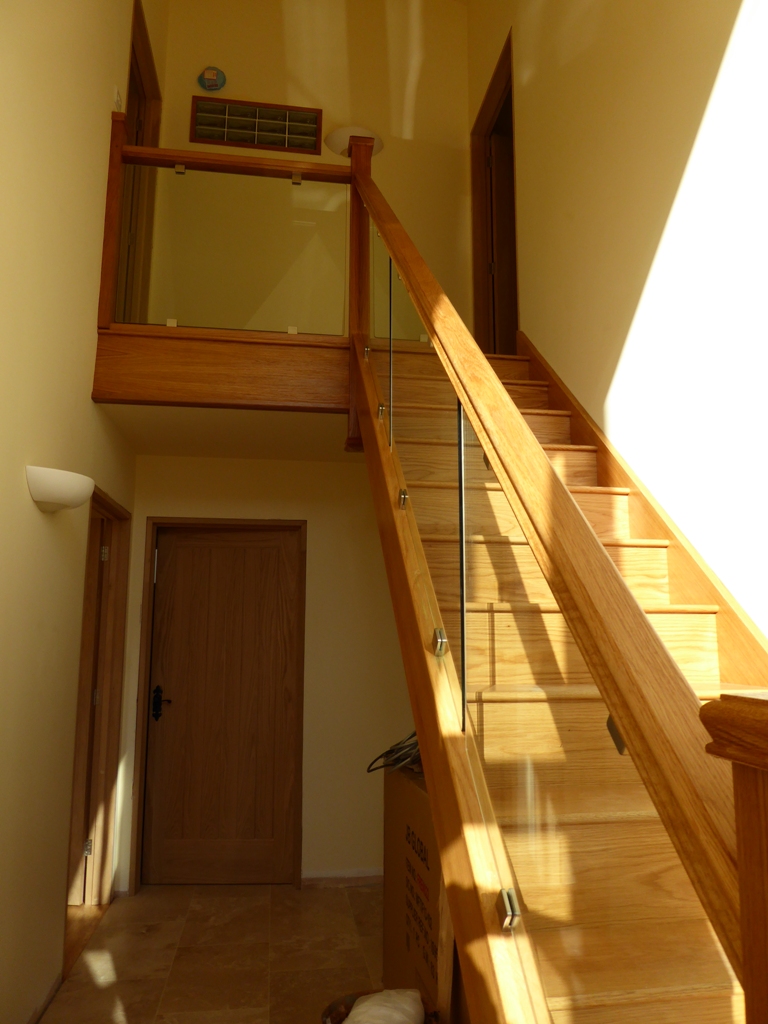
Just to add that we used Pear Stairs, can't speak highly enough about them. Excellent quality, a perfect fit first time, and pretty quick from placing the order to taking delivery. They deliver themselves, too, so the staircase arrives well-packaged and with minimal risk of damage in transit. The joiner that gave me a hand to install it reckoned he'd have had to charge twice as much just to break even, and when we lifted it up and hooked it on, he pulled a torpedo level out of his pocket saying "lets see how far out it is". The bubble stayed resolutely in the middle on all axes, so he scratched his head, said he'd never seen a staircase like that before and we set about fixing it in place. Half a day's work to fit the staircase, landing rail and banister, then a wait for a couple of weeks for the 10mm thick glass, as they get that made after fitting, when you give them the "as installed" dimensions.
-
It's at least 6 or 7 years since I've had to pay car tax, and three years since my wife has. I think I paid £15 a year for the three years or so before that. If I had to pay to tax a car now it would come as a bit of a shock!
-
Animal rights protesters did this to us several years ago. They pitched up at the crack of dawn and parked a scruffy Transit on our drive. Eventually the police turned up, but refused to get involved, as the vehicle was on our property. It was a damned nuisance, as the van was decorated with the usual sort of extremist stuff, plus it stopped us getting out and doing the shopping. Eventually the van was removed, but not without a lot of abuse from it's owners, complete with a loudhailer to "spread their message" to all who'd listen. Given that a lot of our neighbours were military, or former military, their message rather had the opposite result to that they had intended. There was a flurry of letters in the local paper the following week, with several stating their intent to go out shooting the following weekend, just to make a point about the protestors.................
-
Care is needed over controlling parking, particularly if the parked cars are on the highway. Until the house is complete you don't have a legal right to access (the assumed right of access is an old common law provision, and isn't in any statute). Even if people are parking on, or partially on, your land then there is only a limited number of things you can do to stop it, and none include criminal damage! As such, I'd steer well clear of anything that could get you into trouble, like sticking extra sticky tape on windscreens, or doing anything that could be construed as vandalism, tempting as it may be. If you have persistent offenders you may be able to request that the local authority impose a temporary parking restriction. That then has the backing of the law behind it, and makes your case a lot stronger when it comes to stopping people from parking, or having them penalised if they do. The downside is that the local authority may be reluctant to do this, and may well charge you a fair bit if they will do it.
-
It's best to think terms of liability, as really that's the key thing here, not what happens to be in a Statutory Instrument that is focussed on businesses, rather than a private individual. I'd go so far as to say that if you focus on managing the liabilities safely, then you can pretty much ignore CDM (bearing in mind that we've had CDM in one form or another for over 20 years now). Our build started with me contracting with a ground works company on the basis that they had complete control of the site and all works. I was a domestic client, they were the principal (and only) contractor. As such, our contract spelt out the breakdown of responsibilities for HSW&E, with some requirements coming direct from the local authority and some from a structural engineer. When they completed work, they handed the site to me and I took out liability insurance (something I was advised not to do whilst the site was the responsibility of the ground works contractor). A borehole company were contracted to drill a borehole to the specification provided by a hydrogeologist, and again I was a domestic client, but with responsibility for site security. The house foundation and frame supplier (MBC) came on site next, and were the third principal contractor, in CDM-speak. I was responsible for some welfare and environmental issues (toilets, hand washing, provision of skips) and was also responsible for ensuring that a competent scaffolding company was contracted to erect the scaffolding to the builder's requirements. Again I was a domestic client. The next main contractor on site was the roofing company, and again I was a domestic client, and provided them with the same services as the builder. From then on I contracted with a number of small contractors, all on a similar basis, which was that they had responsibility for ensuring that they worked in a way that was safe, not me. The main liability you have as a self builder is really making sure the site is reasonably safe and secure, with proper warning signs, plus having public liability insurance in place in the event that someone breaks in and hurts themself. That risk is far and away the greatest one, in my view, but if you can show that you have taken all reasonable measures to mitigate it then it's extremely unlikely that you would be prosecuted. There are well-proven ways to make sites secure, with officially recognised warning signage. Generally, securely fitted hoardings or Heras fencing, with plenty of warning signs, making sure scaffold ladders are hard to climb out of hours (I chained planks to ours), plus keeping the site as clear of hazards as you can, is all you can reasonably be expected to do.
-
Yes, in our case there's no drainage, as in allowing water to collect under the slab, in fact the whole idea is to prevent this, by allowing water to drain away from the under-slab area. If you don't do this, then on soil like ours (impermeable hard gault) the slab ends up sitting in a swimming pool. The idea was for the free-draining layer under the passive slab to be given somewhere to drain to, to prevent the build up of water.
-
Our BCO had never seen a passive slab before, so seemed to pretty much accept that whatever we were doing was OK! He didn't want to inspect the house related ground works at all; he came on the day we did the foul drain pressure test but didn't do another inspection until the day before we poured the concrete, by which time the land drains were buried.
-
We made the area of sub-base (which was type 3) bigger by around 300mm all around and fitted a 100mm diameter perforated land drain around two sides (the North and West sides). This drains to a large storm surge "tank", more from 20 Aquacell crates, buried under the drive. The same "tank" takes the rainwater run off from both the house and garage roofs and the drive. We're on hard gault clay, but luckily there is a band of relatively free draining soil in one corner of the tank area.
-

An Excellent Modern Terrace Plan
Jeremy Harris commented on Ferdinand's blog entry in God is in the Details
The one thing that really annoys us about our old house is that the living room/dining room is a corridor, as it's the only way to get to the kitchen and back door. Apart from limiting the usability of the space, it also ends up with a track across the carpet where everyone walks. Personally, I'd rather have smaller rooms and retain a "proper" hall, something that our first house, a Victorian terraced cottage, managed to do quite well. The rooms were smaller, but more functionally useful, as each had only a single door leading to them, so there was more flexibility in terms of furniture placement. -
Show me your installation!
Jeremy Harris replied to worldwidewebs's topic in Mechanical Ventilation with Heat Recovery (MVHR)
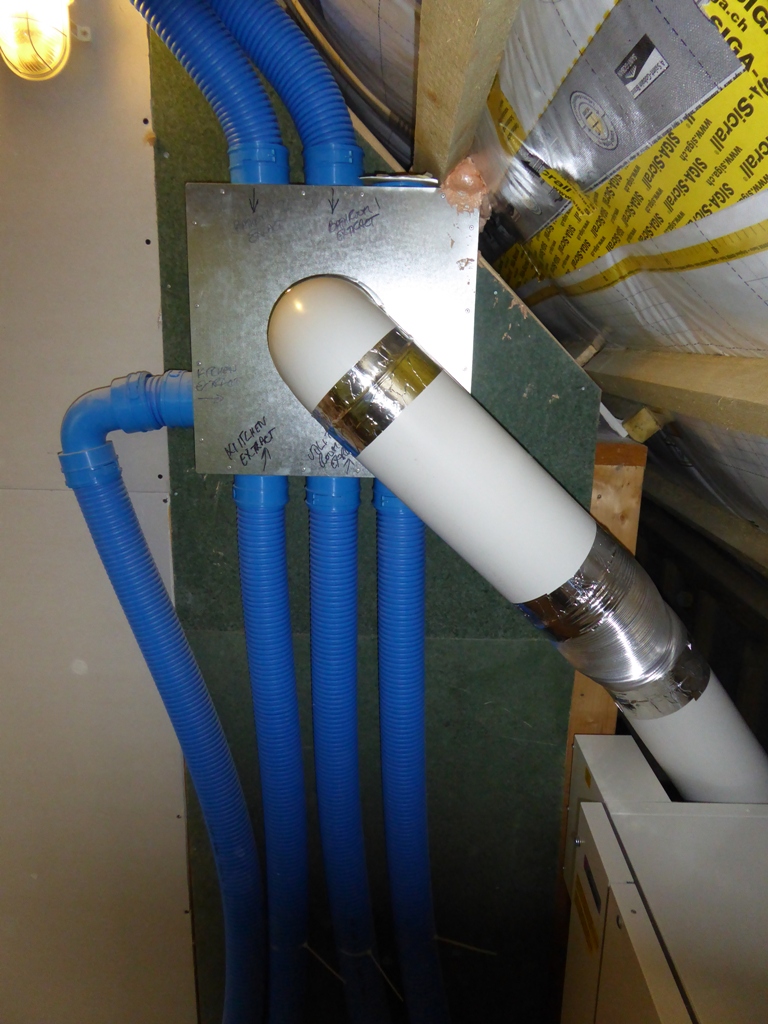
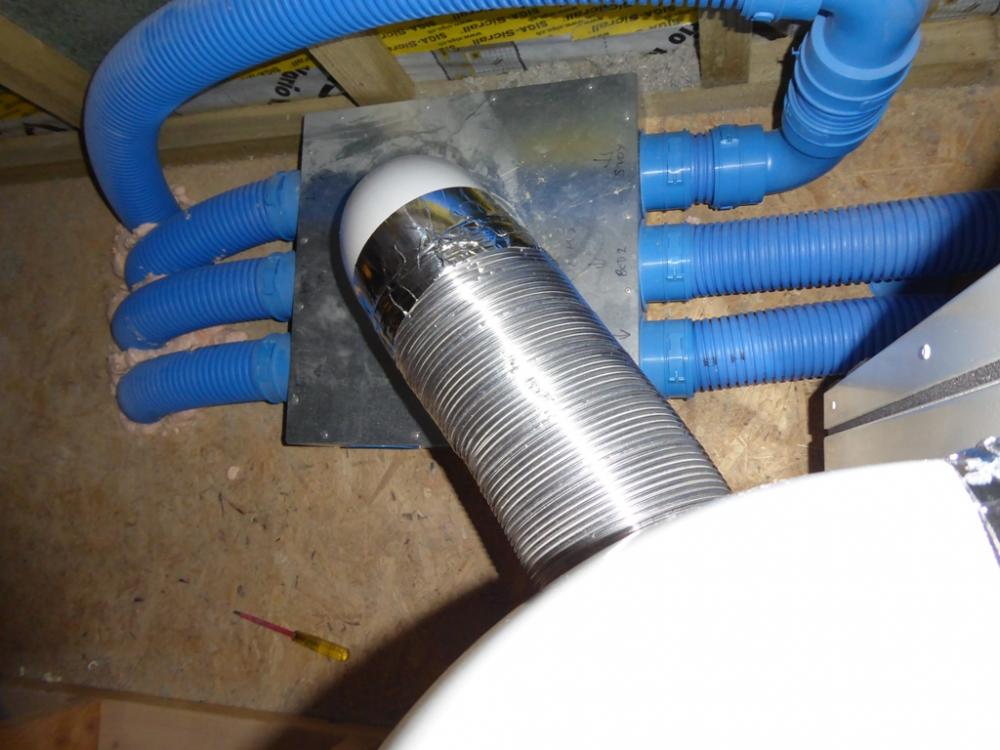
The above photos show the fresh air feed (top) and extract (bottom) for our system. The installations were modified a bit later, when I added the silencers.
-
vat claim on plants
Jeremy Harris replied to Pete's topic in Self Build VAT, Community Infrastructure Levy (CIL), S106 & Tax
I claimed for our hedge plants OK, without specifying the individual plant types. The approved landscaping plan just had something like "native hedging" on it, and the claim was for a few hundred bare root mixed native hedging plants. HMRC didn't comment on this, even though they did comment on other things that held the claim up for around 3 months, -
Great news! We have half moved in, but are waiting to sell our old house before we permanently move. It is a bit of a pain keeping two houses going, though, and if I'm honest, I've sort of lost interest in doing anything to the old house, even though I know that a bit of tarting up might help it sell.
-
This detail really needs to be right, and will usually have been checked using something like WUFI by the SE that designs it. It's not easy to just get this right by guesswork. There may well be a standard detail that you can use, though. It's not something I've looked at closely, as our frame and foundation/sole plate detail was part of an integrated package that was signed off as a whole by the frame companies SE. TRADA have some standard details, it seems. You can get a preview of them here: https://www.trada.co.uk/downloads/publications/Timberframeconstruction.pdf plus there is more detail on sole plates here: https://www.trada.co.uk/publications/download/?id=DD978FA1-D08A-4E16-90F8-19298ABB6B1F
-
The usual sort of detail will ensure that there is some form of insulation under, and often outside of, the sole plate. There are some details here on the forum of different ways this can be achieved, often using materials like thermalite blocks under the frame. MVHR is irrelevant, as the house will have a vapour control layer (VCL) on the inside, to prevent internally generated water vapour from penetrating the timber structure. The main source of moisture will be from outside, with water vapour moving into and out of the timber frame with changes in temperature and humidity. As long as no part of the frame can drop below the local dew point temperature for the vapour concentration at any time, then there's no problem. If the frame can cool to dew point then liquid water will start to condense, and the chances are that it won't be able to dry out, as that requires a significant amount of heat energy.
-
How are you ensuring that the sole plate of the frame can't get cold enough to pose a condensation risk though? The reason I ask is because this design detail is one that can be problematic, as you can get a situation where water vapour passes from the outside to the timber frame, and can then condense at any cold regions. There are ways to mitigate this, but it needs careful detailing to get right. In part it's an issue caused by the need for increased insulation effectiveness, as this can then lead to parts of the frame getting a fair bit colder than they would have done in the past. It's a well-known issue, as interstitial condensation, and consequent rot in the frame and sole plate, was one of the reasons that one of the major manufacturers got caught out around 40 or so years ago. Those failures gave timber frame an undeserved poor reputation in parts of England, and caused insurance companies to be a bit cautious about covering timber frame for a couple of decades afterwards, at least in England (Scotland has been building houses like this for years without problems, though).
-
My guess is that the reason for you getting quotes for a deeper frame is probably to do with the minimum insulation requirements that the frame companies are used to working to. A 140mm frame might "just" meet the minimum requirements of Part L1a when filled with insulation, whereas a 100mm frame probably won't. Where is the insulation going in your design and how is the thermal bridge at the sole plate being mitigated? It looks as if the steel is on the "cold" side, to me, which I think could lead to potential problems. The position of the insulation is fairly critical, as the timber studs can thermally bridge the insulation, so reducing its overall effectiveness. This can be mitigated, but it needs careful detailing to get the integrated design right, particularly critical areas like the wall to floor junction, where there is the potential to both increase heat losses and the risk of sole plate condensation if the design isn't carefully thought through.
-
You're right, it is bizarre, as the regs seem to be heavily focussed on allowing a wheelchair user to get from the car parking area, into the house as far as the entrance floor WC, but don't stop you having stairs to any other room! I've never really got my head around how they came up with this stipulation. We have an arrangement whereby there is a gently ramped path around the house to the back door, with that door being Part M compliant, and which leads to the utility room and WC (with an outward opening door). Our front door access isn't Part M compliant, as we have steps that don't comply, but that doesn't matter because the back door can be used by a wheelchair user. As it happens, I fitted 33" wide doors everywhere, with flush thresholds, so the whole ground floor is wheelchair accessible, but that's really just because we have a friend who's a wheelchair user.
-
bathroom minimum height: spur outlet and light
Jeremy Harris replied to Auchlossen's topic in Electrics - Kitchen & Bathroom
The max/min heights are for switches and switched outlets, not fused connection units, as they were derived from a Part M accessibility requirement originally.