


Jeremy Harris
-
Posts
26430 -
Joined
-
Last visited
-
Days Won
360
Everything posted by Jeremy Harris
-
Come down the walls, with the cables clipped as far back as you can get them to the sides of the counterbattens. That's what we did and it worked pretty well.
-

Towel rail timer
Jeremy Harris replied to Russell griffiths's topic in Electrics - Kitchen & Bathroom
It's easy to replace the supplied cable, usually. Neither of our towel rails came with a cable fitted, just terminals and a seal and cable clamp under the cable entry cover where the element is fitted. If doing this, remember to use heat resistant flex, not standard PVC stuff that may go brittle and crack after a while. -
Towel rail timer
Jeremy Harris replied to Russell griffiths's topic in Electrics - Kitchen & Bathroom
I used immersion timers. Cheap, fit a standard back box and easy to programme. Ours is on the landing, so it outside any zone. -
I chickened out......until
Jeremy Harris replied to ToughButterCup's topic in General Self Build & DIY Discussion
It does look very nice, though. Makes me wish we had a bit bigger garden, as I'd have enjoyed making something like that. It would have gained approval from SWMBO, too, as she's a very keen swimmer. -
Help me out of these holes, please!
Jeremy Harris replied to ToughButterCup's topic in Insulated Concrete Formwork (ICF)
Grease the studding before fitting. Pour the concrete. Unscrew the studding from the concrete after it has partially (not fully) cured. Fill the holes with slow expansion foam. Make sure you remove the greased studding before the concrete has fully cured. Concrete shrinks in the final stage of the cure, and will grip tightly around anything inside it. This is why rebar ends up gripped very tightly inside cured concrete. However, at the "green" stage, where the concrete is solid, but still weak, it hasn't yet started to shrink, so won't have gripped the studding tightly. To get the studding out, either use a stud remover that tightens on the stud itself as you unscrew it, or just lock two nuts together and use the inner one to unscrew the studding. If it were me, then I would sacrifice the ends of the studs and use one of these to unscrew them: http://www.halfords.com/workshop-tools/tools/hand-tools/laser-impact-stud-extractor-1-2-drive Don't get this one from Halfrauds though, there are much better made ones. This was just a quick image I grabbed from a search to show the tool I mean. -
Thanks @MikeSharp01 I did some impromptu tests yesterday afternoon, on some stuff I had lying around. The alumised film used for crisp packets is just too prone to tear. It's pretty strong, but the moment there is a stress raiser introduced, like a small nick, it tears very easily. A space blanket I had in an old caving survival pack (I found it tucked inside my old helmet!) was a lot tougher, but still very thin, and I'm not sure that it would last that long. A bit of silver breather membrane looked good, very tough, but it's IR reflectivity was only around 80 to 85%, so not ideal. The best compromise seemed to be the cheap silver bubble foil, the stuff that has a fabric layer between the two alumised outer skins. As far as I can tell, the outer skins are not Mylar, but something that behaves very like polyethylene terephthalate (PET) and this has the advantages of being pretty tough, flexible and tear resistant. A quick and dirty test seems to show that it has a long wavelength IR reflectivity of around 95%, which should make a significant difference. The clincher when it came to choosing this stuff was a quick search around YouTube, that found loads of videos of people insulating garage doors with the same stuff, usually from the US, and usually to keep heat out. The other nice thing about PET is that it is reasonably easy to bond to, so using adhesive or self-adhesive materials should result in a reasonable long-term bond.
-
I've settled on some fabric reinforced alumised mylar film, and will look at whether I can just glue it together to get the required 3m width, or whether I need to sew it. Luckily I have a small industrial sewing machine. Rather bizarrely, my former employer sent me on a sewing course at a factory on the industrial estate in Pool, where I spent two weeks learning to drive a sewing machine, making ladies underwear, as they felt that anyone designing parachutes should know how to sew (I can sew underwired bras, and do a mean gusset.......). Rather than use velcro down the sides, to fix it to planks fitted to either side of the opening, I've decided to try magnetic strips, the sort of stuff used for fridge door seals. As for the roller tube, I have a couple of 5m lengths of 4" x 16g aluminium tube, plus a 5m length of 2" x 14g and, somewhere, a length of 2 1/2" x either 14g or 12g (I can't seem to find it at the moment.......). I have a feeling that a length of the 4" tube may well be the best option. The plan is to fix two nylon tapes under the top fixing batten, that also secures the foil blind. These tapes will then run behind (on the door side) of the foil, around the tube at the bottom (to which the foil is wrapped around and glued) and then back up to a couple of pulleys at the top, and then to a guide pulley at one side and down to a securing cleat. I may add a motor, linked to the door opener, if the blind works.
-
There are some unusual looking results in there, that make me curious as to the validity of the pass/fail criteria. For example, it seems reasonable to assume that in the test with the ACM with fire retardant PE filler and PIR foam, that the major fuel source was outgassing of the PIR, especially given that there is a significant body of evidence that shows that PIR does provide a fuel source for vertical surface fires, even though the body of the foam tends to char and degrade, rather than burn through. However, we then have a test with ACM with a limited combustibility filler and PIR foam that passed. On the face of it, these two test results look odd. If the major fuel source is not the PIR, but the ACM filler, then I would expect the limited combustibility filler to contribute more fuel than the fire retardant PE. From the tests with mineral wool (which we know is virtually non-combustible, it seems that neither the fire retardant PE, nor the limited combustibility filler, were significant fuel sources. These tests seem to raise more questions than they answer. They do, however, indicate that buildings with mineral wool insulation are OK, as long as the cladding is fire retardant.
-
Sadly, Ian, I do not think your experience of indifferent workers and poor standards is unique to South Lancashire, or even that uncommon. Quality has been slipping in the UK building industry for years. Every weekday I drive past an old farm, with brick built barns and outbuildings. At a guess it's late Victorian, with outstanding workmanship; beautiful corbelled supports for the eaves, very elegant and tidy brick arched lintels and it just illustrates that the craftsmen that built it took a real pride in their work, even if it was "just a barn". The pressure to cut costs by the big players in the construction industry, the removal of proper training and apprenticeship schemes, and the general ethos that all that matters is getting paid, has made finding good people very challenging. I have a theory about one reason that MBC are generally well regarded. It's to do with what happened in Ireland during the boom. Lots of really crap houses were put up, some so bad that they had to be demolished. Even now Ireland is littered with "ghost developments" that will most probably never be lived in. That changed when the crash came, and all the cowboys went out of business. It was compounded when the Irish government introduced strict new building regulations and inspections. Only those companies who were determined to do a good job survived, and MBC was one of them. They came over here, and their work ethic stands out when compared to the majority of UK companies, as most here who have used them will confirm. What we need is a similar way to enforce building standards, and to make sure that people have the skills needed. That means government intervention, as happened in Ireland, I'm sure. I doubt that our construction industry is suddenly going to transform itself unless it is forced to.
-
Electric Towel Rail - Above End of Bath?
Jeremy Harris replied to Barney12's topic in Electrics - Kitchen & Bathroom
I've just found a guy that's made a video of the trip from Lancaster and out through Wretched Rabbit, that same 5 or 6 hour trip we did back in Easter 1986: What's missing is the spectacular bell-shaped chamber that the initial abseil down Lancaster brings you out into. You enter that tight little pothole shown at the start of the video, then it opens out to this (you can just see the base of the narrow entrance pot from the surface at the very top centre): One of the best entrances to a cave system I've ever seen, really dramatic as you leave the narrow bit and then swing out into that big cavern below. I will admit to yelling "geronimo!" on the free fall bit............. -
Electric Towel Rail - Above End of Bath?
Jeremy Harris replied to Barney12's topic in Electrics - Kitchen & Bathroom
With reference to this anecdote: http://forum.buildhub.org.uk/ipb/topic/3478-electric-towel-rail-above-end-of-bath/?do=findComment&comment=54532 I've just found a copy of an archived SWCC Newsletter from 1986 referring to this trip up North: http://www.swcc.org.uk/aboutswcc/newslett/archive/Newsletter_101_1986.pdf There's even a photo of a very much younger me, and a very brief report of our trip down Lancaster Pot, that I've just snipped out: That's me standing right at the back in the doorway to the club house, with John Lister (who was to be my best man a while later) kneeling down in the front. All the others are also visiting SWCC members who went on that trip through Ease Gill, although I can't recall all of the names.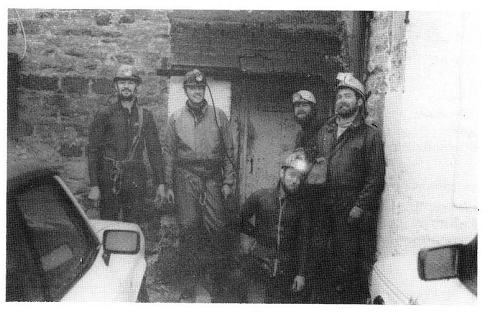
-
Understanding E A rules on waste treatment plant
Jeremy Harris replied to joe90's topic in Waste & Sewerage
Depends very much on how hot your local authority and building inspector are about run off control. Ours were paranoid about allowing any surface run off to enter the stream alongside (but were fine with the treatment plant discharging directly into it - go figure, as our US cousins say......). As a consequence, I had to fit enough storm surge attenuation to ensure that no run off would cross the lane into the stream. This meant burying twenty 196 litre capacity heavy duty Aquacell crates under the drive and feeding all the rain water drainage to them. There is some guidance in Part H, towards the back, that gives the rainfall for areas of the UK and the associated requirements. It also details the soakaway requirements, so may be of use. -
Understanding E A rules on waste treatment plant
Jeremy Harris replied to joe90's topic in Waste & Sewerage
It is illogical, isn't it? I went through much the same when testing our borehole water. One concern I had was that there may be faecal coliforms present, because we're surrounded by agricultural land, with much of it pigs (it is Wiltshire, just.....), cattle or sheep grazing. Clearly there is a significant risk from the tiny number of Escherichia coli strains that have proved pretty harmful to man, but these tend to originate from grazing animal faecal matter, often cattle, so quite why the EA see the risk as greater from treated human waste I don't know. Add in that a treatment plant is reasonably effective at killing the tiny percentage of pathogenic E. coli strains anyway, and that to be excreting these strains the occupants of the house connected to the system would be pretty ill, and there seems little logic in the rules at all. -
Electric Towel Rail - Above End of Bath?
Jeremy Harris replied to Barney12's topic in Electrics - Kitchen & Bathroom
Things did change when the ladies showers and dormitories were added to the cottages at Penwyllt in the late 70's, and the committee seemed to get a bit sanctimonious about mixed showers and mixed bunk rooms after that, to the point of creating a "married" bunk room, and almost asking to see a marriage certificate before allowing couples to sleep there. This was in contrast to some of the Northern clubs. I remember taking my then new girlfriend (now my wife) for her first ever caving trip, up to Red Rose Cave and Pothole Club, at Easter 1986. There the bunk rooms were Alpine style (one very long mattress with boys and girls all snuggled up together) and mixed showers. I well remember coming back from a group trip down Lancaster Pot and then back out through Wretched Rabbit to the beck, when we all went for a shower, where we were all chatting away animatedly. After a few minutes I realised that the "bloke" next to me had bumps on her chest.......... -
That's a good idea. I've never been convinced that multiple reflective layers was much more than plain BS, as alumised mylar has both a very high long wavelength reflectivity and a very low emissivity. Rolls of reflective Mylar film are pretty cheap, and a quick look at the characteristics shows that a single layer will be around 95% as effective as multifoil in this application. Plus, being thinner it will be easier to roll up. In fact, looking at the physical properties, it's hard to see why, other than marketing BS, anyone contemplated stitching multiple reflective layers together. There is a direct parallel with a mirror - putting several mirrors, one behind the one in front, does not produce a better or brighter reflection.
-
Understanding E A rules on waste treatment plant
Jeremy Harris replied to joe90's topic in Waste & Sewerage
That's my sort of logic, and frankly, given the high quality of effluent discharged from a treatment plant I can't see there is any environmental problem at all. The run off from fields will almost certainly have high levels of nitrates, most probably a high biological oxygen demand, together with high concentrations of faecal coliforms (if the field has livestock on it), and may also have residues of pesticides and herbicides, too if it's used for growing crops. For the EA to try and argue that treatment plant effluent is more harmful than agricultural use would seem not to stand up to detailed scrutiny, and could probably be legally challenged, if push came to shove. -
Electric Towel Rail - Above End of Bath?
Jeremy Harris replied to Barney12's topic in Electrics - Kitchen & Bathroom
Not really. Caving club members from Penwyllt were banned from the other pubs in the valley, particularly the Ancient Briton, so we either went down to Abercraf to drink in the Copper Beech or we didn't drink at all................... -
I'm not sure when the change was made, but the original pump was supplied in 2013 with the treatment plant, and is marked JDK-60, and has the same green lid and off-white case as the new one. The old one has no alarm light, nor separate box. The alarm unit that the treatment plant came with was made by another company, and has a pressure switch plumbed into the air line to the tank and a float level switch to sound an alarm if the level in the pump chamber rises too high (our system has a pumped outlet). The new pump, that I bought some time last year as a spare, has a red alarm light on the top of the cover. I haven't had that pump apart, as I just swapped it over with the old one a few weeks ago, in order to service the old one. Clearly there has been some internal change made to the pumps between the date that our original one was made and the date the replacement was made. It's possible that the original JDK-60 that I've just overhauled was made earlier than 2013, and may have been older stock.
-
Electric Towel Rail - Above End of Bath?
Jeremy Harris replied to Barney12's topic in Electrics - Kitchen & Bathroom
I remain unconvinced. I must have consumed many gallons of the stuff in the Copper Beech at Abercraf over the years, and I rather think it deserved it's alternative name, "Feeling Foul"................ -
I chickened out......until
Jeremy Harris replied to ToughButterCup's topic in General Self Build & DIY Discussion
If the whole top of the container is shot, then you could just take the easy way out; wire brush the worst of the rust off and give the whole top of the container a layer of fibreglass. Pretty quick to do, will last a long time and will be waterproof. Probably a lot quicker than faffing about trying to patch up lots of holes. -
Sewing it is, I think. Just need to find a place that will sell me around 5 or 6m of 1.6m wide multifoil at a reasonable price. Using the heat would be nice, but the workshop is detached, at the other end of the garden from the house. Also, when the workshop is getting warm, the house has more than enough heat, and the solar panels are generating like mad, so I wouldn't be able to usefully use the heat. It'll be interesting to see how multifoil works at keeping heat out. My gut feeling is that it may well work well in this role, as the stuff is pretty good at reflecting long wavelength IR, so is ideal for reflecting heat back out from very hot, largely radiating, surfaces.
-
Can a Raspberry Pi run android software
Jeremy Harris replied to dogman's topic in Networks, AV, Security & Automation
Thanks for that, anything would be better than the pretty naff app that the cameras came with. That's the next thing on the agenda, see if I can turn this box into a CCTV NVR. I'll report back on how I get on. -
That's an even better idea. It should be easy enough to sew velcro down the edges, and then use that both to hold the centre join together and fix the edges to the boards I could run down either side. That would improve the thermal performance, too, by helping to seal the blind up and preventing convection. What amazes me is just how much heat is radiated from the inside face of this door. Even on an overcast day the door gets seriously hot, and on a sunny day it's too hot to touch at times.
-
Like the big "swamp coolers"? I've seen them used to cool big marquees in the US, with a fan and atomising ring of nozzles. Might work, but it would need to run most of the time.
-
Thanks, that's a good idea - I've got the best part of a roll of tape left over, too. I can't think why I didn't think of it - I was sort of focussed on the aluminium tape, that I don't think would work.
