Jeremy Harris
-
Posts
26430 -
Joined
-
Last visited
-
Days Won
360
Everything posted by Jeremy Harris
-
You've sidestepped my point about the validity of your publicly published statement on behalf of your company. You claimed that, quote: I proved that to be a wholly untrue statement. Please explain exactly what chemicals are released into the water by a permanent magnet, alternating electric/magnetic field, or catalytic "water conditioner" that has no soluble components and which requires no components to be replaced during its working life (and I specifically exclude any device that uses something like a replaceable zinc, or other metal, component). I cannot see how any of these other water conditioner devices that are on the market can possible release any chemicals into the water, but as a scientist I'm always keen to acquire knowledge, so if you could provide references as to what chemicals they release in to the water, preferably from peer reviewed sources, I would much appreciate it. Please explain, to a humble chemist (and physicist) where the power comes from in a permanent magnet? I'm not questioning that at all. I specifically wished to know, as per the above question, what chemicals these devices release into the water supply, as you have claimed.
-
I have a neighbour who fitted a "water conditioner" (we have pretty hard water here - fed from chalk aquifers) and he's convinced it works. I took samples to the lab at work and proved, beyond any doubt, that the chemistry of the water was unchanged by the "water conditioner". He swears blind that his device works, mind. Worth a read of this website: http://www.chem1.com/CQ/catscams.html if you want to understand a bit of the chemistry of calcium and magnesium compounds in water and how they can and cannot be changed.
- 199 replies
-
- 1
-

-
- hard water
- water softener
- (and 1 more)
-
Just by way of clarification, modern roofing membranes are 100% water proof, but they are vapour permeable. The technology is very similar to that first developed by Gore-Tex, for their first rate waterproof clothing, but there are now dozens of variations on a similar theme. A modern membrane will keep water out every bit as effectively as something like sarking felt, but has the benefit that it allows water vapour (the gaseous form of water) to permeate through so reducing the risk of condensation forming.
-
Did you do before and after water tests to prove the effect of it, or is that a subjective view with no control for comparison?
-
There's a theme here... Our concrete arrived late and Brendan was still power floating the slab will into the night. The problem seems to be that the power floating can't start until the concrete has partially cured, so it only takes a bit of a delay or bad weather to mean that they have to work on into the night to get things finished.
-

The tale of the sale of our old house
Jeremy Harris replied to Jeremy Harris's topic in General Self Build & DIY Discussion
Well, despite my comments above, and notwithstanding that 99% of all communication with the conveyancing company is via their online app, I've just logged on and see that they are now estimating completion as being between 24th August and 7th September, a lot earlier than I expected. However, to find this out I did need to log in to the app, and I only did that to check to see if there were any issues, so had I not logged in I'd not have seen the completion date estimates. The service, in terms of getting this done fairly quickly and very easily seems good, but I'm not wholly convinced that relying on clients regularly checking an app is the best way to communicate. To be fair they do send and email alert when there is an action that you need to take on the app, but there was no alert to show that the completion date estimate had been put up on there. -
The claim I've highlighted isn't actually true, though, is it? There are many "water conditioners" on the market that don't "release chemicals into your water". I could name a few, but as I don't want to promote products based on pseudo-science, or give them the oxygen of publicity on what is a non-commercial forum, I will just give a few generic examples to disprove your statement: - Permanent magnet "water conditioners" - Alternating electric/magnetic field "water conditioners" - Other makes of "catalytic water conditioner" that do not use or need regularly replaced elements. Examples of all of the above can be found easily by a simple web search. I could go on at length about the way chemical reactions work in the context of changing one compound to another, but someone has created a website that, a bit imperfectly, perhaps, explains devices such as this reasonably well: http://www.chem1.com/CQ/catscams.html
-
Welcome. I'd be inclined to park all ideas of PV, storage, heat pumps etc until the house has been insulated and made more airtight. Insulation and airtightness are almost always the cheapest way to make a 1950's built house more comfortable and cheaper to run, and best of all, reducing the heating requirement that then reduces to cost of fitting something like a heat pump or new boiler. If you have mains gas then it's doubtful that fitting a heat pump will give any real benefit. In terms of the environment, an efficient condensing gas boiler has lower overall emissions than a heat pump. In terms of running cost a gas boiler will be slightly cheaper to run than a heat pump and in terms of capital investment a condensing gas boiler will be cheaper to buy and install than a heat pump. Finally, a gas boiler can easily deliver domestic hot water without loss of efficiency, whereas a heat pump will always lose efficiency if asked to deliver water at, say, 50 deg C for hot water.
-
First off, "painted" aluminium windows aren't often painted at all, as others have said, they are usually powder coated. This is not paint at all, but a plastic covering that is applied by spraying the aluminium with powder (using an electrostatic charge to make it stick) then baking the coated parts in an oven to melt and cure the powder into the final surface. The most common powder coats will be polyester, but you can also get nylon, epoxy and a few other types of plastic that are used for special applications. For example, an aircraft kit that I designed had to have the welded steel tube parts of the airframe epoxy powder coated, as epoxy will show cracks if the underlying airframe was damaged (an inspection and airworthiness requirement). Only specific paints will be compatible with the powder coat on the windows, both from the perspective of adhesion and not attacking the underlying finish. You need to get confirmation from the window manufacturers what the specific type of coating is on their product and their advice on refinishing. Polyester powder coat is pretty common and compatible with most finishes, but to match the existing finish any new coating must be sprayed, and I doubt that anything other than a low VOC two pack finish will come close to matching the durability and quality of finish on the original widows. Also, because of the way that the seals and glazing are fitted into an aluminium window I strongly suspect that either the whole window will have to be removed to be refinished properly, or at least the glazing and all window hardware will need to be removed. Spraying two pack paint is also something that needs care, the right equipment and proper PPE. It's not hard to do, and will give a finish that is pretty much the same as the original, which I very much doubt will be the case from any brush applied finish. Others have mentioned the warranty, so you very definitely have to get advice from the window supplier on a way to refinish these windows that does not impact on the warranty. Most aluminium windows will come with at least an 8 to 10 year warranty, so the last thing you need is for that to be adversely impacted by whatever refinishing method you choose. I have to say that, if it we me, then I'd not even think about trying to refinish them. I have the ability and kit to spray two pack and have access to powder coating facilities, but having a lot of experience with both, and knowing the work needed to get a decent standard of finish, I'd just get the windows taken out and replaced. The last time I had a powder coat problem (a kit builder tried to repair scratches he'd made with paint) we ended up getting the whole component bead blasted back to bare metal and re-powder coated, as it was the only way to get a decent finish.
-
The tale of the sale of our old house
Jeremy Harris replied to Jeremy Harris's topic in General Self Build & DIY Discussion
Cheapest local solicitors around here are over £800, plus search fees, mortgage fees, disbursements, VAT etc. Last one I used charged more that that (well over £1300 all told) and was bloody useless - I ended up doing all the donkey work and the process took months. I selected a more expensive solicitor on the basis of reputation and a hope that they might be faster and easier to deal with - they were neither. So far, the lawyers that are sub-contracted to PB are a million times better, but do operate in a very different way - fine if your used to doing app based business, bit weird if you're used to personal interaction. -
The tale of the sale of our old house
Jeremy Harris replied to Jeremy Harris's topic in General Self Build & DIY Discussion
Another update. The Purple Bricks bit has been absolutely fine, no issues at all, and I'd strongly recommend them. The way they work is as I mentioned earlier, you either pay their fee upfront (£895) or you can delay paying it until after completion if you choose to use their conveyancing firm. On the face of it, this looks to be a good deal. The conveyancing is a fixed price, £599, plus disbursements, building society deed fees, search fees etc, plus VAT. So far I have to say the conveyancing service is a bit like the curates egg, good in parts. The good parts are their online system, that once you get the hang of, allows you to download, sign and upload scanned documents relatively easily (but it does rely on you being able to print, sign, scan, and use their upload system - which is a bit like the upload system on this forum). Their electronic communication is generally OK, if not as fast at updating documents on your electronic file as it could be. They are geared around a fixed 6 week to 8 week period from being contracted to exchange of contracts, and don't seem that flexible when faced with a much simpler transaction, where the client is selling to a cash buyer and has no house to buy. Talking to them on the 'phone isn't great. So far I've not actually been able to talk to the person doing the conveyance at all, even after booking a special call all I got was some clueless clerk asking me pre-scripted questions, who wasn't able to answer any of my off-script questions. I have booked another call to speak directly with the conveyancer next Thursday. On the positive side, contracts are signed, the Land Registry transfer is signed, all the fixtures and fittings stuff is agreed, the ID evidence has been submitted and cleared and the current status is awaiting the acceptance of terms by the vendor, the searches from the local authority plus the agreement of a completion date with the purchaser and ourselves. I suspect I may be expecting a bit more - their system relies heavily on electronic document transfer and minimises the need for 'phone calls or letters. I'm a bit old fashioned, in that I'd like to at least have a five minute chat with the actual person doing the conveyancing at the start of the process. We are on track to exchange contracts in around three to four weeks, which is perhaps all we can hope for. The period between exchange and completion will probably pretty short - around a week or two at most. All told it's an OK service, but probably one that's rather different to that which I'd expected. -
Doesn't look like there is any vapour control layer at all, and if this is a high point in the house it's quite possible that it's interstitial condensation caused by the absence of any VCL. I'm as surprised as the others above that this is happening in our current weather conditions, as the temperature has been too high, even at night, for condensation to form at the sort of humidity levels we've had. However, if there is no VCL at all (which I have to say seems highly likely, from the video and photos) then it may well be that very warm and humid air from somewhere like a bathroom, shower room, kitchen or utility room may be entering that void and then condensing out. It doesn't take much - we had severe condensation in the loft of our old house from a very tiny (not visible when looking up from floor level) crack around the edge of the wall to ceiling joint. That was enough to let warm moist air into the loft, which then condensed out on the underside of the sarking felt, dripped down onto the insulation (which was that non-itch stuff wrapped in a polythene sleeve) and then the brown puddles would trickle down and make stains in the Kitchen ceiling, so 6 metres or so away from the bathroom. The fix was to create an airtight vapour barrier under the loft insulation and over the whole of the bathroom ceiling, using plastic sheeting, tape and sealant. That, together with better ventilation in the cold loft space, completely fixed the problem. Interestingly, the problem only appeared after I increased the level of loft insulation, which made the loft a lot cooler.
-
It should be, but at the time I fitted our mixer at the opposite end to the shower in our old house, around 8 years ago now, everyone who saw it thought it was unusual, but a good idea. Several of the people that viewed the house made the same comment, and said what a good idea it was to have the controls well away from the shower head. Even the plasterers, when boarding out our new house, thought I'd made a mistake and called me to come and check the hole for the shower, as there was only one pipe there, and they expected to see two (a cold and hot feed). I had to explain to them that I was fitting the valve at the opposite side of the room, from the eaves space behind where they were boarding out, and the single pipe they could see just led from the mixer valve to the shower head. They'd not seen this done before, either.
-
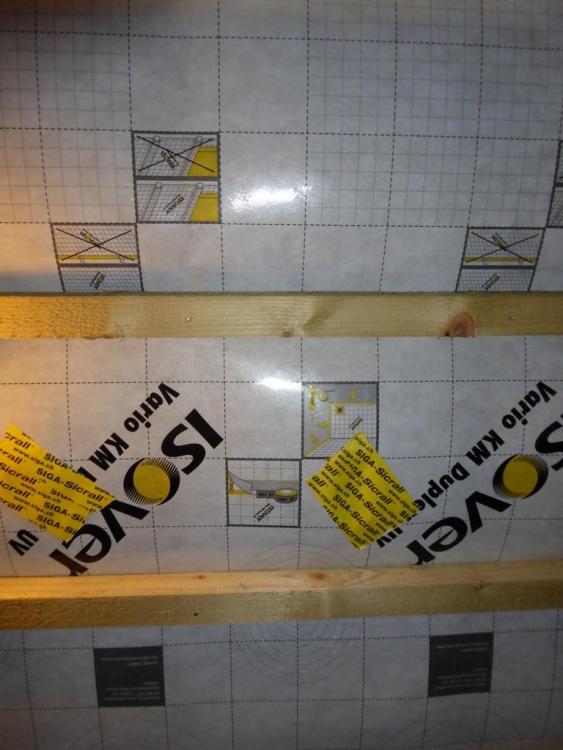
Yes, there should be a VCL fitted somewhere between the inner surfaces and the insulation, to prevent warm, moist, air being able to penetrate up and cause interstitial condensation. Ideally the VCL should be as close to the rear of the inner surface as practical. For example, here's a photo of our roof (we have insulation between the rafters, rather than above the ceiling) showing the VCL - it's a plastic sheet that's there to prevent warm moist air reaching any area that could be cool enough to cause condensation to form: This is an area in the services room upstairs where there's no plasterboard fitted, but everywhere else is the same; the plasterboard is screwed to those 50 x 50 battens/. Where the VCL meets window or door frames it's taped to them, behind where the plasterboard fits, to maintain a vapour-tight seal.
-
It's also possible that it's condensation from thermal bridge around the skylight, especially as water vapour is lighter than air (it's why clouds float) and so any condensation is more likely to occur at any cold spot high up. In the recent weather I doubt that either the temperature or humidity conditions, even at night, would be enough to cause condensation of this sort, though, and anyway, there should be a vapour control layer (VCL) that's specifically there to prevent moist, warm air from inside the house getting into the structure. The VCL should be right behind the internal plasterboard, and have no holes in it - care being needed to seal around it where there are things like light fittings inset into the ceiling.
-
I first did it 8 years ago, when refurbishing the bathroom in our old house, as it seemed daft to have to get your arm wet when turning on the shower to warm up. I adopted the same system in the new house, of having the mixer at the opposite end to the shower head, because it worked so well at the old house. I've never understood why it isn't the standard way to install a shower - seems daft to position the mixer where you have to get a wet arm in order to turn the thing on.
-
Hot water tanks, Temperature and Legionella
Jeremy Harris replied to ProDave's topic in Boilers & Hot Water Tanks
But given that there has never been a case of pneumonia in the UK that has been traced to a domestic hot water system, that contracting pneumonia from Legionella Pneumophila is extremely rare, that the vast majority of cases of pneumonia in the UK are caused by streptococcus pneumoniae, with the rest being caused by other bacteria, viral, or even fungal, infections, then my personal view is that the risk of legionella within a domestic hot water system is already very, very low. The risk from a sealed, anaerobic, hot water system, fed with treated water from an ultrafiltration plant, which in turn is fed by a source that is, cold, slightly acidic and has a low oxygen concentration is so close to zero as to not be worth worrying about. You are far more likely to catch pneumonia caused by Legionella Pneumophila from someone in your local supermarket checkout queue that's just come back from a holiday in Spain... -
Hot water tanks, Temperature and Legionella
Jeremy Harris replied to ProDave's topic in Boilers & Hot Water Tanks
The bottom line is that water treatment (by water companies) allows for either enough residual disinfection to ensure that there is no risk of microbial growth in pipes etc with no flow for some period of time (i.e. when people go on holiday in summer and all the pipes in their roof space sit at relatively warm temperatures for a week or two) or they disinfect the water to the point where pathogens are eliminated. Legionella is an aerobic bacteria. It cannot survive, let alone multiply, in anaerobic conditions. All known cases of legionella effecting humans have come from the bacteria being breathed in, as a consequence of it being released in a mist or spray of water where the concentration of bacteria in the aerosol was sufficient to overcome the bodies defences. The vast majority of legionella cases have resulted from open spray evaporation water cooling or humidification systems, often associated with office building or hotel air handling systems, where the cooling water was not properly disinfected. The bacteria is pretty low risk, as it cannot form spores, therefore cannot bypass water treatment disinfection systems. Ultrafiltration in a water treatment plant will very easily take out Legionella Pneumophila. This means that a closed system, containing disinfected water, cannot have any bacteria within it, therefore there can be no risk that they will multiply and cause an infection risk from using a shower (the means of infection is always breathing in an aerosol that contains a sufficiently high bacterial load as to cause this form of pneumonia). To put this into perspective, like other forms of pneumonia, infection can be spread from one infected individual to another when the infected individual coughs out an aerosol containing the bacteria. Out of the ~300 cases per year of pneumonia in the whole of the UK that can be positively identified as having been caused by Legionella Pneumophila, around 120 of those were definitely people who acquired the infection on holiday overseas. I cannot find a single case where the source was identified as a domestic hot water system - not one. Far and away the highest risk comes from evaporative air cooling systems, where the water feeding the evaporative cooler has not been adequately treated. The total risk of infection in the UK is currently a bit over 5 cases per 1,000,000, with most of those having either contracted the disease overseas or having been infected by someone that has been infected overseas. Most infections from overseas are in people returning from Spain, most probably because evaporative air coolers or humidifiers are still commonly used in the air handling systems of hotels, office buildings etc. I was amazed that there wasn't a massive outbreak following the Barcelona Olympic Games, as they used massive open air evaporative coolers to try and reduce the ground level air temperatures, and these drew water from open lagoons in many areas. Given your position, @ProDave I'd not even bother thinking about legionella, for several reasons. Firstly, it's unlikely that your untreated source water is infected - it will be too cold and the pH will probably be on the low side. The source water will also be poorly oxygenated, I suspect, given where it comes from. Secondly, you have the advantage of an ultrafiltration water treatment plant, which is easily going to remove bacteria as large as Legionella Pneumophila. Finally, you have a sealed hot water system where there is no possibility at all of airborne bacteria entering before the hot water storage tank. -
I'd second @PeterWs comment about not going up to 1000mm. We were concerned that the shower wouldn't be big enough (well, SWMBO was concerned, hence me building the house scale model to 1:50 scale so I could use model railway 1:50 characters to give a sense of scale, mainly for the shower...). Once I'd finished the shower and she came over to see it her first comment was "It's bloody enormous! I didn't think it was going to be that big!".
-
Hot water tanks, Temperature and Legionella
Jeremy Harris replied to ProDave's topic in Boilers & Hot Water Tanks
There's no risk unless air can get at the water before the hot tank. The legionella problem is caused primarily by airborne legionella bacteria getting into a water supply post-treatment and then multiplying. -
Hot water tanks, Temperature and Legionella
Jeremy Harris replied to ProDave's topic in Boilers & Hot Water Tanks
Perhaps a bit of a basic point, but this is a sealed system, isn't it? If so, then there's no way any airborne bacteria, like legionella, will be able to get into the hot water tank. It's different for a vented hot water tank, as it's possible for legionella to get in via the fairly open cold water tank that fills it, which is why you need to periodically heat up the hot water tank to kill anything off. I can't see the point with running an anti-bacterial cycle on a sealed system. It's a bit like our 300 litre sealed pressure vessels. The incoming water is disinfected and bacteria free, so nothing grows in them, even though they could get up to outside air temperature in warm weather, and that's inside the temperature range where legionella can grow. Legionella is primarily an airborne pathogen, so if no part of the system is open to air then there isn't really any risk. -
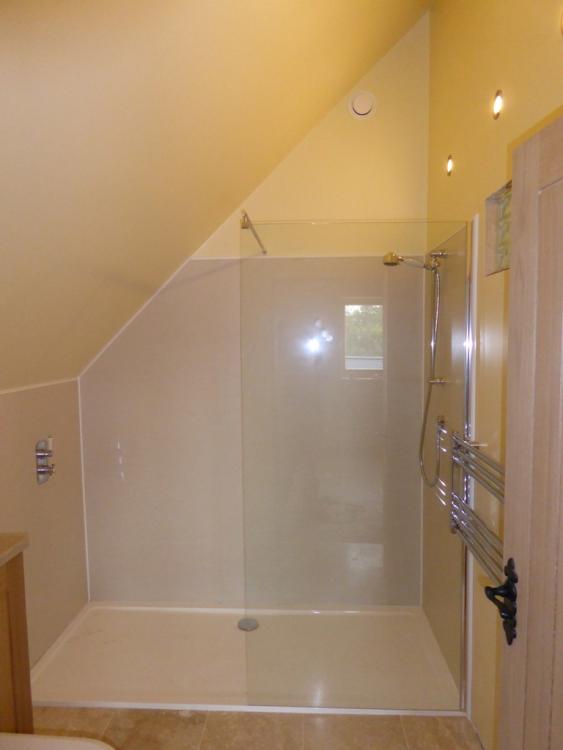
I agree with the need for width. I fitted a 2000mm x 900mm tray with a fixed glass panel on one side, and that's more than enough room, I think:
-
New directory from Passivehouse Plus magazine
Jeremy Harris replied to Square Feet's topic in Environmental Products
Same here. A local member quickly contacted me, but it was clear he was really after work as a consultant. I've since met him a few times and he's pretty much confirmed exactly what you've said, they are only interested in being a business association, not an organisation that has any dealing with the general public or even self-builders. Seems a bit short sighted in my view, as I get the feeling that there are probably more energy efficient houses being built by self-builders than there are by developers etc. -
New directory from Passivehouse Plus magazine
Jeremy Harris replied to Square Feet's topic in Environmental Products
That is EXACTLY the same as my AECB experience, to a tee, even down to the timing, more or less (I think it was about 7 years ago that I first got involved with them). Such a pity, as there was a load of potential there to create an organisation that could really have made a difference. -
New directory from Passivehouse Plus magazine
Jeremy Harris replied to Square Feet's topic in Environmental Products
Same here, I subscribed years ago, when we were first planning the house and at the time when it was only an Irish production. I was then sent the UK version of the magazine for a fair time afterwards, without paying. It's not a bad magazine, but often seems a bit thin on practical content, and even the UK version still seemed to have a fair bit of content that seemed to have come from the Irish version. You used to get a free subscription if you joined the AECB, I believe, but I'm not sure whether you do now. The AECB seems to be very quiet now, with a forum that's barely used, compared to how it was before they revamped things two or three years ago. Pity, as I thought that the AECB was a generally good body. It seems to have suffered a bit from some in-fighting over the wood burning supporters versus the passive house supporters, plus it's become a bit inward looking, from what I can gather.