Jeremy Harris
-
Posts
26430 -
Joined
-
Last visited
-
Days Won
360
Everything posted by Jeremy Harris
-
 We're shifting from Santander right now - we only stayed with them because I'd already set up the "house build" account with them before they managed to REALLY piss me off. My beef with them is the way they reneged on our mortgage and have then refused to refund the costs we'd incurred as a consequence of them unilaterally withdrawing their written offer on the day we went to draw it down. We knew we needed to borrow some money on our old house, which was mortgage free (not a massive amount compared to its value - £110k against a mortgage valuation at the time of £260k) and Santander accepted our application and fee, did all the checks and gave us a formal mortgage offer. I explained that we didn't need to draw it down immediately, but needed the offer in place before I placed our frame contract, so there would be a couple of months delay before I drew down the mortgage. They agreed this would be no problem as their formal offer was valid for three months. First stage payment came in for the frame and I went into the bank to draw down the agreed mortgage. Santander said they were withdrawing the offer as their internal policy had changed. I argued with them that they had taken the money for the arrangement fee, valuation etc and they were in breach of their contract with us. Basically they said tough, we're not lending you the money. We ended up having to use our cash reserve to tide us over whilst I hurriedly arranged another mortgage with the Leeds, at a significantly higher cost. To say it was stressful is an understatement. Nothing on this planet will induce me to do business with Santander ever again after that episode, and I'm still arguing with them over the fee I paid them for a non-existent mortgage.
 -
TBH, I doubt very much that it's anything to do with the ducts at all. The air flowing through the room supply ducts will keep them dry, as long as they are inside the insulated envelope or are well insulated, and at this time of the year there's practically zero chance of getting condensation in the ducts, anyway. It's far more likely to be a problem with a trap somewhere, and the MVHR is then drawing in smells from the drains. I didn't trust the suggested arrangement for the MVHR trap in the instructions for ours, so I raised the MVHR up on a stand, to get better clearance underneath it (also allowed me to fit anti-vibration mounts) and plumbed the drains to a normal 32mm U bend trap. I also plumbed the water softener drain to the same trap, which makes sure it stays topped up. The mention of gurgling noises suggests that air is being pulled up past the MVHR drain trap arrangement, and I'm near-100% certain that your problem will be with that being too shallow, or perhaps with water being sat in the drain tray in the MVHR because it's not angled properly towards the outlet.
-
Smart meters, enough already.
Jeremy Harris replied to MikeSharp01's topic in General Alternative Energy Issues
"Vampire" loads from lots of small things that are left on 24/7 can quickly add up. Years ago I did some experiments in our old house, measuring the 24 hourly consumption of every single appliance we had, including plug-power supplies for things like the cordless phone etc. At that time, our old fridge freezer was the main culprit, averaging around 1.3 kWh per day, with the TV and DVR combination being the next biggest culprit, at around 0.9 kWh/day. Just switching the TV and DVR off every night and replacing the old fridge freezer with a newer one with an A*** energy rating saved us around £70 a year. The other thing using a small, but continuous, amount of power was all the PC and network related stuff. Routers, modems, switches etc all use a fair bit 24/7, as do laptops and tablets whose chargers are just left plugged in and on. In the new house I have all the network stuff powered by a battery pack that is charged during the day (via a time switch) so that it is usually charging from self-generated power from PV. It doesn't make a massive difference, but every little bit helps. I'm hoping that the price of battery storage continues to drop, as being able to just run stuff like the aeration pump on the treatment plant, the MVHR and the other house vampire loads wholly from self-generated energy almost the whole year around will make a fair size dent in the electricity bill. -
We changed an old (c. 1986) gas system boiler (so old it still has a cast iron boiler) for a Vaillant Ecotec 831 combi. Made a heck of a difference to our gas bill; reduced it by around 30%. Getting rid of the cold water tank and F&E tanks in the loft, plus the hot water cylinder was a bonus, as was being able to get rid of the old electric shower and fit a proper thermostatic shower (there wasn't enough head to run a shower off the system boiler, it being bungalow, so there was barely a metre or so head above the shower). We have around 4 to 5 bar of water pressure, but the incoming main is only 15mm, as is all the internal pipework. Despite this we get a pretty decent 10 to 11 litres/minute of water at around 38 deg C from the shower, which is a hell of a lot better than the 3 to 4 litres/minute that an electric shower can manage. Add in that we gained a large cupboard where the old cylinder used to sit, and that, once we solved an odd installation related problem the system has been very reliable. The power wash removed a colossal amount of crud from the system, literally bucket loads of sludge. We took the opportunity to replace all the rad valves with TRVs during the time the system was drained down (it was a two day job, so I replaced all the rad valves in the evening after the guys had gone home). I also supplied and installed the Magnaclean in the return pipe, again whilst they had the system drained down. IIRC, we paid around £2k in 2008 for the boiler change and powerflush, including removal of all the old tanks, pipework, etc, and the new pipework needed to convert the whole house plumbing system so that it was all running at mains water pressure.
-
My experience of fitting a new boiler to an old system is that a magnaclean is not in any way optional. Despite our old system being power flushed for a couple of hours or so before the new boiler was commissioned, and being filled with fernox, the magnaclean always picks up some black iron oxide when I clean it every year. Best £80 and a couple of hours spent fitting it I've ever spent, I reckon. Every time I get the boiler serviced the service bloke reckons they save more boiler problems than any other thing you can fit, and I tend to believe him.
-
I think people have actually submitted samples with fake labels on before now, labelling the sample they want to use as being one from the mandated local source. The planners really don't care too much as long as it looks OK and they can tick the box that says they complied with the local rules... You can always say that the samples were labelled when you received them if they query it, so suggesting that it's someone else's error if it ever gets picked up.
-
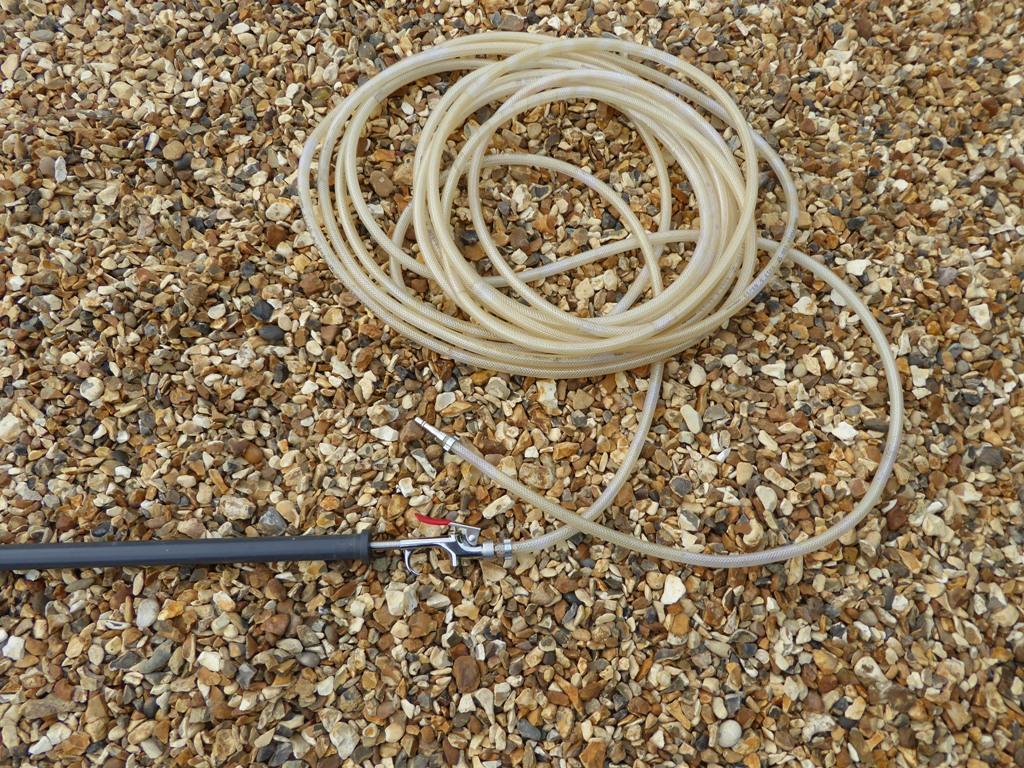
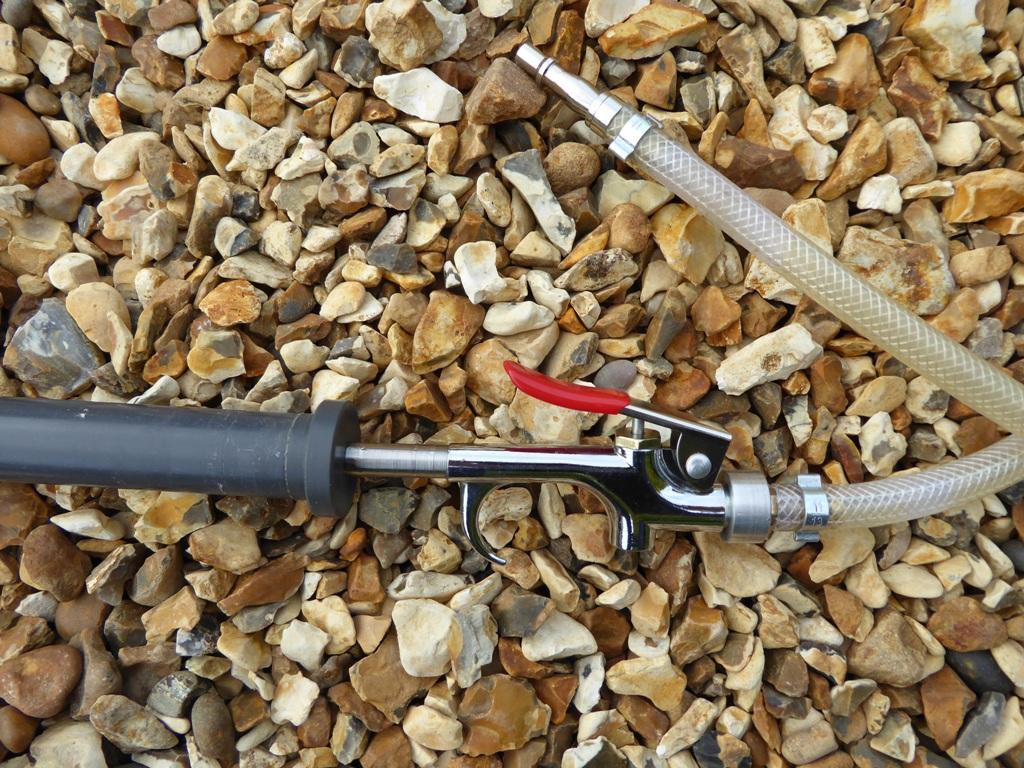
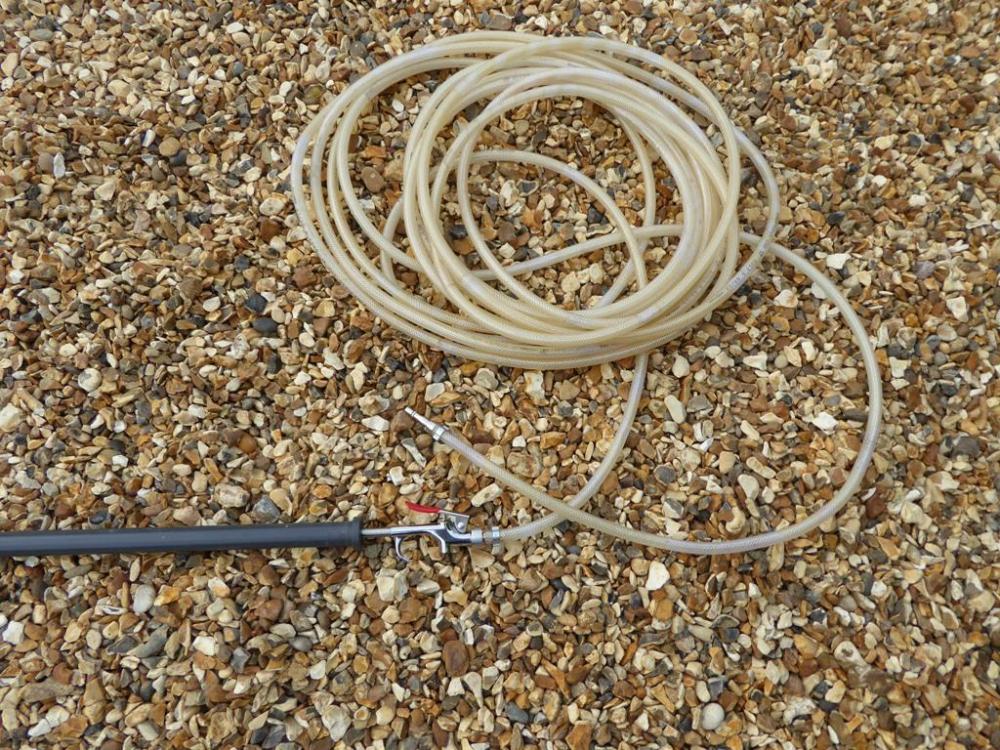
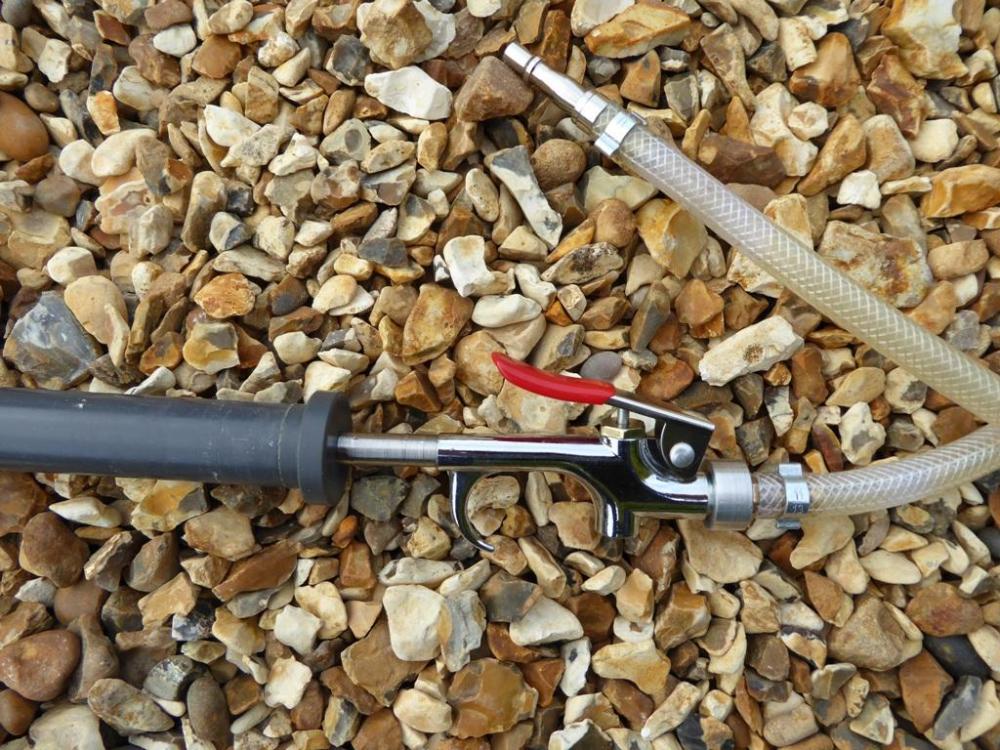
The one in the corner above our bedroom is still there, as wasps never come back to an old nest, apparently. At a guess I'd say it's close to the size of a football, around 10" to 12" in diameter or so. The only entrance was through a small gap in the soffit, and they had made a "paper" tunnel to the nest itself, that was built around one of the roof trusses. The wasp man went up in the loft to look at it and beat a hasty retreat, saying that it we should keep the loft hatch closed for several days and he'd treat the nest from the entrance hole. He used a device that looked very like a modified garden sprayer, one of the pump up things, filled with permethrin powder. He put on what looked like bee keepers garb and just went up a ladder and puffed the powder into the entrance hole. He reckoned there would have been several thousand wasps using the nest, and recommended that the best time to treat them was early morning or late evening, when they tend to be less active. The device I made has been used so much that I've improved it, by adding a spring loaded lever air valve at the base, rather than the Schrader valve and fitting a long length of crimped on air line to it, with a quick release connector that fits my compressor. This makes it a lot easier to use, as I can now control the flow of powder into a narrow nest entrance a lot more easily.
-
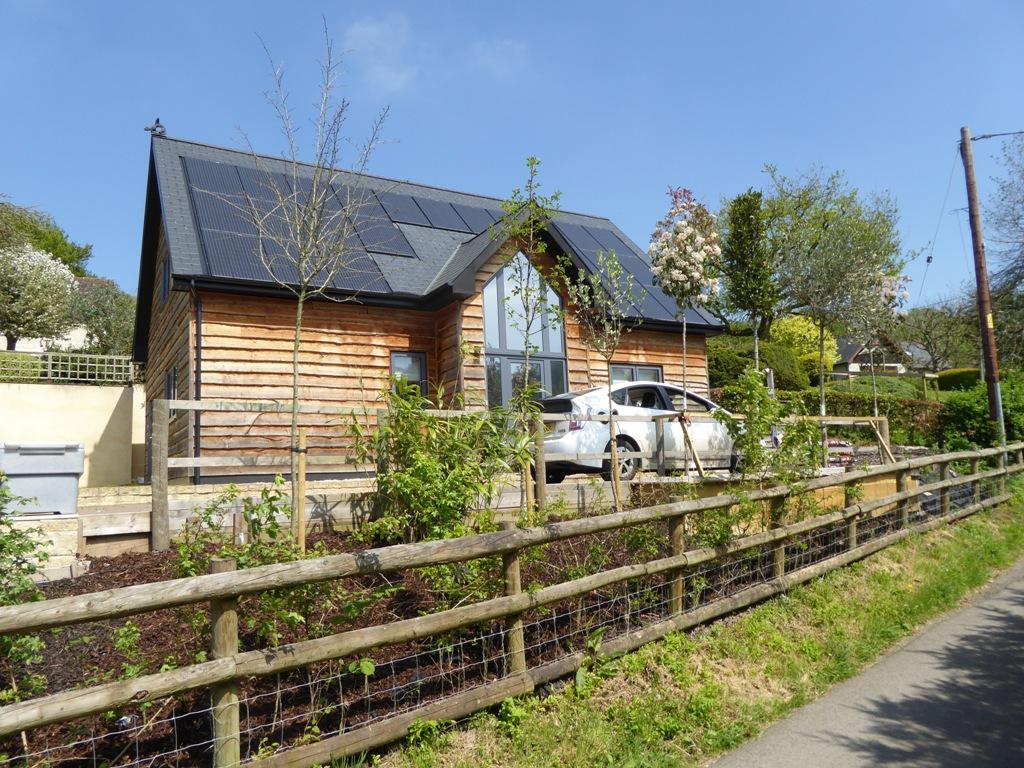
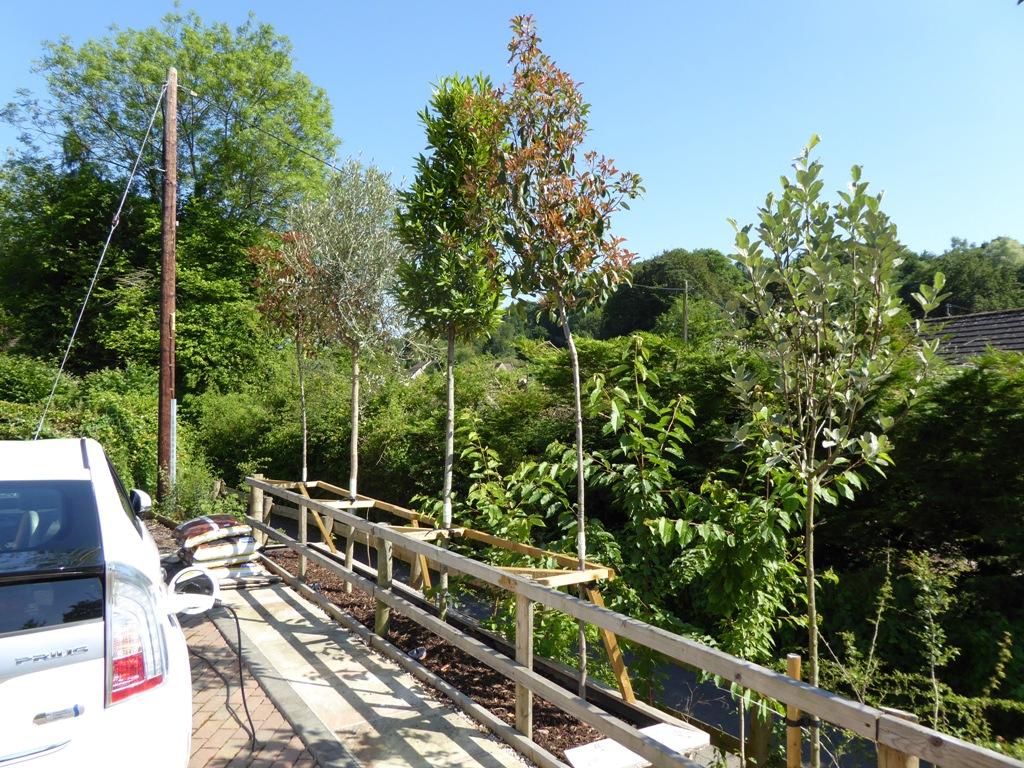
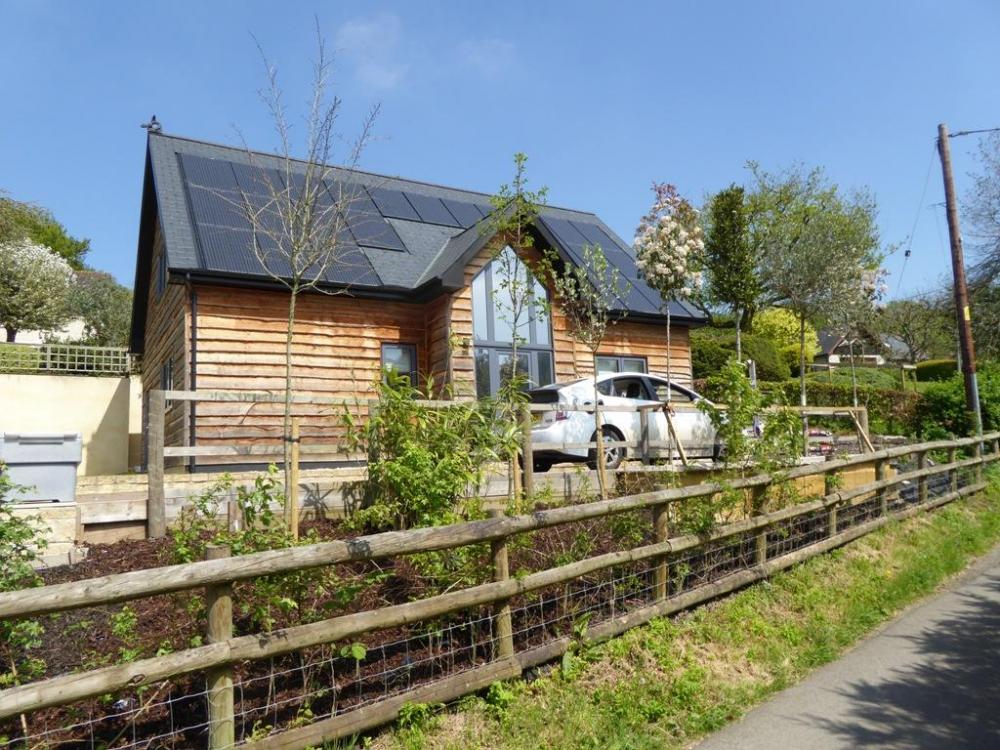
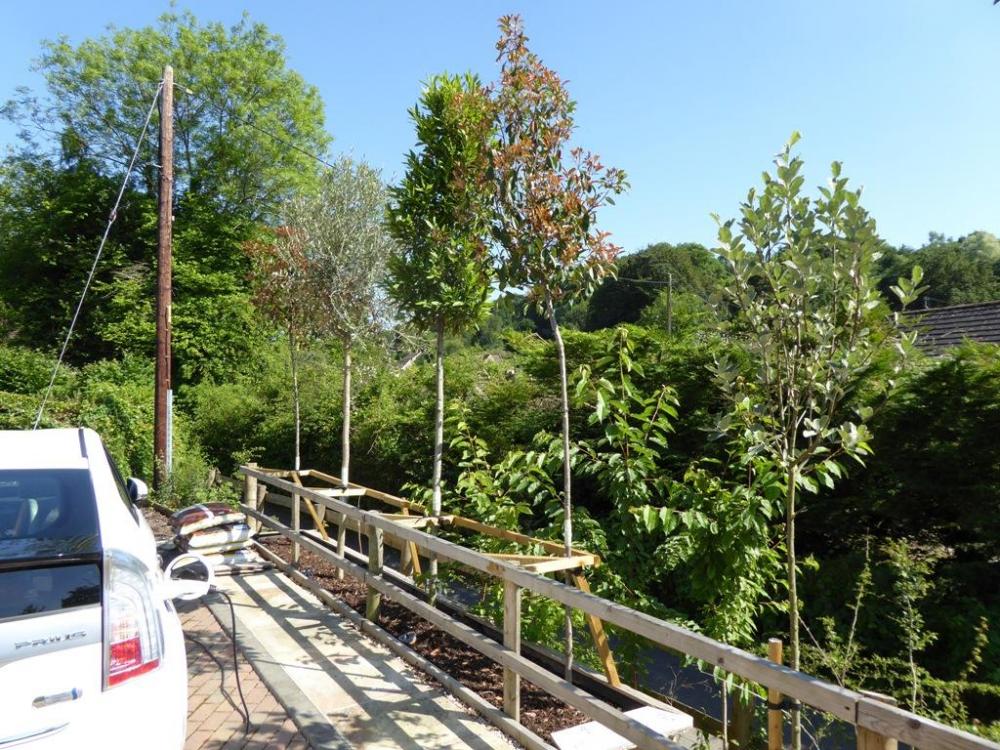
The solar panels have an anti-glare glass, but they still cause a fair bit of glare at times, not that you can see it from ground level. The screening trees we planted were a couple of cherry trees, a couple of red flowering hawthorns, a couple of photinias, a whitebeam, a flowering crab apple, a bay tree and a fairly large olive tree. This is what they looked like in March: And this was taken in July (we've since added a close board fence along the top of the retaining wall at the back and around the garden, on top of the dwarf stone wall):
-
I was warned never to ever seal the entrance hole to a nest, last time I paid to get a chap in to deal with a nest that was in the roof space above the corner of our bedroom. Apparently the trapped wasps have been known to chew an escape hole through a plasterboard ceiling, and fill the room beneath with thousands of angry wasps... Injecting powder in the entrance hole seems to work 100%. I've now treated four nests this summer, three at our old house and one at the new house. It seems to be the year for wasp nests in houses, as we've only ever had one before, and that was several years ago (and was when the chap advised me never to seal any entrance hole up).
-
@Triassic, I'd just like to thank you for raising this and generating so many useful replies. We're shortly going to be in a similar position when the sale of our old house goes through, and the £85k liability limit was something I was wholly unaware of. I'll be following this thread with interest to see which options best suit us; I know my wife's first priority is to go on an expensive holiday, so that will blow a hunk of the cash in one go...
-
Glare was a minor planning issue for us, as we have 25 solar panels on the South elevation, but the planner was happy because they were screened from the neighbour over the road to the South by a tall Leylandii hedge along his boundary with the lane. The neighbour has since cut the hedge down, creating a privacy problem for me (which I've fixed by planting some fairly tall trees) but I've heard mutterings that the glare into his daughters bedroom window is very harsh. He's not said anything directly to me, but I don't think he can do anything about it anyway, realistically. In your case I'd ignore the neighbour and do as suggested above, apply for a retrospective change of materials. I did this twice when things changed after we'd got PP, including changing the roofing material from Tata Urban steel sheet roofing to IkoSlates, and the planning officer treated it as a minor amendment both times
-
IVT Ecolane ASHP - any owners out there?
Jeremy Harris replied to readiescards's topic in Air Source Heat Pumps (ASHP)
They all have a cooling function, as they have to in order to defrost. The problem is that to be sold in the UK as an MCS approved product, that's eligible for RHI, the cooling functionality has to be hidden from the installer or user instructions. I had to reverse engineer mine to find it, which wasn't hard as the installation instructions showed that two no-volt connections had to be switched to ground to make the ASHP turn on. I tried just grounding one and the heat pump didn't turn on, so then tried just grounding the other and it turned on, but in cooling mode. A quick test with grounding the other connection showed that all it did was switch the unit to heating mode if grounded or cooling mode if left open circuit. -
Planning permission refused - options
Jeremy Harris replied to oldkettle's topic in Planning Permission
Just to add, if you are granted permission to speak to the committee, on the basis that someone has requested to speak as an objector, you don't have to speak yourself, you can appoint someone to speak on your behalf. Very often people get their planning consultant to stand up and speak on their behalf, but you can choose anyone who you think may present your case more clearly and confidently than you may feel you may be able to. -
The EV charge point just needs a dedicated radial run from the supply, much like a cooker or immersion heater. You can either run it from the main consumer unit in the house, or sometimes it's easier to run it from it's own dedicated CU. If you only have a single phase supply, then there's no point in going for more than a 14 kW charge point. The cable size will be determined by the voltage drop along its length, in all probability. I ran 6mm2 SWA to our garage, fed from a small CU with a 40A DP RCBO in a small CU in the meter box. 6mm2 is overkill, but it reduces the voltage drop at the garage end. I have a 14 kW charge point at the garage end of the drive, plus a 7 kW charge point at the other end, so I can charge wherever I happen to park the car.
-
Planning permission refused - options
Jeremy Harris replied to oldkettle's topic in Planning Permission
I would definitely see if you can persuade someone to apply to "object", so that you get your 3 minutes to address the committee. Anyone can "object", they don't have to be a neighbour, or even live nearby, so if you can persuade someone to request to speak to the committee to object, but in reality only object about some very trivial non-planning policy point (like they don't like the style of something that you're not intending to fit anyway), then you should be OK and get your opportunity. I did something similar for our neighbour, who found his application for a granny annex going to committee, really just because he'd managed to upset a lot of people in the village by trying to sell the land behind his house to a developer, who got PP to build 24 houses on it (another story). People being what they are, when he put in a quite reasonable application he had a lot of objections in writing, so it was automatically called in to committee. None of the objectors registered to speak at the committee meeting, so he asked if I would, really so he could address the committee himself. He was planning to move a phone pole as a part of the changes, a pole that was a nuisance in that it narrowed the pavement and caused people with prams to walk into the lane. The movement of the pole wasn't in his planning application (no need for it to be) so my reason for standing up and objecting was to request that a condition be placed on the application, if it were approved, such that the phone pole was relocated in order to reduce the risk to pedestrians walking past the new entrance he was creating for his granny annex. I stood up, made the point about pedestrian safety and that the pole needed to be moved, then went on to say that other than that I supported the application as it closed off his old double garage entrance to the lane and so made more parking spaces available for churchgoers. Both points were noted by the committee, and then my neighbour stood up, made his case for needing accommodation for his ageing Mother and mentioned at the end that he accepted my point about moving the pole. His application was approved. He did come around later that evening with a bottle of wine, but I felt I had to refuse it, as it sort of seemed to seal the fact that we'd colluded to give him his chance to speak. So, I'd suggest you try and do something similar, just so you can get your three minutes of fame., -
Credit/Debit Reward Cards, Discounts etc
Jeremy Harris replied to Ferdinand's topic in General Self Build & DIY Discussion
Yes, the last chance to use the card for normal DIY stuff was yesterday. I needed some plumbing bits and bobs, so was going to take advantage of the card one last time, but it turned out that Wickes was cheaper, even allowing for the 10% off in B&Q. I doubt I'll bother going into B&Q again now - perhaps they'll notice my absence there on most Wednesdays! -
Using "off the shelf house plans" yes or no?
Jeremy Harris replied to Olly P's topic in New House & Self Build Design
If we're going through that list ticking off the things we did, then I did the following, for the reasons given: 10. Site public liability insurance - because I felt it was damned stupid to try and self-insure, given the relatively low probability, but extremely high cost, of such a risk maturing into an incident. 14. Ring the site with cheap second hand Heras fencing. Because my site insurers demanded it, and it was just common sense to try and keep kids, etc, out of a dangerous environment. 15. Buy appropriate mandatory warning notices, again because my site insurers required it, my frame contractor mandated it in their contract and because it was plain common sense to fit warning signs (I think they cost me around £30 all in, and I sold them on to another self-builder when I'd finished with them) For the others I either had no requirement to do them from the planners etc, or I just did them myself. As we had no intention of selling the house I chose not to buy a warranty, a personal decision based on my past experience of an NHBC warranty on a new house not being worth the paper it was printed on. -
I wouldn't go as far as to say CTP, I think that honour very definitely belongs to Evan, who had prototype stuff running in his house long before I fitted one of the early pre-production SPVs. I'm looking forward to getting a final production standard UniQ eHW though, as looking through the installation instructions and other paperwork it looks to be a massive improvement on the SPV. Much simpler in design, and taking out the pump, ultrasonic flow sensor etc, makes for far less to go wrong (not that my SPV's gone wrong). The only two issues I've had with the SPV are it's sensitivity to minute air bubbles in the water, which tend to upset the ultrasonic flow sensor, and which are, for us, a consequence of our water treatment system, which aerates the water in order to oxidise out the relatively high ferrous iron content. This was partially fixed by installing a Spirovent, a device that uses a wire mesh to cause microbubbles to coalesce and then float up to a standard type of automatic air vent. It's not a 100% fix, as we still very occasionally get an air bubble induced trip, but it's now a pretty rare occurrence, and I don't think it can happen at all, looking at the design of the UniQ eHW. The other minor issue was with the over-temperature trip operating from time to time. This was due to heat soak in the heater block after the pump and heater had shut down, being enough to cause the block to get hot enough to cause the resettable trip to operate. I replaced the original trip, as there was a known issue with some of them, and that almost completely fixed the problem, but I never got around to changing the firmware for the later version that has a longer pump over-run time, which apparently reduces or removes the heat soak problem altogether, by keeping the pump running for a time after the heater has turned off. I'm still incredibly pleased with the performance of the SPV, it has exceeded my expectations, for sure. I'm still amazed that the case of the unit never feels warmer than room temperature, yet it delivers water at around 55 deg C or so on demand. I'll be interested to see what sort of difference in performance I get from the much greater storage capacity UniQ 9 eHW. That can realistically store around 10.5 kW, a fair bit more than the 4.5 to 5 kWh of the SPV. The fact that the UniQ is plumbed with 22mm, rather than 15mm, pipe should make a difference too, as it means I can run all the pipe to the hot water manifold in 22mm now.
-
I can't find anything on their website, so presumably it's invite-only, is it?
-
Using "off the shelf house plans" yes or no?
Jeremy Harris replied to Olly P's topic in New House & Self Build Design
All the big developers just use a small sub-set of standard designs, often placed on a plot with no regard for sensible orientation. It seems rare to find more than about 5 or 6 different house designs on a development of a few hundred houses, at least around here. I'll try and take a photo of one I pass every day. It has a garage door opening on to a bit of grass with a footpath in front, and no way to get a car near the garage, let alone in it. I makes me chuckle every time I drive past it. I can only assume the garage door is a fake, and that there's really a wall behind it. -
Using "off the shelf house plans" yes or no?
Jeremy Harris replied to Olly P's topic in New House & Self Build Design
Taking your list and breaking it down to items that anyone building on that plot of land would have to face, and those items that are optional, or could be resolved in more than one way: 1. Any form of demanded environmental study/report/mitigation measure is going to be mandated by law and/or the planning authorities. Nothing anyone can do except comply with the requirements or walk away from considering developing that land. It's nothing at all to do with self building. 2. Archaeological surveys, reports, watching briefs etc, exactly as above, the developer of the land only has a choice as to whether to comply with the law/planning requirements or walk away, and it wouldn't make a jot of difference if the developer was a self builder or any other builder, the same would apply. 3. The use of a planning consultant depends on many factors. Self-builders are no different from any other builder when it comes to making this choice - if it looks like obtaining PP may be challenging then anyone should carefully consider if there is merit in using a planning consultant who will be far more familiar with local planning policy and the particular quirks of the local planning department. 4. Ground condition determination, not necessarily drilling, there are a host of ways of obtaining the data needed and anyone developing any land anywhere is going to need this information, whether they are a self builder or any other person wanting to build on the land, 5 All foundations need to be either designed using approved details (effectively SE designed systems that are known to work for those conditions) or have to have an individual SE's input. It matters not whether the builder is a self-builder or not, Part A applies equally to all. 6. The vast majority of houses built in the UK are not designed by an architect. Last time I looked at the data that was available, the figure was something like 10% are architect designed. Whether a self builder chooses to use an architect to design a house is no different a decision as to whether any other builder chooses to use an architect. 7. An architects project management service is probably something a larger developer may choose to use, probably on a non-domestic development, than it is something a self-builder would opt for. Some architects offer it as a service, usually along with some form of certificate to satisfy a lender, some don't. 8. No such thing as a "Technical Architect" as far as I'm aware. There are architects, who have their own professional body, and their are architectural technicians, who are not architects but often do many of the smaller jobs for which an architect's fees may represent too high a proportion of the total value. 9. A building warranty is not usually optional for self-builders using a lender to fund the build, or who need to sell the house within ten years of completion. There is an alternative, to have an architect manage the build and provide a certificate, and some lenders will accept that in place of a warranty, some won't. The decision as to whether to have some form of warranty is not at all unique to self builders, it applies to anyone building a house that wishes to either use a lender to fund the build or wishes to sell it within ten years to someone who needs a lender to fund the purchase. 10. Site insurance applies equally to anyone building on land. It's not mandatory, but you need deep pockets if you wish to self-insure for public liability risk. Everyone from big developers to self-builders face exactly the same decision on site insurance. 11. CDM doesn't normally apply to self-builders - read the useful summary on it here: https://forum.buildhub.org.uk/topic/2514-cdm-2015-and-the-domestic-client/?tab=comments#comment-38515 12. There is no legal requirement for any "site cabin", for self builders; there will be for a developer or big builder employing people though. All a self-builder has to provide is a toilet and hand washing facilities, which can be met with a portaloo. 13. Not sure where you get the idea that there is any requirement for a "fancy mineral water dispenser". There needs to be clean water on site, but there isn't a requirement on a self-builder to provide potable water (although most would, as tea/coffee definitely lubricates site workers and keeps them happy). 14. There is a legal requirement to put fencing around a site that meets the requirements of the insurers, primarily, and the general test as to whether site fencing is adequate, in terms of protecting the general public, is the normal legal test for reasonableness, "would the man on the Clapham omnibus consider this fencing to be a reasonable way of keeping people out?" 15. Site safety notices are a mandatory requirement, to warn the general public that it is a potentially dangerous building site, to tell them to keep out (this backs up the statement that the fencing makes) and to advise anyone entering the site on the minimum level of PPE that they should both equip themselves with and use when working on site. There is no requirement on a self-builder to enforce the wearing of PPE, although many of us try to, just out of common sense. So, in summary, quite what amongst this lengthy list is specific to a self builder, and doesn't apply to anyone else building on a given plot of land? -
Using "off the shelf house plans" yes or no?
Jeremy Harris replied to Olly P's topic in New House & Self Build Design
I've said this before, but although we couldn't find an architect we could work with at the time were were looking around, I did find that the aesthetic design of our house was far and away the hardest part, and even now I'm absolutely convinced that an architect could have added some real value (if we could have found one that had a clue about low energy design, which was our primary problem at the time). I found the engineering aspects, in terms of modelling performance, defining the sizes, specifications and locations of glazing and shading, working out the relative advantages and disadvantages of the many different construction methods and materials available, etc, was pretty straightforward. It was far from easy, especially when so much is also impacted by building regulation requirements (primarily the access requirements elements of part M and the fire egress requirements of Part B), but was something that I found I could learn. No amount of study would ever have given me the artistic and design skills of a good architect, though, and I still can't help but wonder if we'd have had a better designed house if we'd been able to find a good architect we could have worked with. -
There was a house (I think in Passive House magazine) a few years ago that had a large cylindrical water tank as the central core of a staircase. I can't remember the details but I think that worked OK to fill the short period when the house needed heating. I remember thinking that it looked like a neat solution, putting the large thermal store pretty much in the centre of the house, extending up well into the first floor. Unfortunately I threw out all my old copies of Passive House magazine as apart of the ongoing "mass clear out"!
-
Years ago there was a discussion elsewhere about big thermal stores. IIRC, I suggested that burying an old milk tanker might be a reasonable option. They are already insulated but it wouldn't be hard to add more insulation around them if burying one in some form of basement-like structure. They hold around 8,000 to 9,000 litres, I think.
-
The trays are adjustable for panel height, at least the GSE ones are, they have a sort of ratchet system that allows them to be moved up and down to get the spacing right for the panels.