


Jeremy Harris
-
Posts
26430 -
Joined
-
Last visited
-
Days Won
360
Everything posted by Jeremy Harris
-
Welcome. The outer skin of a cavity wall isn't usually structural, it's primarily there as a rain screen. The inner leaf bears pretty much all the dead and live loads imposed by the structure, wind, snow loading etc. Years ago it was common to not even bother to fit lintels over doors and windows set in the outer skin, as it's not normally structural, but to rely on the door/window frame itself to support the masonry above, something that's caught out a few of the cheaper after market uPVC window people, with an unreinforced uPVC frame, which then ends up bowing under the load of the masonry above.
-
I'd go for an all-RCBO CU and run the outside circuit on a dedicated circuit. I can't get my head around the logic in having a standard 17th Ed CU, with just two RCDs. The additional cost of an all RCBO CU over a standard 17th Ed one is pretty small when compared with the whole cost of the electrical installation. I fitted a 12 way CU for our 2 bedroom house, plus another 4 way all RCBO CU for the external services (garage, treatment plant, car charge point and water pump and treatment system). In the overall scheme of things it may have cost me around £100 more than a standard 17th Ed CU for the whole lot, but it's a great deal more convenient to have every circuit on a dedicated RCBO.
-

Risk of dislodged wall blocks during slab pour?
Jeremy Harris replied to epsilonGreedy's topic in Foundations
Wacking the sub-base in 50mm layers will almost certainly place more side load on the blocks around the edge than pouring, vibrating, levelling and floating the concrete I reckon. I was surprised how much side load there was when just wacking two layers of MOT 1 for a path; I'd driven in stakes and fitted boards to contain the sub-base, but found they tended to push outwards a bit. -
That's the "carry with the car" charger, commonly called the "granny lead". The UK ones are only rated at 10 A, as they run on a 13 A plug, which won't really supply 13 A for long periods of time (I believe the 16 A Schuko is the same, in not being rated for 16 A continuous use). I doubt that the charger he had was rated at more than 3 kW, as that seems to be about the maximum for all the European single phase granny leads I've heard of, even the Tesla one that is supplied in Europe (with a 16 A Schuko) is only rated at 13 A, 3 kW. The granny lead that came with my car is rated at 2.3 kW at 230 VAC, but that's more than enough to fully charge my PHEV in a few hours.
-
Mine's smaller, at 6.2m x 4.2m,m but again is timber construction, but with 150mm of insulation in the walls and ceiling, a boarded loft and OSB boarded inside. BCO wasn't interested in even looking at it, as it's the other end of the garden from the house.
-
Just had one delivered from them the day before yesterday, as a temporary boat cover until I get my workshop sorted out with room for the boat. Very impressed with the quality and the price, the thing is a lot heavier duty than I expected, and looks like it will last for years.
-
Single phase AC home car charge points are limited to 7 kW by design, but you can go up to 21 kW with a 3 phase AC charge point. Higher power DC charge points require DNO approval, as well as a 3 phase supply, I believe. The limitation is primarily the local distribution network, which will be sized to provide an average of around 2 to 3 kVA per phase per dwelling at the substation. Provided that a car charge point isn't charging 24/7 then diversity should take care of the potential overload on the local distribution network, although the DNOs are concerned and are looking at how they may fund local network infrastructure improvements, to allow a higher average power per dwelling, if electric cars that require a high power domestic charge point become widespread. As someone who's owned a PHEV for nearly 5 years, I'm not convinced there is any requirement for a high power domestic charge point, at least nothing higher than the 21 kW that's available from a 3 phase domestic supply. Most people will have their car sat still for hours, either at home or at work, accepting that some people drive all day as a part of their job. A typical EV uses around 200 to 300 Wh/mile, and round-trip charge efficiency is pretty good, probably around 85 to 90%. With a car sat parked for, say, 10 hours overnight, a 7 kW single phase AC charge point would be able to deliver around 70 kWh, which would equate to around 60 kWh or more of usable energy, or something like 200 to 300 miles of range for the following day. That's almost certainly more than enough for most people who commute by car every day, and if they also have the opportunity to top-up charge at work then their daily range could easily be a lot greater. I've found that I only really need around 20 miles of electric range for well over 90% of my normal driving. I typically drive around 32 miles a day on weekdays (16 miles each way) and can charge at both ends of the journey. At weekends I do a regular shopping trip of around 12 miles in total, and don't need to charge other than at home. It's the small number of longer trips away that need more range, but there are now a lot of places to charge, so, for example, we can go away on holiday and almost always charge wherever we are staying (I've yet to find any hotel or self-catering place where I've not been able to charge).
-
The difference is the class of land, I believe. If you build a helipad in your garden, and only use it yourself, that's fine, and doesn't require change of use. The same goes if you build an airstrip in your garden (and I know of one massive mansion of a house in Somerset that has one right in the front garden - I flew in there many years ago to see the owner, who is, rather oddly, now in prison). The problem arises if you try and use an agricultural field as an airstrip for more than 28 days, as I'm pretty sure that requires planning consent, in the form of change of use. I would guess that there aren't many houses with gardens large enough for even a modest airstrip (I could have got in and out of a strip around 400m long, if it was clear of obstructions at either end) but not many gardens are that big. IIRC, there is a definition of what constitutes a garden, that has something to do with the defined curtilage of the dwelling. I know that my neighbour over the road had to apply for change of use consent to convert the former trout farm that's effectively in his back garden (although was classed as light commercial use) into a paddock (which is in one of the classes of agricultural use, I think). The local authority wouldn't approve him including the land within the curtilage of his house when he tried. Locally there was a fair bit of concern about it, as if the land had been designated as a part of his dwelling, then it may well have made it easier for him to then apply for planning consent to develop it for housing. As agricultural land he has a higher set of hurdles to jump if he does try to develop it (and I'm absolutely sure that's why he bought the house and attached trout farm in the first place, as are many others!).
-
It's inherent in the Electricity Supply Regulations, which define the legal responsibilities of the DNO and supplier and make it an offence if those responsibilities are not complied with. The supply equipment now has two owners. The incoming cable and cut out are the private property of the DNO, and the meter and the tails supplying it are the private property of the electricity supplier. As such, the offence is one of interfering with the private property of either the DNO, or the supplier, (although the biggy here is really the DNO, for the reasons that @ProDave has given) in such a way as to render the supply potentially unsafe. By definition, no one other than the DNO or the supplier (or their authorised contractors) can have the lawful authority to interfere with the respective property of either the DNO or the supplier, bearing in mind that the DNO and supplier may have a reciprocal agreement that allows either to work on the interface between their equipment.
-
As @ProDave said. I have three radials for these, a 20 A one that supplies power to the Sunamp, a 16 A one that supplies power to the ASHP and a 6A one that supplies power to the MVHR. The Sunamp needs two supplies split off from this radial; one always on supply that is low current (it's fused at 3 A inside the control unit) and a supply for the 2.8 kW/3 kW rated heater (which is the same as an immersion heater, so typically around 12 to 14 A). I have a 20 DP isolator in the feed to the Sunamp, which then supplies power to the PV diverter (with an over-ride switch and timer) and also supplies power to an FCU with a 5 A fuse that supplies the always on power to the Sunamp. The 5 A fuse in the FCU is only there to protect the low power cable supplying the Sunamp control box, and the 20 A DP isolator allows all the power to the Sunamp to be isolated easily. Because my ASHP only draws a maximum of 2.32 kW (around 10 A maximum) and as the UFH pump and control circuitry only draw a tiny amount of current (less than 1 A) I run both from the same radial, with a similar arrangement to the Sunamp. I have a 20 A DP isolator that allows power to the whole heating/cooling system to be switched off locally, the ASHP is fed directly from that, the receivers for the thermostats are fed from an FCU with a 3 A fuse and the control box, which also supplies the UFH pump and valves, is supplied by another FCU with a 3 A fuse. Again the 3 A fuses are only there to protect the cables supplying the equipment.
-
Yes, I am sure. It is an offence to interfere with the DNO installation, has been even before the DNOs were created, back when we had electricity boards. The reasons are primarily related to safety, rather than electricity theft, as the DNOs are not required to follow the same wiring regulations as those that apply to any wiring installation on the consumer side of their connection (BS7671). For example, they don't size their cables to anything like the requirements in BS7671, the normal concentric incomer will be far less than the 25mm² CSA copper that's required for the meter tails on a typical 100 A domestic supply, and will often be aluminium. That undersize (by consumer side regulations) bit of concentric cable will be protected by an 800 A fuse, which is significantly higher than the cable current carrying capacity. The rule on the consumer side is that every cable in the installation has to be protected against overload, which means that it must have a fuse or circuit breaker protecting every cable that is rated at less than the maximum current rating of the cable (with ring finals being effectively treated as if they are two cables in parallel, hence the use of a 30 A fuse/32 A circuit breaker to protect cable that will have a BS7671 rating of around 18 to 27 A, depending on installation method). It's not uncommon for an incomer to burn back from a short without the 800 A fuse protecting it rupturing, hence the protective gear that the DNO people wear when doing any work on their side of the supply. The reasoning by the DNO for these different rules is related to the way they rate cables and supplies, which is very different to the ratings in BS7671 that relate to the consumer side of an installation. Part of their reasoning is the fact that only DNO staff can ever do any work on their side of the supply by law, so they can accept higher risks than any consumer, as they are trained and provided with kit to allow live working, whereas consumers cannot be expected to fully understand the risks of working on any cable that has fairly poor fuse protection. They also apply their own diversity rules, which is why a substation will normally be rated at between 2 and 3 kVA per household supplied, yet each household may well be fused at 100 A (typically over 23 kVA for the normal UK supply voltage). They assume that there will never be a case when all households supplied by a substation are consuming their rated supply current at the same time - if they did then their local distribution network would be heavily overloaded. They apply a similar logic to their cable sizing, plus they allow their cables to run hotter than would be allowable on the consumer side, so they use higher nominal current ratings for a given cable CSA and material. All this means that the risk to life by interfering with anything on the DNO side of the supply is many times greater than it is on the pretty well protected consumer side of the supply.
-
Help me find a dual rate electricity meter.
Jeremy Harris replied to ProDave's topic in Boffin's Corner
I'll try and do a test on a spare one of mine to see if just connecting together the in and out neutrals outside the meter, then adding a switch from the meter neutral to the common connected ones, switches the meter on and off, with the switch only carrying the meter circuitry current. I'm pretty sure it does, as I'm sure the two neutrals are just connected together at the meter connection. If so, then two of them plus a low current DIN rail relay would give separate metering without needing to switch the load current. -
I'm pretty sure it comes under the change of use part of planning, in that land designated as agricultural, or associated with a dwelling, can't be used as an airstrip, other than under the 28 day rule, without needing planning consent for change of use. I can't remember what class of use airstrips fall under, probably one of the light commercial categories, perhaps. I know a few strips that only operate for 28 days in any rolling 12 month period within about 30 miles or so of here. It sort of works, as long as you can trailer your aircraft around from strip to strip. Mine used to live de-rigged in a covered trailer anyway, as did a few others at the strip I flew from. Even when I moved to Old Sarum I still kept the aeroplane de-rigged in the trailer there, as it was a lot cheaper than the hangarage charges, plus the aeroplane didn't get hangar rash from being moved around by other people all the time I think a lot of small rural strips just operate without any form of consent, though, certainly around here. There are at least half a dozen farm strips that I've seen from the air that don't seem to be marked on any charts and are in places where no one would know there was a strip if they didn't spot it from the air.
-
No, they haven't been challenged at all, and they've been using the poly tunnel hangars for at least 15 years that I know of. The founder of the group is the farmer that owned the land originally, and wanted his own airstrip (as a fair few farmers around here seem to have; for some reason we have seem to have a lot of "flying farmers" around here). The local authority never seem too bothered by farmers having airstrips around here, for some reason, as I know of another one where the farmer has been operating his Piper Cub from the same field for around 20 years now. He did come to the attention of the local authority a few years ago, when his airstrip ended up being marked on a chart by the CAA, but because there's a CAA requirement to maintain a record of every aircraft movement, with dates and times, and he'd been doing that ever since he first started using the strip, he could prove that he'd been using it for well over a decade, so it qualified as a lawful development, I believe.
-
I agree, and housing associations are now often building to much better standards than building regs, apparently. It's interesting to note that the first three near-passive standard houses that MBC built in the UK were housing association homes - we walked around the coast in South Devon to see them whilst taking a Christmas break, in 2013. I'm in touch with a couple of local housing associations, as they've come along to some of the local energy-saving gatherings over the past few years. Apparently they are trying to decrease energy usage by building homes to higher standards, for commercial reasons. Tenants that don't have high energy bills are usually less likely to default on rent payments. I can find out the current cost per m² they are paying for new builds next time I talk with them. I'm inclined to think it's unlikely to be as high as £1200/m², even after the recent hike in materials cost. Apart from anything else, I'm pretty sure that the materials don't make up the largest cost for a new build, so improving the fabric build standard doesn't add a lot to the cost. Our own build illustrates this. When a local (commercial) architect came and had a look around he asked me if I'd mind sending him our cost breakdown. He reckoned our passive standard structure was around 10% less than the normal cost for a brick and block new build, largely because of the much reduced on-site labour cost, with no wet trades.
-
You can be very cunning with the 28 day rule, too, as long as you have a group of at least thirteen, preferably 14, people. A small group of flying friends have provided themselves with an airfield, without needing planning permission, by using the 28 day rule. They clubbed together and bought a field, then divided it up into strips, and each member holds the title to one of the strips. They erected a couple of poly tunnel hangars, that are classed as temporary agricultural buildings, to keep their aircraft in. They keep a separate usage log book for each of their airstrips, to make sure that none of them is ever used for more than 28 days in any 12 month rolling period. The strips are used in sequence across the field, with the unused strips being used for rented out grazing (they just move an electric fence). You could, I'm sure, do the same with mobile homes, just move them from one pitch to another every 28 days. The key is to ensure that each pitch is in separate ownership - this trick does not work if one person owns the lot.
-
You may well be able to add a boost switch using a remote control switch. The Quinetic system (https://www.tlc-direct.co.uk/Main_Index/Wiring_Accessories_Menu_Index/Quinetic/index.html ) might be an option, all you'd need to add is a 230 VAC relay, driven by the receiver, so that you have dry contacts to switch the MVHR to boost. It'd mean switching the boost on and off, rather than having the timed function, but that's probably OK for a kitchen. The dimmer switches are slightly more convenient to use, as they are "click on, click off" when used with a normal receiver, whereas the ordinary switches can, apparently, "forget" whether they are on or off after a power cut and default to off, even if the switch is apparently on.
-
Looks like it's 156 for yours too, but it has an additional use as a trace heater power source which isn't mentioned in my manual. This is the section from my manual that shows pretty much the same selections:
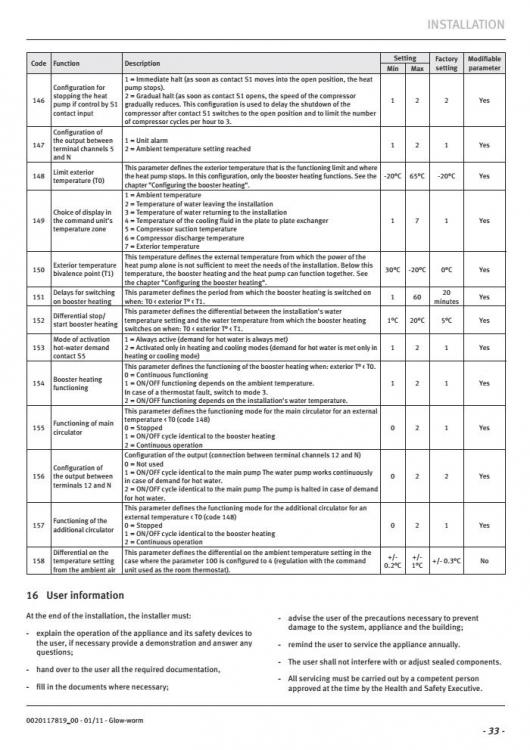
-
Help me find a dual rate electricity meter.
Jeremy Harris replied to ProDave's topic in Boffin's Corner
Another option might be to use a couple of the reasonably cheap DIN rail meters, switched via a relay. I have a couple of these, one on my car charger and another on the ASHP. The ones I have are the same width as a normal DP switch, and fit neatly into the old Wylex single isolator cases, the ones with a plastic DIN rail. For this, a small CU box with two meters and a relay/contactor might work well and retain double insulation around the wires. The DIN meters I bought cost around £10 each, and can be reset if needed, although they do normally work just like a normal meter and retain the total reading during power off. The downside is that the relay would probably have to switch the load current, rather than just trigger a dual rate meter, although, thinking about it, switching the common neutral from one meter to the other would get around that. Just common the neutrals to the rail in the small CU, then use a changeover relay to switch the neutral from one meter module to the other. Bugger all current will flow through the neutral feeding each meter, as they do all the sensing in the line connection. All the neutral does is provide power for the meter module itself. -
Just had a thought re: turning on the UFH pump. The ASHP has a relay controlled output to switch an additional circulation pump, between terminals 12 (line) and neutral, all you need to do is wire the pump to this and then set the command unit to operate that relay. The option for that is to go into the command unit installation menu and scroll to code 156. There are three options, with the default being 1 normally. The three options are: 0 - additional circulator remains off 1 - additional circulator ON/OFF cycle identical to the main pump. The water pump works continuously in case of demand for hot water. 2 - additional circulator ON/OFF cycle identical to the main pump. The pump is halted in case of demand for hot water. The default setting should supplier power to the UFH circulation pump whenever the ASHP is turned on, which seems a reasonable option to me. You will need to check that Kingspan have set up the programmed defaults to be the same as my Glowworm badged version of the same Carrier heat pump, but it's just a matter of going into the installation menu on the command unit and scrolling through to see what code 156 is set to and changing it if need be.
-
I made our large scale (1:50) models by printing off 2D drawings and glueing them to foam board (available from artists suppliers, some stationary suppliers) using spray mount. Foam board is dead easy to cut accurately and quickly using a sharp craft knife and a steel rule. I used PVA glue with pins to hold the parts together whilst the glue dried. For internal walls I used LitePly (available from model shops) which is also easy to cut with a sharp craft knife, and used the same technique of using spray mount to glue the printed plans to the LitePly. I added an extra layer of LitePly to the external foam board to give a scale wall thickness, but LitePly on its own is close to scale thickness for internal walls. I printed some textured paper for the roofing and made the model so that the roof and first floor could be lifted out to show the areas beneath. Using 1:50 as a scale is useful, because you can buy model people at the same scale from model railway shops, that help to give a sense of scale to the model.
-
I did indeed! I made around 5 or 6 models of the house at a large scale (1:50), just so that my wife could get a better feel for the spaces inside. There are photos of the final design, plus the smaller scale model of the house on the plot (to help with planning consent, which it did) in this post:
-
Our experience was very similar to @PeterStarcks, in that we had no experience of house design at all, and little knowledge of how the building industry works, yet somehow we also managed to design a house to passive house standards, without using an architect, or whatever. The only consultant we used was a structural engineer to design our big retaining wall, and that was really to satisfy insurance companies more than anything else. I found the technical aspects of design interesting and fairly straightforward, but I did struggle a bit with the aesthetics. The downside of that was that I spent a lot of time going through different design iterations until we had something that we thought looked OK.
-
Great result, but doesn't this illustrate very well the perpetual self-builder's problem, which is that we can be buggered around for weeks or months just because the utilities (and it seems they are by far the worst) employ people who are, at best, incompetent? Like pretty much everyone on here we were buggered about by both the DNO and OpenReach (actually, OpenReach made the DNO seem vaguely competent). The water company ended up shooting themselves in the foot, as they were such a PITA that we opted to drill a borehole, rather than continue to play silly games with them (yet they still contact me every six months with a new offer for providing a water supply, after five years...). The key seems to be being able to find an individual in the organisation that can apply a bit of common sense. Sadly common sense doesn't seem very common...
-
Impressive, isn't it?


