Jeremy Harris
-
Posts
26430 -
Joined
-
Last visited
-
Days Won
360
Everything posted by Jeremy Harris
-
The next two models up have a soft motor starter, but this model doesn't, hence the 20 A starting current for a unit that draws less than 6 A without the integral immersion heater running. Looking at the tech data sheet none of this range have inverter control, it seems, as they all have a pretty high starting current listed.
-
These were the Chinese, non-inverter control, units that ESP were importing and selling at one time, I believe. I have a feeling that Navitron may have imported and sold some too. They are pretty basic, can only run flat out or off, have a high starting surge current and pretty rudimentary controls. The comment about cooling is interesting, as they have a four way reversing valve, for defrosting the evaporator, which means they can physically run in cooling mode.
-
Or, perhaps, run it in reverse in a small, well-sealed, cupboard. You could call it a "refrigerator"... ?
- 3 replies
-
- 10
-

-

-

Daikin Altherma ASHP Heat Output Issue
Jeremy Harris replied to GHDirect's topic in Air Source Heat Pumps (ASHP)
FWIW, I used the Screwfix No Nonsense stuff. Seems fine so far. -
From purely empirical evidence, I'm convinced that recessed fittings that allow the electronics in the base of the lamp to overheat is the primary cause of earlier failure. I've done a few autopsies on dead LEDs, many donated by members of other forums, and every single one I've taken apart has suffered a failure of the LED driver electronics in the base; not one has suffered from an LED failure, as such. One problem may be that fittings designed to house halogen lamps will aim to keep the lamp hot, as halogen lamps are at their most efficient when run hot. This is exactly what is not needed for an LED lamp, where keeping the lamp as cool as possible is likely to increase reliability and life.
-
Without wishing to derail the thread, I can add an interesting data point. On Wednesday we had a removal van here, shifting the rest of our furniture over from our old house, plus both our cars were filled with stuff that we had to carry indoors. It was damned cold here on Wednesday, around 2 deg C and snowing in the morning, dropping through the day and evening to well below zero. During all the unloading, the front door was wide open for a couple of hours, and this leads directly into the entrance hall where the room stat is located, even though that is ~5m from the front door, so not in the direct influence of it being open. However, the temperature in the hall did drop to around 18 deg C, and the room stat is set to come on at 20.5 deg C, so the ASHP was on, heating the UFH for a lot of the time on Wednesday. I expected that we would get a big temperature overshoot in the evening, as we'd effectively over-charged the slab with heat. However, because the slab temperature is limited to about 23 to 24 deg C max, this didn't happen, much to my relief. We got a small overshoot, up to about 21.8 deg C, early in the evening, but that settled back to the normal 21.5 deg C or so later, and things were very comfortable, with the bedroom temperature at around 20 deg C. All told I was impressed with the way this simple control system behaved. I think the key is controlling the maximum flow temperature into the slab, as well as using room temperature sensing with a low hysteresis (+/-0.1 deg C). Limiting the UFH flow temperature sets a limit on the amount of heat the slab can be charged with, which in turn seems to limit the overshoot from the mismatch in response time between the fairly rapid air temperature sensing and the fairly slow response of the slab. The most important point is that Wednesday was the first night that SWMBO had spent here, and she was very impressed with the comfort level, so much so she keeps going on about it. I have a feeling she wasn't convinced by any of my arguments about the virtues of a passive house, but is now very much a convert, especially when it comes to MVHR and the very much better air quality than we had in our old house.
-
Daikin Altherma ASHP Heat Output Issue
Jeremy Harris replied to GHDirect's topic in Air Source Heat Pumps (ASHP)
Yes, the ASHP must be filled with combined antifreeze/inhibitor, to deal with the case when the ASHP is turned off and the outside temperature drops below freezing point, which may risk freezing the water inside the ASHP secondary heat exchanger. It's why I was glad that Newark screwed up and supplied a buffer tank with a coil, as it meant I didn't have to shell out an arm and a leg for around 25 to 30 litres of antifreeze inhibitor, but could get away with just using a bit less than one 5 litre can of the stuff. -
Air Source Vs Ground Source
Jeremy Harris replied to Big Neil's topic in Air Source Heat Pumps (ASHP)
As far as I can tell, the fan speeds up and slows down independently of the compressor speed (but bear in mind this is far from a scientific test; all I've done is stand by the thing and listen to what it's doing). My gut feeling is that the fan speed is controlled by the evaporator temperature, so when that cools down the fan speeds up to chuck more air through it, which makes sense, as more air = more enthalpy (in rough and ready terms). The compressor speed seems to be determined by the difference in temperature between the water flow and return temperature. As the water flow rate is fixed for the installation (the circulation pump is a constant power unit, so more or less constant flow for a given set of operating conditions) the flow temperature determines the power that the heat pump needs to work at to deliver the target flow temperature, and this seems to be the primary parameter governing the compressor speed (there may be other factors at play too, like a variable expansion orifice - not sure exactly how that's controlled). There is a definite change in the fan behaviour at about 4 deg C, as it speeds up. There is a humidity and temperature sensor on the rear of the unit that measure the air flowing in towards the evaporator (in heating mode), and that seems to play a significant part in determining when a defrost cycle will start. -
Air Source Vs Ground Source
Jeremy Harris replied to Big Neil's topic in Air Source Heat Pumps (ASHP)
Yes, it is, but [pedant_mode_on] the evaporator becomes the condenser during the defrost cycle [/pedant_mode_off]. -
Air Source Vs Ground Source
Jeremy Harris replied to Big Neil's topic in Air Source Heat Pumps (ASHP)
There is about 7% less heat available in air at -10 deg C than there is available in air at +10 deg C, so the tiny reduction in heat available in the air to extract using a heat pump is negligible, and doesn't make a significant difference. What does make a difference is the design and sizing of the ASHP, as few can operate below about -18 to -20 deg C, and if badly sized for the heating demand then icing of the external evaporator coil is likely, which hits performance pretty hard. As above, oversize the unit, and choose one that's inverter controlled, so it can modulate right down in output when there isn't a high heat demand and the efficiency can stay high in cold weather. I've found the worst case isn't when it's well below freezing, but when it's between 0 deg C and about 4 deg C, when the air still has a lot of water vapour in in that can easily ice up the colder evaporator. Once the temperature drops well below freezing evaporator icing tends not to be such a problem, probably because in very cold weather the air tends to be a fair bit drier. -
Daikin Altherma ASHP Heat Output Issue
Jeremy Harris replied to GHDirect's topic in Air Source Heat Pumps (ASHP)
As long as the buffer tank is run indirectly (i.e. with a coil) then the antifreeze volume can be very small. I used about 5 litres of the stuff to get the right concentration in our ASHP, as the antifreeze inhibitor is only in the ASHP, buffer coil and UFH loops, so not a lot of volume. To pressurise the system I used a modified garden sprayer, fitted with a new 8mm LDPE pipe (luckily a perfect fit in the pump bottle gland) and terminated that with a 15mm double check valve, using an 8mm to 15mm compression adapter. This then fits directly to a standard flexible fill loop hose with fill valve: This will pump up to a few bar, so can be used for leak testing as well as filling and pressurising.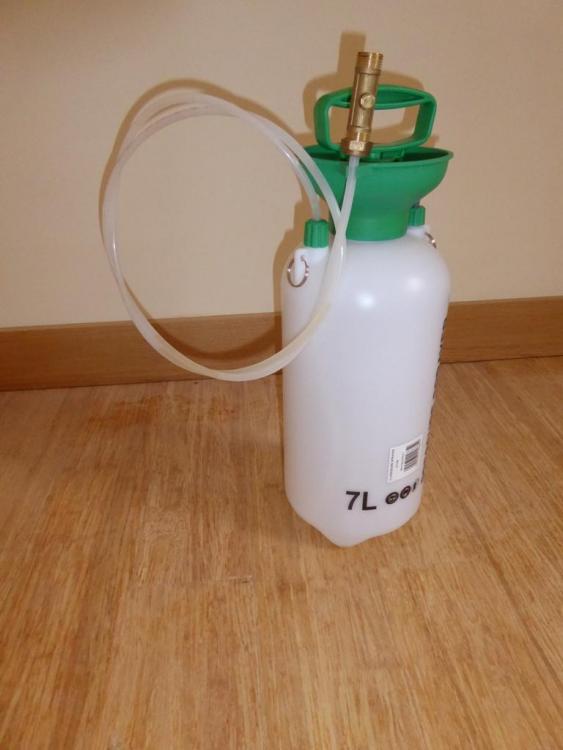
-
Not as far as I can see. I looked at the data lines to and from the unit, thinking that I might be able to make a more elegant control system by just sending data directly to the unit, but after hours of trying to reverse engineer the data protocol I gave up. One thing I did find is that not much data routinely passes from the main board to the command unit, which tallies with the delay there is between something changing and the command unit display reflecting the change. I suspect there is some form of "factory set up" mode that can be enabled to dump every default parameter from the command unit to the main board, but it's not clear how to access that mode. I do know that you can disconnect the command unit and the unit carries on running perfectly well without it, as once programmed all the settings in the main board are stored in non-volatile memory. If I were designing something like this I'd try to limit the number of writes to the non-volatile memory, as it has a finite write life. That would explain why the command unit doesn't routinely re-write data to the main board, but only does so when a parameter is actively changed.
-
Saves me having to go and cycle through all the settings on our command unit and write them down, at least for now! I must get around to doing it sometime, so I have a record of every parameter that's set. Out of interest, what do you think got it working? I have a theory that the command unit only actually sends a programmed parameter to the main board when you enter that parameter in the menu, otherwise it just sits there. There's a hint on one of the sites somewhere that mentions that a new main board arrives unprogrammed, and needs a command unit to set it up, and I have a suspicion that the command unit doesn't just dump all the default parameters to the main board, it waits until you cycle through and change them, even if changing them to something and then changing them back to what it was before, before the main board actually stores the set parameter.
-
We went around a few new builds (not self-builds) when we were looking for a builder, and one was in the middle of doing an air test when we arrived (the house failed to meet building regs) and another where the guys were taping up inside in attempt to pass the air test (one of them told me as soon as the boss who was showing us around went off to answer the phone this was their third attempt to pass building regs). Both those were being tested as bare shells, without any lining internally, and before first fix.
-
That's normally when it's done, as otherwise it's impossible to fix porosity issues in the structure without ripping the house apart. The exception might be for wet plastered block construction, where the parge and plaster will be very effective at sealing up the natural porosity of the blockwork.
-
The 0.6 ACH is the PassivHaus Institut target figure, so anything under 0.6 ACH would get a tick in the box for air tightness as a certified PassivHaus, and there aren't many of those around in the UK (not sure, but I think the number is in the low hundreds in total, out of the thousands of new builds every year). 0.58 ACH is a damned good result, and as others have said probably 1/10th of the allowable leakage for a "normal" new build. Given that mass housebuilders often really, really struggle to get airtightness that's around 10 times worse than yours, I'd be as chuffed as anything to get that figure. In practice, I doubt that there would be any impact on overall practical, real world, thermal performance or comfort issues for any airtightness figure below about 0.6 ACH.
-
Depends on the volume. For example, our house has 2.4m ceilings in the ground floor rooms, but the hall is 2m wide and goes up to around 6.5m at the apex, and the bedrooms and bathrooms have ceilings that are vaulted and go up to about 4m or so. The consequence of this is that our 0.43 ACH figure equates to 1.22 m³/m²/h, which is a (perhaps extreme) example as to how misleading the UK BR measurement can seem way out of kilter with the generally accepted ACH measure used virtually everywhere else in the world.
-
No,, unfortunately not. The whole world (except the UK) uses ACH. Why we have to relate airtightness to floor area is beyond me. Logically, the air change rate should relate to volume, not floor area, as the latter takes no account of differing ceiling heights, and lost heat relates to the volume ratio, to a significant extent.
-
It's a law of diminishing returns. In a windy location, getting better than 0.6 ACH might give a small benefit, but in most locations I doubt that their would be any noticeable difference. One factor that starts to dominate is how often you open the outside doors. We had our front door open a fair bit this morning, whilst shifting furniture, and that dropped the temperature by a couple of degrees. Only took around 20 minutes or so to warm back up, though, as all the heat stored in the slab quickly brought the house back up to temperature.
-
I'm confused
Jeremy Harris replied to canalsiderenovation's topic in Ground Source Heat Pumps (GSHP)
RHI is a really GREAT scheme. The worse you build your house, the more money you get paid for 7 years. Conversely, the better you build your house, the less money you get paid - in our case the RHI for a heat pump installation was going to pay us a bit over £80 a year for 7 years, yet cost us over £2000 more initially in getting an approved installation. These schemes are often a bit crazy. The Northern Irish one was so bad that people were being paid massive subsidies to heat what amounted to empty barns, as the more heat you wasted the bigger the subsidy you got paid. -
I arranged our PHE to be on the first floor, with a 28mm thermosyphon feed from the buffer below. The pump is on a flow switch, triggered by hot water demand, but the PHE will often already be slightly warmer than the buffer, as it is right at the top of the system. This means there's no delay with preheat in practice, as the PHE is always nice and warm.
-
We're another one who got caught out by too much solar gain. I spent a year designing and thermally modelling our house before we started work, including carefully working out just how much glass we dare put in the South elevation, yet we still ended up with a house that overheated in Spring and Autumn. Heating is virtually non-existent, and rarely comes on, but solar gain, coupled with incidental gains from stuff in the house, and especially having visitors around, adds a fair bit of heat to the house. I've spent far, far more time and effort trying to keep the house cool than I have on heating; in fact I'd go so far as to say that heating is a non-issue, as so little is needed.
-
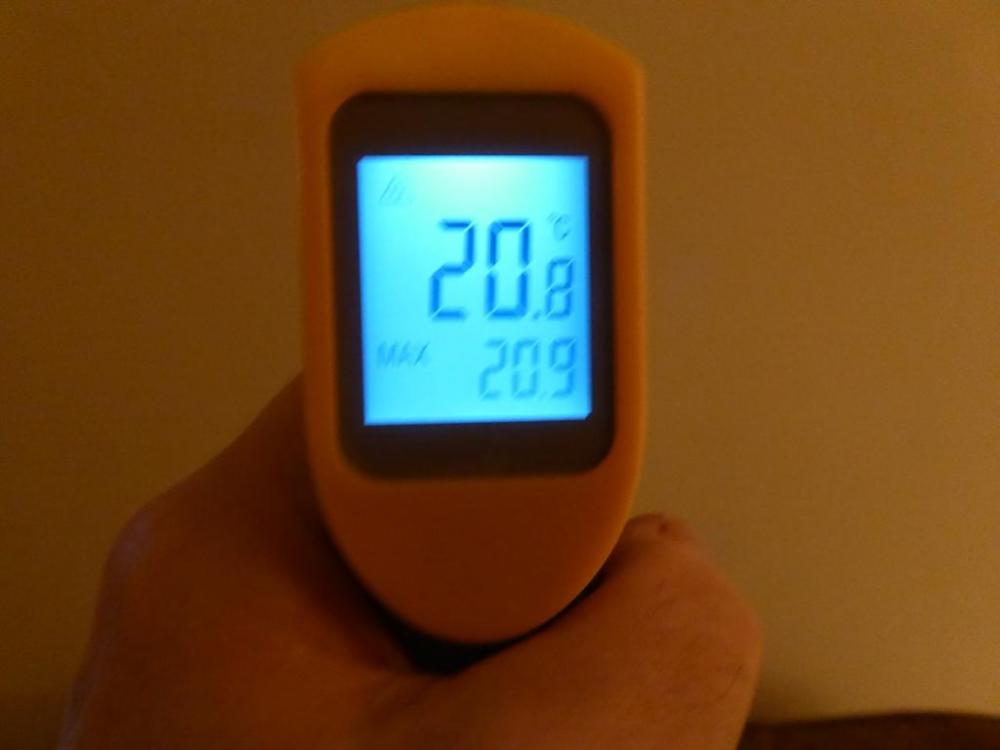
Lounge just now (outside wall): No cats (yet...), thank goodness...
-
Brilliant result, IIRC we were 0.43, so you're way better! As encouragement, I can say that it was snowing today, then cold, sleety, rain, and we're sat in our beautifully warm and cosy MBC home, walking around in bare feet and just enjoying the superb level of comfort that a super-insulated, airtight, house gives. For the keyholes, if they are deep ones, then get some motorcycle chain lube. It comes in an aerosol with a thin pipe on the nozzle, like WD40. Shake the can really, really well, then spray the chain grease as deeply into the keyhole as you can get. It will set nearly solid in the middle, as it's designed to be really thick so that it doesn't fling off motorcycle chains, and will last years as an air block in the centre of the keyhole. If you get the white stuff then a bit of spillage into the key mechanism doesn't make too much of a mess. I tried a silicon grease spray initially, but found it tended to melt out in hot weather. The motorcycle chain grease stays solid, even in fairly hot weather.
-
I think knowing the heating requirement and DHW requirement is the first thing to work out. I Is this a new build? If so, then the heating requirement, even if only built to the pretty bloody awful building regs "low energy (!)" requirements won't be very high at all, and hot water probably at least equal the heating requirement, may well exceed it (hot water makes up most of our energy usage by a fair bit). I hate thermal stores with a passion, for the same reasons that @ProDave has given. You get more usable hot water from an unvented cylinder and even more from a Sunamp PCM store. If the UFH is set into a heat store (cast into the ground floor slab, for example) then you probably have no need of a buffer, as you can fire the boiler to charge the floor and that will act as a buffer. Take a look at how @TerryE is running his UFH, albeit with a direct electric heater, to get some idea as to how well this can work. We do something similar, but with a lower flow temperature and an ASHP. Our underfloor heating comes on for an hour or two every day or two and charges up the floor like a big storage heater, and the house stays within about 0.5 deg C of our target temperature all the time, with nothing more complex than a single room thermostat to control it.