Jeremy Harris
-
Posts
26430 -
Joined
-
Last visited
-
Days Won
360
Everything posted by Jeremy Harris
-

Oil Prices nearly 30% Down
Jeremy Harris replied to Ferdinand's topic in General Self Build & DIY Discussion
I think the oil price drop has been caused by the games that Saudi Arabia have been playing. They increased exports, which caused the price to crash, as part of a price war they are having with Russia. -
Seems daft to steal something that's sending data back to Amazon and which can probably be traced back to the IP of the connection. How exactly did this thief think he was going to use or sell the thing, when it's registered to the original owner and sending data back to them whenever it's activated?
-
Ring also passes all the data it collects back to Amazon (surprise, surprise) so they can add it to their database on you and so target you with stuff. In essence, they are asking you to pay for something that gives them more information about you. As an example of the data that Ring devices collect and send back to Amazon, have a read of this BBC article where they got hold of all the data that Amazon had acquired from a Ring user: https://www.bbc.co.uk/news/technology-51709247
-
Isolation - what will you do?
Jeremy Harris replied to Ferdinand's topic in General Self Build & DIY Discussion
Our village is a pretty good illustration of the way social distancing was practised during the Black Death. The centre of the present village is about 3/4 mile from the centre of the old medieval village and church. When the plague struck, the villagers buried their dead in pits around the church, then built new homes where the village is now. The old village fell into disrepair and has all but disappeared from the landscape, except for the church and a manor house. -
You can buy trip wire operated alarm mines fairly cheaply. They use 12G saluting blanks, that can usually be purchased from gun shops without a shotgun certificate. Not sure if you can buy saluting blanks online, I suspect not, as you probably have to be over 18 and maybe produce ID to buy them.
-
Anyone used online 3D printing services
Jeremy Harris replied to Gone West's topic in Tools & Equipment
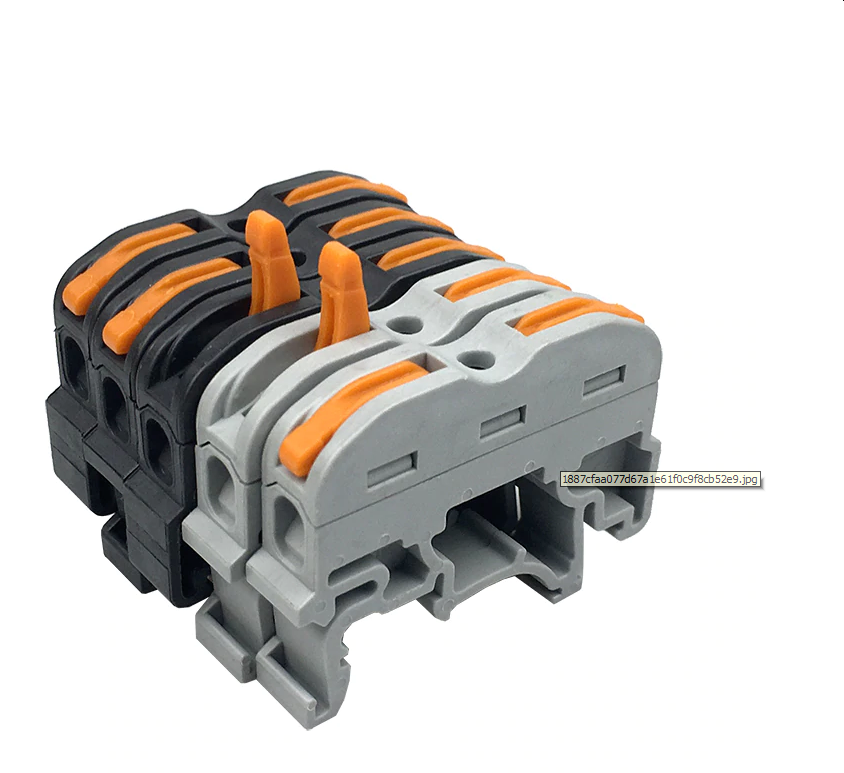
The ones I used were knock-offs, like this: Nice and easy to use, as being fixed down makes lifting the lever and poking the wire in easier. Keeps everything nice and neat, too.
-
Anyone used online 3D printing services
Jeremy Harris replied to Gone West's topic in Tools & Equipment
I've wondered why Wago don't have a range of them (or, if they do, then why they don't seem readily available). I used some Wago copies that fit a DIN rail recently. They did look really neat when mounted like this, and were a lot easier to use when held firmly inside a box. -
Isolation - what will you do?
Jeremy Harris replied to Ferdinand's topic in General Self Build & DIY Discussion
I've spent the past half hour sorting out my wife's ebook reader. She stopped using it ages ago, as she prefers real books, but has now decided that it's sensible to get it working again to avoid going to the library (which may well close before long anyway, I expect). The battery system may be playing up because the batteries were completely discharged during that recent power cut. Not sure how these things behave when the batteries have been depleted, TBH. Which make/model of inverter/charger have you got? -
Isolation - what will you do?
Jeremy Harris replied to Ferdinand's topic in General Self Build & DIY Discussion
I'm not a very sociable person by nature, so being stuck at home won't be a significant problem. For us, the changes we must adopt probably won't have a major impact, the main adaptations are going to be working around the logistical challenges of getting food safely. Not a biggie in the overall scheme of things. We have a reasonable small shop and post office in the village, so we'll probably switch to using that, as the risk from shopping there will be massively lower than shopping in the supermarket in Salisbury (already had one death from this in Salisbury, a 59 year old man, so we know their are probably hundreds of infected people there). We may be able to work with our village shopkeeper to set up some sort of local delivery system, to further minimise the risk from contact. Given that more than 50% of those living in this village are over 60 this may help a lot of people, although it will inevitably be a bit more costly, I think. -
I sat our island on a bit of 18mm ply, with the plinths and side and back panels covering the edges. I didn't do this to spread the load, the ply was there to locate the island. I just stuck the ply to the floor with a few dabs of silicone, then put the island on top, as a free standing unit. The ply locates it and stops it moving, although there the thing is so heavy that I don't think it would have moved anyway. The legs rest on the ply, so the load is spread, although I didn't need this particular quality.
-
No idea, TBH. If you want to do a simple experiment to see what happens, then get a bit of foam insulation (or foam packaging), a bit of cardboard and a bit of strong plywood. Put the cardboard over the foam (this simulates a relatively weak screed or floor) and then push on it with a narrow stick. You'll find that the cardboard won't be able to spread the load and will fail, resulting in the stick sinking through it. Try the same with a bit of stiff plywood over the foam and you'll find it takes a great deal more force to try and push the stick through it. In each case the foam hasn't changed at all, it's just that the surface above has, with the plywood spreading the load more evenly.
-
Most probably. Any floor will have a maximum allowable point load capacity, so the solution is either to change the floor to one with a higher point load capacity or reduce the point load to remain within the floor limit. It's very common to do the latter, thing like heavy water tanks can exceed the floor load capacity and the solution is to fit bearers, so the load is spread over a greater area. I've seen a bed go though flooring for the same reason, that the point load imposed by the legs exceeded the capacity of the floor.
-
I'll repeat, it has nothing at all to do with the thickness of the PIR (or any other insulation). All foam insulation has a maximum compressive stress that determines how much it deflects when loaded. Making the insulation thicker doesn't change this. For example, the EPS under our floor has a maximum allowable compressive stress of 100 kPa for 10% compression. In reality this equates to about 10 kPa for a more realistic 1% deflection . It doesn't matter if the insulation is 50mm thick, 100mm thick or 300mm thick, the max allowable compressive stress remains exactly the same. To get a higher value means changing the insulation for one with a higher max allowable compressive stress, like EPS300 that can take 300 kPa for 10% deflection. The ability of the screed to work to spread a point load more evenly into the underlying insulation is key, as is the magnitude of the point load and the area over which it is imposed (which gives the imposed bearing stress on the floor immediately under the foot). The best analogy I can think of is snow shoes. Walk on thick snow in ordinary boots and your feet will sink in. Spread the same load over a wider area by using snow shoes and you can walk on top of the snow. If you have a floor where the screed isn't strong enough to take the point load, and so fails and crushes the underlying foam insulation, then spreading the load over a wider area will stop that from happening. .
-
Warm Air Hand Dryers - Anyone Used?
Jeremy Harris replied to Ferdinand's topic in Kitchen & Household Appliances
@Onoff is our whole body dryer guru -
This isn't related to the PIR thickness at all, really, it's a consequence of the inability of the floor surface above to adequately spread the point loads. One reason that passive slabs use reinforced concrete over the top of foam insulation is to increase the strength of the slab so that any imposed point loads don't cause the slab to fail locally. The risk can be mitigated by making the floor stiffer and stronger, or it can be mitigated by reducing the magnitude of any point loads. For example, if a kitchen island was built with wide, stiff, plates under the feet, then that would very significantly reduce the point load and remove the risk. The same may apply to kitchen units in general, although usually there will be lots of feet to reduce the load imposed by each of them. An island is probably the likely worst case, as it may only have a few feet to transmit a pretty hefty load into the floor.
-
You have to make sure that the ground level around the house remains 150mm below the DPC. You can probably see the DPC as a line in the brickwork, at around or just below the finished floor level of the house. The reason for this is to ensure that damp cannot penetrate in above the DPC - it's there as its name implies, to keep damp out.
-
Idiots guide to mvhr.
Jeremy Harris replied to Russell griffiths's topic in Mechanical Ventilation with Heat Recovery (MVHR)
Yes, the only place spiders get is is when we open one of the doors, usually the back door. They used to sit in wait under the outer bit of the door, and run in as it opens, but I now squirt diluted peppermint oil around the outside doors and that keeps them away. As we don't get flies and bugs in the house, it seems human to keep spiders out, as they will probably only die from starvation if they did get in . . . -
Idiots guide to mvhr.
Jeremy Harris replied to Russell griffiths's topic in Mechanical Ventilation with Heat Recovery (MVHR)
Yes, we have an F7 filter on the intake to ours, which filters out pollen and a fair bit of the smaller particulates (takes out about 70% of PM2.5s). A useful benefit if you suffer from hay fever (as I do). It means that I can go for days in the pollen season without needing antihistamines, which is a definite plus. Ours was audible initially, but fitting silencers fixed that. I'd recommend fitting the biggest silencers you can, as they really do make a big difference. -
It's not that the airbrick is too low, it looks as if it's in exactly the right place to me. The reason for the apparent ditch to the side of the entrance is that the entrance has been designed to comply with Part M of the building regs, which mandates that there must be wheelchair access. This means that there needs to be a ramp up to the door, whereas before there may have been a front door step there. The path is therefore higher, relative to the ground level, to allow the mandatory wheelchair access. There also needs to be at least 150mm from the DPC level to the ground level outside, and if the door threshold is close to the finished floor level inside, then it would be normal for there to be a drop of around 150mm from the entrance path right outside down to ground level.
-
Yes, but it did need a bit of careful adjustment initially to set it up. Once set up it's been fine, don't think I've touched the adjustment screws since.
-
There seems to be two inspection covers in the photo. I wonder if the loo is connecting further down to the second one? Might explain why you can hear it but not see it. It also looks as if the invert is a lot deeper than the hole you've dug, so the chances are that the pipe will be a fair way down.
-
Warm Air Hand Dryers - Anyone Used?
Jeremy Harris replied to Ferdinand's topic in Kitchen & Household Appliances
The newer Dysons don't have that U shape that collects drips and blows stuff back. Not sure when they changed the design, though. -
I have an Evolution mitre saw. Pretty near indestructible, and I've seriously abused it, like cutting off lumps of 4" aluminium bar stock with it. Only thing that has played up randomly has been the laser guide. Mines about 6 years old now.
-
Warm Air Hand Dryers - Anyone Used?
Jeremy Harris replied to Ferdinand's topic in Kitchen & Household Appliances
It's hard trying to get this message across, though. Had a chat with my MiL this morning. She's very bright, but in a high risk group (well over 80, COPD and poor eyesight which doesn't help). She's just adopted the "clean anything new that comes into the house" principle without prompting, along with the need to wash your hands if there's a chance they've become contaminated. Others seem to be struggling with this, though. I heard a lady in the village complaining that all this hand washing was making her hands sore. Seems she thought she needed to wash her hands regularly through the day, even if there had been no risk they'd been contaminated. The message on hand washing really needs to clarified, so that everyone can understand why there is a need to do it under certain circumstances. -
Warm Air Hand Dryers - Anyone Used?
Jeremy Harris replied to Ferdinand's topic in Kitchen & Household Appliances
One reason we used them at work was that the air feed has a HEPA filter. As long as the hands that are put in the airstream have been properly washed there shouldn't be any risk of pathogen spread.