Jeremy Harris
-
Posts
26430 -
Joined
-
Last visited
-
Days Won
360
Everything posted by Jeremy Harris
-
I believe this is banned by the RHS now, plus it's expensive. £15 of copper sulphate makes around 25 litres of concentrated solution.
-
We had a moss problem on the concrete tiles on our last house. The moss would grow so thick that rain water would pool behind it in heavy rain, then make its way between/under tiles around a chimney breast. The water level would briefly overtop the lead flashing and trickle in, I think. I cleared the moss but within a couple of years it was back again, so I tried spraying the roof with a concentrated copper sulphate solution. This was extremely effective, and left enough of a residue in the textured surface of the tiles to dissuade moss from growing back for several years. Very well worth doing, IMHO. I just bought a couple of kg of copper sulphate pentahydrate (about £15 from eBay), made a saturated solution in a pressure sprayer and sprayed that all over the roof. Not only does it stop moss growing, but it will kill any moss that you can't easily reach, and it will then dry and fall off.
-
From what I can gather, Sage glass uses very little power, so I wonder if it might be possible to fit a rechargeable battery, power supply and wireless controller into a sliding door frame, Including a wireless charger, so that the battery recharges whenever the door is closed, would make for a neat solution for moving glass panels.
-
I've just looked in detail at the spec for that Karcher pump, and it has no controls at all, just an on/off switch. The equivalent IBO pump (would do exactly the same thing) would be this one, for £74: https://www.ebay.co.uk/itm/IBO-3-SQIBO-0-55-Borehole-Deep-Well-Water-Submersible-Electric-PUMP-14m-cable/172266242720?hash=item281bde42a0:g:UkEAAOSwepJXX-Aj The snag with this, and the Karcher one, is that it would be all or nothing, and could not be connected to a tap. The pipe from it would have to run directly to the hose or irrigation run, with water being turned on full by switching the pump on. When I was pumping out our borehole I had a submersible pump down the hole connected to a length of 25mm MDPE pipe, and just switched it on, with no controls. It pumped around 30 litres per minute of water, which is a lot, maybe three times more than a typical shower. Watering a garden with it would have needed some thought, as I think the only sensible approach might have been to install fixed irrigation pipes and sprinklers, so that there was no need to throttle the flow rate. One problem with just putting a tap directly on a pump outlet is that as the tap closes the pressure rises, by far more than it does with a tap running from the mains. Even the small 700 W pump I was using would run at around 6 or 7 bar pressure with a tap partially closed, with a jet of water that was more akin to a pressure washer. That's the big advantage of using a pressure switch and pressure vessel arrangement, it keeps the pressure down to a manageable level, even with the tap almost closed.
-
Looks just like a standard submersible pump with a pressure switch to me, and it doesn't seem to have a pressure vessel, so it will probably pulse on and off a lot in use. How much is it? The bits needed to do this should be around £110 or so for one with no pressure vessel or ~£140 for one with one (for a submersible pump). If the surface of the water never drops lower than about 8m below where you can fit a pump, then you could look at a cheap surface pump set like this for ~£70: https://www.ebay.co.uk/itm/IBO1-WZI250-BOOSTER-WATER-PUMP-portable-small-electric-house-24L-pressure-VESSEL/172442502988?hash=item28265fc74c:g:JOkAAOSwvO5bs3Kr
-
The way the tap controls the pump is via the pressure switch, in conjunction with the pressure vessel, which allows for the fact that water is incompressible (to all intents and purposes). What happens is this. When power is turned on and the tap is closed, the pump operates until the pressure in the pipe to the tap reaches the switch turn off pressure, typically around 3 bar. The pump then turns off and that pressure is held, as there is a non-return valve in the pipe to the pump. When the tap is opened water starts to flow, and the pressure drops. When the pressure drops below the turn on pressure, typically about 2 bar, the pump switches on to continue to supply water. If the rate at which the pump can supply water is greater than the rate at which it's being used, then the pressure will increase. When it reaches the turn off pressure the pump will turn off, until the pressure drops back to the turn on point again. If the tap is turned off, with the pump running, the pressure will increase until it reaches the turn off pressure, when the pump will turn off and the system will just sit pressurised, ready for use. The advantage of this system is that the pump can be placed low down in the well, so it can always draw water, and there's no need to mess about switching power on and off. The tap can be treated just like any other tap. Water will flow when the tap is turned on and stop flowing when the tap is turned off, plus the pressure will stay reasonably constant, between 2 and 3 bar. An alternative is to not have a tap, and just have a pump down the well with a suitable weatherproof switch to turn it on and off. This doesn't allow for any flow variation, as the pump will be either producing water at it's maximum capacity when turned on, or not pumping at all when turned off. Even a small submersible pump will deliver maybe three times or more of the flow rate from a normal size outdoor tap, and so may be a bit difficult to use for delicate watering.
-
It's nothing to do with being in the ground, it's to do with the base of the timber being kept cool, because of the thermal bridge to the ground that the concrete pad would provide. The effect of this for an indoor structure would be to create a condensation locus at the base of the timber. Our insulated slab has a load of point loads from the whole mass of the house into timbers with a 89mm x 38mm section applied to a timber sole plate that works just like a padstone. Structurally all that is required is to reduce the point bearing stress to a value that is well within the allowable bearing stress for that area of the slab. This is dead easy, and doesn't take much at all. For example, let's assume that the slab is the same as ours (which it is, it looks near-identical AFAICS). Say the outer reinforced concrete ring beam has a max allowable bearing stress of 5 N/mm² (that's a very conservative figure, as after 30 days cure plain RC35 concrete should be able to take at least 10N/mm², without allowing for all the steel reinforcement). For a post bearing area of 150mm x 150mm (22,500mm²) the max allowable load is about 112.5 kN, or around 11.5 tonnes. Just adding a modest padstone would increase that in direct proportion to the ratio of bearing areas, assuming sufficient thickness to allow for the lower edge perimeter to remain with the 45° line.
- 13 replies
-
- 1
-

-
- raft
- calculation
- (and 1 more)
-
The snag with that would be the combination of a nasty thermal bridge and cold ends to the timbers, which may well result in interstitial condensation. Better to ensure that the ends of the timbers are always kept warm, and hence dry.
-
It's a bit of a grey area. I had a tough time with a building inspector who insisted that the requirement to restrict water use in the regs applied to us, even though we don't use either mains water or mains drainage. Whether or not it's OK to use non-WRAS approved stuff I don't really know, as a part of the WRAS stuff is aimed at protecting people within the house from possible water contamination. Clearly the WRAS regulations that relate only to reducing the probability of contaminating a mains water supply, like double check valves on incoming pipes doesn't apply, but I suspect that we do still need to comply with other requirements, such as ensuring that outdoor taps have double check valves, for the same reason as anyone on mains water has to.
-
Could always transfer the bearing load from the frame into padstones on the slab to spread the load.
-
The snag with the submersible pumps that places like Screwfix sell is that they are all float switch operated, so won't turn on and off when you open a tap, without some playing around and making underwater mains cable connections to the switch cable and adding a pressure switch and small pressure vessel. To be able to just turn on a tap and have a pump start needs a pump that has a pressure switch that turns the pump on when the pressure drops from opening the tap, plus small pressure vessel to prevent the pump from short cycling. There are two types of pump, and which you choose depends on how far down the water level is at it's lowest. No non-submersible pump will draw up more than about 8 to 10m, so if the water never falls this far below the height of the pump, then you can look to use an above water pump set. If the water level is likely to drop below about 8m from the top, then it would be best to fit a submersible pump with a pressure controller. Something like this would do the job (again, just picked at random to illustrate the type of system): https://pumpexpress.co.uk/shop/the-peak-bundle/ We use a borehole for our water supply and I've found the Polish made IBO pumps to be pretty good value and reliable. You could put together a system using parts from them fairly cheaply, for example: Submersible pump (OK for use at depth): https://www.ebay.co.uk/itm/IBO-3-SQIBO-0-55-Borehole-Deep-Well-Water-Submersible-Electric-PUMP-14m-cable/172266242720?hash=item281bde42a0:g:UkEAAOSwepJXX-Aj Pressure vessel: https://www.ebay.co.uk/itm/Druckkessel-24-l-mit-Membran-Druckbehalter-Membrankessel/182952158436?hash=item2a98cc64e4:g:HYgAAMXQNOZRCnkG Pressure switch: https://www.ebay.co.uk/itm/IBO-PC-59-Intelligent-Automatic-Pump-Control-System-dry-running-run-protection/182278785811?hash=item2a70a98b13:g:EDcAAOSw8vZXMzy2
-
Hilliard certified our Kore passive slab, too. This is a section through it: Structure - Detail for BC.pdf and this is the report Hilliard wrote on the Kore passive slab system: Kore_Insulated_Foundations_Report.pdf
-
You won't spot it, as it went in last year, when we were finishing the garden landscaping, planting trees, putting fencing up etc. I must take some up to date photos, now the trees have grown a fair bit and the garden's full of flowers. Still won't be able to spot where the safe is, though!
-
Ours was the same, they just paid the whole lot in one go.
-
John Ward is generally pretty sound (does drone on a bit though!). As you're looking at running power to a metal shed, and as there is a risk that there may well be a difference in earth potential between an exported TN-C-S/PME earth and the potentially exposed metal of the shed, I would definitely opt to wire the shed as a separate TT installation, and not connect the earth from the house to it. The metal of the shed should also be bonded electrically to the earth electrode and earth conductors within the shed end of the installation, with no connection to the house earth, other than to the metal armour of the cable (which needs to be insulated from the shed). The logic is the same as that applied to caravan electrical installations, or an electric vehicle charge point, in that there is a need to ensure that any metal that may be touched cannot rise above 50 VAC in the event of a fault.
-
TBH, I've never yet encountered somewhere where there was nowhere to bang in a rod, but there are alternatives. The DNO and National Grid use buried earth mats or grids, and these can be made to work in difficult terrain. Every pylon is earthed like this, as are many power poles that have intermediate earths.
-
I like that a lot. Brilliant way to make a neat, strong joint, especially in a location like that where it would have been difficult, if not impossible, to mortice the rail to the post.
-
I looked at what was needed in order to make a heat recovery unit that would comply with the regs as far as WRAS certification was concerned. The main issue is that the regs require a drained space between the potable water piping and the waste water piping, with some form of tell-tale drain indicator to show if there's a leak into this space. This means the efficiency tends to be reduced a fair bit, as it's hard for that drained space to not insulate the two sections from each other. My solution was to look at running several paralleled small bore potable water pipes up alongside a length of 50mm diameter copper waste pipe. Ideally these small bore pipes would be soldered to the waste pipe in order to make good thermal contact, but that seemed to be in breach of the regs. I'm inclined to think it would have been perfectly OK, just the same. The cost for a home made version would be a fair bit cheaper than for some of these things, maybe £100 worth of pipe and fittings.
-
I'm with @ProDave on this, and would use 2 core SWA, with the armour connected at the supply end to the incoming PE and left unconnected at the shed end. Put in an earth rod and connect that to the shed and the earth block in the shed consumer unit. A simple garage consumer unit is ideal for this, as it will have an RCD plus a couple of MCBs, and you can then have properly protected lighting and power circuits at the shed end, with all the exposed metal bonded together and at local earth potential for safety. The snag with this arrangement is that you really need to have the installation tested, just to make sure that the wiring is OK and that the earth rod has a low enough resistance. However, unless you're on sand, or perhaps dry chalk, the chances are that the earth electrode resistance will be low enough. On the clay we have around here I can get around 50Ω to 70Ω or so pretty easily with a single rod. Anything under 200Ω is the general guidance, although for a 30mA RCD the earth electrode resistance can be as high as 1667Ω before the touch potential limit is reached. In my limited experience I've never seen an earth electrode with a resistance that high, though, so I suspect going without testing isn't likely to be a major risk. If push comes to shove then you're welcome to borrow my multifunction tester and measure the earth electrode resistance. It's not hard to do, and the same box of tricks will test everything else, like RCD trip times and current as well, so you can be assured the circuit's safe.
-
 Doesn't seem to be a problem in practice, at least we've not noticed any variation in temperature at all. The same goes for the shower at our old house, as I fitted that in a similar way, with the mixer at the opposite end to the shower head.
 -
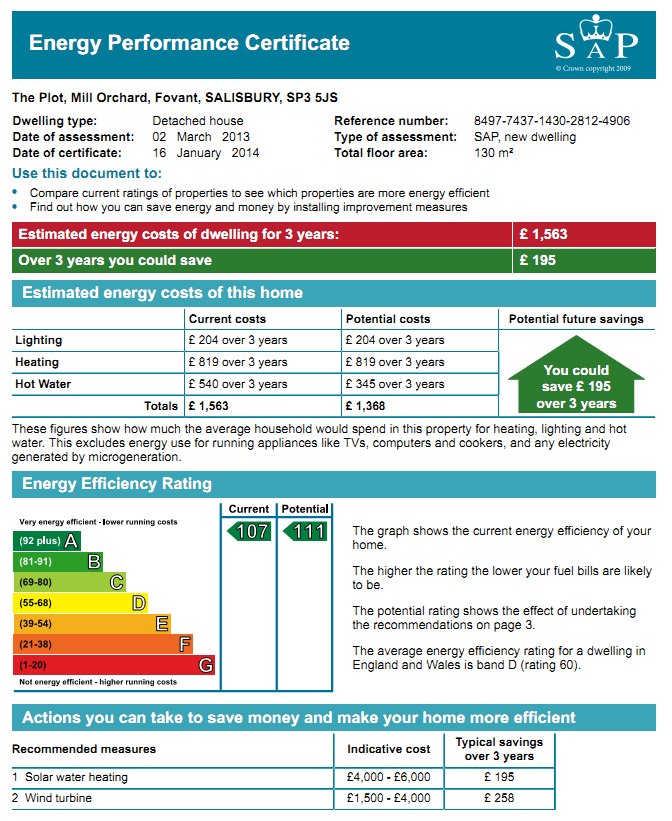
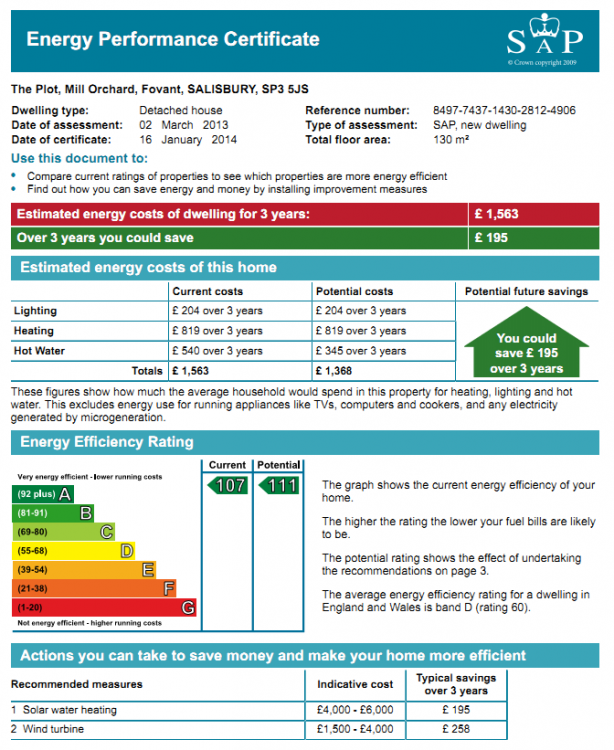
Inaccurate doesn't begin to sum up the EPC for our house. The thing's a joke, really, when applied to a passive house. I particularly like the automatic observations that get inserted on the EPC, for recommended improvements. This is the front of ours: Note the "Recommended measures" at the bottom. We already have solar water heating via PV, but SAP doesn't take account of this for some bizarre reason. The suggestion to install solar water heating, at an indicative cost of £4,000 to £6,000, with a typical saving over 3 years of £195 is completely bonkers. The payback time would be between 61.5 and 92.3 years, assuming we scrapped the PV water heating we already have. Our house is alongside a stream at the bottom of a steep sided valley, and very sheltered from the wind and weather. It's also inside an AONB and Conservation Area, and opposite a GII listed building, so there's no way a wind turbine would work, let alone get planning consent.
-
Not quite the same, but similar: https://curtisfurniture.co.uk/case-studies/old-palace-lodge/ Not sure if they'd do a one-off, or whether it might be affordable, though.
-
No, I trust him, plus he'd never be able to get his digger in there now, and I doubt he'd be able to shift it any other way, now it's concreted in place. It's made from two iron castings, one for the main cabinet and another for the door, so weighs a fair bit. It's a massive over-kill for our needs, but it looked too good to be scrapped when it was being thrown out, so I felt I had to give it a home. It's been stowed away in my garage for years, before we moved, and I'm glad I've been able to put it to good use. Nothing very valuable is ever stored in it now, unlike some of the files it once held back in the 1950's, when it was made.
-
Just been looking around, and it seems there are several sites specialising in hotel furniture that may have something like this (not found exactly what you want yet). There are also a few hotel second hand sales sites that may have something similar; could be better value than having something custom made, especially if it's just the head board and cabinets needed (not sure I'd want a second hand ex-hotel bed!).
-
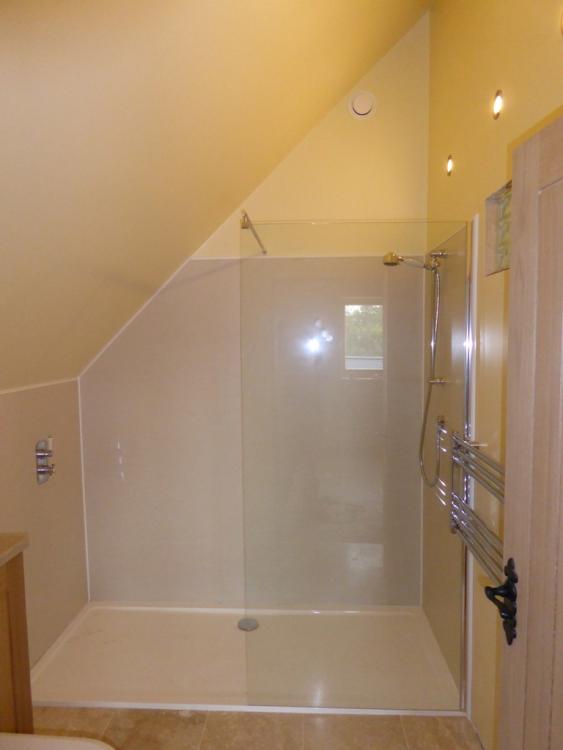
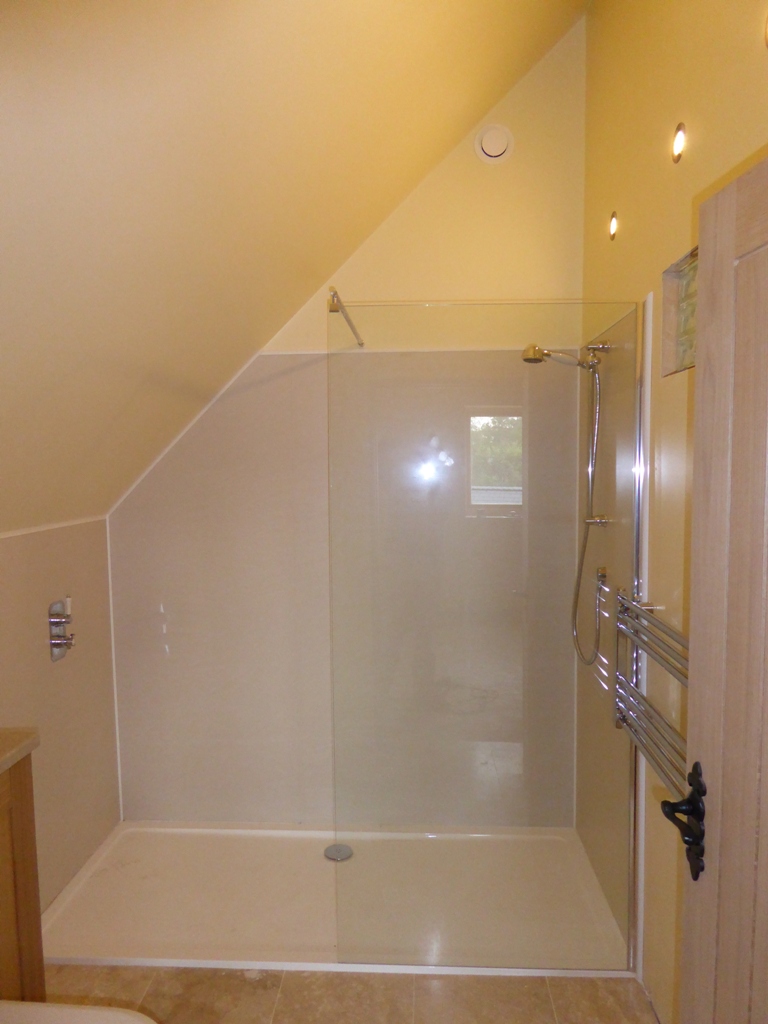
I can't see any obvious reason why an electric shower couldn't be installed the same way I installed our mixer shower, with the controls outside the wet area and a pipe running under the floor and up to the shower head at the wet end: There's an extra advantage to fitting an electric shower like this, in that it keeps the cable run etc out of the wet area.