Jeremy Harris
-
Posts
26430 -
Joined
-
Last visited
-
Days Won
360
Everything posted by Jeremy Harris
-

Fan Coil Units for use with a (cooling) ASHP
Jeremy Harris replied to ProDave's topic in Air Source Heat Pumps (ASHP)
Found these, but they are probably pricey: http://www.quartz.co.uk/products/wall-mounts/ Looks like using the search terms "chilled water" might yield some results, perhaps. Edited to add: https://www.hushonuk.co.uk/hitesca/chilled-water-fan-coil-units/ https://www.trane.com/commercial/asia-pacific/th/th/products-systems/commercial/TerminalDevices/FanCoilUnits0.html https://www.carrieraircon.co.uk/product/42n/ -
Fan Coil Units for use with a (cooling) ASHP
Jeremy Harris replied to ProDave's topic in Air Source Heat Pumps (ASHP)
One thing to watch for with the fan driven water heater type units is that if designed just for heating they probably won't have a condensate tray and drain, and for cooling one of these is essential. There is a steady trickle of condensate coming out of both the MVHR drain and the air con drain right now, as water condenses out on the cool heat exchanger. -
Single Room Air Conditioner or similar
Jeremy Harris replied to Ferdinand's topic in Other Heating Systems
Re: MVHR, we find that most of the time the Genvex combined MVHR and air-to-air heat pump does a pretty good job of keeping things cool and comfortable. The main advantage is that it's completely silent at night, yet still delivers cooled air to the bedrooms. The snag with it is that it doesn't have enough cooling capacity to deal with really hot weather. Re: the Unico unit fitting, this doesn't seem to need a lot of skill to fit. I suspect it comes with a fitting template that can be used to mark where the holes need to be, and the best way to do this might be to locate the stud positions inside the house, make sure the holes aren't likely to hit any services (shouldn't do, as wiring and plumbing runs should be fairly self-evident from the position of stuff), then use a long drill to drill a pilot hole right though the wall from inside to outside. The big holes can then be cut out with a large hole saw, working from both inside and outside to get a neat finish and not cause damage to the render. The most important detail would be sealing up around the ducts where they go through the wall. Probably best to over-size the hole in the plasterboard, so that there's room to apply sealant around the ducts where they go out through the vapour tight board that forms the inside skin of the structure. Sealing outside is simpler, as it looks as if there are grills that fit after sealing around the ducts. -
Single Room Air Conditioner or similar
Jeremy Harris replied to Ferdinand's topic in Other Heating Systems
Yes, the main thing would be to find where the studs in the frame are and then make sure that the holes are positioned in the clear space either side of one. This should be fairly easy, as the internal service void battens are lined up with the frame studs, so a stud finder (or strong magnet to find the plasterboard screws) should be able to locate exactly where the studs are. The only other thing needed would be a nearby power outlet to connect the unit to. One of these is slightly noisier than a split unit, I think, because it has the compressor inside the house, but it's probably a lot quieter than a portable air conditioner.- 64 replies
-
- 1
-

-
- aur cniditioner
- aircon
- (and 2 more)
-
Single Room Air Conditioner or similar
Jeremy Harris replied to Ferdinand's topic in Other Heating Systems
Just found the brochure for the indoor room unit that just needs two holes through to an outside wall (no external unit needed): https://drive.google.com/file/d/1d3pQBX6rWc0c8inlgs22ZN1uJL2yNSXi/view Looks pretty neat and easy to fit, just core drill two holes through the wall, screw the thing in place and then plug it in. -
Single Room Air Conditioner or similar
Jeremy Harris replied to Ferdinand's topic in Other Heating Systems
Yes, a small split would fit, but the unit I linked to isn't a split, all it needs are two holes through an outside wall, all the gubbins is inside. It also has a remote, I believe. -
Building Regs Compliance
Jeremy Harris replied to Woodgnome's topic in Mechanical Ventilation with Heat Recovery (MVHR)
That looks OK to me, there's no requirement for any specific competence for someone signing of a Part F chit, so just your signature should be fine. -
Single Room Air Conditioner or similar
Jeremy Harris replied to Ferdinand's topic in Other Heating Systems
I have a portable unit, which we bought a few years ago to use at the old house. Sort of OK, but a bit of a pain to use, for a couple of reasons. Firstly, you need to open a door or window to lead the exhaust hose out through. Secondly, they suck air out of the (cooled) room to pass through the heat exchanger and so onwards to the exhaust hose. This means that warm air gets constantly drawn in from outside, often through the same door/window that the exhaust hose is led out through, with the risk that some of that air will be warmer than outside, because of the hot exhaust. I got around this in part, by making up a bit of plywood with a hole in for the exhaust hose. This was wedged tightly in a window opening, and reduced the warm air drawn back in. Not ideal, because warm air was still pulled in from elsewhere. Somewhere I saw a unit that got around this problem by using two air ducts to outside, one drawing in air to feed the heat exchanger, the other being the hot air exhaust. It had the advantage that it didn't mix the air being used to pump heat out with the room air, so didn't create the inward warm air draft problem that the portable unit creates. The snag is that the one I saw wasn't designed to be portable, but that might not be insurmountable. It might be possible to fix one of these to a bit of plywood that could be secured in a door or window frame, so it could be dismounted when not needed, or when leaving the house (for security reasons). I'll see if I can find a link to it. Found it: https://www.orionairsales.co.uk/unico-easy-sf-fixed-air-conditioning-unit-cooling-only-no-outdoor-unit-2kw--7000btu-a-240v50hz-5376-p.asp -
Building Regs Compliance
Jeremy Harris replied to Woodgnome's topic in Mechanical Ventilation with Heat Recovery (MVHR)
Welcome. My experience (MVHR, new build) was that building control weren't really bothered, they just needed a bit of paper to tick the box. I wrote a report for our system, with measured flow rates, but frankly they weren't really interested in the content at all. Best bet might be to just ask what they want, as that way you won't waste time writing up stuff that they aren't interested in. -
Regarding noise, I've been very pleasantly surprised at how quiet the outdoor unit is. All that can be heard is a very faint whirr from the fan, and that can only be heard when standing pretty close to it. The compressor seems to be silent. I was a bit concerned about compressor noise being transmitted into the structure, as the unit is mounted on a wall bracket, but there doesn't seem to be any noise transmitted at all as far as either of us can tell. The indoor unit makes more noise than the outdoor unit when running at full blast, but is nearly silent when running at it's lowest setting.
-
As that has a metal pipe coming out of the ground to a metal stop cock, I'd bond and tag it. The idea behind main protective bonding isn't primarily to ensure that all metal pipes in the house are at earth potential, it's to both lower Ze (the external earth loop impedance) and to provide an additional path to earth for the CPC for the whole installation if, for any reason, the PE connection at the incomer fails or has a high resistance. This bit dates back to the time when incoming metal water pipes were often used as the primary protective earth for the whole installation, something that's not permitted now, but used to be commonplace years ago. Nothing wrong with this as a means of earthing the installation, either, the main reason it was discontinued as normal practice was the introduction of alkathene pipe around 40 years or so ago, as there was no longer a guarantee that the incoming metal pipe to the house had good connectivity to the ground outside, as there could be a length of plastic pipe just outside the wall.
-
Personally I think it's wise to invest in better insulation and airtightness, than to try to fiddle SAP by adding stuff like PV that will inevitably need replacement at some future date. I've never, ever, heard of anyone regretting spending money on better insulation. Worth remembering in this hot weather that insulation works both ways. It keeps heat out in hot weather every bit as well as it keeps heat in during the heating season.
-
IIRC, the "Blank It" back box plaster protector things project out a mm or two. Our plasterers preferred working to a raised edge around doors etc, so I doubt a mm or two of box projection is going to cause any hassle.
-
I'd agree with @joe90, strap a bit of timber across the top of the ladder. It won't have much of a load on it, as most of the load in a ladder goes downwards. I'd probably use a bit of alloy tube, just because I probably have a bit and it'd be lighter to lift up.
-
As a former IEE member for many years (what is now IET) I can say categorically that you are wrong. The reason why earthed, non-electrical, metal items pose a risk is simply because they offer zero protection to the electrical installation, and at the same time pose an additional risk to anyone who may be in contact with a faulty electrical appliance and who happens to also touch the earthed exposed metal. Perhaps you'd like to explain why you believe that BS7671 is wrong, and your rationale for suggesting that extraneous metal items benefit from being earthed.
-
Anyone fitted a pre-charged aircon unit?
Jeremy Harris replied to Jeremy Harris's topic in Air Source Heat Pumps (ASHP)
Trying an experiment this morning, leaving the bedroom door wide open with the air con running. I have to say it's very effective at cooling the top of our entrance hall as well as the bedroom. Ideally I'd have fitted some sort of cooling unit at the top of the hall (it's around 6m high and in the centre of the house), something that would have been easy to make provision for at first fix. However, it seems as if just leaving the bedroom door open does almost as good a job. The bedroom's back down to 19°C again, whilst downstairs is sitting at 21°C, but will probably cool down a bit, as the floor cooling only came on about 20 minutes ago. I'm hoping that if I can hold the bedroom temperature at around 19°C all day, this may cool the internal fabric down and so keep the bedroom cool over night. Pretty humid here this morning, after the rain last night, makes it feel a lot warmer outside than it really is. I've just been out, putting the finishing touches to the air con installation (fitting trunking over the pipes and cable) and was glad to get back indoors. -
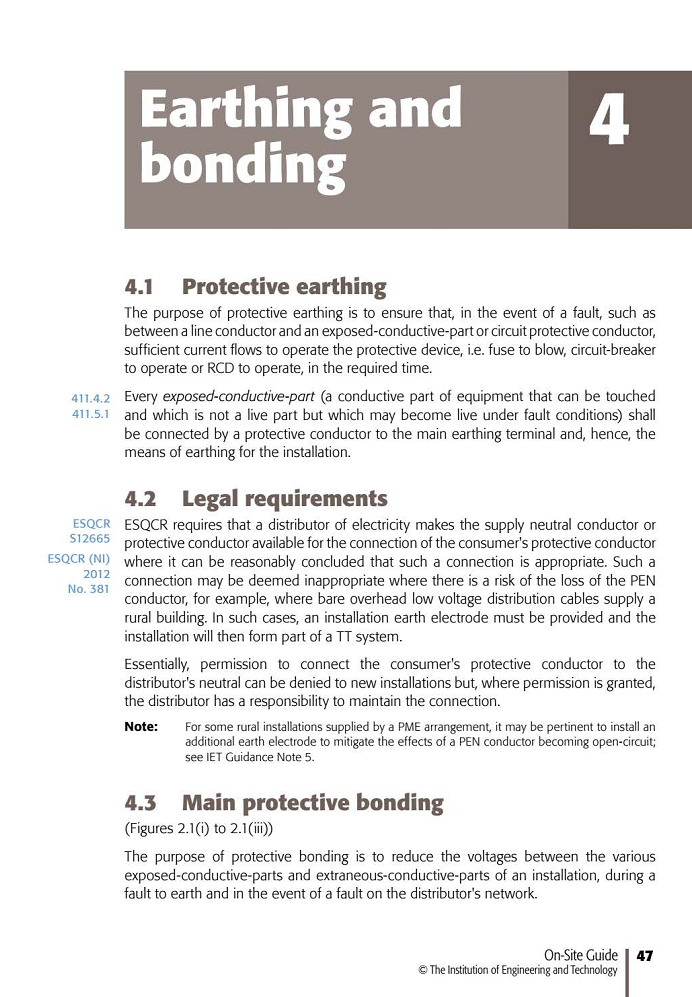
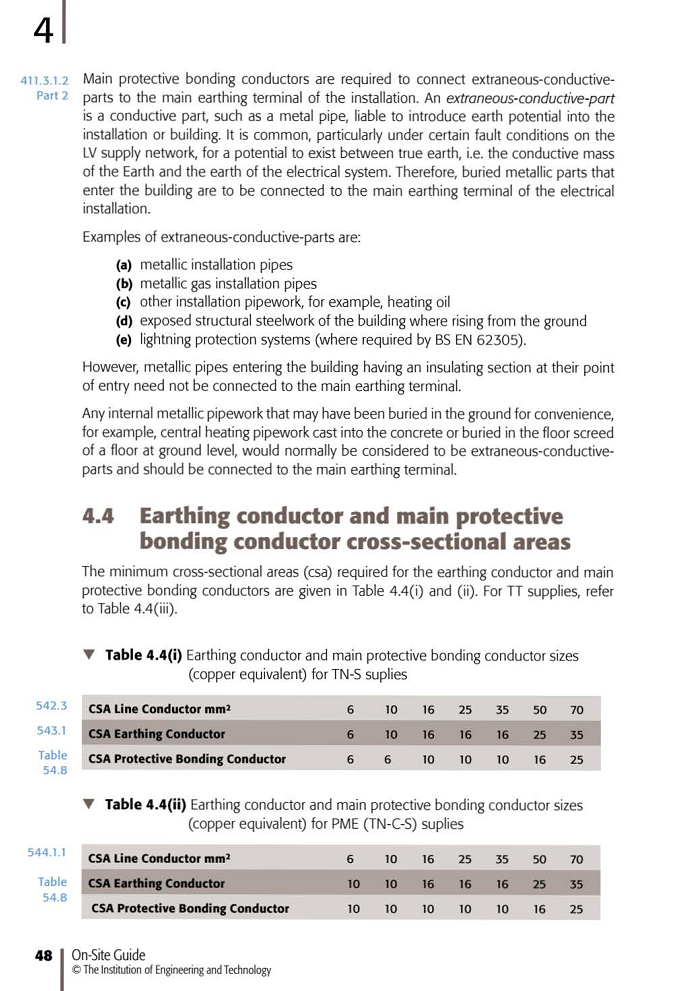
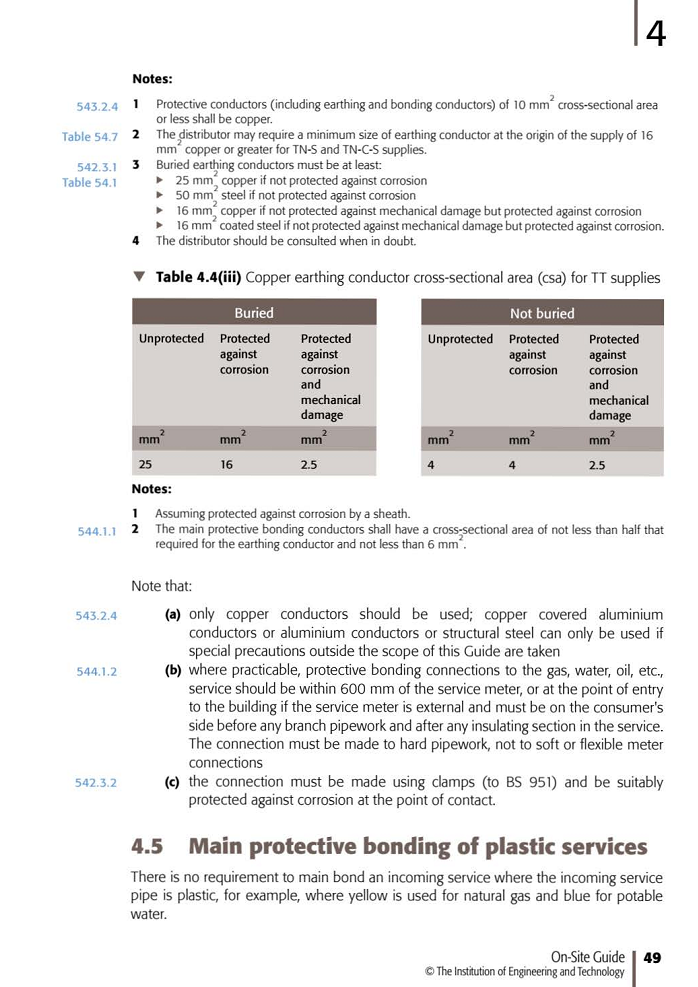
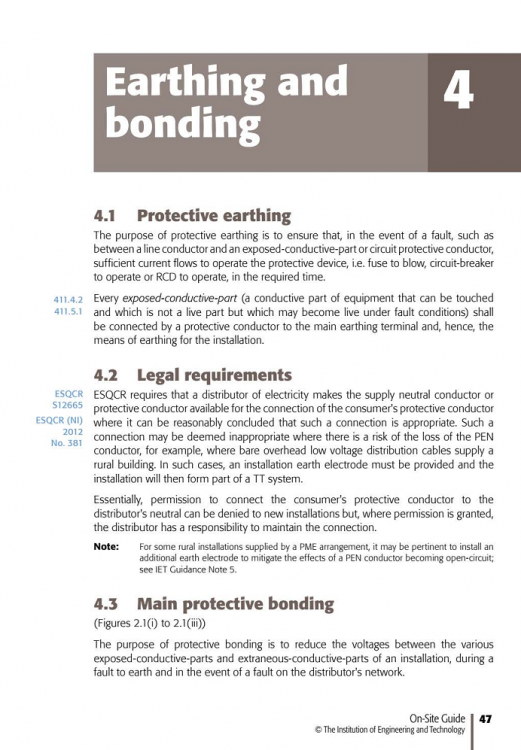
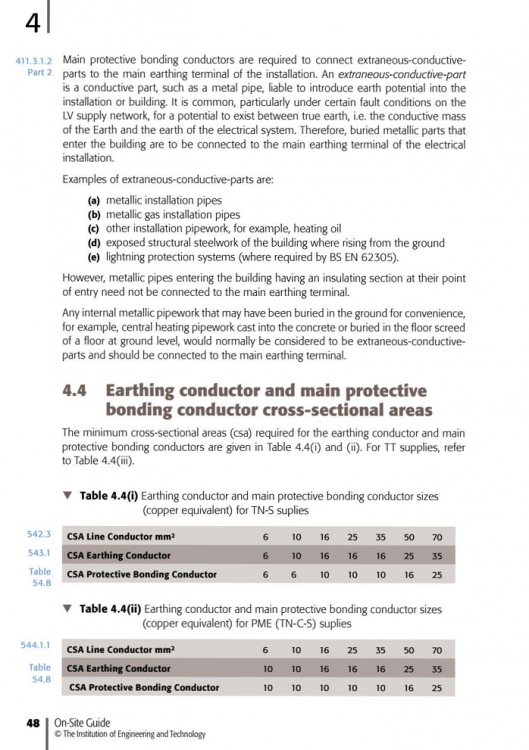
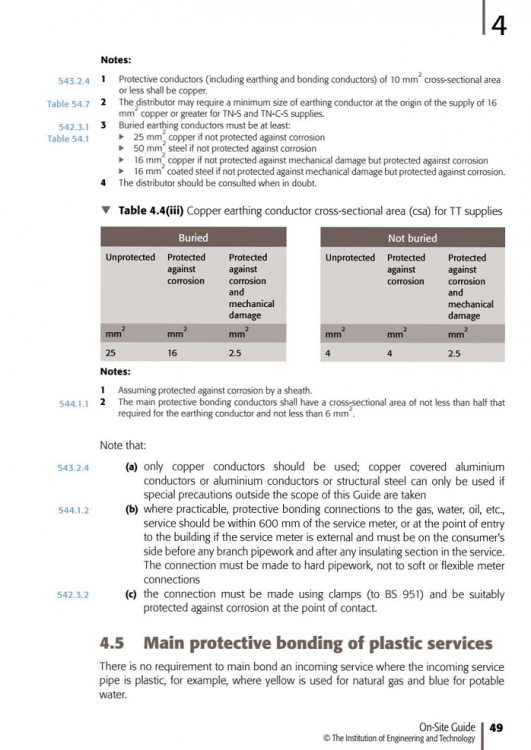
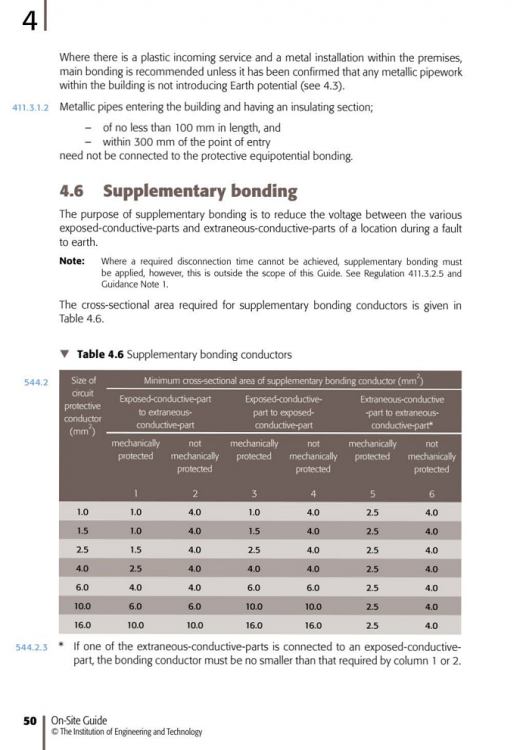
You must have a 10mm² main protective bond from the incoming copper water main back to the main earth block where the PEN is connected. There is no need to equipotential bond extraneous metal, like taps, sinks baths etc, and it's safer not to have them bonded. This is the relevant section from the current (18th Ed) OSG for reference (excerpt posted here under the "fair use" provision):
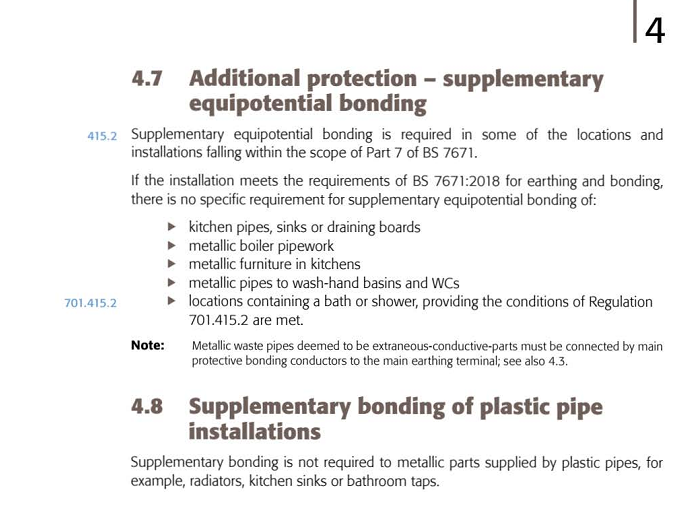
-
Not that long ago, either. Our old house was built in 1981 and everything was equipotential bonded. TBH, I'm not convinced that it was ever a good idea, even in the days when the majority of houses didn't have RCD protection. Thinking about it logically, providing a highly conductive touch path to earth is pretty daft. Arguably, chucking an electric fire into a non-earthed bath with someone in it probably wouldn't result in them getting an electric shock, whereas if the bath was metallic and earthed they almost certainly would.
-
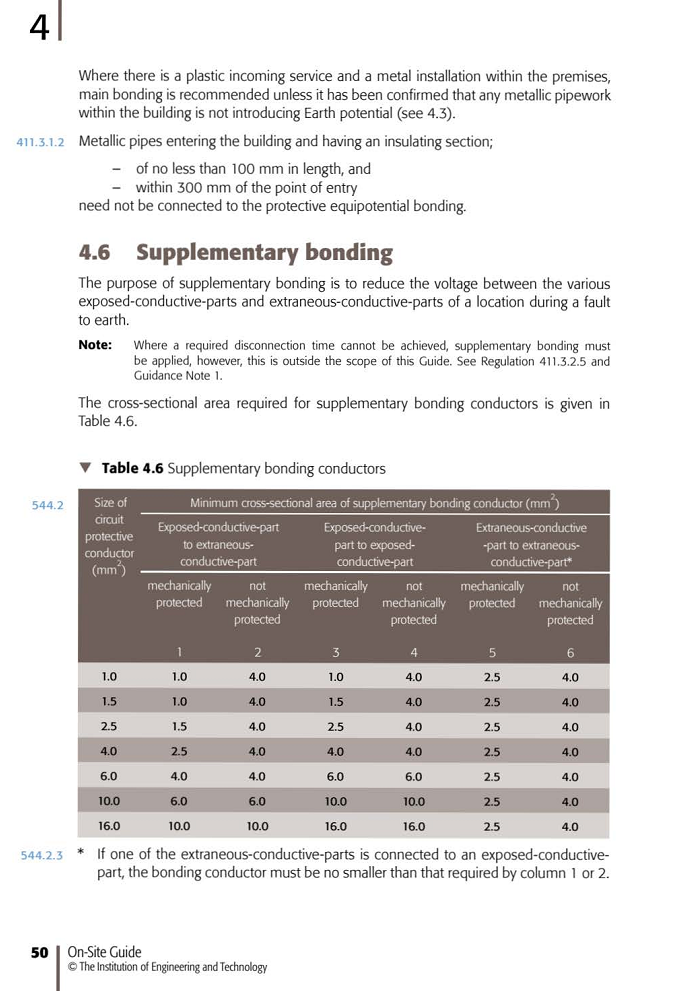
There are two separate issues here, one is main protective bonding plus supplementary bonding and the other is supplementary equipotential bonding. Main protective bonding is still required for all metal service pipes coming into a house, even if some of the piping in the house is plastic. Water (including metallic waste pipes), gas, oil etc, plus lightning conductors and structural steel frames have to be protectively bonded. The minimum size of protective bonding wire has changed over the years, but for a TN-C-S/PME installation (which is what most will have) it is now 10mm² (used to be 6mm²). There is no requirement to protectively bond incoming plastic water or gas pipes. Supplementary bonding is used to bond extraneous exposed conductive parts to the incoming PE (usually when an adequate disconnection time cannot be achieved on test, as a way to ensure touch potentials remain below 50 VAC under earth fault conditions). Supplementary equipotential bonding (i.e. earth bonding by an additional conductor, other than one in the supply cable) is only required for a very few special locations now, like electric showers and electric water heaters (if this is mandated in the MIs). There is no requirement to run equipotential bonding wires to metallic sinks, baths, basins, taps, metallic pipework, boilers, etc. It's worth noting that earthing exposed metal parts that are not associated with the electrical installation may significantly increase the risk of serious electric shock, by providing a highly conductive path to earth that may be easily touched. It definitely is not safer to do as @scottishjohn suggests, best to follow the regulations, which have been amended specifically because this risk was recognised.
-
Anyone fitted a pre-charged aircon unit?
Jeremy Harris replied to Jeremy Harris's topic in Air Source Heat Pumps (ASHP)
After one night, the answer is a partial yes, turning the air con off during the night does sort of work, but the bedroom was up at about 22°C this morning. Not too bad, but a quick wander around with the IR thermometer shows that the walls are all sitting at around 22.5°C, even those on the North side, so my guess is that a few hours of running the air con yesterday evening didn't take much heat from the internal structure, and that just radiated heat back into the room through the night. We could leave the unit on all night, at it's lowest setting, but I'm going to try just keeping it on all day today, to remove as much heat as possible from the internal structure, furnishings etc, and see what that does. I suspect I can get it to work much like the under floor cooling, by sucking heat out during the day, when the PV is generating, with the house then remaining cool overnight. -
Anyone fitted a pre-charged aircon unit?
Jeremy Harris replied to Jeremy Harris's topic in Air Source Heat Pumps (ASHP)
Thanks, @joth, the unit seems to work fine. My main regret is in not having realised that we might need more cooling earlier, and including ducts to run the pipes and cables during first fix. What I should have done, perhaps, is just make provision for running pipes from the UFH up to fan coil units, together with cabling, as we have lots of spare cooling capacity from the main ASHP, all we need is more cooling upstairs (downstairs seems fine with just the floor cooling). You could run insulated 1/4" and 3/8" copper pipes in, ready to be flared and connected, as that seems to be the standard size for small to medium power indoor units. I'm afraid I don't know how the multi-split systems are connected, but would assume that they have a radial piping system from the outdoor unit. The copper piping is reasonably flexible, if a bit awkward to handle, so pre-installing it may make sense, rather than just putting ducts in place. -
FWIW, if our ASHP pumps water at 12°C into the UFH, the surface of the slab never seems to get colder than 18°C, so at 15°C flow temperature I'd say you should have no condensation risk at all.
-
FWIW, our Genvex controller has one of these sensor-type screens, that is supposed to light up when you wave your hand over it. That works randomly, too, and I've yet to find out exactly where the sensor is that turns the backlight on, or why it behaves as it does. My guess is that it's just typical flaky technology. Seems normal now for manufacturers to produce flaky stuff. Perhaps it's just a function of a whole generation growing up with tech that falls over, needs rebooting, constant updates, etc, so we don't have product designers who value making things that just work reliably, all the time...
-
I can understand their concern about the possible need for sensors, as it's conceivable that there could be a floor condensation problem if the floor got too cold and the humidity level was very high. I was worried about it when I first thought of switching our system to cool the floor, but realised after some experiments that the floor just doesn't get close to being cold enough to cause a condensation risk. I think the coldest I've ever measured at the floor surface is about 18°C, which is more than enough to cool the house a fair bit, but with a room temperature of 22°C would need a relative humidity of around 78% to pose a condensation risk. Today's been pretty humid, but the highest I've seen indoors was about 55%, and that's a fair bit higher than we normally see, it tends to sit around 40% to 45% much of the time. Hopefully your friendly installer can alter the wiring to get this working, as if it works as well as both ourselves and @jack have found it should definitely improve your comfort level on days like today (and, I suspect, the next couple of days). What tends to cause our house to get a bit too warm is a few consecutive hot days, without cool nights. It looks as if the temperature isn't going to dip below 20°C here tonight, and that, combined with much of the day being over 30°C, tends to build up the temperature in the fabric of the house, such that it will gradually get warmer with every additional hot day. Still, I've just checked and our bedroom is now sitting at 19°C, so I think we should be able to sleep OK. Pity we cannot just send "coolth" as an attachment to a post here to help others stay cool in this weather.
-
I can dig the correspondence file out and check, but off the top of my head I think the mortgage deed cost something like £200 to £300. If it had been more than this I'd have remembered!