


Jeremy Harris
-
Posts
26430 -
Joined
-
Last visited
-
Days Won
360
Everything posted by Jeremy Harris
-

Your Home Base Load / Background Power Draw
Jeremy Harris replied to MrMagic's topic in Photovoltaics (PV)
If you need an always-on PC, then there are some very low power, passively cooled ones about. We have two of these, one with a Core i7-7500U, one with a Core i7-8550U. Both sit at around 7 W most of the time, less than 1 W on standby, and never more than 15 W. One has 8Gb of RAM, the other 16Gb, and both are fitted with Samsung Evo SSDs. Although the Core i7-8550U is supposedly about twice as fast as the Core i7-7550U I can't say I've seen any difference at all between them. As these machines have turned out to be reliable, low power and have reasonable performance, I've been thinking about buying one of the same companies multiple Gigabit Ethernet port machines as a firewall/router. The company is Hystou, in China, and their basic kit seems very good, although best to get a barebones machine and fit decent RAM, SSD etc. Also their WiFi cards are not great, but I removed these and blanked the antenna holes, as we have no need of WiFi, and removing the WiFi card reduces the power very slightly. -
From the photo, it looks as if this is just an inspection chamber located within your own private foul drain run, not a public sewer manhole, so a 450 should be OK. Note 7 to Table 2 refers to manholes that run down to a sewer, not inspection chambers (they are covered in Table 11).
-
The plastic ones come as a complete kit, with lid, etc: https://www.drainagepipe.co.uk/complete-inspection-chamber-sets-c-248/
-
Just what I was thinking! Has to be better to just replace it with a plastic one, I think. I doubt it'd be any more work, either, as there's a fair bit needed just to repair that chamber from the look of it.
-
As a fair few here may remember, I went through a pretty mentally tough time when building our house (it's in this blog entry: http://www.mayfly.eu/2015/08/part-thirty-seven-a-long-tale-about-water-and-life/ ). One thing I stuck to after this was having weekends off. I pretty rigidly kept to that, even though it slowed the build down. Damned glad I did, as I'd rather be criticised for being slow to finish than end up in the state I was back then. PS: I also used the "90%" joke, here: http://www.mayfly.eu/2014/04/part-twenty-eight-90-finished-so-only-around-90-left-to-do/
-
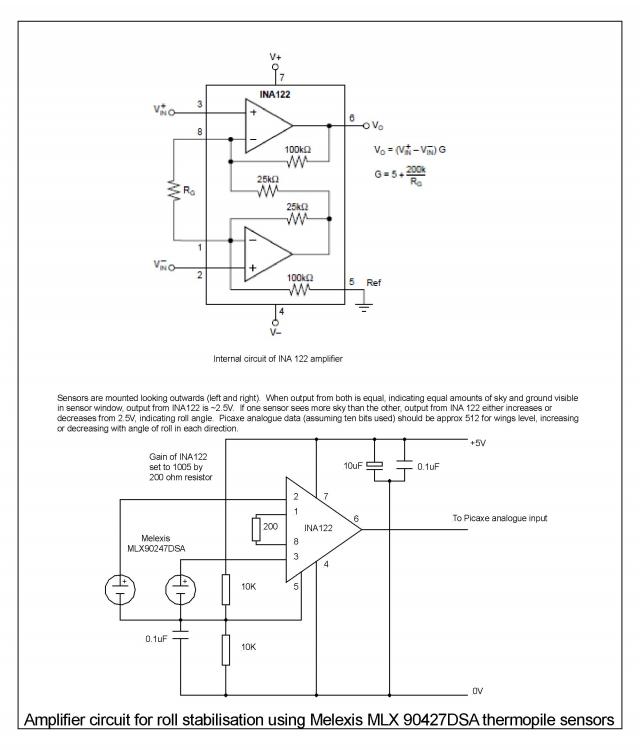
Just dug the box out. Seems I have a handful of Melexis 90247 sensors: Melexis MLX90247_v2.pdf Looking back it seems that I used an INA122 low noise instrumentation amplifier to get a large enough signal to feed into a microcontroller A/D input: INA122.pdf Not sure if one of these would be any use to you. I may well have a spare INA122 knocking around too. I found the circuit that I drew up years ago of my prototype "wing's level" IR sensor unit too:
-
Not sure I understand what you're trying to say here. How can anything become "less radiant" by being heated? Water in a closed pipe system cannot radiate heat at all, all it can do is conduct heat to the walls of the pipes or whatever it is contained within. In the case of a wet underfloor heating system, those water-heated pipes can then conduct heat into the sub-floor. In our case the UFH pipes are set into the floor concrete slab, so they conduct heat into that slab. In turn, the surfaces of the slab conduct heat into their surroundings, with the majority of the heat moving upwards into the floor covering. Radiation starts at the interface between the floor covering and the air in the room, with the wavelength being largely determined by the surface temperature (in accordance with Planck's Law and Wein's Displacement Law) and the amount of heat radiated determined by the differential temperature between the surface and its surroundings, together with the surface emissivity. As I mentioned earlier, I agree that comfort is a personal thing. In a previous reply I mentioned this with regard to the reduced emissivity of 3G windows, when compared to 2G ones, an effect that seems largely related to the way our skin can sense the reduced radiated heat loss when surrounding services are at an apparently higher surface temperature.
-
Yes, I did. What you refer to as FIR is the same as IR-C. What seems to be very clear is that IR-C only penetrates as far as a few µ into the epidermis, where it then gets conducted as heat into the underlying tissue. The effect is going to be pretty much exactly the same as applying a hot compress or similar, and we know that this can work well for some types of pain relief. As for claims about cures for ailments and illnesses them I'm nowhere near qualified to judge. What I have seen a great deal of are unsubstantiated reports of many apparent cures, which when tested properly are nothing of the sort. Damned hard to test medical treatments, though, as the placebo effect is often as powerful, perhaps even more powerful, than many accepted treatments.
-
I've got a box of various Melexis IR sensors around somewhere. Can't recall which ones offhand, but I can try and dig them out and check. I used them to make an aircraft artificial horizon, by sensing the boundary between the ground and the sky. Not exactly 100% successful as a project, but good fun. It semi-worked, but the idea was to try and build a cheap and cheerful gadget that would allow the pilot of an aircraft without IFR instruments to be able to get out of trouble if he/she accidentally flew into cloud.
-
Your Home Base Load / Background Power Draw
Jeremy Harris replied to MrMagic's topic in Photovoltaics (PV)
One of the plug-in meters would do the job, perhaps like this one: https://www.screwfix.com/p/energenie-ener007-energy-saving-power-meter-socket/3477h or one of these: https://www.amazon.co.uk/plug-energy-meter/s?k=plug+in+energy+meter -
Best to remove it and replace with normal plastic soil pipe. Sooner or later the pitch fibre pipe will give trouble, as it had a service life of about 40 years, and I think we stopped using it around 50 years or so ago, so it will already be past the end of its useful life.
-
Yes, the first law of thermodynamics applies, and it is physically impossible to prevent a primarily radiant heating system inside a house from not heating up the whole of the house until a state of thermal equilibrium is reached. This is exactly the same as for any other heating system, where all the internal surface temperatures will end up being heated, directly or indirectly, by whatever heating system is used, until the point is reached where the rate of heat input to any surface exactly matches the rate of heat loss from that surface. It's worth noting that wet under floor heating is primarily a long wavelength (IR-C) radiant heating method, as only a relatively small proportion of the heat transfer to the room is from wet UFH is by conduction/convection. The rate of heat loss from external walls, roof and floors will be governed largely by the thermal conductivity of those fabric elements. The rate of heat loss from internal surfaces will usually be smaller, and governed primarily by ventilation loss (the loss mechanism is from conduction from the surface to the air, and then convection away from the surface by air movement). For a house with a low ventilation heat loss (pretty much any house that is fairly airtight and has MVHR, as the majority of those here are building) then the heat loss rate from wholly internal surfaces and objects will be pretty small, so they will all end up at a temperature very close to the air temperature. Measurements I've made in our own house show that the walls, ceilings, and furniture all tends to be within about 0.2°C of the room air temperature. The floor is usually around 0.5°C to 0.8°C warmer than the rest of the internal surfaces, because of the UFH (during the heating season).
-
Interesting paper, and it seems to support the suggestion I made earlier in this thread, based on the evidence from the other paper I linked to, that long wavelength IR (IR-C) doesn't penetrate beyond a few µ into the epidermis, but gets absorbed and heat is then conducted more deeply into underlying tissues. This fits with the popular view that applying heat locally to the body can alleviate aches and pains (certainly my mother felt that using one of the pig lamps eased her pain from arthritis). Edited to add: This graphic seems useful in illustrating the depth of skin penetration of wavelengths from UV-C through to IR-C:

-
That's an old pitch fibre pipe. They were used for a few years, then abandoned, as they tend to collapse with time and cause blockages. They can be lined, using a pressurised internal sleeve system, to limit the amount of collapse and internal delamination, but this isn't really ideal. Best to remove and replace it if you can, as sooner or later it will end up causing a problem, in all probability.
-
We also have Indian sandstone laid as paths and patios around our place, and the chap that laid it had previously been caught out, years before, when using the "Tommy Walsh" method, with dobs of mortar. He went on at length about the need to lay slabs on a solid bed, and related tales of having to remove and relay some of his early work because of this problem. I've had a look around, and sadly I've been unable to find any solid evidence to suggest that this staining can be removed. The oracle on all that's paving suggests it's permanent: http://www.pavingexpert.com/stain_reflective_01.htm . Not sure if anyone else here knows anything more. As the stone will have to be lifted, then you might want to try cleaning one or two slabs up, getting rid of any mortar on the backs and perhaps trying something like mortar cleaner to see if that will remove or reduce the staining. Mortar cleaner is just dilute hydrochloric acid, so should dissolve any salts fairly easily, and it's unlikely to harm the slabs. As you've really got nothing to lose, it seems to be worth trying.
-
Yes I did, which is exactly why I wrote this first sentence, that you have quoted:
-
125mm non-standard bends?
Jeremy Harris replied to phatboy's topic in Mechanical Ventilation with Heat Recovery (MVHR)
Bear in mind that you must have short lengths of flexible duct at the connections to the MVHR, in order to isolate vibration. If you fit rigid duct to the MVHR then there is a risk that the vibration from the fans will pass into the ducting. Most MVHR MIs include mention of this, but even if they don't it's good practice, as is mounting the MVHR itself on some form of vibration isolating mount. The need for short lengths of flexible duct may get around your bend problem. -
OK, I'll wait to review your evidence. I hope that it's been properly peer reviewed, as it needs to in order to be compared fairly with the published data. I don't doubt that you have expensive test equipment, I used to be head of the RCS and IR measurement facilities at what was then the Defence Research and Evaluation Agency Funtington Range, (now run by Qinetic, before that it was a part of the Admiralty Surface Weapons Establishment). The IR measurement equipment we had cost a few £M, and was primarily used to measure IR signatures of ships and aircraft, in order to research ways to reduce them. Just maintaining the cryogenic bolometers used in the sensors cost a fair bit. FLIR room temperature sensors are sort of OK for non-critical comparative analysis, but they are, like all IR imaging devices, highly dependent on the surface emissivity of the object being measured, so they will only give accurate results when their image output is adjusted for the specific emissivity of the various surfaces they are looking at. This requires emissivity measurements to be made of the surfaces, so that the required adjustments can be made when post-processing the data. Fluke have a short, non-technical, user guide that covers emissivity and the issues it can cause with thermal imaging fairly well: 2563251_6251_ENG_B_W.PDF
-
Interesting site. Not sure about the prices they are using though. We pay 15.729p/kWh peak rate, that site quotes 20.99p/kWh peak rate. We run our ASHP for heating exclusively on the E7 rate, which is 8.148p/kWh. Using their ASHP COP, then at peak rate the cost would be 5.8p/kWh and at the E7 rate we use the cost is really 3.01p/kWh, much cheaper than mains gas. In reality, our ASHP always runs with a COP of well over 3, usually around 3.5, so the true running cost is closer to 2,5p/kWh, much less than half the cost of a boiler running on mains gas.
-
TBH, and without in any way which to be rude, I'm not at all sure you have really looked at the evidence. FIR and IR-C are pretty much the same thing. In general, long wavelength infra red is defined as being a wavelength of around 3µ to 50µ at the shortest wavelength to 1000µ at the longest wavelength. This paper that I linked to earlier in this thread: http://ec.europa.eu/health/scientific_committees/emerging/docs/scenihr_o_035.pdf seems to show that IR-C/FIR only penetrates the skin to a depth of a few µ, so doesn't get anywhere near the 30mm penetration claimed earlier. If you have peer reviewed evidence that shows that IR-C/FIR does penetrate deeper than the epidermis, then it would be interesting to see it.
-
The hard evidence suggests otherwise, especially for an ASHP that heats up a high heat capacity slab, via UFH, using E7. I'm 20 miles or so from you, and you're more than welcome to visit, look at our systems, and then say that an ASHP costs more, or uses more primary energy, than a gas boiler (we have had both, a condensing Vaillant combi, and now a 8 kW ASHP that only ever runs on E7 when heating the house. One key aspect is that UFH only needs a low flow temperature (never more than about 28 deg C), so is very well matched to the most efficient operating conditions for an ASHP, and less well suited to the typical operating conditions for a gas boiler.
-
No, mains gas. UFH running from an ASHP is already slightly cheaper than mains gas at normal electricity rates. At E7 cheap rate it's about 30% cheaper to run than a mains gas boiler.
-
That was a problem I had when I had the Portapak, house insurance wouldn't cover the storage of oxyacetylene bottles at all. I used to keep the thing in the back of my car, just to get around the insurance problem. Not sure it was in any way safer, mind!
-
I agree, as the efficiency is likely to be much the same, but an E7/E10 system will have a significantly lower running cost, due to the use of cheap rate electricity. We run our UFH exclusively from E7, and this reduces the cost by over 30%, making it significantly cheaper than heating the house using gas.
-
The upper and lower bound seems to be 1350nm and 650nm respectively, set by the start of strong absorption by blood and water. This article gives more detail: http://ec.europa.eu/health/scientific_committees/emerging/docs/scenihr_o_035.pdf From that article it looks as if long wavelength IR barely penetrates through the skinss epidermis, so not very deep at all (µ rather than mm). Certainly doesn't look as if long wavelength IR penetrates the human body to anywhere near 30mm depth. What I suspect happens is that the surface of the skin warms from the radiated heat (skin isn't far off being a black body, with an emissivity of about 0.98), and this warmth is then conducted into the underlying tissue where it is felt.



