chrisb
-
Posts
95 -
Joined
-
Last visited
Everything posted by chrisb
-
I'm approaching the point where I need to crack on with covering my new extension flat roof (approx 5m x 5.5m) deck. It's currently 18mm T&G OSB over firrings over posijoists. The room underneath is a ground floor kitchen / dining/ living open space, with a study / playroom on the side. GRP is going to be the waterproof covering, done by my builder. So the remaining questions are insulation (type, thickness & supplier) and VCL +/- another deck, with or without pre-laminated sheets. 140mm PIR or greater seems to be sensible. I think any old PIR will do, foil faced is unnecessary? I have seen references to T&G PIR and PIR with a fabric coating that GRP can stick directly to, but the GRP systems seem to demand a timber deck underneath, not PIR, so not sure how useful these boards really are? I've seen some plywood/PIR laminates, which could go under the GRP, but not sure how these work out cost-wise yet, and I think the ply is only 12mm where the GRP systems demand 18mm, so not sure if they're an option yet either. I'm thinking that pre-laminated sheets may be better given the season. Suppliers on the web seem hard to come by though. All advice welcome!
-
Can you use a momentary grid switch and indicator and a contactor to deal with the 6kw load? Then the switch can be anywhere and the contactor located to reduce the necessary (expensive) high-current wiring.
-
I think I've worked out that I need a buffer 100l or perhaps slightly larger. I've picked up a 250L UVC from eBay brand new at a bargain price. For the buffer, is there any reason why I cannot use a UVC, but connecting to the top and bottom ports, ignoring the coil? eBay UVCs seem fairly available, but not small buffers......
-
UFH in slab or screed, eps or pir insulation?
chrisb replied to Tin Soldier's topic in Underfloor Heating
The issue seemed to arise because when standing on the mesh, even without the UFH pipe attached, it gets bent a small amount (as it's held on 50mm chairs). This tends to lift the edges of the mesh upwards where it pivots on the chair. After attaching the UFH pipe, this is then harder to level out as there is now pipe tied to the mesh on one side, holding it in that position. In the end, there is no UFH pip, or mesh at the surface, so I think all is fine. -
UFH in slab or screed, eps or pir insulation?
chrisb replied to Tin Soldier's topic in Underfloor Heating
Take it to the car park at Selco in Slough and someone will rob you pay good money for it! Seriously, take a look at eBay. There was hardly anything around when I was looking a month ago. -
UFH in slab or screed, eps or pir insulation?
chrisb replied to Tin Soldier's topic in Underfloor Heating
Depending on when you intend to do this, you may encounter supply issues with both EPS and PIR. This has been the case over the last month or so with my extension. I have 250mm EPS in the new extension and 150mm PIR in the existing kitchen (floor dug up and replaced). -
UFH in slab or screed, eps or pir insulation?
chrisb replied to Tin Soldier's topic in Underfloor Heating
I've just done this - see other thread that I can't link to on my phone :-( Don't underestimate the work involved in cable-tying UFH pipe to mesh. Also, walking on the mesh (necessary to install pipe) caused it to bend and lift in places. The builder and concrete chap were concerned about it rising up when the concrete was being laid. We had a 120mm slab. In the end, the whole thing took an extra 2m3 of concrete as the EPS underneath compessed, so the actual thickness is a bit more than 120mm. Perhaps consider 150mm slab thickness so you have no worries about covering the mesh/pipes? Chris -
I'm coming round to the idea of a pressurised system with buffer and UVC. So, how big a buffer and UVC? Can the rads come off the buffer so I can regulate the temperature with a TMV? I'm guessing the 30kW boiler is still valid, but a system boiler now.
-
This should be reflective of the number of spaces making up a zone. A zone can have multiple Ufh loops heating it, for eg an open space kitchen diner could have 4 Ufh loops but only be controlled by a single thermostat. That thermostat would open and close those 4 of the manifold actuators in unison to govern the room temp. Most important would be making sure they're not in direct sunlight or in any draught. My bad - I meant thermostats on the TS, not in the rooms for UFH. Eventually I'd like to do some more intelligent monitoring/control with a Pi or similar, but will need sensible stuff at first so it 'just works'. A sealed system would require G3, so yes, going open pipe ( vented ) would negate that. You don't need to have an open system and you will suffer a lot more conviction / evaporation heat loss with a TS that's connected to an f&e tank and its associated pipework. It will self - maintain though, and never need any 'topping up' manually as you have to do when sealed and pressurised. I think I understand this, but just to be sure: Open Pipe/Vented means having a F&E tank in the loft, with a feed pipe from the bottom of that tank to the bottom of the TS. Also, a pipe from the top of the TS runs up and discharges over the F&E tank. This arrangement means that the TS, rads, UFH and boiler are all running at low pressure as defined by the height of the F&E tank above them. A system boiler cannot be used with this type of system. Am I on the right track? The alternative would be to pressurise the whole system with a system boiler and fill loop, but this results in needing G3 compliance.
-
Now that the UFH pipe is in, and slab about to go down, I'm now beginning to think about this again a bit more seriously. UFH Load as calculated by Wunda is max 5kW. I also have 2 small towel rails, three small rads and one large rad covering non-UFH rooms. I'm hoping that the plinth fan convector is now redundant with the UFH now in (although my wife loves it for drying clothes). Current mains water supply is in 15mm copper at least under the slab in the kitchen (we found it). It runs inside a 4" pitch pipe as a duct to the front of the house and to the road. The last 300mm was running direct in concrete before popping out under the sink. it has plenty of corrosion and dents. I'm likely to replace it with 32mm MDPE when we have the drive relaid (planning condition, so not too far off). I guess mains flow will increase afterwards? This is what I'm thinking so far: 300L TS on @Nickfromwales advice - no idea which brand, material, model etc Tappings to UFH manifold from the bottom to get low temperature? Do I need a pump TS-->UFH, or will the UFH pump do this? Do I need a 2 port valve here to stop convection when UFH is off? Tappings for rads from the middle of the TS, with a TMV, pump and 2 port valve to stop convection? DHW coil in the top with TMV. Should I have a pair of tappings here too, incase I want to convert to FPHE later for increased DHW flow? Tappings for boiler - not sure of best place for these? 2x 3kW Immersion - bottom and mid-position, partly to give some redundancy, but also for future PV. Additional questions: Should I be hydraulically separating the UFH circuit from the rads to prevent muck going down the UFH pipes? How many thermostats should I have and what position should they be in? As the TS will go in the garage, and the rads are upstairs, I think I'll need to keep the F&E tank in the loft to maintain vented status and thus not require G3 compliance? The 30kW boiler: should it be heat-only, or system? I think system won't do for vented TS, so it should be heat-only, with a pump to circulate water through the TS. Am I correct? Recommendations for the boiler would be great. Thanks all Chris
-
Just to close this thread, after removing all the screed and deciding I'd had enough of breaking concrete, I handed this over to my builder who has done exactly what @Nickfromwales said above. New slab gets poured tomorrow.
-
Your broadband speed is going to limit some options here, unless you're prepared to set up a router that will do QoS properly to ensure that there is protected bandwidth available for VoIP. My first suggestion would have been to port your numbers to a VoIP provider and bring them in over IP, retaining one or two POTS lines as a backup, but I think with only 6.5Mb/s download, and far less upload, this isn't going to work. I'm guessing that you are on ADSL and aren't likely to get VDSL or Virgin for a very long time, if at all? So you need to convert your two POTS lines to IP using one or more devices with FXO ports. A quick eBay search finds this which looks fine for the job. Either you can connect your IP phones to the SIP trunks produced by the above device, or for more features, you can add a PC of some description - a Raspberry Pi will be fine. This will need to run Asterisk, and probably FreePBX - a GUI front-end to administer it. This will be essential if you want to be able to transfer calls between phones, and make simple calls between extensions, amongst other things. There are various places offering prebuilt IP PBXs based on Asterisk. I have always rolled my own as then I have control and some reassurance that it's not locked down, or 'dialling home'. You can then take your pick of VoIP phones. I like Snom, but pretty much any SIP phone will be fine. PoE is very much a feature of most manufacturers products. I much prefer a phone with a decent web interface to manage the settings and phonebook etc, but most are good for that kind of thing these days. Yealink is slightly less well-rounded than Snom, but still perfectly reliable and I know several offices running on them without issue. Beware of routinely using the built-in switch on any phone to routinely plug in a PC etc. Not all of them are gigabit, also, if you reboot the phone for a config change etc, it usually reboots the switch too, which can be annoying. I've just looked around a little, and it seems that there are some more options for SIP/DECT handsets. I have no experience of these, so can't offer a personal opinion here. Most of them look far more acceptable than the majority of wired phones though, given some at least will be in the domestic setting. You can connect POTS phones using an ATA to turn the SIP into an FXS port. Useful for a fax machine or Sky box. Also if you already have a phone(s) that you want to keep using. Alternatively, Draytek make some nice routers which have built-in VoIP capability - the fully fledged IPPBX is pricey, but does keep things simple, and relieves you of several hardware boxes and the complexity of Asterisk. I am not aware of any other manufacturers which do anything similar suitable for home use. Whatever you do, please make sure that you use strong SIP passwords. A hacked SIP account used to make continuous multiple calls to a Russian premium-rate number can be very costly! If you need a VoIP (or broadband) supplier, I can highly recommend Andrews & Arnold as a satisfied customer. I hope this is of some help, and that I am interpreting your answers above correctly. Chris
-
I have a VoIP phone service at home. Primarily because it costs me £2.50/month, and gives me a nice incoming number with voicemail to email. Really only used for incoming calls, and ringing the mobile when I can't find it. I don't have a copper phone line at all - internet comes from parents in law house by wireless bridge about 100m away. There are a few things to think about which I mention as a result of my experience over 10 years of doing this, and working with another 6-phone IP system for a voluntary organisation I'm involved with. It's of no use whatsoever if you have a power cut, unless you have battery backup for every piece of kit involved. Don't rely on your mobile for use during power cuts - many cell sites are not backed up. Cordless VoIP phones are quite difficult to come by, and expensive with relatively limited features. Corded VoIP phones are available in many styles/designs, but none I've found at a sensible price point have a high enough WAF for domestic use! Things can end up quite complex, and if it doesn't 'just work' when you go to pick up the phone and make a call, it can get very frustrating for family (and you). You can end up with a really nice and fully featured system that does exactly what you want really well. I do, and its very economical I'm sure there are others with skills and knowledge to assist here too. To make it more helpful, we need a bit more info: What do you have at the moment? copper phone line? what type of broadband and from which provider? What are you trying to achieve by using VoIP phones / a PBX? Do you see your needs changing in the future? Do you need/want cordless phones in the house? Do you have knowledge / skills to set this stuff up, or are you willing to learn? (It's fun, and there are loads of opportunities to 'improve' things all the time, but if you aren't interested in tinkering a bit, I think you'll get frustrated quite quickly). What's your budget? Do you have a place for some hardware, or does all the kit need to be aesthetically pleasing?
-
There may be issues with fire resistance of your external cladding material. Your architect should be able to advise, it's well documented in building regs. I wanted to use brick-effect fibreglass at 5mm thick, rather than a 50mm cavity and 100mm brick wall - thus gaining an extra 145mm internal room width. Unfortunately we're semi-detatched and therefore I would need to maintain 1hr fire resistance in both directions through my walls. This would have meant adding additional fireproof board under the caldding which made it prohibitively expensive.
-
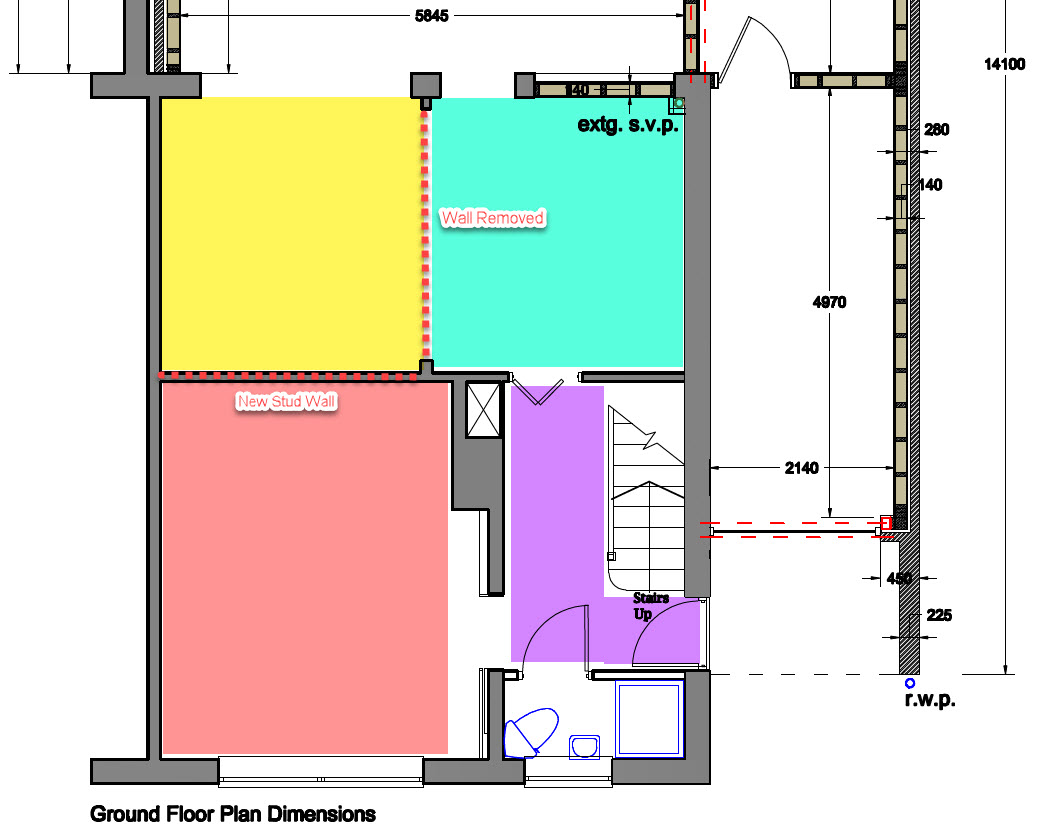
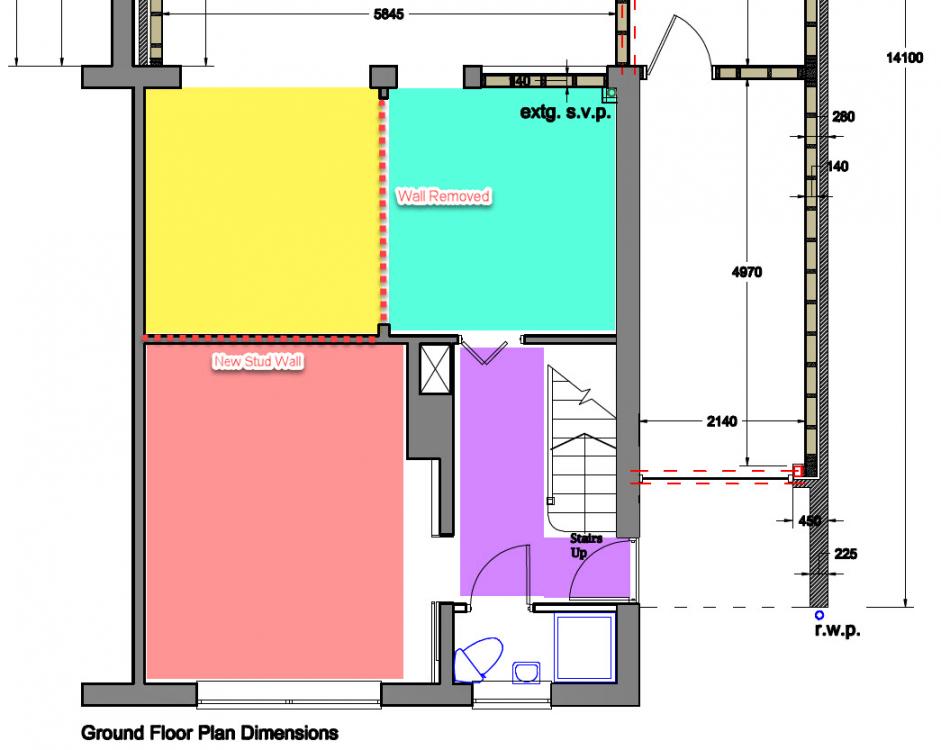
@Crofter the issue is that I only want to replace half of one of the slabs (the part at the back of the house), so the stones will naturally slide down into the hole as I dig, probably destabilising the section of slab that I want to keep. @Nickfromwales I hadn't thought of that. DPM is bitumen paint on top of the slab, under the screed. Along the stud wall will be kitchen units (600mm deep). I wasn't planning on installing UFH under them, and don't think I need to take the new slab all the way back to the stud wall. So long as the join is under the units, so it isn't uneven to walk on, I can't see a problem with this? Given I have about 500mm to play with under the units, I suppose I could break out the concrete slab, leaving the stones underneath. Then pour the wet mix, let it dry, and then remove the stones where I want to replace with insulation. The 'old' slab could then be reinstated with concrete over the stones. I thought a picture may be helpful. The yellow and pink parts are all one slab. No idea if there any footings underneath, and if so, where they may be.
-
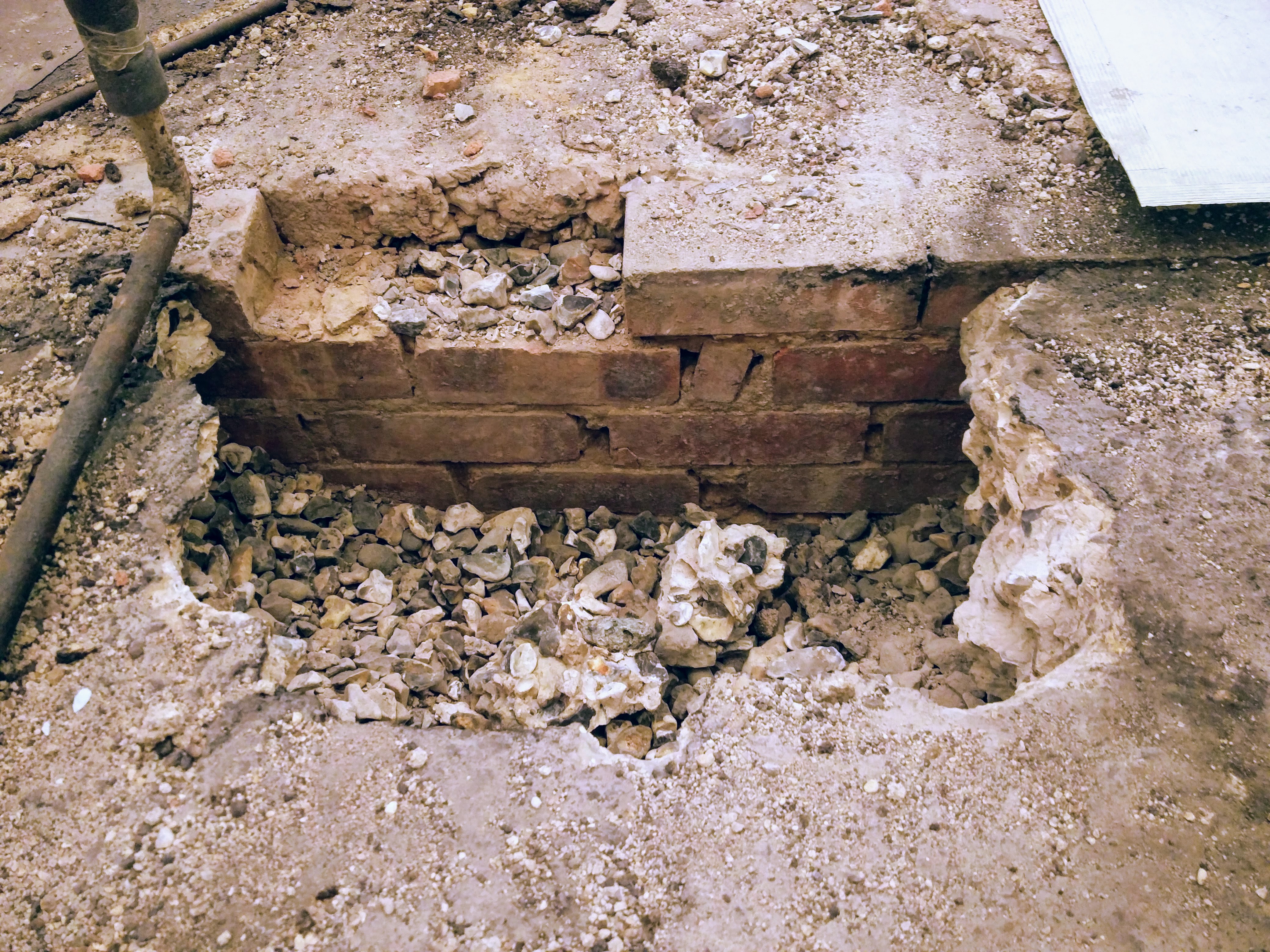
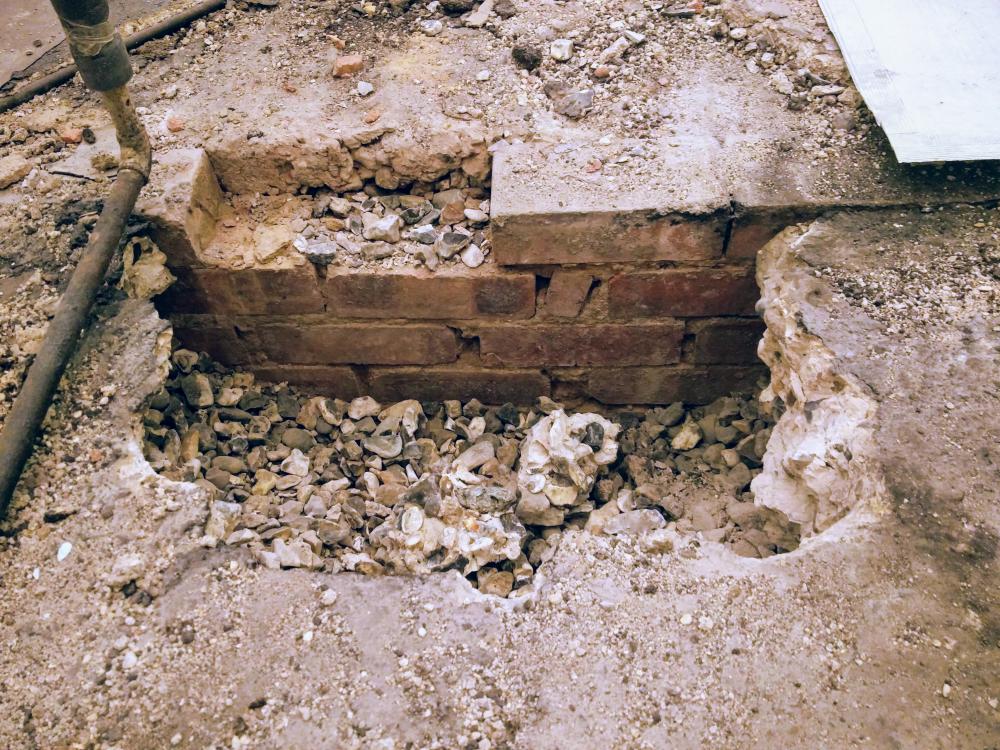
We're extending rearwards to create a large open plan kitchen / dining / living area. The existing kitchen / diner at the back of the house used to be two rooms (kitchen and back half of the lounge. I built a stud wall to divide the lounge and then took down the wall between the new room and the existing kitchen. The floor is very much less than flat, particularly in the middle where the wall used to be, but also around the edges of the lounge side of the room. The intention was to dig up the existing slab and relay with insulation and UFH as per the new slab in the extension. I have taken up some of the screed to expose the slab. The screed varies between 10mm and 55mm thick. The slab is concrete approx 50mm thick, poured directly onto approx 200mm 20-30mm stones/pebbles. First thought was to take all of this up and replace. This will probably be OK in the original kitchen as there is almost certainly a footing under the doorway, and there is a footing where the old dividing wall used to be. However, in the other side, (what used to be the back of the lounge), the slab runs the whole length of the house, so there is unlikely to be a footing underneath where I have put the stud wall. Any ideas how to prevent the stones under the front of the slab from being disturbed whilst I remove the stones from the back? I was thinking of some kind of shuttering, but not really sure how to go about installing it with 200mm of stones trying to slide around.
-
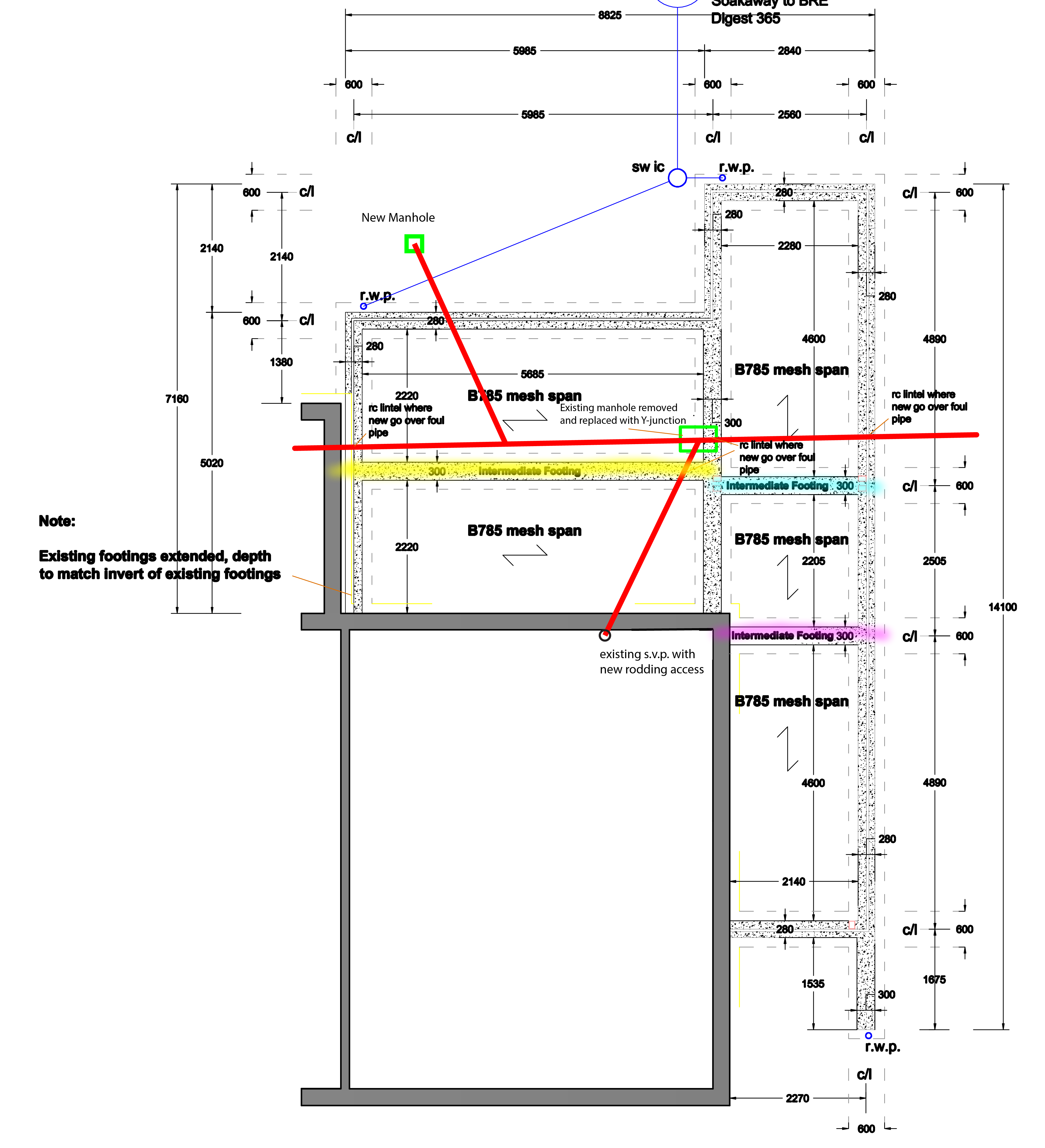
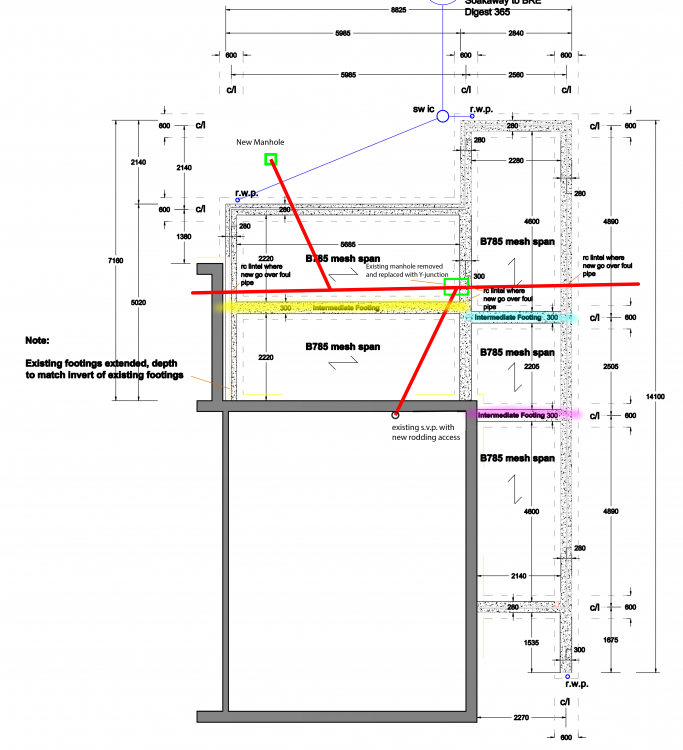
The next question is regarding intermediate footings. Since going to a ground-bearing slab, is there any need for the intermediate footing highlighted in yellow? I suspect that the light blue one will be required to take the load of the first floor walls which are directly above. Not sure about the pink one though, there is nothing above it. Is a function of the intermediate footings to provide a joint in the slab to avoid cracking?
-
Servicing included. I have mains services, the house is still habitable, but its easier than having door key issues and boots on my floor. The interesting thing is that we seem to have ground-nesting wasps in the front lawn, right where the bog will go. I'll soon see on the CCTV if any of the guys makes a rapid exit :-)
-
Just had an unbeatable quote for site toilet hire from http://www.tlcloohire.co.uk/ They charge £25 each way for delivery and £23/week. Initial hire is 4 weeks. They are not VAT registered, which helps me, but perhaps not everyone. Selco were the next cheapest I found and they started at £29/week +VAT. I have ordered a loo and will report on service in due course.
-
Great, thanks for the advice. I'll stick to 150mm.
-
I don't disagree @Onoff, and I may get what I asked for. I'm more concerned in the first instance on the hardcore thickness as there is significant cost /work involved.
-
So, the build is underway. Old garage removed and taken away, guys are working on drainage right now. I have been asked about the slab detail. The builder would usually use 150mm hardcore under sand blinding then DPM then EPS. I have the above design. He's confident that the 25mm EPS under the DPM is unnecessary as the blinding will be 25mm. The biggest issue is the hardcore thickness. What is acceptable? Does it really need 150mm hardcore? How should this be calculated?
-
Thanks @SteamyTea & @Nickfromwales. Sounds like ASHP is out - I thought that might be the case. Whole front roof is south facing, so PV is an obvious option, but I don't want to commit the capital now as it might mean no kitchen in 6 months time. Not sure i'd hear the last of that. I can add later when funds are certain. I'll run some cables for this purpose at first fix. Logically, I think my next questions are which model of gas boiler, in what size, and how big should the TS be? Also, should I look out for certain features? FPHE vs internal coil for DHW etc? @SteamyTea we're on mains gas, and as much as I love the idea of a sunamp (or two), the numbers just don't stack up right now as the repayment time would be excessive I think. Ref Hot return circuit, the new cylinder will end up no more than 3m from the kitchen and 5 m from the bathroom, so its probably not worth it. Kitchen and utility are currently the longest to wait for hot water, and the distances to those will be halved, so not really an issue IMO. Thanks Chris
-
Some may have seen my thread(s) elsewhere about our extension. Relevance here is to UFH installation, and also new space for boiler +/- something to store hot water in. Reading through the threads here and on the old place, I think I have four options, and I think I know I'd be best with a thermal store, but I'm losing the capacity to think objectively and would welcome some advice please. So we have what is now a 2.5 bedroom semi and will become a 4.5 bedroom semi. Currently one shower-over-bathroom and another shower-only room. We are a family of 4, with 2 young boys. Current showers are thermostatic (when not scaled up) bar mixers, both separately pumped. We also have a pump on the DHW for all but the shower room sink, otherwise 1. My fancypants kitchen sink tap only dribbles, and 2. the utility DHW isn't much better. The existing plumbing at the time made it easier to also pump the bathroom sink and bath DHW. DHW is fully pumped open vented with cylinder in airing cupboard in main bedroom. I converted this from gravity DHW, pumped CH a few years ago and never rearranged the feed and expansion pipes properly. Basically, I want / need to replace it, both for plumbing and space reasons. The boiler is a Potterton Kingfisher, so that's leaving too. Current heating is by panel rads in back bedroom and 1/2 size bedroom (both childrens rooms) and towel rail in each bathroom. Our bedroom has the rad disconnected as I never bothered replacing it, and we never have it on anyway. Lounge has a panel rad (with a sofa in front of it). Kitchen has a wet fan heater (temporarily installed for now, and highly effective). Also tiny rad in hallway (possibly a bit undersized, but can't easily fit a bigger one). We can run out of hot DHW fairly easily if we both shower and bath kids, or do big washing up in a short timeframe, so I'd be keen to improve that if possible. No water softener now, but I think essential to go into replacement solution. Mains water I have just measured to be 3 bar static pressure with ~20l flow at 1 bar dynamic pressure. Seems pretty good? Large ground floor rear and two-storey side extension going on, so I'm expecting heat losses to reduce due to improved insulation in new external walls and floors. UFH is going into the slab in all new floors, and I'm hoping to take up the existing kitchen floor to do the same there. (In an ideal world, I'd take up all the ground floor, but not going to happen now). Option 1: Keep open DHW and CH, with buffer for UFH. Relocate DHW cyl to utility / garage in new extension. Keep pumps for showers and some DHW. New boiler. Option 2: New combi boiler feeding rads & buffer for UFH. Option 3: New boiler feeding rads & buffer for UFH & UVC for DHW. Option 4: Thermal store heated by new boiler. Feed UFH from bottom and rads and DHW either with coil or FPHE from top. Possibly adding PV or ASHP in future. Any more thoughts or advice on this please? Thanks, Chris
-
Discount Offers of the Week
chrisb replied to Ferdinand's topic in General Self Build & DIY Discussion
On an amateur radio forum that I frequent there is a lively thread going about how much electrical noise those Lidl Generators chuck out. Perhaps not an issue for most intended uses, but worth being aware of.