
Nickfromwales
-
Posts
31377 -
Joined
-
Last visited
-
Days Won
346
Everything posted by Nickfromwales
-

Bel'm Entrance Doors - Any Experiances
Nickfromwales replied to actionjackson's topic in Windows & Glazing
Ah. Found you! Why are you all alone in this room, by yourself? -
90 Degree Turn Not Using An Inspection Chamber
Nickfromwales replied to MortarThePoint's topic in Rainwater, Guttering & SuDS
2x 45’s may give you more wriggle room then. -
At least it’s not an AMG, or you’d be out there more often Bloody oil cooler this weekend and it’s front end off……again. Gotta love a V8 though lol.
-
90 Degree Turn Not Using An Inspection Chamber
Nickfromwales replied to MortarThePoint's topic in Rainwater, Guttering & SuDS
@MortarThePoint You may need the 2x 45° option if there’s a sudden change in levels. Also, I’m sure most of these square pots drop into a round socket, so you can rotate the pot and the grille stays square to the house. -
I'm not so sure your bespoke design would get through MCS, as it's very much away from a "standard installation". For BUS you need an MCS accredited designer and installer, and I think most would cry for their mummy when they are asked to do something that they didn't do yesterday, and the day before, and repeat. I'd buy a cheap as chips ASHP for the outbuilding, and feck the idea of a grant off, and install some fan coils. The go BUS for the house? If I've got this right.
-
Just order the posis with a longer upper chord Have that long enough to fly over the top of the wall so the OSB has something to fix down into. Then fix the longer chords to the wall plate. This allows a bit more movement between structural elements vs the OSB trying to contend with the movement of the posis vs wall plate. The edpm will heat up and cool down seasonally, expanding and contracting, so I’d consider creating some ‘give’ at that junction.
-
Does aerobarrier negate need for airtightness detailing?
Nickfromwales replied to SBMS's topic in Ventilation
If R&D had said “let’s use emulsion”, or something else, one assumes they’d be using it? This was a concept born in the states and franchised over here, afaik. So it’s been around, successfully, for some time apparently. -
Does aerobarrier negate need for airtightness detailing?
Nickfromwales replied to SBMS's topic in Ventilation
They say it’s akin to pva. Not sure where that sits in the periodic table? 👀 -
Willis heater not heating! Scaled up?
Nickfromwales replied to oranjeboom's topic in Underfloor Heating
Is this staying as the long term solution? If so, time to add the second pump and a 25L volumiser, and max out on efficient operation / longevity. Or, get a cheap as chips ASHP and put good money after good. Can you install the house ASHP there and export heat to the new build later on, via an underground pre-insulated umbilical, when you do the house? The one ASHP can then heat both spaces / buildings. -
Bad idea. Keep heating and hot water well apart. Just use a 50L volumiser and a very small heat pump. Why not go to a split A2A setup and have the bliss of AC to compliment the bit of heating you need? Then just use cheap electric to heat DHW in an oversized UVC.
-
You can ask the timber merchant to cut the 8x4 down to 4x4 to make it more manageable. If you’re doing this yourself, you’ll have bigger balls than most! Good luck, and make sure you search this place for plumbing tips etc, or just ask more questions and we’ll do our best to try and not let you feck it up.
-
MVHR installers or alternatives?
Nickfromwales replied to Swampy's topic in Mechanical Ventilation with Heat Recovery (MVHR)
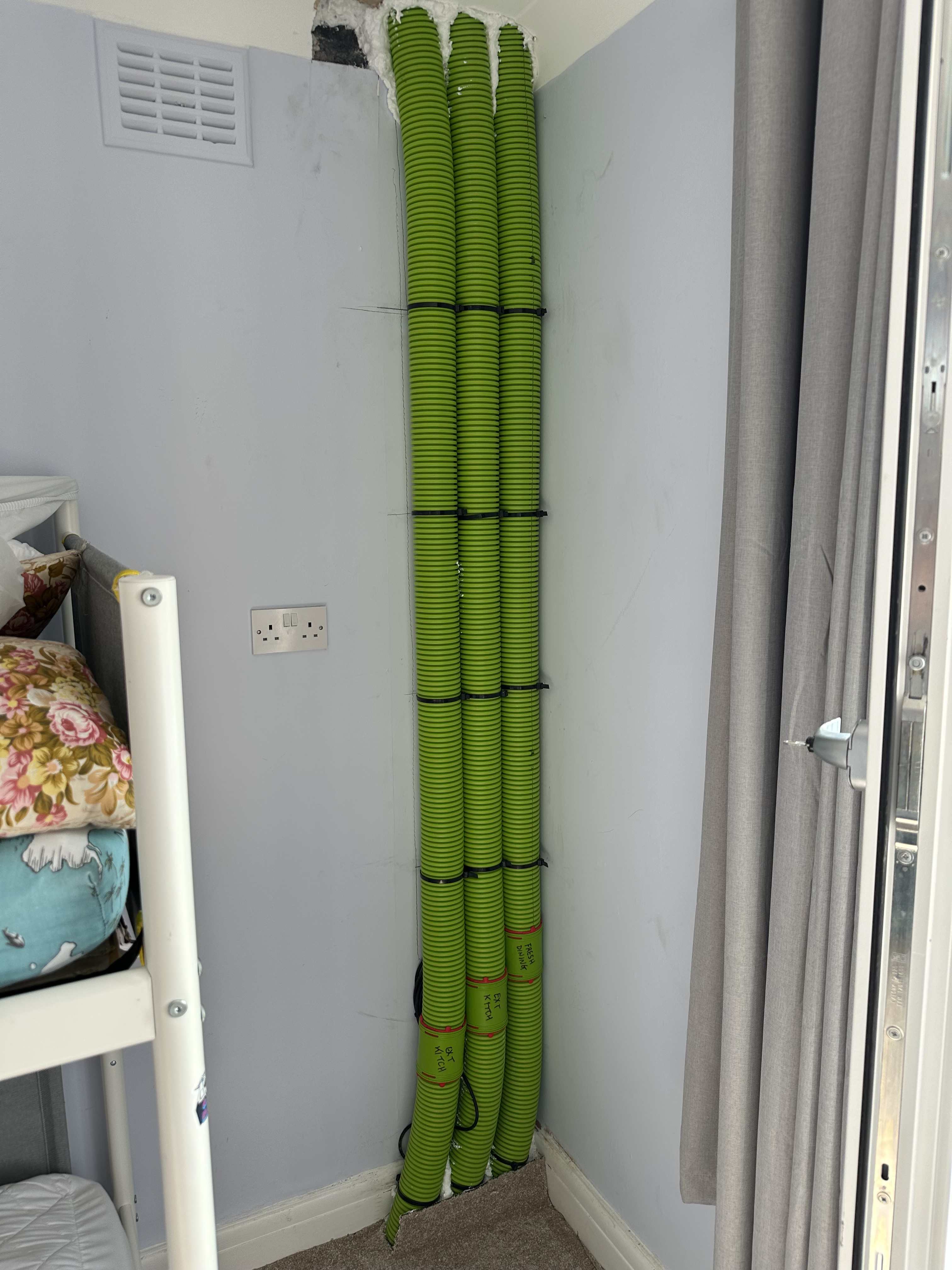
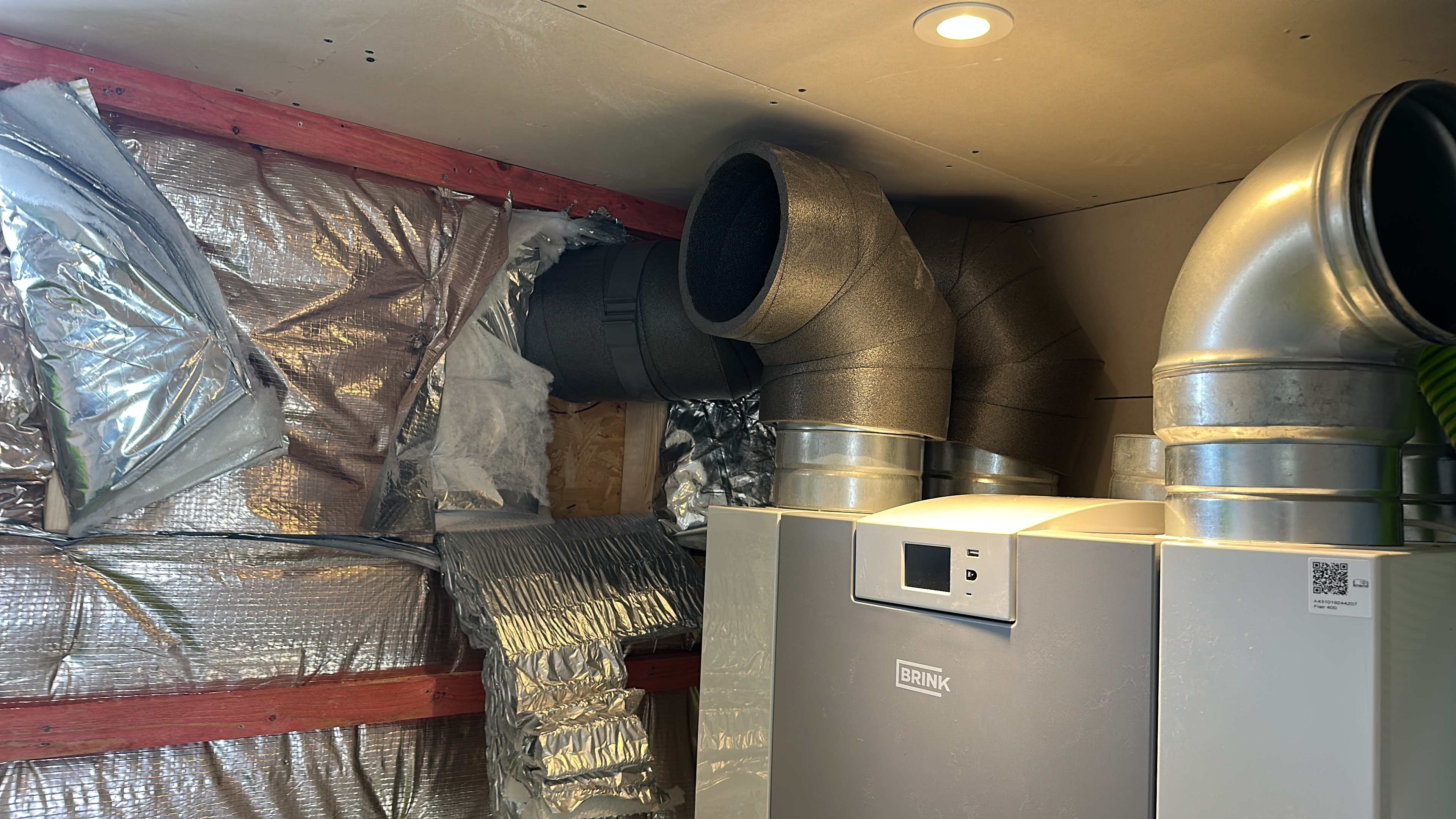
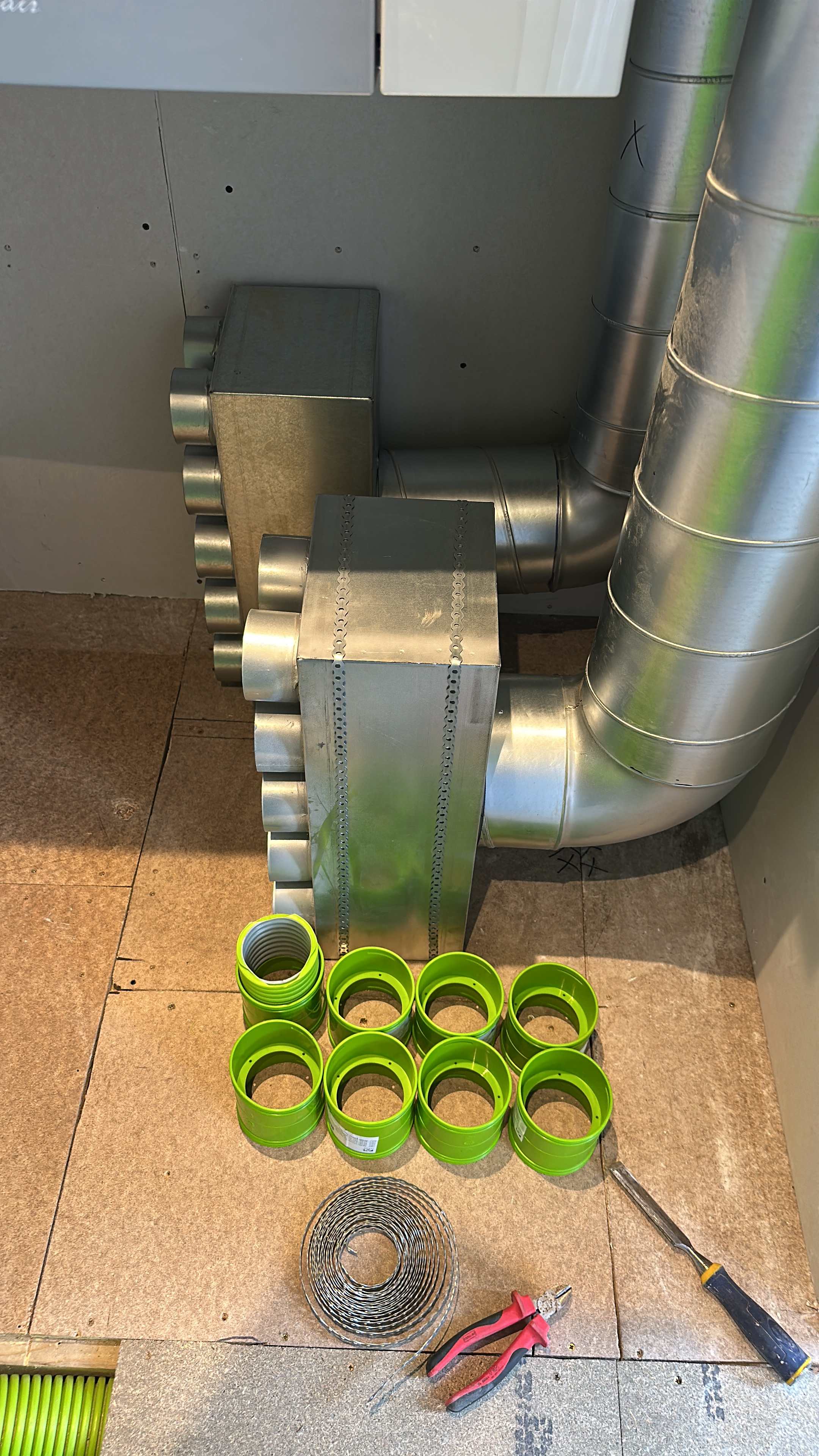
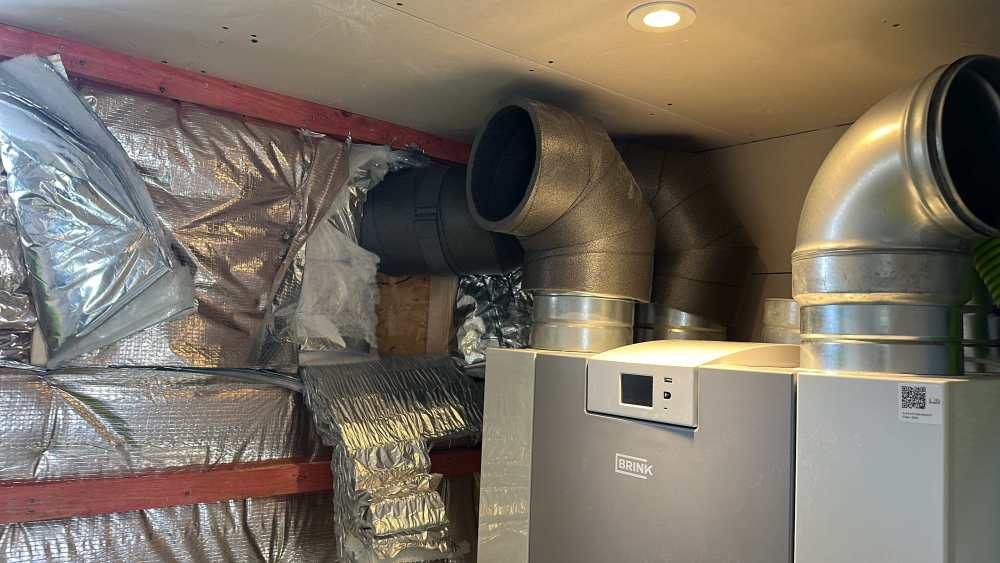
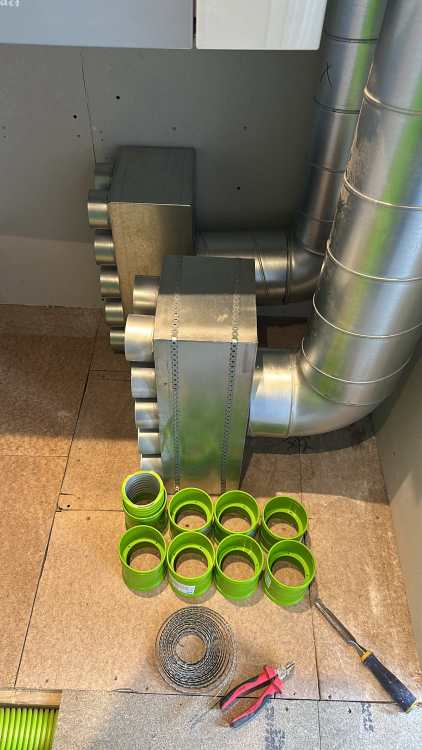
I’ve just done an MVHR retrofit in quite a large, 3-storey residential home, and you’d be surprised how you can blend a radial system in to an existing house. You can use multiples of smaller bore ducting to replace one larger one, for eg, with duct sizes down to 50mm, 75mm (and 92mm being the largest you need for radial). No need for rigid 100/125/150 etc, as all the big bore stuff is at the unit only. Two left ducts were fresh and exhaust to atmosphere. Right hand pair dropped under the unit via 2x acoustic attenuators to the manifolds. And that was all in a very compact cupboard space. This is 3x 92mm ducts, soon to be boxed, plastered and painted to allow them to blend in. Transfer grilles are a great way to cheat out of getting a duct to a particularly problematic space, but the caveat is needing higher flow rates in the room that is then sucking or blowing through two. Oversizing the unit is good advice too. It’s doable if you get someone with a bit of an engineering based brain and some tenacity.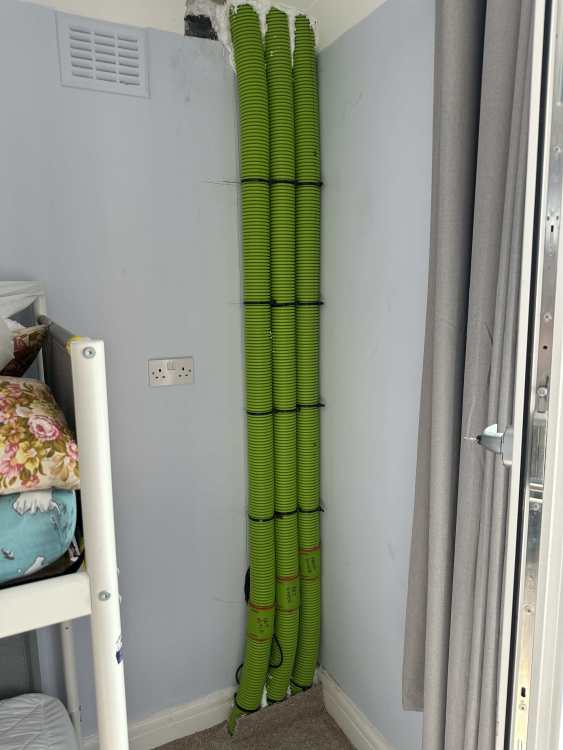
-
lol. Carted a few around and my bollocks are still in mint condition Most would have a +1 on these jobs.
-
90 Degree Turn Not Using An Inspection Chamber
Nickfromwales replied to MortarThePoint's topic in Rainwater, Guttering & SuDS
Defo overkill to have an IC to do this. Option B is a plenty good enough (normal) solution, afaic. -
Bingo.
-
As always, you get what you pay for @HighlandWoman ask questions of the quality of the plywood, and get a good installer.
-
If I was going to buy 18mm ply and then pay someone to fit 18mm ply, I’d at least want to consider going to 25mm and see if it was a much better, long term solution, than to find 18mm was just ‘ok’. UK b regs is a “standard” it’s just a totally crap standard and the worst job you can do legally. Nothing to strive for!! If a few more £10’s can make an ok job into a great one, and then that negates the plasterboard, then on paper it would be cheaper and better?
-
And?
-
Do you have a picture of it? And if it’s small, as above, just leave it alone as joists can be drilled without compromise, and tbh a filler would only be for aesthetics.
-
Go for 25mm plywood? These grab rails may have to prevent you from taking a tumble, so I’d have this done properly first as last. If you tank the plywood then you can tile straight to it with a flexible, cementitious tile adhesive. Do NOT let anyone use ready mixed acrylic tile adhesive here, whatever you do!!! This stuff is crap, regardless of what promises are written on the side of the tubs.
-
Not seen one yet, but I live in hope that they’re out there, somewhere, but seems like finding such a conscientious architect is like trying to find a Yeti in a snowstorm. Seems you have to find the best possible one, and look further into what they’re doing for you to identify the gaps or omissions; not easy if you’re a novice, and something I am still amazed at when I’m introduced to a project after the architect has already ‘got the wheels in motion’. Thats great, if the wheels aren’t fecking square ones.
-
Is this a cable back to plant or a local 230v supply that’s off a local circuit? I always run a unique cable from every single corner of every opening back to a centralised location. This way I can send AC or DC to each unit, according to what’s needed. If the solar / battery solution works for now then great, but they won’t last forever. If you can match the voltage then you’ve got the option downstream to send it some juice from a transformer, if there’s a dumb cable run to it. If they were cheap enough then maybe the cost to replace them, with like for like by whomever, when the time comes, may be acceptable.
-
Ouch. The money shot for you will now be airtightness afaic, as with possibly compromised insulation volume you can still get a very well performing dwelling with AT and MVHR, as with a draughty house you can have 500mm of rock solid insulation and still be sat in the cold.
-
Does aerobarrier negate need for airtightness detailing?
Nickfromwales replied to SBMS's topic in Ventilation
First unit was the fan, the second was a 3 stage, digitally controlled diesel heater. It was a very cold day, and it was very reassuring to see that they heated the incoming air to aid the process. Only negative was that every single flat surface, and I mean EVERY one of them, gets a layer of product left on it. This included the screeded floor which was like walking on fly paper for the next 2 days. I was horrified when the team prepped and just laid 2” masking tape onto the flat sections of the new Norrsken doors and windows……with zero dust sheet or other over the glass or vertical sections of the frames. All these guys did was throw poly sheets over the precious stuff and get to work. My only criticism was that this could have been better, and a few things got residual goop on them that I’d have preferred they didn’t. Was this a problem? Nope. It just wipes / washes away pretty easily, so things like pipes and lagging in the plant room will need a bit of cleaning after, which is fine. Just could have been avoided with some better prep. This was the first time I’d been on site during one of these treatments, so next time I’ll do the shitty (more intricate) masking / sheeting ahead of their arrival. In one of the pics you’ll see a tripod near a window, and that was guffing this stuff out at a rate of knots. I inspected the window after AB stripped their seemingly rudimentary masking off, and I can report that there was absolutely no evidence of them being there. This stuff just doesn’t stick to ANYTHING vertical. Not one bit. Happy days! All told, a great team arrived on site, they were speedy and got straight to business. Prep was done (looks a bit underwhelming but does what it needs to) and they were off to the races in no time at all. Quite an impressive setup with no reliance on electricity etc; as seen they just plonk gennys down and get on with it. I’ll defo be using and promoting AeroBarrier, anytime it’s the obvious choice. -
Does aerobarrier negate need for airtightness detailing?
Nickfromwales replied to SBMS's topic in Ventilation
No negative testing as AB only blow. I inspected a lot of the areas where this stuff had done its job, and there’s no obvious threat of it getting loosened by a negative test. It’s in that masonry and any such gap like swimwear! AB test certificate isn’t good enough for you to provide at the end of the build, eg for your “as built” AT score, so you’ll need to do another. The as built test is an average score taken from 10 positive and 10 negative, if memory serves me correctly. I asked the chap there and he said it’s something they’re looking into atm. The bottom line is, I’m seriously impressed by this system and the results it yields in not much time at all. You must fill the obvious gaps up, and do as much as you can to get the best results possible, but this will do quite a good job even if you’ve been lazy I expect.