

Nickfromwales
-
Posts
31377 -
Joined
-
Last visited
-
Days Won
345
Everything posted by Nickfromwales
-
From what I gather, and as per Dave above, there was a working light here before.
-
 Yup. Defo the culprit if it’s not a diverter!!
 -
Yup. If the old one worked, this one can be made to work. Light needs to come off and we need to see some pics, whilst I’ve still got hair! 🙃
-
Ah! I think you have the wrong valve. Google says this is a mid-position valve, and you should have a diverter valve. Can you confirm you have a mid vs diverter plz?
-
Pumps usually last a minimum of 10 years in a typical household, often much longer. Good to hear it’s sorted, but how old was the pump they replaced? Did they leave the old one there, and did they offer an explanation as to why they thought the old one had failed?
-
Ah. “No”. Whoever told you that needs to lay off the crack pipe. Sorry for the misunderstanding.
-
Can you post a pic of the internal piece that you need to connect to please? I’ve seen a few variations of these so want to advise according to what you have there.
-
Observations on need for heating upstairs
Nickfromwales replied to Post and beam's topic in Air Source Heat Pumps (ASHP)
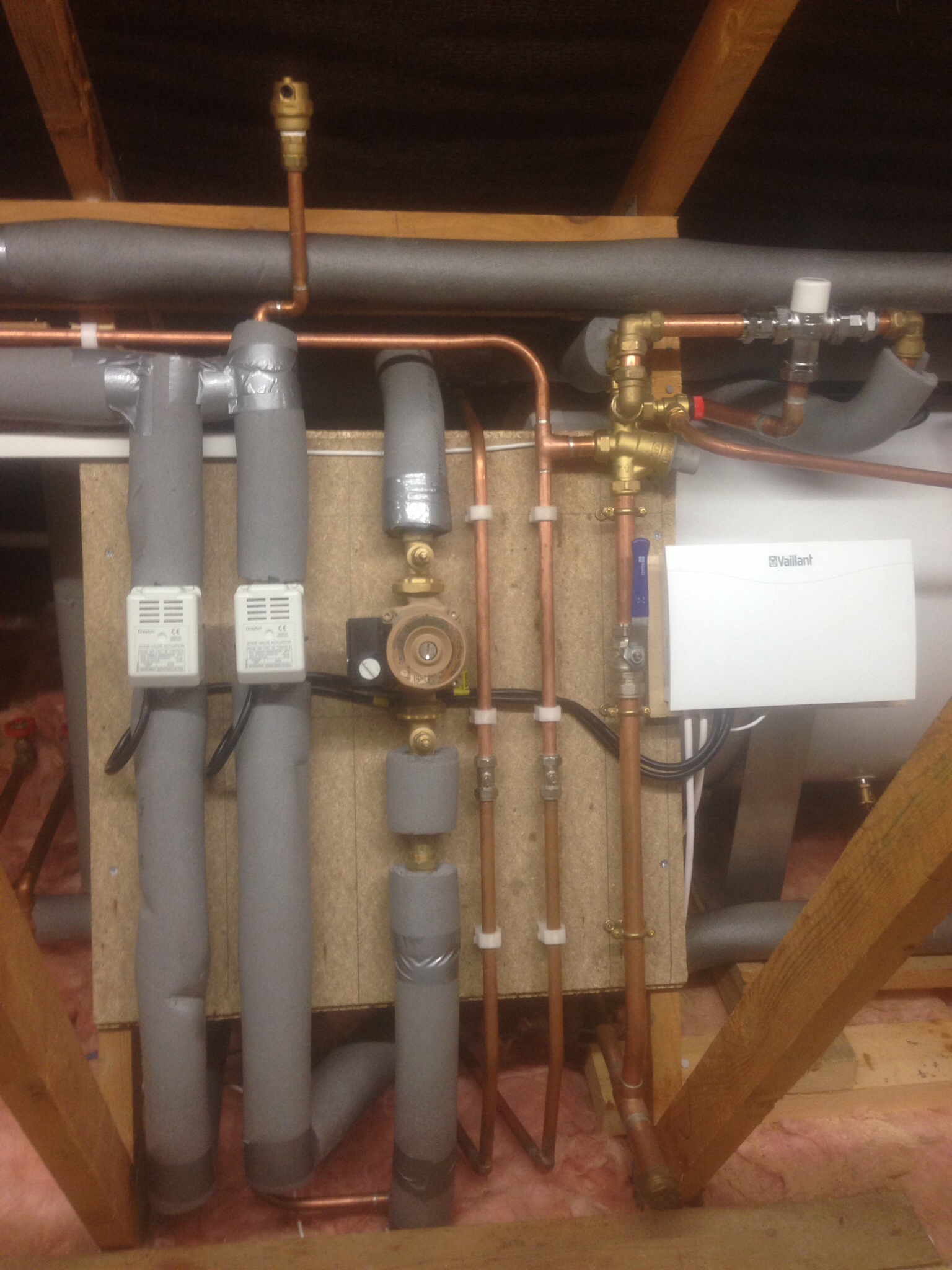
That can be made to work, but I’d need more info and to understand the way it’s been plumbed / pumped / operated etc to see if hydraulic separation needs to be considered in this conversion. Assuming it’s just the OEM pump in the ASHP atm, and flow and return just tee off to UFH and rads? Day job for a decent plumber, one who doesn’t spend longer talking about how it ‘can’t be done’ than the job would actually take to do. This is a low temp pump and mixer set, one I’ve been fitting for nearly a decade. 1” BSP connections to match your manifold. Link This isn’t a typical, much cheaper, TMV, but instead a thermo couple type actuator which responds by temp / hydraulic in a far smoother and more refined way. These don’t whine or chatter at their lowest settings like a regular TMV’s often do, so with this type of unit you’ll get very accurate, low temp control for the UFH in the slab. Needs a bit of “tight space plumbing” skills, and prob to pack the manifold off the wall very slightly, but defo can be done in the room available. Done these in much tighter spaces tbf! -
Repairing or replacing old floorboards to remove bounce
Nickfromwales replied to paro's topic in General Flooring
I’m not in radio 4 territory yet sorry. -
Repairing or replacing old floorboards to remove bounce
Nickfromwales replied to paro's topic in General Flooring
That would delete all the decorative beams? -
Just pics and words unfortunately. Can you take a pic of the instruction manual and post it here? Just take the pic and save it to your photos. Then click add files below the text editor here and it’ll ask you to choose photo.
-
PIR lights will usually have a connector block with 4 terminals. 1) earth (usually just somewhere to park the earth that you have at the end of your cable, and not always needed if “double insulated”) 2) N neutral 3) L permanent live 4) SW L switched live Some will have the L disappear into the fitting and feed the sensor, and then the sensor sends the SW L output back to 4. The factory wiring then has the live to the lamp in there too. Some are set up so you don’t see the 4 terminals, as the factory working is contained within the unit, a-la most modern led floodlights, so you only get to give it L, N and E. Do you have a link to the exact fitting you bought?
-
You may need a differential bypass valve, across flow and return before the valve. Are you 100% sure that the flow and return are the correct way around, as the thump is often associated with the valve 'paddle' being slammed shut in the flow.
-
A switched live is only a switched live, if you keep flipping the switch. If you flip the switch on, and leave it on, it's then a permanent supply Live is live, comes from the same place, ends up in the same place.
-
Sounds nonsense. If this is a PIR light then you’d just turn the light switch on and leave the unit powered 24/7. Then you have L & N + E constant power. If you want to turn the switch off, for some reason, then seems an odd choice of light fitting! Switching it back on will provoke a start up time event, every time you do so, but then it’ll go off and into PIR mode. Just turn the light switch on and leave it on. I assume you know you shouldn’t be connecting L and SW L together? Nothing but the factory wiring should be in SW L.
-
What m2 of area do you have the ‘dip’?
-
The exact same one I fitted in Leicester. IIRC I used a threaded fitting from hep2o, and PTFE taped it onto the threads of the Frosti. I had to use that to lengthen the tap though. Are you going to need to have an angled fitting immediately on the end of the tap to connect it flush to the wall?
-
Changing a downlighter.
Nickfromwales replied to saveasteading's topic in Electrics - Kitchen & Bathroom
Aurora are very good imho. -
Temporary shower cubicle ideas
Nickfromwales replied to paro's topic in Bathrooms, Ensuites & Wetrooms
I stayed in The Falmouth Hotel a good few years back, and the shower curtain over the bath, in the multi coloured suite, looked like Zoro had been using it for target practice. Stayed in a Greene King hotel (?) in Halstead, and as someone had run out of loo roll, and the shower curtain was right there……. Yup. Staff member apologised to my mate, and he said she took that one and swapped it into another occupied room, giving him their curtain…….saying they had no spares and no facilities on site to clean it. 💩🤢 -
Changing a downlighter.
Nickfromwales replied to saveasteading's topic in Electrics - Kitchen & Bathroom
There’s no issue of trust here?! He just fitted the spots he thought were correct at the time I guess? Just open the circular junction box and remove the offending article. Are these units in the pic fixed modules or can you replace the lamp? -
Observations on need for heating upstairs
Nickfromwales replied to Post and beam's topic in Air Source Heat Pumps (ASHP)
My bad! I was thinking of another job. Too many plates spinning atm -
Need to purge one circuit, Help please
Nickfromwales replied to Post and beam's topic in Underfloor Heating
Miles off here, sorry! The water in the UVC is fresh potable water, which is hydraulically separated from the heating system ‘brine’, so that can only push water out of taps etc. You can turn the system off, then close the red and blue flow and return valves on the UFH manifold, and then connect a hose to the end of the return rail and run to outside or to a drain. Then you’ll need another hose from an outside tap (or you can uncouple and use the filling loop) connected to the flow rail. You’ll then be using cold mains to blast the loop through. Shut the other working loops off. Leave the one problematic one fully open. Open the drain off and then turn the outside tap on and watch / listen to see if water and air then gets dumped out. Repeat as needed. -
Observations on need for heating upstairs
Nickfromwales replied to Post and beam's topic in Air Source Heat Pumps (ASHP)
100mm? Thickening over ring and intermediate beams. -
Observations on need for heating upstairs
Nickfromwales replied to Post and beam's topic in Air Source Heat Pumps (ASHP)
Modern, domestic AC is none of these. Nobody would ever sell one if they were For 2 current live projects, one MBC ph TF and one (TBC) Nudura ICF I’m specifying AC on the FF, with wall mounted units being suggested (for the first revision for discussion). Also for cost reductions and simplistic installation, integration, and maintenance etc. Cooling is part of each clients remit to me, so my job is then to find the best units, at the best price, with installation methodology that ensures maximum longevity and minimum nuisance to the occupants. Sizes will be considered (over) to get the units to be near zero impact (audibility etc). I recall staying in hotels pre / post Covid, one quite small room, and the AC on the wall doing its thing. An occasional waft (no noise or draughts) as the output was nearly fully modulated, and I slept like a baby in a perfect ambient, with the unit offering surprisingly little sound. It was wonderful, plain and simple. Very apparent that the room had AC, as the unit was gloss black lol (maybe not a good choice for an otherwise lightly decorated room) and it was less than 1m from the bed, but it was an asset for sure. My plan is to set the units as far away from the bed and as high up as I can get them, so the modulated output is of no nuisance whatsoever. The focus will be on cooling the room, not the occupant. One will service the other, indirectly, by design. In reality, us humans will tolerate a fan blowing directly onto us if it makes us cool, think desk or pedestal fans, so a near silent AC unit will simply not offend. This is more of a storm in a teacup than it would actually be in real life. -
Observations on need for heating upstairs
Nickfromwales replied to Post and beam's topic in Air Source Heat Pumps (ASHP)
That’s cold, and it would drive me crazy. At 19° I’m looking at my room stat and asking WTF. Absolutely! This is why, for every new client, I start with a blank bit of paper. I don’t create ‘other people’s homes’, I create homes for the intended occupants and take my lead from them. Heating on the FF is just a thimble-full, when required, but cooling is a very different issue altogether. At 21.5° I know my room is too hot, at 22° I want to kill. Successfully managing this hysteresis and matching the occupants preferred ambient needs control, and the sun has a huge effect on the sums. Solar reflective glazing is a huge asset here, but then folk will quickly moan about needing heating to offset the lost solar gain. The cost and impact of active cooling (by automation or human manipulation) outweighs this many times over.
