
Nickfromwales
-
Posts
31384 -
Joined
-
Last visited
-
Days Won
346
Everything posted by Nickfromwales
-

Shower(s) and hot water supply
Nickfromwales replied to Pocster's topic in Bathrooms, Ensuites & Wetrooms
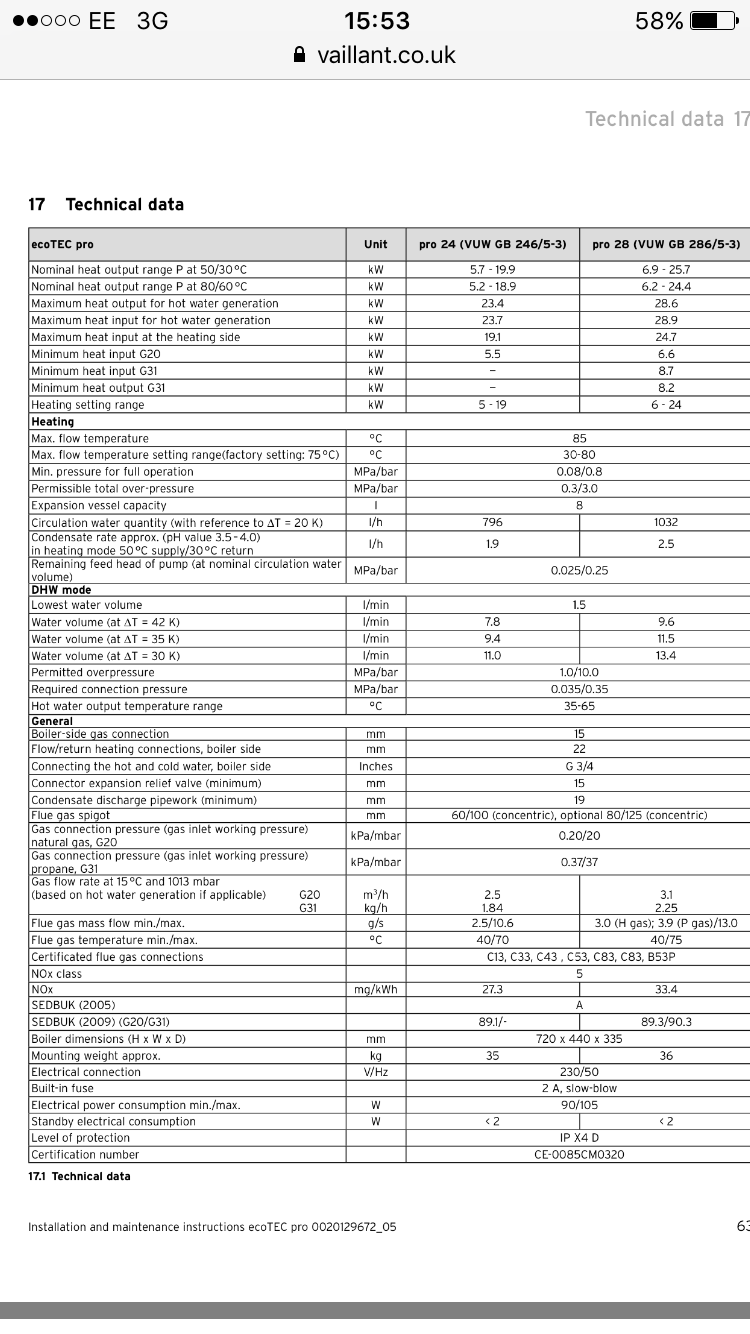
If it's only a 28kw then we may end up going W-plan aka "DHW priority" where it doesn't do space heating and hot water together, so any time the hot water needs topping up the system will divert from heating to do so, by design. The 28kw gives around 25Kw to heating ( or heating / hot water in your case ) so going Y or S plan ( space heating and DHW reheat simultaneously) is a bit ambitious from 25Kw for a cylinder that big. You really should be taking the combi out and be fitting a correctly sized system boiler TBH. The hot out of the combi could just do the kitchen sink so it ( the moving hot water components etc ) stays active, with the heating output serving the rads and UVC via the W-plan arrangement. Controls can be discussed on a separate thread if you like, when a system is firmly decided upon. The uvc won't typically 'go down', the most likely failure will be the boiler or motorised valves. Are all the showers ensuite?
-
Yup. A better central location for the airing cupboard ( aka hot-press ) so even though the TS will have to stay topped up during the day, it can be better utilised to reduce losses, but also utilise the waste heat to keep your undercrackers toasty .
-
If your plumber will work to a design then great. If they won't, and are adamant about firing ~26kw or more heat directly into a manifold that can only consume about a quarter of that ( IF the house was being heated from cold, because after it's up to temp it's probably less again ) then you have to make a choice. It's your house and your paying the bill for the oil, plus your going to pay extra maintenance if the boiler can't fire for reasonably long burns eg run 'clean' and needs heavier cleaning of the baffles more frequently. You don't need to justify having a TS, and you certainly don't need a solid fuel burner to justify it being fitted either. Stick to your guns and ask your plumber for a meeting. Sit him down and explain why you've decided to fit one. If he runs for the hills then he's not much of a professional. ( When asked to fit 600x600 black and white porcelain tiles in a bedroom I didn't say "no way, they're not to my liking" because it wasn't my house. . Instead I fitted them to the best of my ability and the customer was over the moon with them. That's why we get called "professionals" isn't it ? A lot of plumbers still think an oil boiler can modulate just because it condenses You will need a hot return if your plumber will do the usual knee-jerk '28mm-22mm-15mm' series plumbing, or you'll have washed your hands in cold water and dried them before getting hot water out of the furthest away basins, especially the cloak. A TS will best suit your DHW needs IMO, as long as you set it up PROPERLY eg correctly specified controls, again not something to expect from joe public plumber. If you have a very good cold mains you'll be able to have pretty much constant, instant DHW at very high flow rates, with the ability to run at least 2 good showers at the same time. Not having PV is a bad idea IMO, and I'd at least run cables for it now, which is cheap as chips, if it's down to lack of immediate budget rather than purely deciding against.
-
Can any of us?
-
CT1 and/or Sikaflex for a shower tray installation?
Nickfromwales replied to MAB's topic in Bathrooms, Ensuites & Wetrooms
Deffo break it down into chunks if possible. Once set you can stand / kneel on the tray which makes life a LOT easier -
Hi and welcome Plans please !
-
He's on hols mate
-
Shower(s) and hot water supply
Nickfromwales replied to Pocster's topic in Bathrooms, Ensuites & Wetrooms
Ok, next up is available plant space and some plans maybe? The flow will naturally reduce with demand, but if the restrictors are selected properly you won't be stealing all of the available flow. You need to give ADEQUATE flow to each shower to guarantee results, OR you fit a second accumulator. A Zimlet 500L will set you back a bit less than £600 iirc but you can check on the PumpsUkLtd website under accessories. That'll give you dimensions too if you look under downloads on the same page. FYI, running 5 showers and still having a bit of oomph for other outlets is nigh-on commercial territory, so dont expect to do this on a shoe-string budget, it'll need some moola throwing at it. FWIW I would ditch the notion of the single electric shower and go all mixers. Instead, used the immersions ( 4 x 3kw in a 500 is possible if ordering bespoke ) as your failsafe, so you'll still have DHW even if the boiler goes down. Pointless in just having one working failsafe electric shower unless its in a communal bathroom ( if the 5 showers are all ensuite then no-one is going to want to share the only working shower with 4 others ). The sparky will have to be on board with this design too, so involve them as early on in the process as possible. -
This is the one ive got. Change the heads over for 1/2' or 3/4" tap connectors, but the head also move so it will do varying sizes too, like the back nuts. As you apply pressure it tightens its grip.
-
Bath Surround / Boxing In, and concealed pipework
Nickfromwales replied to Onoff's topic in Bathrooms, Ensuites & Wetrooms
Just turn the taps off gently for now, and fit a small water hammer arrestor vessel ( EV ) when you go to mains. -
Bath Surround / Boxing In, and concealed pipework
Nickfromwales replied to Onoff's topic in Bathrooms, Ensuites & Wetrooms
It's not banging in the new stuff, it just sounds like it is. It'll be water hammer due to the new taps being 1/4 turn instead of 10 turn. -
Forget the rapid set. Trust me, you'll spend more time panicking and cleaning out dead or dying mixes than tiling.
-
CT1 and/or Sikaflex for a shower tray installation?
Nickfromwales replied to MAB's topic in Bathrooms, Ensuites & Wetrooms
Do you still have access from underneath ? -
CT1 and/or Sikaflex for a shower tray installation?
Nickfromwales replied to MAB's topic in Bathrooms, Ensuites & Wetrooms
Ground floor in screed or 1st floor on joists? -
Bath Surround / Boxing In, and concealed pipework
Nickfromwales replied to Onoff's topic in Bathrooms, Ensuites & Wetrooms
Yup. Just the tanking solution to bed the membrane in. -
Seems like a nice, straightforward job ?
-
CT1 and/or Sikaflex for a shower tray installation?
Nickfromwales replied to MAB's topic in Bathrooms, Ensuites & Wetrooms
Make sure you clean the underside as sometimes they're contaminated with mould release agent and then nothing will stick to it. Make up a little dry sand / cement mix to use like an Ajax and scrub it in with a sponge. Do this directly before laying the tray. Use a flexible tile adhesive to bond the tray down. Any recognised make will be fine, but I purposely avoid Unibond as I've had a couple of bad experiences with that make refusing to go off. Whatever your bonding to, make sure you prime it with a flexible primer not PVA. Ultra is what I normally use. First coat 75% water and leave to dry ( 1 hour usually ) then 50/50 directly before putting the tray down so your more or less bonding to wet primer. If your feeling brave use rapid set, if not use standard set so you've got at least 30mins to adjust it. Lay with a 10 / 12mm notch trowel and stay about 50mm from where the seal of the trap hits the tray. The adhesive will squeeze over a bit leaving only an inch or so un-bonded which is fine as typically you'll not ever stand on / directly next to the waste anyhoo. If there is any serious undulation in the floor eg 0mm-6mm-0mm again then notch the underside of the tray as well. If no serious undulation then just notch the floor and 'butter' the underside of the tray, the idea being to bring two lots of wet adhesive together for a guaranteed full bond. -
CT1 and/or Sikaflex for a shower tray installation?
Nickfromwales replied to MAB's topic in Bathrooms, Ensuites & Wetrooms
Is it a former or a tray ? -
Bath Surround / Boxing In, and concealed pipework
Nickfromwales replied to Onoff's topic in Bathrooms, Ensuites & Wetrooms
?? "Haaaaaaaleeeeelllluuuuujyaaaaaaaaa" ? -
Kingspan heating (or lack of) issue
Nickfromwales replied to Lynford's topic in Air Source Heat Pumps (ASHP)
Lol. Buy some wellies. You need to isolate the 3 pipes or your going to get very wet. Remember to isolate the electrical supply so you don't get electrocuted as well as drowned -
Shower(s) and hot water supply
Nickfromwales replied to Pocster's topic in Bathrooms, Ensuites & Wetrooms
Need to know as it'll be heating the system. If it's only a 24/28kw then we may end up going W-plan aka "DHW priority" where it doesn't do space heating and hot water together and any time the hot water needs topping up the system will divert from heating to do so by design. The hot out of the combi will just do the kitchen sink so it ( the moving hot water components etc ) stays active, with the heating output serving the rads and UVC via the W-plan arrangement. Controls can be discussed on a separate thread if you like, when a system is firmly decided upon. -
Shower(s) and hot water supply
Nickfromwales replied to Pocster's topic in Bathrooms, Ensuites & Wetrooms
Yup. The combi.... What size is it ? -
Shower(s) and hot water supply
Nickfromwales replied to Pocster's topic in Bathrooms, Ensuites & Wetrooms
No need. You run them all together and then see if they actually need restriction first. If you have the accumulator ( remembering that until we have the details of the main this is all hypothetical ) then you'll have a guaranteed X litres per minute flow, so restricting them will then leave some pressure / flow for other outlets, such as kitchen / utility / cloakroom WC etc etc. Look at it like having a nice V8 engine but only going at 30-40MPH, but you have the option to briefly open the throttle a bit more when needed. -
Shower(s) and hot water supply
Nickfromwales replied to Pocster's topic in Bathrooms, Ensuites & Wetrooms
Just fit one of these onto the end of each shower hose, then the handset -
Shower(s) and hot water supply
Nickfromwales replied to Pocster's topic in Bathrooms, Ensuites & Wetrooms
The manifolds can be made to have as many outlets as you require. You would simply connect the electric shower ( yuk ) to an outlet of the cold manifold. Same for the basins / sinks / baths / showers. Simplicity itself, and you can make outlets live as the build progresses. If an item fails, you can just isolate that one outlet and leave the rest of the house working.