Jump to content

Nickfromwales

Members
  • Posts

    30336
  • Joined

  • Last visited

  • Days Won

    297

Everything posted by Nickfromwales

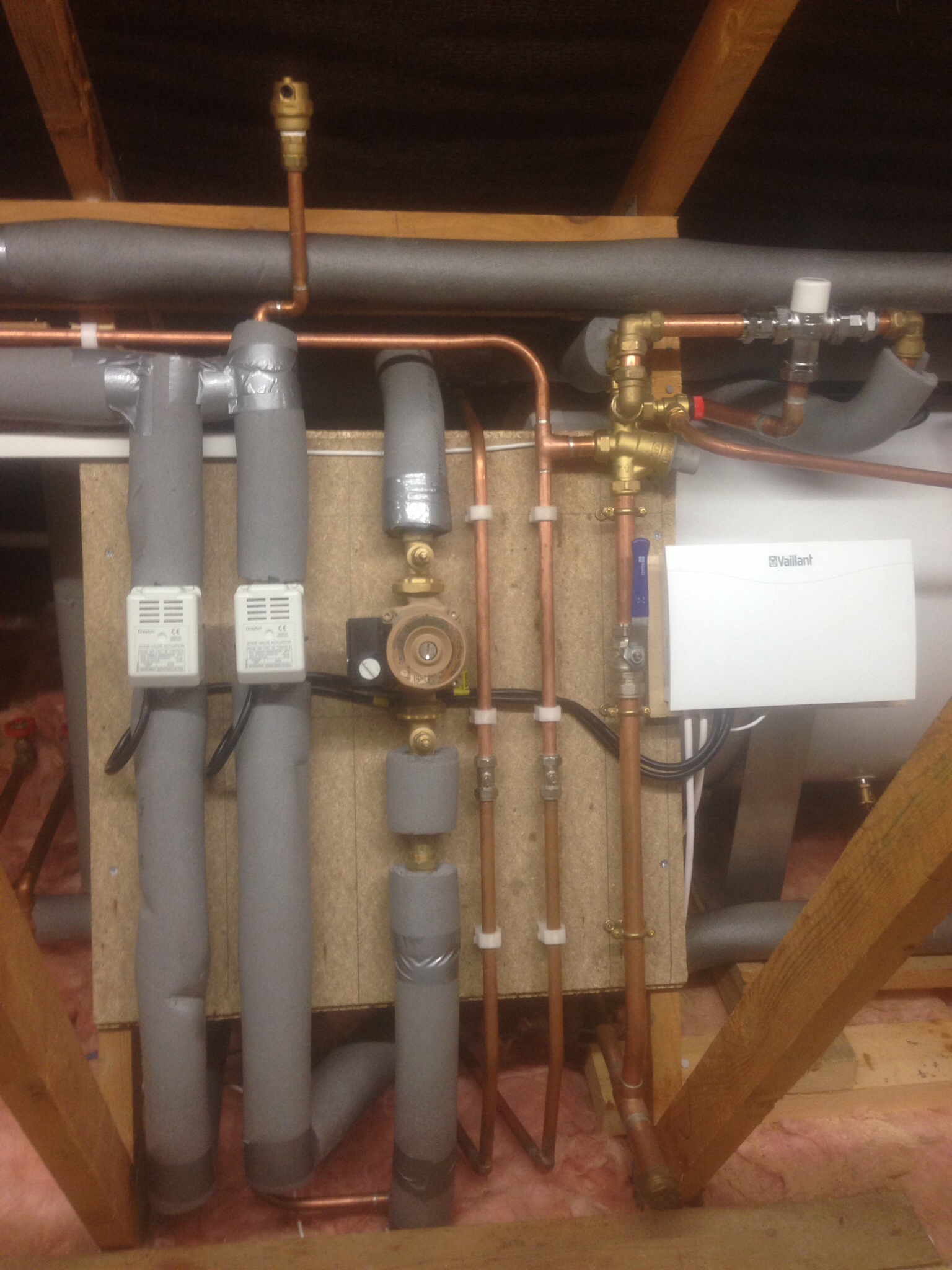
  1. Right then, here we go...... Order of events :- ( chapter one lol ). Electric boiler which is sealed and pressurised. Thats the reason why the pressure needs topping up occasionally. It should run at around 1.5 bar- 2 bar, rising when hot, falling when cool. Vertically mounted rectangular white box to the left of the boiler, and silver pump to the left of that : White box is a PHE ( Plate Heat Exchanger ), required to hydraulically separate the sealed and pressurised body of water in the boiler from the open pipe 'gravity' fed body of water in the TS ( thermal store ). Silver pump is the pump required to circulate the water in the TS through the PHE so it can be heated by the PHE, the other side of the PHE is heated by the boiler. The black plastic tank in the cupboard is the F&E ( Feed and Expansion ) tank which keeps the TS topped up without the need to pressurise that too, eg a bit less maintenance intensive that way. Needs no attention other than to top up with inhibitor perhaps. Silver pump lower left TS. That pump circulates the water in the TS through another PHE, the one in a silver / metal box affixed to the side of the tank with the pipe going to the upper of the TS side. That heats the DHW ( domestic hot water ( what comes out of your hot taps )) in the same way the boiler PHE heats the TS. Under that pump is a thermo head which regulates the flow temp through that circuit. A naff idea as the DHW is serviced by a TMV ( thermostatic mixing valve ) anyway, thus giving you control over your maximum DHW delivery temp. A TMV is necessary with a TS as you can have very high / near scalding temperature DHW without it I assume that either runs off a Hot Water time clock setting, or is operated by a flow switch that senses you opening a tap and fires that particular pump up for the duration the tap is open. Anyone's guess without being there.....and poking @MikeSharp01's fingers in the corresponding pump connections and then opening the taps to see if he screams and when / how long etc The other two green pumps and their corresponding red - topped TMV's are space ( central ) heating flows. eg one ( the upper hotter coil ) could be going to 1st floor heating radiators, so would be set to around 55-65oC, and the other ( the lower cooler coil ) could be going to the UFH manifolds, so set at 35-40oC, hence the lack of pump and blending valve on the UFH manifolds. The water that is pumped to the UFH has already been cooled down to the correct temp by the dedicated TMV before going into the UFH loops. IMO an inherently flawed design, but it'll work if set up correctly. At the top of the TS you have the Quenching Coil, ONLY NEEDED WITH A SOLID FUEL HEAT SOURCE As you have stated that you don't have / were never having a WBS ( wood burning stove ) then fitting that was a waste of time and money. The PRedV ( with the gauge thats showing 6.5 bar, which I missed because I'm blind ) is there to limit the pressure and flow that arrives at the Quenching Coil control valve so it can operate smoothly and accurately. That valve is opened by a capillary probe that heats up and the hydraulic fluid inside expands with heat. That fluid expands and opens the control valve according to how hot the TS is, eg slightly over temp, a trickle of cold mains water, way over temp, a high flow of cold water. A good system in principle, and used on many good quality sealed and pressurised WBS's, but has no place in your house as its function is redundant. My recommendation is to remove all that and bin it, capping the cold feed to the PRedV as its knackered anyway ( it would be showing around 3 bar if functioning properly ). The black circular bit halfway up is the backup 3Kw ( assumed ) immersion heater. That should be turned on by a switch on the wall for emergency use only. Follow the cable and ensure that the switch ( usually a white switch the size of a light switch with a red neon light on it ) is off. The white rectangular thermostats ( cylinder stats ) x3, from the top down so highest is 1: 1) Summer setting - The boiler is controlled by this stat ONLY, when space heating is not required. That allows the boiler to only heat the upper portion of the TS so you can get DHW only without heating the entire TS and wasting energy unnecessarily. 2) and 3) Winter setting - Stat 1 gets ignored and 2 & 3 come into play. I have no idea why 2 stats would be so close together but tbh I think they ( technical ) may have given me duff info and its actually 1 & 2 that govern summer setting with 3 doing the winter 'full heat' of the TS. If its not, thats how I'd set it up, but id also simplify by ditching the middle stat ( stat 2 ) as I really see no need for the third one. The wires that disappear into unions on the TS are ( assumed ) the temperature probes for the ST ( solar thermal ) system, so I dont see the other rotary cylinder stats doing any of the ST referencing AFAIC. Principle of operation ( as advised from technical support ) : You should have a two-channel time-clock for toggling between summer and winter 'mode' which you will have to do manually as required. You may also have another time-clock for DHW production, depending on how its been configured. If it has a flow switch after the DHW PHE output then you might not have a DHW time-clock. Anyones guess at the moment tbh. Selecting winter mode kicks all the space heating controls into action and starts the various pumps and faff to work accordingly. Simple eh ?!? What to do next : 1) Roll your sleeves up and shout very loudly at your boiler and TS for approximately 3 minutes, only stopping to breathe in again. That'll reset everything and show it that you mean business, probably. When done, read all the above again which will allow your blood pressure to return to normal again. You'll feel better then. 2) Turn off the big chunky switch to the boiler so it goes dead. 3) Turn off all the time-clocks and turn down all the ROOM / HOUSE stats. 4) Turn the 3 TS cylinder stats to their lowest positions, marking first with a pencil their current setting. 5) Wait for the TS to go cold. 6) Switch the boiler back on, report what it does for the first 15 mins. It should cycle for maybe 2 minutes and then go into standby, whilst it does a self-diagnostic, or simply do nothing at all. It should not run and heat up the white PHE, and the silver pump for the white PHE should not run. The system should now simply be sitting in standby aka 'holiday mode'. 7) Assuming the above went accordingly ( lol ), turn on all the heating time controls you can find, but leave all ROOM / HOUSE stats set to mimimum, including the one some cock has fitted in a cupboard. Do NOT switch the black immersion heater on. 8) Turn TS cylinder stat 3 to 65oC. Report what happens for the first 5 minutes. The boiler should kick in, the pump and PHE adjacent should run and all get hot and the TS should then proceed to heat up entirely until the cylinder stat tells the boiler to switch off again, maybe an hour or so, maybe a bit less / more. This is the critical bit which will identify if the wiring is in order or not. The boiler should, at this point, be receiving instruction to heat until stat 3 tells it otherwise. If not the most recent pipe butcher has fecked something up whilst charging you for the pleasure. 9) If the boiler does not kick in within the 5 min period, turn up the stat in the cupboard and see if that has been put in line with the other controls, making sure its partnered time-clock is deffo on too. 10) If the boiler still doesn't kick in, turn up TS stat 2 to 65oC. 11) If the boiler still doesn't kick in, turn up TS stat 3 to 65oC. 12) If the boiler still doesn't kick in, turn the ROOM / HOUSE stats back up and set things back to how you had them. 13) Note when the heating / whatever came on during the above and file your report here and we'll go from there. As Dave has said, you need to try and make heating on / consumption coincide with each other to maximise efficiency. Its not ideal tbh as the TS will go cold very quickly ( so you'll soon run out of DHW between heating intervals ). The only problem is is that the system has been designed around a busy full household and its just yourself ( IIRC ) there, so basically its like driving a double-decker bus with only one passenger on board. Also, heating the TS for 3 x 2 hour bursts / 24hrs won't even scratch the surface. Whenever heating is on, the boiler needs to be on. Whenever DHW is wanted, likewise. I think id have designed it differently but I also think I would have chosen different lottery numbers last week too as I didn't win....hindsight being a wonderful thing and all that. Chapter two to follow after some feedback.
  2. PS, I am doing a draft in the background.
  3. Did the sparky look like this ?
  4. Only if you stick your fingers in Mike.....only if you stick your fingers in.
  5. Manual already posted.
  6. Just been on the phone to technical for some divine intervention Thats the PRedV ( pressure reducing valve ) that supplies cold water to the quenching coil at the very top, the one that has the silver corrugated pipe, which cools the tank down as stated in the red text I posted. Shouldn't ever have been fitted ! @newhome, can you confirm that you done have / never will have / dont have pipework run for a woodburner or solid fuel heater / boiler / other? Oh, and its Fecked too.
  7. Yup. Just starting to understand it. Have you been able to find a detailed schematic anywhere as I can only find images but nowt of this exact cylinder in technical format. Ill ring them now, see if I cant get an emailed diagram or two.
  8. Where are you seeing that ? Ive looked at this so many times ive gone pipe blind
  9. "eureka, Marty! We'll just open the windows" So, to clarify, its cold, in your low-energy house, so you light the stove and then open all the windows to get the smoke and heat out?
  10. I doubt if any car salesman has ever heard a customer walk in and say "it needs to carry doors" I think you need to hire a van for a day, and drive something that suits your day to day needs best, or get the chippy to pick them up in his van and chuck him £50 for his time and trouble.
  11. Strange as the boiler should be sufficient to heat that TS up to the flow (set) temp of the boiler. The pic shows the cylinder stat ( the creamy white box under the round black immersion heater ) set to over 75oC.
  12. Getting closer...
  13. Adding bits as I find them, for the collective view. Some manufacturer website excerpts : The protection system on the Xcel works on the basis that the heat can circulate from the wood burner to the Heat Bank naturally using thermo-syphon (gravity) circulation. The Xcel is fitted with a heat exchanger in the top, and if the temperature of the water in the store ever goes over 95°C then a mechanical valve opens up to allow cold mains water to pass through the heat exchanger and out to drain, cooling down the stored water as it does so. The heat exchanger can extract over 12kW of heat and as such is suitable for all types of wood burner, and in many instances is the only way that the latest building regulations (now covering vented systems) can be met when using a wood burner. So that explains why theres a lot of additional pipework at the upper portion of the TS. Im guessing that the stainless corrugated hose that brings that reference temp to the mechanical quenching valve. Strange that they specified such a cylinder when they knew it wouldn't be serviced by a woodburning stove It is also worth pointing out that there are two other forms of overheat protection built into Xcel Heat Bank systems. The first is an overheat thermostat that turns on the central heating when the store reaches 90°C. This protection is the normal day-to-day protection and requires power supplies to be on, and pumps to be functional. The other form of protection is the system is open vented. Whatever happens and if ever the system does boil, you have peace of mind that the vent pipe will protect the system from catastrophic failure. So with the system being void of a woodburner, this function should never kick in. Still trawling to find a cylinder schematic that I can see when zoomed in. Lots available but none helping yet.
  14. If the boiler flow is set too low then here is the boiler manual which should show you how to raise the flow temperature back to 60 degrees. Personally id set it for at least 65. That way you should get much better hot water performance. If you check that and the boiler is already set higher than 50, then we need to look at the TS cylinder thermostat which will have a temperature setting on it. If your going to tweak anything on the cylinder, make a note of what it is set to before adjusting it, or better still, take a pic and ask before you tweak.
  15. Do you mean he turned the BOILER down? The HEATING would be turned down on the room thermostats.
  16. On the copper pipework, not the plastic. They'll be around the TS if any at all usually. Some pics of the boiler and any pipework / valves / paraphernalia too please. You can post them tomorrow
  17. Runs = pipework from one location to another. Do try and keep up !
  18. Pics are much better. Thanks. Ignore the following silence, im preparing my speech lol.
  19. Bloody anywhere judging on what were seeing so far Im trying to ascertain if the ufh have any on the runs between the TS and the ufh manifolds.
  20. Can you also identify if there are any motorised zone valves. They look like this or this
  21. OK Could you please take a couple more pics of the thermal store, zoomed out a good bit so I can see whats going where. Ive just about sussed it but I cant see the path of one or two items. "normal service will soon be resolved" lol.
  22. Just beating the kids into submission and ill join the chaos.
  23. Fwiw, I absolutely HATE having customers 'dangle carrots' like that, it makes my blood boil. And its usually the ones who can afford to pay and think they have the upper hand. Thats usually where I nod my head like a good little boy, and then shove another 20% on the bill for "wanker tax". A previous customer had me pay for some trinkets, only £60-70 worth, but I took the money our of my pocket to buy them whilst the customers were on a luxury holiday. At the end of the job ( and them agreeing the job was way beyond their expectations ) I asked for the money and had to give chapter and verse to get the amount AGREED, not paid. 3 months later I get a call from said customer....could I go back and explain how to hook up the sky cables I ran for a song whilst the ceilings were down.....so along I pop. Deed done, and on the doorstep, I turn and politely say "could you transfer that £x materials money for me please?"....."we'll see" came the reply. I left. Another month or so went by. I get a call...."X item you fitted has stopped working, could you come out and fix it please?"......I replied "We'll see"....and the line went quiet. I made that person wait 3 months, with them ringing to voicemail and texts going unanswered, until I went to do the repair. Of course, one of the terms of my return was to have the outstanding money in my account FIRST. At that point I think the penny dropped. They asked for some more 'favours' whilst I was there, but I just said I was late for another appointment and thought F.U. Moral of the story.....Stump up when the bills due, end of chat. Anything else is a massive piss-take. If you want a retainer, state that thrice UP-FRONT before a single screw has been turned. There, I did my worst.
  24. That makes more sense. Pics would be good.
×
×
  • Create New...